17 079 résultats
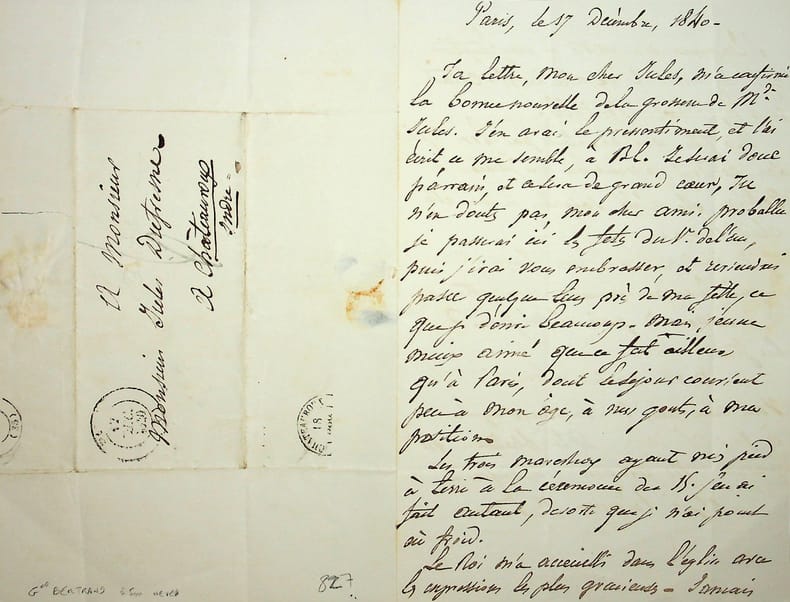
020417Henri-Gatien Bertrand (1773-1844), général, compagnon de Napoléon à Sainte-Hélène. L.A.S. « B », Paris, 17 décembre 1840, 2p in-8. A son neveu Jules Duris-Dufresne (1798-1888) au moment du retour des cendres de Napoléon le 15 décembre (et la dépose de l'épée dans le cercueil, épée donnée par Bertrand le 4 juin 1840). : « Ta lettre, mon cher Jules, m'a confirmé la bonne nouvelle de la grossesse de Madame Jules. J'en avais le pressentiment et l'ai écrit, ce me semble, à Bl. Je serai donc parrain, et ce sera de grand coeur, tu n'en doutes pas, mon cher ami. Probablement je passerai ici les fêtes du jour de l'an, puis j'irai vous embrasser, et reviendrai passer quelques temps près de ma fille, ce que je désire beaucoup. Mais j'eusse mieux aimé que ce fût ailleurs qu'à Paris, dont le séjour convient peu à mon âge, à mes goûts, à ma position. Les trois [nom illisible] ayant mis pied à terre à la cérémonie du 15, j'en ai fait autant, de sorte que je n'ai point eu froid. Le Roi m'a accueilli dans l'église avec les expressions les plus gracieuses. Jamais l'Empereur n'a assisté à une réception qui approchât de celle du 15. C'était une apothéose véritable. Ma fille qui ne s'était pas levé depuis son accident, a craint hier une fluxion de poitrine, elle a été soignée. Le soir elle était mieux. Je vous embrasse tous. Vingt [mot illisible] depuis le commencement de ma lettre me laissent à peine l'espoir de la finir. Mille amitiés à tous, je vous embrasse, mes souvenirs et respects à M. Mde Joseph, de S. [..] tous enfin et je termine. B ». Belle lettre, beau témoignage de premier ordre. [491]
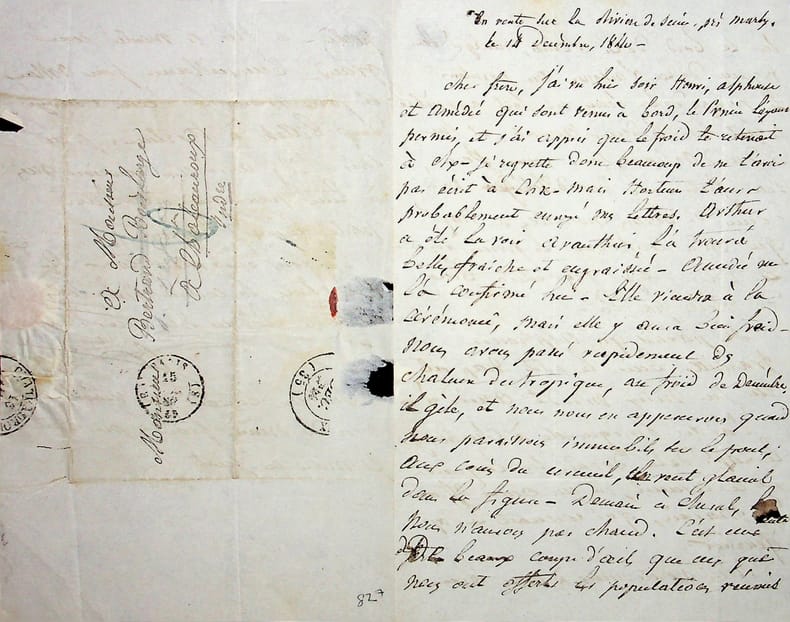
020419Henri-Gatien Bertrand (1773-1844), général, compagnon de Napoléon à Sainte-Hélène. L.A.S. « B », « En route sur la rivière de Seine, près Marly, 14 décembre 1840, 3p in-8. A son frère Louis Bertrand de Boilarge (1774-1861), la veille de l'arrivée des cendres de Napoléon à Paris par bateau, sur lequel était donc Bertrand. « Cher frère, j'ai vu hier soir Henri, Alphonse et Amédée qui sont venu à bord, le Prince l'ayant permis et j'ai appris que le froid te retenait à Chateauroux. Je regrette donc beaucoup de ne t'avoir pas écrit à Chateauroux mais Hortense t'aura probablement envoyé mes lettres. Arthur a été la voir avant hier, l'a trouvée belle, fraiche et engraissée. Amédée me l'a confirmé hier. Elle viendra à la cérémonie, mais elle y aura bien froid. Nous avons passé rapidement des chaleurs des tropiques au froid de décembre. Il gèle, et nous nous en apercevons quand nous paraissons immobiles sur le pont, aux coins du cercueil, un vent glacial dans la figure. Demain à cheval, nous n'aurons pas chaud. C'est de beaux coups d'oeil que ceux que nous ont offerts les populations réunies sur les bords de la Seine, malgré la rigueur de la saison. Au printemps, le voyage de la Seine est fort agréable. Avant hier, le duc d'Aumale et hier le duc d'Orléans sont venus. Le duc d'Elchingen m'a donné de bonnes nouvelles de Nap que m'a confimées le prince royal. Le cher Nap regrettera bien de n'être pas là. Il parait qu'Alphonse travaille bien. Le petit Nap est un peu mieux m'a dit Amédée. J'ai vu [Armand de] Bricqueville à Cherbourg. Le capitaine de la Dorade sur laquelle est le cercueil est un ancien officier de marine, qui connait le capitaine [nom illisible]. Nous continuons à bien nous porter. Le Roi a montré une grande bienveillance pour Arthur et pour moi. La Reine a envoyé deux billet à Hortense. Je ne sais s'il y aura une occasion [mot illisible] à temps pour que cette lettre parte aujourd'hui. Je vous embrasse tous [liste de personnes] toi en tête cher frère. B. Sur un bateau qui marche avec des mains froides [fin illisible] ». Nap est Napoléon Bertrand, un des fils du général. Belle lettre, beau témoignage de premier ordre. [491]
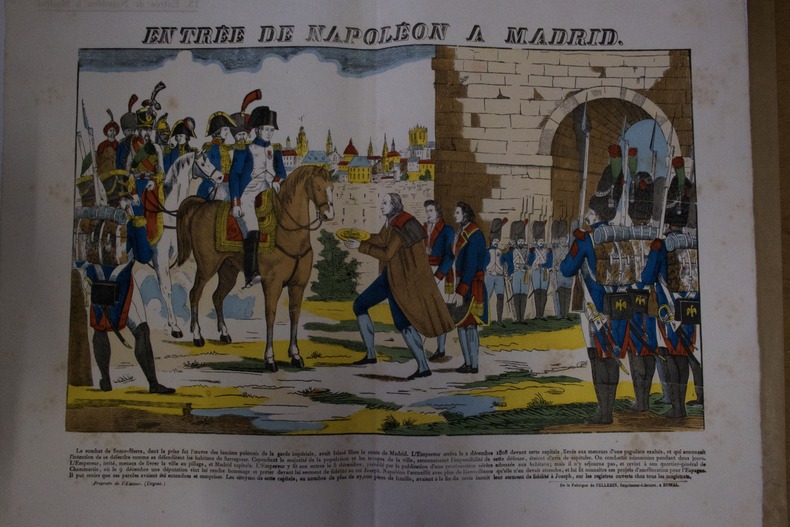
1835DES4024MLot de 30 estampes datant du deuxième quart du XIXe siècle retraçant la vie et les batailles de Napoléon Ier et Napoléon II. Édité par Pellerin. Peint sur papier (bois de fil (colorié au pochoir)). Chaque estampe est numérotée et elles font toutes a quelques millimètres les mêmes dimensions. 47 x 64 cm. Chaque estampe est accompagnée d une description détaillée. Certaines rousseurs et tâches d'humidité légères sur quelques unes. ( !! Il manque des numéros !! ) 1: Napoléon sur la colonne; 3: Napoléon au siège de Toulon; 4: Bataille et passage du Pont de Lodi; 8: Bataille des Pyramides; 8bis: Bonaparte touchant les péstiférés; 10: Bataille de Marengo; 11: Capitulation d Ulm; 12: Napoléon au camp de Boulogne; 13: Entrée de Napoléon à Madrid; 15: Bataille d Austerlitz; 16: Bataille d Iéna; 22: Bataille de Lutzen; 25: Napoléon à Arcis-sur-Aube; 26: Tombeau de Napoléon; 28: Tombeau de Napoléon II; 29: Napoléon à Sainte-Hélène. Estampes représentant des gloires nationales : 1: Napoléon 1er; 3: Eugène Bauharnas; 7: Kléber; 10: Maréchal Ney; 12: Maréchal Masséna; 17: Poniatowski; 18: Skrzynecki; 20: Le général Drouot; 25: Bertrand; Estampes représentant les évènement les plus marquants( non numérotées ) : Le retour de l île d Elbe; Apothéose de Napoléon; Mort de Napoléon-Le-Grand; Bataille de la Moscowa.
20475Cahier In folio broché,33 pages manuscrites et 36 blanches muettes,sur imprimé ,bon etat
18265A Paris, chez Prault et Rondonneau, an VII (1799), 1 plein veau marbré, dos orné, roulette sur les coupes, manque de cuir sur le plat inférieur, coiffe supérieure usagée, coins légèrement émoussées. in-8, gravure sous serpente en frontispice ("Bonaparte au Caire"), IV-240 pages ;
Luxusdruck in 800 nummerierten Exemplaren. Tadellos erhalten.
205442Paris, Henri Plon et J. Dumaine, 1858-1870 32 vol. in-8, broché. Petits accrocs à certains dos sans gravité et qqs rousseurs.
224184Londres, chez Martin Bossange et Henri Colburn, 1823-1828 8 vol. in-8, 8 cartes, 2 tableaux et 10 fac-similés, tous dépliants, demi-chagrin vert à coins, dos à nerfs orné d'un N et de l'abeille impériale dorés et alternés (reliure du XIXe). Qqs usures au dos. Rousseurs (plus prononcées dans certains volumes).
242490Paris, Bossange, 1830 9 vol. in-8, 2 tableaux repliés, demi-veau framboise, dos à nerfs orné (reliure de l'époque). Dos passé. Rousseurs, parfois fortes.
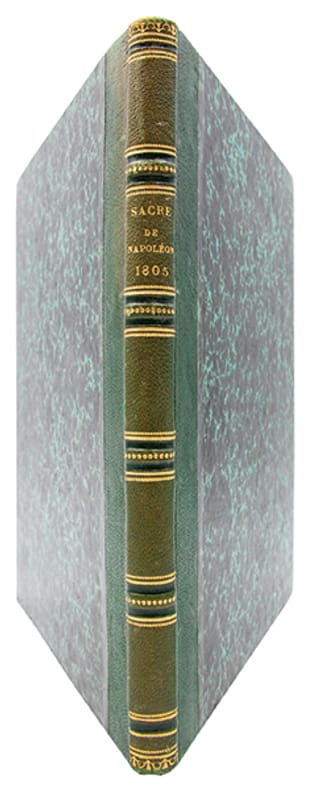
39408In-4 (245 x 193 mm), demi-chagrin vert impérial, dos à quatre nerfs soulignés de filets à froid et de roulettes, jeu de filets et roulettes aux coiffes, titre doré, (4), 117 pages, grande vignette de titre gravée aux armes de lEmpereur. Paris, Imprimerie Impériale, An XIII=1805.
603828A Paris, chez Petit, An 8 - 1800. In-8, reliure de l'époque plein-veau blond, dos lisse orné aux fers dorés, pièce de titre vert foncé, double encadrement doré sur les plats, armes dorées au centre, roulette dorée sur les coupes, roulette intérieure, toutes tranches dorées (rel. P. Bozerian) ; VII-232 pp. Etiquette ex-libris ms (Mad. de Vintimille, 2e ex-libris armorié (Bibliothèque de Roger).
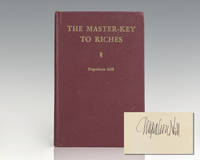
1945116778Los Angeles: The Willing Publishing Company 1945. First edition of Napoleon Hill's classic work. Octavo original cloth. Boldly signed by Napoleon Hill on the front free endpaper. In near fine condition with light rubbing. Based on the Andrew Carnegie formula for money-making The Master Key To Riches describes in step-by-step detail today's greatest practical philosophy of success. This philosophy culled from the success experiences of hundreds of the world's most powerful and wealthy men will show you how to succeed in any walk of life. The Willing Publishing Company hardcover books
8vo (185 x 125 mm), 4pp., folded, with short tears to fold. The extremely rare catalogues of works published by Prince Bonaparte, listing 142 titles, apart from 'Ouvrages Sous Presse', each entry gives the number of copies printed, usually 250, and the number printed on special paper.
Mm 200x270 Opera completa nei suoi 4 volumi pubblicati tra il 1845 ed il 1850. Legatura in mezza pelle marrone con titolo e fregi in oro al dorso che è interessato da leggere abrasioni ai margini, piatti marmorizzati. Vol. I°, 1845, di 654 pp. con 24 tavole a colori non comprese nel testo. Vol II°, 1847, di 582 pp. con 16 tavole a colori non comprese nel testo. Vol. III°, 1849, di 552 pp. con 15 tavole a colori non comprese nel testo. Vol. IV°, 1850, di 608 pp. con 20 tavole a colori non comprese nel testo, ( la prima in apertura, che riguarda Talleyrand, ha un minuscolo foro ed è interessata da gore causate,crediamo, dallo stesso stampatore). In questo ultimo volume sono aggiunti rispetto alla edizione francese ed alla prima in lingua italiana (1833) il "Testamento di Napoleone", le "Massime di Napoleone relativamente alla Guerra", le "Massime estratte dalle Memorie del celebre Generale italiano Montecuccoli", le "Lettere di Napoleone a Giuseppina, durante la prima Campagna d'Italia, il Consolato e l'Impero; e lettere di Giuseppina a Napoleone ed a sua Figlia", lo "Assassinio del Maresciallo Brune", la "Dell'Evasione di Napoleone dall'Isola d'Elba", i "Pensieri di Napoleone dulla Divinità". Sporadiche e tenui fioriture riguardano le prime ed ultime carte dei quattro tomi, peraltro tutta l'opera è assai fresca ed in ottime condizioni complessive. Tutte le 75 incisioni in rame con la loro coloritura coeva, che illustrano le battaglie e i loro protagonisti, sono presenti. Text in Italian. "Weighing over 2 Kg. international orders may need extra shipping". Spedizione in 24 ore dalla conferma dell'ordine.
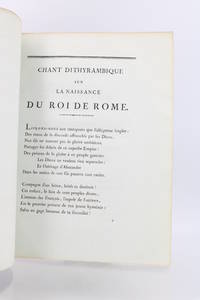
181190382Paris: Imprimerie Impériale 1804-1814 1811. Fine. Imprimerie Impériale 1804-1814 Paris s. d. 1811 19.5 x 24.5 cm Broché Rare first edition of this poem printed on bluish paper and composed by Tissot in honour of the birth of the King of Rome the Emperors son.Not in Quérard.Our copy is preserved in its original wrappers under a modern marbled paper cover. Not in Quérard. A fine copy. Imprimerie Impériale (1804-1814) unknown
18071008118vo contemporary calf spine and tips and marbled boards red leather spine label folding colored fronstispiece illustration for the last pamphlet 89 132 2 ad 48 pp. Covers almost completely detached hinges rubbed and extremities rubbed and worn in places light foxing and aging; otherwise near very good. Interesting collection of three scarce pamphlets relating to the conflict between England and France at the beginning of the 19th century. OCLC Worldcat locates only two copies of the third Title The Trial. The folding hand colored frontispiece at the beginning of the third pamphlet depicts a confrontation between Napoleon and John Bull.
18071008118vo contemporary calf spine and tips and marbled boards red leather spine label folding colored fronstispiece illustration for the last pamphlet 89 132 2 ad 48 pp. Covers almost completely detached hinges rubbed and extremities rubbed and worn in places light foxing and aging; otherwise near very good. Interesting collection of three scarce pamphlets relating to the conflict between England and France at the beginning of the 19th century. OCLC Worldcat locates only two copies of the third Title The Trial. The folding hand colored frontispiece at the beginning of the third pamphlet depicts a confrontation between Napoleon and John Bull. books
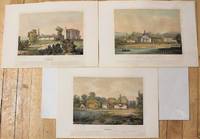
1870P5292Warszawie Warsaw c.1870. Very Good some age toning. Notes: Very scarce set of three lithographs from: Album widokow przedstawiajacych miejsca historyczne Ksiestwa Poznanskiego by Orda Napoleon. Album of historical views of Poland. They show churches mansions and historical sites around Warsaw Poland. Image Size : 193x286 mm 7.60x11.26 Inches Platemark Size : Paper Size : 290x418 mm 11.42x16.46 Inches Coloring: Hand Colored Medium: Lithograph Categories: Views Europe Lithuania & Poland; unknown
8vo., First Edition; handsomely bound in early twentieth century green crushed half morocco, marbled boards with gilt rules, backstrip lettered in gilt, gilt top, marbled endpapers, BY ZAEHNSDORF, uncut, very neatly rebacked with old backstrip laid down, a very good, clean copy. The binding is signed by Zaehnsdorf on front free endpaper verso. As usual, this copy is bound without the half-title and advertisement leaf. 'Very rare, in any condition - the half-title is usually lacking. A copy in wrappers is an extreme rarity' (Randolph). Randolph p. 40; Wise I, p.100.
181420693Wien, Strauss, 1814. 3 Bde. und Atlas (so komplett). VIII, 189 S., 1 Bl.; 3 Bll., 320 S.; 2 Bll., 357 S. 1 Kupfertafel und 12 lose gefalt. teilkolorierte Kupferstichkarten. (Text:) 8°. OBrosch. (etw. gebräunt, Gebrssprn.); (Atlas:) OPp.-Mappe mit Deckelschild (lädiert). [5 Warenabbildungen]
1815100992London: T. Tegg 1815. First edition. George Cruikshank. 8vo. 30 hand-colored aquatints including illustrated title-page by George Cruikshank. 260 pp. Full crushed red morocco gilt a.e.g. by Riviere & Son; expertly rebacked light offsetting from plates. Book-plate First edition of this early George Cruikshank-illustrated work with mispaginations on pp. 83 109 121 187 and 253 and two plates with captions misspelled. Plates 14 and 15 bound in reverse orderREFERENCE: Cohn 153; Tooley 151 T. Tegg unknown
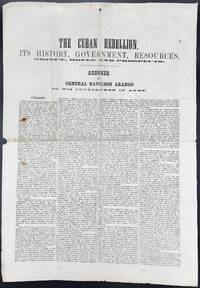
1870449481870. Broadsheet circular with title printed in various sizes and styles of type 17 x 12 inches printed in four columns on both sides of the sheet. The address is signed in type by Napoleon Arango and dated March 28th 1870. Arango eloquently states his objections to the insurrection declared by Carlos Manuel de Cespedes an effort aimed at achieving independence from Spain fought as the "Ten Year War" or "Great War" 1868-1878. OCLC locates four copies American Antiquarian Society Princeton Harvard Michigan. Creased from folding thumbnail sized chip to left margin not affecting text; one small hole at fold slightly affecting a letter or two and another small hole in top margin possibly from posting. A small spot or two of browning but a nice copy. <br/><br/> unknown books
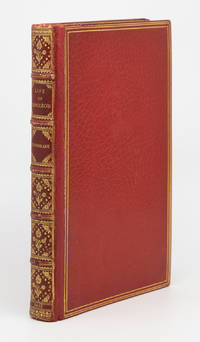
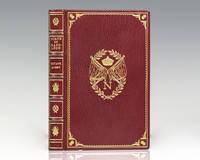
1969130509Paris: Editions Buchet / Chastel 1969. Finely bound example of Octave Aubry's Ecrits de Napoleon. Octavo bound in full crushed red morocco by Sangorski and Sutcliffe with gilt titles and tooling to the spine in six compartments within raised bands double gilt ruling to the front and rear panels gilt central vignette to the front panel gilt turn-ins and inner dentelles marbled endpapers all edges gilt. In fine condition. A beautiful example. French novelist and historian Octave Aubry was one of the five members of the Académie française elected on 1 February 1946 to replace the many vacancies left by the Nazi occupation of Europe. Aubry's fascination with history led to several historical novels. These included Louis XVII Bonaparte and Josephine The Coup d'état of Brumaire The Lost King Marie Waleska The Bed King and Gaspard Hauser. He also authored numerous scholarly books on the great historical figures of 19th century. These were Napoleon III Empress Eugenie A History of the Second Empire King of Rome The Private Life of Napoleon and French Revolution. One of his most famous works was The Journey to St. Helena a book to write which he spent several weeks on the island. Editions Buchet / Chastel hardcover
43719Sprig from the Willow tree which grew over the tombe of Napoleon Buonapart at St Helena." on one side 8vo. no place no date but circa Napoleon was exiled to St Helena in 1815. In mid-1817 Napoleon's health worsened. His physician Barry O'Meara diagnosed chronic hepatitis and warned Lowe that Napoleon could die from the poor climate and lack of exercise. Lowe thought O'Meara was exaggerating and dismissed him in July 1818. His health continued to worsen and in March 1821 he was confined to bed. In April he wrote two wills declaring that he had been assassinated by the "English oligarchy" that the Bourbons would fall and that his son would rule France. He died on 5th May 1821 at age 51. Napoleon was buried with military honours in the Valley of the Geraniums.Napoleon's heart and intestines were removed and sealed inside his coffin. Napoleon's penis was allegedly removed during the autopsy and sold and exhibited. In 1840 the British government gave Louis Philippe I permission to return Napoleon's remains to France. The weeping willow that shaded Napoleon's grave in the Sane Valley on St. Helena became an iconic symbol of his exile and death. Napoleon frequently rested under these trees and they became a major souvenir attraction for visitors who stripped them of branches Provenance: From a small collection of locks of Royal Hair which were all collected about between 1817 and 1820 so this much have been fairly soon after he was buried. unknown
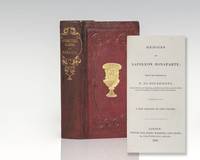
183698390London: Scott Webster & Geary 1836. Rare finely bound example of the Memoirs of Napoleon with a fine fore-edge painting of Napoleon on horseback leading his troops to battle. 12mo. bound in full red morocco gilt titles and tooling to the spine gilt vignettes to the front and rear panels gilt turn ins all edges gilt. In near fine condition with light rubbing. The earliest fore-edge paintings date possibly as far back as the 10th century; these earliest paintings were symbolic designs. Early English fore-edge paintings believed to date to the 14th century presented heraldic designs in gold and other colors. The first known example of a disappearing fore-edge painting where the painting is not visible when the book is closed dates from 1649. The earliest signed and dated fore-edge painting dates to 1653: a family coat of arms painted on a 1651 Bible. Around 1750 the subject matter of fore-edge paintings changed from simply decorative or heraldic designs to landscapes portraits and religious scenes usually painted in full color. Modern fore-edge painted scenes have a lot more variation as they can depict numerous subjects not found on earlier specimens. These include scenes that are erotic or they might involve scenes from novels like Jules Verne Sherlock Holmes or Dickens etc. In many cases the chosen scene will depict a subject related to the book but in other cases it did not. In one instance the same New Brunswick landscape was applied to both a Bible and to a collection of poetry and plays. The choice of scenes is made by either the artist bookseller or owner thus the variety is wide. The technique was popularized in the 18th century by John Brindley 1732-1756 publisher and bookbinder to the prince of Wales and Edwards of Halifax a distinguished family of bookbinders and booksellers. The majority of extant examples of fore-edge painting date to the late 19th and early 20th century on reproductions of books originally published in the early 19th century. Scott, Webster & Geary unknown