3 186 résultats
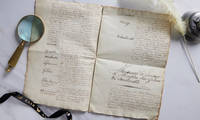
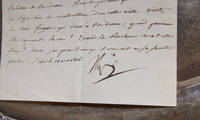
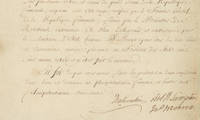
18033595823/05/1803. <blockquote><p>James Monroe and Robert Livingston receive the Treaty signed by Napoleon notification of French ratification and instructions from the French: Deliver this ""to the President of the United States without delay to do what must be done"" and secure American ratification</p><p> </p><p>This doubled the size of the United States and is one of the most significant moments in American history; In 2019 this document was saved from a fire at the Karpeles Manuscript Library and survived</p></blockquote><blockquote><p>This document central to the Louisiana Purchase is among the most important we have ever carried</p><p> </p></blockquote><p>https://vimeo.com/1180578110share=copy&fl=sv&fe=ci</p><p> </p><blockquote><p>Hear more on <a href=""https://www.raabcollection.com/tags/podcast"">Inspired by History</a>:</p><p> </p><p><iframe style=""width: 100%; max-width: 660px; overflow: hidden; border-radius: 10px;"" src=""https://embed.podcasts.apple.com/us/podcast/a-historic-manuscript-central-to-the-louisiana-purchase/id1796821278i=1000761089641"" height=""175"" frameborder=""0"" sandbox=""allow-forms allow-popups allow-same-origin allow-scripts allow-storage-access-by-user-activation allow-top-navigation-by-user-activation""></iframe></p></blockquote><p>The Louisiana Purchase stands as one of the most transformative acts in American history instantly doubling the size of the young republic and securing U.S. control of the Mississippi River and the vital port of New Orleans. Negotiated at a moment of shifting global power—amid Napoleon’s imperial ambitions the threat of imminent renewed war with Great Britain and the collapse of French plans in the Caribbean—the agreement reshaped the geopolitical balance of North America and set the United States on a path toward continental expansion and emergence as a major world power.</p><p>As the United States had spread across the Appalachians the Mississippi River became an increasingly important conduit for the produce of America’s West which at that time referred to the land between the Appalachians and the Mississippi. Since 1762 Spain had owned the territory of Louisiana which included 828000 square miles. The territory made up all or part of fifteen modern U.S. states between the Mississippi River and the Rocky Mountains. The Pinckney Treaty of 1795 had resolved friction between Spain and the United States over the right to navigate the Mississippi and the right for Americans to transfer their goods to ocean-going vessels at New Orleans. With the Pinckney treaty in place and the weak Spanish empire in control of Louisiana American statesmen felt comfortable that the United States’ westward expansion would not be restricted in the future.</p><p>This situation was threatened by Napoleon Bonaparte’s plans to revive the French empire in the New World. He planned to recapture the valuable sugar colony of Haiti from a slave rebellion and then use Louisiana as the granary for his empire. France acquired Louisiana from Spain in 1800 and took possession in 1802 sending a large French army to St. Domingue and preparing to send another to New Orleans. Americans became very apprehensive about having the more-powerful French in control of the Mississippi and New Orleans. President Thomas Jefferson noted “There is on the globe one single spot the possessor of which is our natural and habitual enemy. It is New Orleans.†He determined to do something to change this situation.</p><p>In addition to making military preparations for a conflict in the Mississippi Valley in April 1803 Jefferson sent former Minister to France James Monroe to join present Minister to France Robert Livingston to try to purchase New Orleans and West Florida for as much as $10 million. Failing that they were to attempt to create a military alliance with England. Meanwhile the French Army in St. Domingue was being decimated by yellow fever and war between France and England was on the horizon. Napoleon decided to give up his plans for Louisiana and offered a surprised Monroe and Livingston the entire territory of Louisiana - all 828000 square miles of it - for $15 million. That was three cents per acre. Although buying all of Louisiana far exceeded their instructions from President Jefferson Monroe and Livingston saw the golden opportunity and agreed. The treaty was signed on April 30 1803.</p><p>The treaty itself actually consisted of three linked agreements: the Treaty of Cession by which France transferred the Louisiana territory to the United States and guaranteed rights of property religion and eventual citizenship to its inhabitants; a first convention establishing that the United States would pay 60 million francs about $11.25 million to France through government bonds as the purchase price; and a second convention by which the United States assumed 20 million francs about $3.75 million in claims owed to American citizens for prior French seizures and commercial losses. Together these three instruments formed the full legal structure of the purchase bringing the total cost to 80 million francs or roughly $15 million.</p><p>The French ratification of the Louisiana treaty and conventions was dated May 22nd and signed by Bonaparte Foreign Minister Talleyrand Minister of the Treasury Barbé de Marbois and Hugues Bernard Maret who as the secretary of state was responsible for promulgating laws and decrees. It was delivered to the representatives of the United States Robert R. Livingston and James Monroe who here sign to acknowledge receipt of the treaty to be sent to President Thomas Jefferson ""without delay.""</p><p>Historic <strong>manuscript</strong> DS <strong>signed</strong> <em>""Jas. Monroe""</em> <em>""Rob. R. Livingston""</em> and ""Barbé Marbois"" in French Paris May 23 1803 being the monumental document recording France's sale to the US of Louisiana just approved by Napoleon Bonaparte and the French government.</p><p><em>""Today May 23 1803 we Barbé-Marbois Minister of the Public Treasury named by the French People as Minister Plenipotentiary and Robert R. Livingston Minister Plenipotentiary of the United States of America and James Monroe Minister Plenipotentiary and envoy extraordinaire of the said States at a meeting in one of the rooms of the Hotel du Public Treasury in Paris Citizen Barbé-Marbois transmitted to us Robert Livingston and James Monroe: 1. The treaty concluded and signed by us on 10 Floreal an 11 30 April 1803 and the two conventions concluded and signed by us on the same date. Said treaty and conventions in three separate instruments written on vellum parchment and bearing the grand seal of the French Republic imprinted in red wax ratified by the First Consul Napoleon of the French Republic signed by the Minister of Foreign Affairs Ch. Mau. Talleyrand and countersigned by the Secretary of State Hugues B. Maret; therefore the said treaty and conventions are to be sent by us to the President of the United States without delay and for him to take the necessary steps. For which we have signed the present document in two copies one for the French ambassador and one for the American ambassadors.""</em> With loss to one letter of Monroe's signature.</p><p>It is interesting to note that Barbé Marbois who played a key role in negotiating the Louisiana Purchase Treaty and delivered the signed ratification was former ambassador to the United States and had lived in the U.S. for years spoke English and married an American. He was well connected in the U.S. and was elected a Foreign Honorary Member to both the American Academy of Arts and Sciences John Hancock and John Adams were also members and the American Philosophical Society Thomas Jefferson was also a member and the two dealt extensively. He was a logical choice to negotiate the treaty.</p><p>There was some delay in getting the ratified treaty to the United States and Jefferson did not see the treaty until early July 1803. When news of the sale reached the United States people were incredulous and mostly elated. President Jefferson however was in a quandary. He had always advocated strict adherence to the letter of the Constitution yet there was no provision empowering him to purchase territory. Given the public support for the purchase and the obvious value of Louisiana to the future growth of the United States however Jefferson decided to ignore the legalistic interpretation of the Constitution and forgo the passage of a Constitutional amendment to validate the purchase. This decision contributed to the principle of implied powers of the federal government.</p><p>Because the treaty stipulated that the American ratification must be concluded by October 30 Jefferson hurriedly convened a special session of Congress on October 17. The United States Senate consented to ratification of the treaty with a vote of 24 to 7 on October 20. On the following day October 21 1803 the Senate authorized Jefferson to exchange the ratification document with France take possession of the territory and establish a temporary government.</p><p>In very good condition with repaired loss to the right edge truncating the final letter of Monroe's signature.</p><p>This document central to one of the most significant moments in American history is one of the most important we have ever carried. It is from the famed collection of The Karpeles Manuscript Library from which it was rescued during a fire in 2019.</p><p><img class=""alignnone wp-image-25018 size-post-window"" src=""https://cdn.raabcollection.com/wp-content/uploads/20231204144051/Folder-site-11-1600x1327.jpg"" alt="""" width=""1600"" height=""1327"" /></p> hardcover
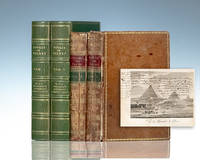
1799146536A Paris: Chez Dugour et Durand Libraires Rue et Hotel Serpente 1799. Volney's important work on Egypt and Syria from the library in exile of Napoleon Bonaparte with his annotations and corrections throughout several made as he was dictating details from the Egyptian Campaign for his own Memoirs. This copy may also have accompanied him during his Egyptian Campaigns; it is known that Napoleon brought along a copy of Volney's book to Egypt and it served as the standard reference source for the members of the campaign. Octavo two volumes bound in full contemporary French sprinkled calf with gilt tooling to the spine morocco spine labels lettered in gilt gilt scrolling to the front and rear panels with 3 engraved folding maps and 5 folding plates. First published in 1787 this important travel account by the renowned French historian orientalist philosopher and politician Constantin Francois de Chasseboeuf comte de Volney 1757-1820 is considered the best exposition of Egypt from Ottoman Syria in the late eighteenth century. It served as a basis for later Egyptian expeditions and many scientists as well as Bonaparte himself took this work with them on their expeditions. His candid descriptions did not romanticize Egypt's history or its contemporary social and political conditions but discussed the ills that plagued the country and explored the military weakness of the Ottoman Empire. Based on his observations Volney discouraged a conquest of Egypt and while he supported his friend Bonaparte politically he declined the invitation to accompany Napoleon's expedition in person. It is known that Napoleon brought along a copy of Volney's book to Egypt and it served as the standard reference source for the members of the campaign. The French campaign in Egypt and Syria 1798--1801 was a Napoleonic campaign in the Ottoman territories of Egypt and Syria executed by Bonaparte. Napoleon proclaimed to "defend French trade interests" and to establish "scientific enterprise" in the region. Despite early victories and an initially successful expedition into Syria Napoleon and his Armee d'Orient were eventually defeated and forced to withdraw especially after suffering the defeat of the supporting French fleet by the British Royal Navy at the Battle of the Nile. However on a scientific front the expedition was a success that led to the discovery of the Rosetta Stone creating the field of Egyptology. This important copy contains numerous annotations in ink and pencil in Bonaparte's hand mostly concerning measurements and other calculations including a heavily annotated folding plate of the pyramids "Vue de Pyramides de Djize" in Vol. I. The first volume contains ink annotations on pages 188 232 272 273 277-79 281 plate at page 229 cited above and map "Carte de la Syrie" at p. 288 outlines drawn in red pencil. The second volume contains mostly pencil annotations on pages 223 225 227 229 272 ink and pencil and 333. These corrections were made by Napoleon as he was dictating details from the Egyptian Campaign for his own Memoirs see provenance below. After Napoleon's death on St. Helena a large portion of his last library was divided by the executors among heirs and friends. The remainder was removed from St. Helena by order of the British Government and sold to the important French bookseller in London Martin Bossange. The lots that failed to sell almost half were quickly consigned by Bossange to Sotheby's and sold on 23 July 1823. The lengthy catalogue entry for the present lot in the Sotheby's catalogue reads: "This Work is one of the most interesting books that has occurred for sale for many years. Most persons are aware that Napoleon wrote very little but dictated to his favorite Generals Bertrand Montholon and Count Las Casas. The Egyptian Campaign which forms a part of two volumes just published of his Memoirs have been dictated from these volumes: he has taken notice of the most trifling error in the book; hence the many CORRECTIONS BY HIM. The Plate at page 229 vol. i is entirely covered with his hand writing. This unique Book forms an historical document which will be looked at with a mixture of pleasure and pain by the admirers of so great a man." Provenance: Napoleon I each title-page with circular hand-stamp in brown ink from Napoleon's library at Longwood House on St. Helena; and with his numerous ink annotations to plates and text in both volumes; Sir James Lewis Knight-Bruce bookplates; and with a note from his grandson regarding this copy: "These two volumes of 'Volnay's Voyages' which belonged to Napoleon the first were understood to have accompanied him during his Egyptian Campaigns and contain many notes in his the Emperor's handwriting. My grandfather the late Lord Justice Sir James Lewis Knight-Bruce of Roehampton Priory purchased these books presumably about 1821-2 when they were sent to England from St. Helena for sale. They being in Napoleon's possession there until his death in 1821." In very good condition with splitting to the spine and joints small section of leather torn from the upper cover of Vol. II; some wear to extremities. Occasional pale spotting internally final blank leaves 30/8 of both volumes removed presumably at the time of binding. First map in Vol. I with small marginal tear repaired near gutter margin second and third maps each with 2-inch tear repaired at gutter a few other plates with small marginal tears or reinforcements. Housed in a custom full crushed levant morocco clamshell box by Riviere & Son. Third edition revised and corrected. An exceptional piece of history with fascinating provenance. Chez Dugour et Durand, Libraires, Rue et Hotel Serpente hardcover
1812306091812. <blockquote><p>It is based on an 1809 intelligence operation that Napoleon commissioned to chart Persia Russia and the steppes</p><p> </p><p>A remarkable and apparently unpublished manuscript documenting Russia and its environs in the early 1800s fascinating for that purpose as well</p><p> </p><p>Acquired from the direct descendants and never before offered for sale</p></blockquote><blockquote><p>""Resistance could only result in the burning by the assailant of a large part of the wooden houses of Moscow""</p></blockquote><blockquote><p> </p><p>""Minsk is a town of 10000 inhabitants of which two thirds are Jewish.""</p></blockquote><p> </p><p>https://vimeo.com/916160568share=copy</p><p>In 1803 Camille Alphonse Trezel obtained the rank of lieutenant in the corps of topographical engineers. The next year he was promoted to assistant engineer geographer. After the Polish campaign as a lieutenant he was appointed acting aide to General Gardanne in the embassy of France to Persia. He was commissioned at this time by Napoleon to take extensive notes topographical geographical and otherwise of Persia and its environs. On his return he came through Russia. On his return to France he was promoted to Captain in late 1810 / early 1811 and assigned as an aide-de-camp to General Armand Charles Guilleminot; he became lieutenant-commander in 1813. Napoleon aimed to defeat not only Russia but England and the latter in part through India. Trezel and Gardanne in 1809 were tasked to survey the vast regions that would have to be crossed and to probe the dispositions of the populations and as evidenced here did so.</p><p>Trezel's notes on Persia are published and important primary resources for the period and region. We found no record of the publication of his notes on Russia.</p><p>In May and June 1812 Napoleon turned to mapping the pending invasion of Russia and finding the correct route. He had few great options. As the published papers of Napoleon state ""Despite the efforts of his geographical engineers Napoleon never had good maps of Russia throughout the campaign. To compensate for this shortage the Paris topographical office should have drawn large numbers of the few available maps and given them to the corps commanders. This was not done on the scale that the emperor wanted.†He complained during this stretch that he needed more routes to Russia that one would not suffice for planning and he wrote to Generals Clarke and Berthier complaining on this subject.</p><p><img class=""alignnone size-post-window wp-image-30623"" src=""https://cdn.raabcollection.com/wp-content/uploads/20240216175221/Mouton-Russia-Manuscript-1812-L-1-1600x740.jpg"" alt="""" width=""1600"" height=""740"" /></p><p>On June 24 1812 Napoleon commenced his famed campaign in Russia ordering his Grande Armée the largest European military force ever assembled to that date into Russia. The enormous army featured more than 500000 soldiers and staff and included contingents from Prussia Austria and other countries under the sway of the French empire. The campaign would be characterized by the massive toll on human life: in less than six months Napoleon lost near half of his men because of the extreme weather conditions battle disease and hunger. On both sides nearly a million soldiers and civilians died.</p><p><img class=""alignnone size-post-window wp-image-30624"" src=""https://cdn.raabcollection.com/wp-content/uploads/20240216175843/Mouton-Russia-Manuscript-1812-J-1-1600x820.jpg"" alt="""" width=""1600"" height=""820"" /></p><p>General Mouton the Count of Lobau was a prominent general and later Marshall of the Empire for Napoleon. Mouton means ""lamb"" in French the source of Napoleon's now famous statement on Mouton: ""My lamb is a lion."" Napoleon valued Mouton to the extent that for his great Russia campaign he made him senior aide to camp. In 1806 Mouton was a Brigade General. He would remain in Napoleon's service until the end of the Empire during which time he showed himself to be forthright direct “he's no fawner†Napoleon is noted to have said but also disciplined loyal meticulous and highly organized. He was at Austerlitz with Napoleon and was charged with the preparation of the campaigns in Spain 1808 Russia 1812 Germany 1813 and Belgium 1815. Napoleon also wrote “Mouton is the best colonel to have ever commanded a French regiment.†In 1812 Mouton took an active part in the planning and enacting of the Russian campaign. When Napoleon left the army during the retreat and returned to Paris Mouton accompanied him.</p><p><strong>Manuscript</strong> in the hand of an intelligence officer likely from the topographical department from the Library of Georges Mouton no date but likely late Spring 1812. The manuscript notes the position of Trezel as Captain and aide to camp for Guilleminot a position Trezel effectively occupied between 1811 and 1812. It appears to be a shortened version of the report from the 1809 intelligence operation that Napoleon commissioned. Our gratitude to the Fondation Napoleon for their generous assistance.</p><p><em>""Notes on the Route from Warsaw to Moscow by Tykoezinn frontier of the Grand Duchy of Warsaw 47 leagues Grodno 77 leagues Mir 133 Mink 158 Orzay 208 Smolensk 237 and Moscow 333. Extracts from a voyage made in July 1809 by Captain Trezel aid de camp of General Guilleminot.""</em></p><p><strong>The following are quotes from the report:</strong></p><p><em>""The country between Warsaw and Moscow can be divided in three distinct parts separated from each other by large rivers or by old political limits recent changed by a great usurpation but which remains in the hearts of the inhabitants of old Poland.""</em></p><p><em>""The first part enclosed by the Vistule and the Niemen has 77 leagues of length and the Neiman has 77 leagues of length. The route that goes through it passes by a good number of little towns among them the towns of the route that goes through it passes by a good number of little towns among them the towns of Siroska Pultuska Ostrolenka and Byalistok are the largest.""</em></p><p> </p><p><em>""The second from Grodno to Orzay has 125 leagues. It includes old Palatinate of Troki Minsk part of that of Vitebsk all the high parts of the Niemen and also those of the Dnieper to the right bank of the Pleure beyond which starts the Russian government of Smolensk. The route passes by the towns of Norogrodek Mir Minsk Barisow Toloezinn Orzay and Doubrovka.""</em></p><p><em>""The third part between Smolensk and Moscow is entirely in old Russia. It's length by the route is 131 leagues. One finds in succession the towns of Dorogouer Viarnie Gradsk and Moyaiska. This last part is the most fertile and the most populated.""</em></p><p><em>""All these countries present more or less the same aspect. There are still immense plains in which the slopes are nearly undetectable and which offer everywhere swamps and prairies grand forests of birch and fir trees sandy fields.""</em></p><p><img class=""alignnone size-post-window wp-image-30625"" src=""https://cdn.raabcollection.com/wp-content/uploads/20240216180100/Mouton-Russia-Manuscript-1812-G-1-1600x828.jpg"" alt="""" width=""1600"" height=""828"" /></p><p><em>""Care is particularly necessary and the third part which forms a sandy field elevated between the sources of the Duna the Dnieper the Locka and the Volga. From Warsaw to the Dnieper at Orzay the routes are generally very difficult for the carts and because even impassible at a great number of points during times of thaw and great rains. It would be necessary to make them viable in these seasons by burying a part of the wood found there. A regular system of works would find few difficulties in the execution because the Polish countrymen is accustomed to it and their hatred toward Russia would serve them to work in the hopes of a return to the former limits.</em></p><p><em>""Resources for provisioning are unequally spread along this long route. Strong and vigilant administration would certainly succeeded in nourishing a grand Army from Warsaw to Norogrodek. But the swampy forests of the government of Minsk offers only a few groups of large cattle. And difficulties of all types become their much larger and more numerous than any other part. It is necessary that the fertile government of Vilna suffices. In any case one no longer finds to the right of the route anything except immense swamps of Pinsk on which one must travel by boat during half of the year. One only exits this beyond Toloczinn a small town distance from Minsk by around 40 leagues.""</em></p><p>The manuscript continues to discuss the dedication of national spirit <em>""in all classes""</em>. Only the poorest nobility it states would want to join the Russian Army. Many it continues are unmoved by any advantages offered them by Tsar Paul I ruler until 1801 and <em>""remain far from all public functions and hide very poorly their aversion for anything Russian. All the officers of the government are forced to live completely isolated. Beyond Toloczinn the columns would march with along the beautiful routes of the government of Smolensk and of Mohilow both abundant with grain and cattle.""</em></p><p>One finds still fewer animals approaching Moscow and this town pulls all its provisions of cattle from Ukraine and above all from the government of Pultava.</p><p><em>""The river passages are many but the majority are easy to execute because beyond the Vistule one finds no longer any impediments. Nearly all the bridges are firm. Pontoon bridges could nearly everywhere be employed at least for the passage and movement of artillery and field baggage because the rivers have such a tranquil course that the pontoons could be very close to one another without causing any accident.""</em></p><p><img class=""alignnone size-post-window wp-image-30626"" src=""https://cdn.raabcollection.com/wp-content/uploads/20240216180205/Mouton-Russia-Manuscript-1812-C-1-1600x702.jpg"" alt="""" width=""1600"" height=""702"" /></p><p><em>""The best points of passage are:""</em></p><p>The manuscript now moves to the rivers and the possible bridge crossings of Warsaw Syroska Ostrolenka Tykoczinn Grodon Barisow Orzay and Smolensk. This includes the Dnieper and Vistule and other waterways along with the size and strength of the bridges.</p><p>""Itinerary from Warsaw to Moscow by Grodno and Smolensk""</p><p>The bulk of the manuscript begins here by listing the post stations of locale along with its distance in the antiquated Russian measure of Werstes and also in Leagues and population in number of houses. This is accomplished using a charge which lists left to right distance name of location number of homes and 'observations.' The indication of the number of houses of each one is only an approximation and relates solely to groups of habitations that could be perceived on the route.</p><p>What follows is a remarkable 5 two-page spreads of each station between Warsaw and Moscow with observations intended to instruct an invading army. They are at once military observations and a fascinating cultural demographic and geographical account of the region. The names are in some cases obscure or antiquated spellings including Moscow which is Mouscou and not Moscou as one would expect in French.</p><p>Manuscript: The manuscript begins in Warsaw or Varsovie: <em>""In leaving Warsaw one crosses the Vistule on a boat bridge. The length of the river is around 300. It is very quick the banks are accessible and a little elevated.""</em> The manuscript notes it is a town of 10000 houses.</p><p>The march to Russia: On June 24 1812 and subsequent days the initial wave of the Napoleon's Grande Armée crossed the Niemen River marking the entry from the Duchy of Warsaw.</p><p>Manuscript: Trezel notes that at Miaskovo in Poland still and beyond Ostrolenka <em>""The Russians had established a hospital for 300 sick"".</em> The next large town is Bialystock. Here he notes <em>""A great village named Vassilkoff around halfway down the path from Bialystock to Boukstell. The path is in a sandy plain for an hour after which one passes on a fixed bridge over a river of 25 toises of length with a reed rope. The final league is follows on the right a sandy and rocky field. They have planted ash and other trees. Two batallions of grenadiers were camped a half league from Trokolska.""</em></p><p>The chart now takes us into Belarus and toward Grodno. <em>""Grodno is an open town on the right bank of the Niemen. To enter one crosses the river on a large boat bridge. The banks are strongly inclined.Immediately above the bridge on the right is a large amphitheater surrounded by homes. One sees on the other side of town on the right and to the left of the route from Smolensk ruins of defensive fortifications. It is fertile in grain.""</em> The manuscript notes 2000 houses.</p><p>The march to Russia. On July 1 Jerome Bonaparte’s right flank crossed the Niemen at Grodno. The VII Corps stayed in the Grodno region to protect the Duchy of Warsaw.</p><p>The manuscript: <em>""There are many swamps between Lyda and Lipini. Exiting Lyda one crosses a bridge in the middle of which is an old ruined chateau. The post house of Lapini is immediately beyond a river of 16 or 17 toises.One crosses the bridge on a large square boat that could carry two strong carts.""</em></p><p>The march to Russia: On June 27 the Russian corps stationed between Lida and Grodno was almost cut off by the Grande Armée's crossing of the Niemen and Gen. Davout's troops making for Minsk.</p><p>The manuscript: <em>""Mir is the last town of the government of Grodno. I did not enter here because the post is outside and near an old abandoned chateau belonging to the Prince of Radniville. It is flanked by 4 paths a grassy rampe. The door has been removed the rest falls into ruins.""</em></p><p>The march to Russia: With Jerome's troops trailing the retreating Russian Army Platov's cossacks ambushed Jerome's advanced Polish lancers on July 8 - 10 near the village and Mir. These clashes were the first real combat of the campaign and saw the Polish troops defeated.</p><p>The manuscript: <em>""Minsk is a town of 10000 inhabitants of which two thirds are Jewish. It is located on a little river of 20-35 toises of length bordered by a lovely promenade. One crosses on a good bridge. The roads are straight and wide and the houses spaced between each other. They are nearly all in wood. The territory is without comparison the worst path of those that one pases to go to Moscow. The population has retained the Polish cavalry. The entire population of all classes retains the most pronounced aversion to the Russians. There are only the poorest nobility who wanted to take up service.""</em></p><p><img class=""alignnone size-post-window wp-image-30627"" src=""https://cdn.raabcollection.com/wp-content/uploads/20240216181202/Mouton-Russia-Manuscript-1812-E-2-1600x740.jpg"" alt="""" width=""1600"" height=""740"" /></p><p>The march to Russia: On July 8 Davout's troops reached Minsk. He lost many troops on the way there. Large store houses were constructed here.</p><p>The manuscript: <em>""We are approaching Russia. Near Zadinn and Barisow he notes the river Bereczina whose ""right bank forms an sandy escarpment of which the slope is steep but practicable to cars. There is on this bank a settlement of around 30 homes. I found there an artillery park of the 25th miitary division Siberia.""</em></p><p>In approaching Smolensk he passes through a tiny town he calls ""Reritnia."" He notes a rampart ""flanked by by a few towers. Its height is around 30 feet and thickness around 6 feet at most. It is entirely vested and supported in the interior by brick arcades. It's only defense would be a fusillade by the large pines that crown it and one could ruin this all in less than one hour with canons. One would seize very easily the high neighborhood and two beautiful churches one of which is surrounded by a wall crenelated with bricks. The passage from the Dnieper would not present much difficulty because one could crush anyone who remained in the settlement on the right bank.""</p><p>The march to Russia: On the afternoon of August 15 troops under Murat and Ney arrived at the western edge of Smolensk. Over the course of the next two days Ney's and Murat's troops along with Poniatowski's Polish Corps clashed with the Russians pitched in Smolensk. About 11000 Russians died defending the city which fell to the French and was a major depot for the troops heading east.</p><p>The manuscript: <em>""Moscow is enclosed only an earthen rise of 3 feet in height. One could attempt to defend the passage from Moskova. but this resistance could only result in the burning by the assailant of a large part of the wooden houses of Moscow. One could hold up there peacefully occupying the interior chateau called the Kremts Kremlin which is situated on the Moskwa more or less in the middle of the town. It contains 2 churches the arsenal several considerable columns.""</em></p><p>The march to Russia: On September 14 the French entered Moscow only to find it abandoned. All but a few thousand of the city’s 275000 people were gone. Napoleon retired to a house on the outskirts of the city for the night but two hours after midnight he was informed that a fire had broken out in the city. He went to the Kremlin where he watched the flames continue to grow. Reports began to come in telling of Russians starting the fires and stoking the flames. Suddenly a fire broke out within the Kremlin apparently set by a Russian military policeman who was immediately executed. With the firestorm spreading Napoleon and his entourage were forced to flee down burning streets to Moscow’s outskirts and narrowly avoided being asphyxiated. When the flames died down three days later more than two-thirds of the city was destroyed. The images of Moscow on fire are iconic; many great works of art depict the event.</p><p>The 14-page manuscript is an extraordinary piece of history the survival of which was unknown until now: notes used to plan and help guide Napoleon and his Grand Armees in their invasion of Russia.</p><p><img class=""alignnone size-post-window wp-image-25018"" src=""https://cdn.raabcollection.com/wp-content/uploads/20231204144051/Folder-site-11-1600x1327.jpg"" alt="""" width=""1600"" height=""1327"" /></p> unknown
17932182723/10/1793. <blockquote><p>Written just days after his first ever promotion</p><p> </p><p>One of only 4 documents of Bonaparte stretching back a century we can find during the siege signed with the early Italian form his signature Buonaparte</p></blockquote><p>The French Revolution had not only overthrown a monarch it had pitted Europe against France. Austria and more distantly England saw a revolutionary France as a transcendental threat. So as Paris was engaged in a massive upheaval it faced an ongoing state of hostilities with its neighbors. This led to a series of executive governments the most famous of which was the Committee of Public Safety established in April 1793 after the King had already been beheaded. In July of that year Maximilien Robespierre was elected to the Committee; and so under his leadership began the Reign of Terror so named because terror was in fact a policy instrument recognized by the state as an extension of the Revolution which must be maintained at all costs. This control extended everywhere; they controlled the police and the army and their agents went nationwide to do Robespierre’s bidding.</p><p><a href=""https://cdn.raabcollection.com/wp-content/uploads/20231204170943/buonapartebody.jpg""><img class=""alignnone size-post-window wp-image-21845"" src=""https://cdn.raabcollection.com/wp-content/uploads/20231204170943/buonapartebody-1600x567.jpg"" alt="""" width=""1600"" height=""567"" /></a></p><p>Among the gravest threats to the new government under Robespierre was the royalist sentiment in the South along the coast which just so happened to be within reach of the British Royal Navy. Here in open defiance of the Republicans royalists hoisted the “flour de lys†flag in the fall of 1793 in the city of Toulon. By that time French troops were already on their way to that city where they would confront 13000 men from the combined forces of England Spain Naples and Piedmont. The French generals were in control of their troops but Robespierre also sent to this key battleground his brother Augustin and Antoine Saliceti a Corsican like Napoleon and like him close to the French cause. These two were to report on the loyalties of generals the extent of success and to advise Paris in all matters. They had final say in the South and in reality controlled life and death.</p><p>At the time when the siege of Toulon began the Chief of Artillery was wounded and since Toulon would require a strong bombardment this deficit had to be filled. Napoleon Buonaparte as he spelled his name then had until then mainly been involved in provincial battles in his native Corsica. He was a relative unknown in France and had no high title although he had studied in the military academy there and was in service to the national army. His family had in fact fled Corsica because of its allegiance to France. In what may go down as one of the great coincidences in history he happened to be in the area as the French gathered for the assault on Toulon and was given the command of artillery by Augustin Robespierre and Saliceti whom he knew from Corsica. This seemingly insignificant event at the time would make his career and changed the history of Western Europe.</p><p>The siege itself began in mid September. He was dissatisfied by the sole battery—called the ""Mountain"" positioned on the height of Saint-Laurent since September 19. He established another on the shore of Brégallion called the ""sans-culottes"". On the first of October after a failure of General La Poype against the ""Eastern Fort"" of Faron Bonaparte was asked to bombard the large fort of Malbousquet whose fall would be required to enable the capture of the city. He therefore requisitioned artillery from all of the surrounding countryside. Promoted to Chief of Battalion on October 18 he set about strengthening his battery for the great push.</p><p><a href=""https://cdn.raabcollection.com/wp-content/uploads/20231204170934/Buonapartebody2.jpg""><img class=""alignnone size-post-window wp-image-21847"" src=""https://cdn.raabcollection.com/wp-content/uploads/20231204170934/Buonapartebody2-1600x506.jpg"" alt="""" width=""1600"" height=""506"" /></a></p><p><strong>Document signed</strong> October 23 1793 Ollioules near Toulon signed Buonaparte an early Italian form of his signature just days after being promoted to Chief of Battalion. ""<em>Statement of the pieces of artillery and other necessary effects to complete the army for the Siege of Toulon.""</em> The document continues us columns to note the type of weapon what would be necessary what they have now and what is missing along with any observations.</p><p>Napoleon performed with great skill and Toulon was taken a significant defeat to the royalists and to England. Buonaparte was credited with French success. Where soldiers who failed Paris were guillotined those who won were feted and promoted. Augustin reported back to his brother Maximilien Robespierre that Napoleon was an exceptional commander. The elder brother decided that he would be named brigadier general in December 1793.</p> unknown
1885117078London: Richard Bentley and Son 1885. Exceedingly rare edition of M. de Bourrienne's Life of Napoleon extra-illustrated with additional portraits and views and over 50 autograph letters and notes signed by Napoleon I members of his family associates and the author bound in. Octavo bound in three quarters scarlet morocco with gilt titles and tooling to the spine in six compartments within raised gilt bands marbled endpapers top edge gilt with others uncut tissue-guarded frontispiece and full color portrait to each volume illustrated with engravings issued in the initial publication and over 100 extra portraits and views bound in. With over 50 autograph letters signed bound in including 3 autograph letters signed by Napoleon I bound into Vol. I page 201 Vol. I page 369 and Vol. III page 530 and autograph letters signed by Charles J. Bernadotte King of Spain; Joseph Bonaparte King of Spain; Fauvelet de Bourrienne; A.A.L. Caulincort Duc de Vicenza; Marquis Emmanuel Grouchy; Napoleon's second wife Marie Louise. Duchess of Parma; Joachim Murat King of Naples; Comte Horace Sebastiani and Arthur Wellesley 1st Duke of Wellington among others. With the original compiler's printed catalog of extra material detailing the location volume and page number of each added engraving and autograph letter signed. In near fine condition. Accompanied by an additional military endorsement signed by Napoleon during the Peninsular War "Approuvé Np." An exceptional collection of significant Napoleonic era signatures. French military and political leader Napoleon Bonaparte rose to prominence during the French Revolution and led several successful campaigns during the Revolutionary Wars. As Napoleon I he was Emperor of the French from 1804 until 1814 and again in 1815. Napoleon dominated European and global affairs for more than a decade while leading France against a series of coalitions in the Napoleonic Wars. He won most of these wars and the vast majority of his battles building a large empire that ruled over continental Europe before its final collapse in 1815. One of the greatest commanders in history his wars and campaigns are studied at military schools worldwide. He also remains one of the most celebrated and controversial political figures in human history. Based on years of intimate friendship and professional association with Napoleon Bonaparte Louis Antoine Fauvelet de Bourrienne's Memoirs of Napoleon gained the author fame upon publication for its vivid and detailed account of his interactions with Napoleon and his extended family. Invigorated by many dialogues not only in which the author participated but even of conversations that he was only told about by others the narration offers an intimate portrait of its subject: his brilliance skill at governance and military prowess. Richard Bentley and Son unknown
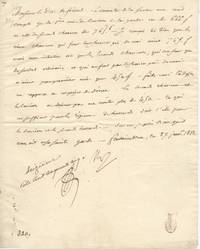
14083044514/08/1806. <blockquote><p>He aims to build back the Navy after the defeat of the Trafalgar Campaign and worries about saboteurs in Bordeaux</p><p> </p><p>A letter never before offered for sale acquired from the direct descendants of the recipient</p></blockquote><p>https://vimeo.com/916159720share=copy</p><p> </p><p>Napoleon’s appeal to his men is legendary. More than almost any other person he embodied the nationalism of the 19th century; his soldiers revered him and for generations after he was studied for his populist leadership. He was a man of the people. Many books have been written on this subject movies produced tracking his magnetic and popular character. Ralph Waldo Emerson spoke for many when he wrote of Napoleon in his essay focused on the General ""Among the eminent persons of the nineteenth century Bonaparte is far the best known and the most powerful; and owes his predominance to the fidelity with which he expresses the tone of thought and belief the aims of the masses of active and cultivated men.""</p><p>Zacharie Allemand was a French naval man who won great victories for Napoleon but did not endear himself to his superiors or the sailors under his command. After attacks in the Atlantic on British outposts he returned to Brest one of the main French naval ports and upon his arrival there he was relieved of duty for ""brutality towards his crews"" and ""rudeness towards his passengers"". He was reinstated and eventually earned a larger command and operated a major Atlantic campaign as a diversionary affair to the Trafalgar campaign which ended without the loss of a single ship in his fleet. This is now referred to as ""Allemand's expedition"" of 1805. In spite of complaints against his character he was made Rear Admiral in January 1806.</p><p><img class=""alignnone size-post-window wp-image-30604"" src=""https://cdn.raabcollection.com/wp-content/uploads/20240216141859/Napoleon-1806-1-1600x783.jpg"" alt="""" width=""1600"" height=""783"" /></p><p>Napoleon was intent on laying low the British. His defeats at sea had made him all the more certain that the Atlantic venue must not be ignored. He had major ports for his fleet at Brest Rochefort and the Gironde in Bordeaux where there were frigates under construction among them the Penelope. The Battle of Trafalgar had seen the loss of 20 ships more or less and well over a thousand sailors. Napoleon was anxious to see a return to strength of his fleet.</p><p>General Mouton the Count of Lobau was a prominent general and later Marshall of the Empire for Napoleon. Mouton means ""lamb"" in French the source of Napoleon's now famous statement on Mouton: ""My lamb is a lion."" Napoleon valued Mouton to the extent that for his great Russia campaign he made him senior aide de camp. In 1806 Mouton was a Brigade General. He would remain in Napoleon's service until the end of the Empire during which time he showed himself to be forthright direct “he's no fawner†Napoleon is noted to have said but also disciplined loyal meticulous and highly organized. He was at Austerlitz with Napoleon and was charged with the preparation of the campaigns in Spain 1808 Russia 1812 Germany 1813 and Belgium 1815. Napoleon also wrote “Mouton is the best colonel to have ever commanded a French regiment.â€</p><p><strong>Letter signed</strong> St. Cloud August 14 1806 to General Mouton Compte de Lobau.</p><p><em>""General Mouton I desire that you speak with Rear Admiral Allemand. He is too harsh. His captains and officers do not like him and they leave him. Attempt to make him understand that it is advantageous for the good of the service to be liked.</em></p><p><em>""Go see the site at Rochefort. Things go slowly there. How many vessels will we be able to send to sea this year When will the vessel now in the armament for fitting be able to go to harbor</em></p><p><img class=""alignnone size-post-window wp-image-30605"" src=""https://cdn.raabcollection.com/wp-content/uploads/20240216142042/Napoleon-1806-4-1-1600x682.jpg"" alt="""" width=""1600"" height=""682"" /></p><p><em>""Go to Bordeaux. Examine the most of the Gironde and visit the batteries. Visit Blaye up the river from Bordeaux. Observe the spirit of the inhabitants of Bordeaux. I have heard from people who have assured me that there are malevolent actors in this town.</em></p><p><em>""Visit the three frigates which are in Bordeaux. When can we launch them to sea The Penelope - when will she be completed""</em></p><p>Never before offered for sale acquired in the US from the direct descendants of the recipient residing in the states.</p><p><img class=""alignnone size-post-window wp-image-25018"" src=""https://cdn.raabcollection.com/wp-content/uploads/20231204144051/Folder-site-11-1600x1327.jpg"" alt="""" width=""1600"" height=""1327"" /></p> unknown
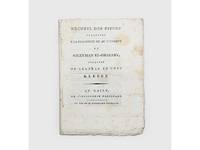
1800178043Cairo: Imprimerie nationale 1800. The commission unanimously declared that the said Suleiman al-Halabi is guilty First edition one of 500 copies printed of the court proceedings from the murder trial of Suleiman al-Halabi. The Kurdish student was tried for the assassination of Jean-Baptiste Kléber the French army's commanding officer whom Napoleon described as "the god Mars in uniform". This detailed record includes the interrogations of al-Halabi and his accused accomplices during which the former admitted his guilt and premeditation alongside the closing arguments by Antoine Léger Sartelon commissaire-ordonnateur as well as the court's judgement. It also comprises supporting documents from the trial such as a list of court members and witness statements in which the sub-officers Perrin and Robert describe finding al-Halabi covered in blood. Also included is a post-mortem examination of Kléber and a report of the injuries sustained by the architect Jean Baptiste Protai who survived the attack. The medical reports are both by the chief doctor René-Nicholas Dufriche Baron Desgenettes. After the assault on Alexandria Kléber 1753-1800 was given command of the province later leading his division into action on the expedition to Syria. When Napoleon left for France in secrecy at the end of 1799 he made the unsuspecting Kléber commander of the army. In this capacity he negotiated the Convention of El Arish which was signed by representatives from the Ottoman Empire and France. It intended to end the French campaign with the repatriation of troops and return of territory to the Ottomans. The armistice was abrograted by the British leaving the outraged Ottomans to send an assault force commanded by Grand Vizier Yusuf Ziya Pasha d.1819 whom the French defeated at the Battle of Heliopolis. Shortly after retaking Cairo which had risen in revolt Kléber was viciously stabbed in the heart chest arm and thigh by al-Halabi c.1777-1800 who was supportive of the Ottoman cause. Al-Halabi was convicted of the murder; on 17 June 1800 he had his right hand burned before being impaled while four scholars accused of complicity were beheaded. The skull of al-Halabi is held at the Musée de l'Homme in Paris and was for a time studied by French phrenologists while Kléber's remains are buried in his hometown of Strasbourg. The French army capitulated to the British in 1801 and Egypt was returned to Ottoman control in 1802 following the Treaty of Paris. Napoleon reflected on the character of Kléber during his exile on St Helena: "Kléber! It was the god Mars in uniform. Courage conception he had everything; All he needed was to have his battlefield at his disposal longer" quoted in Correspondance. When Napoléon invaded Egypt in 1798 he saw printing as a strategic necessity and established a press immediately after reaching Alexandria. Known as the Imprimerie nationale in Cairo and the Imprimerie orientale et française in Alexandria it was the third press to be established in Ottoman territory following Muteferrika's in Istanbul and Abdallah Zakher's press in Lebanon. Although discontinued after Napoleon's occupation ended the Imprimerie inspired the Bulaq Press as "many Egyptian intellectuals had seen the presses and realized the benefit to be derived from them" Kent p. 61. Sartelon ordered 500 copies printed with translations made in Turkic and Arabic for provincial distribution. We have traced 14 copies in institutions of which 12 contain all three translations two are unclear. Octavo 220 x 157 mm pp. 47 1 blank as rear wrapper. Stitched as issued in self-wrappers. Pale staining to wrappers and four leaves at end a few marginal paper flaws not affecting text. A very good copy. Boustany 10; Geiss 15; Schnurrer 422; all citing three language versions together. Allen Kent Harold Lancour Jay E. Daily eds. Encyclopedia of Library and Information Science vol. 24 1978; Napoléon "Éloge de Kléber Tome II page 65 30 mars 1821 " in Correspondance de Napoléon Ier: Tome XXXI oevres de Napoléon Ier à Sainte-Hélène 1869. unknown
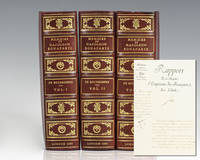
18361284121836. First Edition. Signed. NAPOLEON DE BOURRIENNE Louis Antoine Fauvelet. Memoirs of Napoleon Bonaparte. By His Private Secretary. To Which Are Now First Added An Account of the Important Events of The Hundred Days of Napoleon's Surrender to The English And of His Residence And Death at St. Helena. London: Richard Bentley 1836. Four volumes bound in eight. Octavo late 19th-century full red morocco raised bands spines and boards elaborately gilt-decorated with Napoleonic emblems blue and red morocco gilt doublures watered silk endpapers all edges gilt. Housed together in a custom slipcase. $25000.Expanded edition of de Bourriennes classic biography of Napoleon with 27 plates a facsimile of Napoleons abdication and a folding map depicting the Battle of the Nile expanded to from four volumes to eight and abundantly extra-illustrated with about 300 engraved plates including portraits scenes views and maps with a document signed by Napoleon bound into the front of the first volume. Beautifully bound by Sangosrki & Sutcliffe in full morocco with Napoleonic emblems in gilt.""Bourrienne a French statesman studied at the military school of Brienne where he was on friendly terms with the young Napoleon. In 1797 he became Napoleon's secretary"" an appointment which ""continued during all the most brilliant part of Napoleon's career"" and afforded him the intimacy upon which the Memoirs are based CBD:189; preface. ""The fame of Bourrienne rests not upon his achievements or his original works but upon his Memoirs"" Britannica. First published in French in 1829; in English translation in 1830. Bound into the first volume is a manuscript document from 1799 signed by Napoleon as ""Bonaparte"". The document a manuscript letter concerns the operations of the French Army in Egypt; it reads in part: ""Take advantage of the days when General Dugua can stay at Damietta to disarm the army there arrest suspect men and send them to Cairo. Disarm the villages take hostages and take complete control of Lake Manzala. As long as you are not master of this lake you cannot be sure of controlling Damietta. I am writing to General Dugua that he is to reconnoiter the shores of the sea Try to learn the name of the English frigate and if you should learn that they are disembarking somewhere to get provisions let them disembark for a few days in order to have the time to take them in an ambush. The Province of Damietta should already have supplied the horses that it has to supply. I salute you. signed Bonaparte."""" General Dugua was in charge of the fifth division of the French Army during the Egypt Campaign serving as commander of Cairo from February of 1799 until March of 1800 when he returned to France. With a typed index to all of the extra illustrations. Napoleon document with unobtrusive evidence of glue removal along one edge; joints to beautiful bindings expertly repaired. hardcover
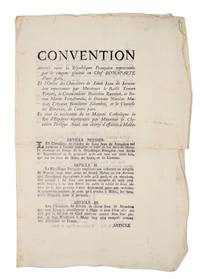
17982196<p><strong><em>The first printed edition of the terms of Malta's capitulation to Napoleon: printed in Malta!</em></strong></p><p>Napoléon Bonaparte 1769-1821; Knights Hospitaller; Felip d'Amat i de Cortada 1754-1828.</p><p><strong>Convention arretée entre la République Française representée par le citoyen général en chef Bonaparte d'une part. Et l'Ordre des Chevaliers de Saint Jean de Jerusalem ….</strong></p><p>Malta Imprimerie Nationale after June 12 1798.</p><p>Folio. 4 pp. Paper watermarked "C / BA". Signed by hand in ink at the end: "A monsieur / Boré / je suis".</p><p>An extremely rare copy of the terms and conditions for the capture of Malta by Napoleon dated June 12 1798. This document was printed in Malta and is possibly the first item produced under the French regime. Although it lacks an imprint the National Library of Malta has confirmed its origin. We have found no copies of this treaty in any digital catalogues including those of France WorldCat KvK or other major repositories.</p><p>Following the capture of Italy Napoleon maintained strict secrecy regarding the destination of his next campaign. While it was known that he had assembled the largest expeditionary fleet ever seen in the Mediterranean its destination remained unclear. In a surprising move the fleet arrived at Malta on June 6th and within a matter of days the island was captured. The capitulation as outlined in this treaty was negotiated between Malta represented by the Knights Hospitaller the French Republic represented by Citizen General-in-Chief Bonaparte and the Spanish Crown as mediator. To control the flow of information the French immediately seized the only printing press on the island and relocated it to the former Chancellory of the Order. The press originally known as Stamperija di Sua Altezza Serenissima was renamed Imprimerie Nationale. During the French occupation Giovanni Mallia who had been working at the press since 1763 continued to manage the printing office and remained in his position until the end of French rule in Malta in 1800.</p><p>Among the press's notable outputs was the publication of Malta's first newspaper Journal de Malte printed in two columns: one in French and the other in Italian. Only ten issues of this newspaper were ever published. A comparison of the typographic features of the Journal de Malte and this treaty reveals striking similarities particularly in the initial "L" used in the treaty which matches that in the title of the Journal de Malte. We have scans of the Journal available upon request. This combined with the treaty's extreme rarity and its absence from the French Collective Catalogue strongly suggests that it was printed in Malta rather than in France. The National Library of Malta through correspondence and the expertise of Prof. William Zammit has confirmed our suspicions. Prof. Zammit is currently developing a comprehensive retrospective bibliography of all works printed in Malta between 1642 and 1800. The treaty appears to have been printed in France for the first time in 1801 in Pièces diverses et correspondance relatives aux opérations de l'armée d'Orient en Égypte; imprimées en exécution de l'arrêté du Tribunat en date du 7 nivôse an IX de la République française Paris Baudouin Messidor an IX = June 1801.</p><p><strong>Condition:</strong> creased and frayed at the margins old fold with marginal tear. Otherwise in good condition.</p> Imprimerie Nationale
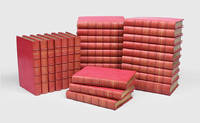
1902181292New York: Anglo-American Authors Association 1902. A unique homage to the age of Napoleon An extraordinary extra-illustrated set produced at the turn of the 20th century in Napoleonic splendour including the autographs of Napoleon and 33 other luminaries of the age and 800 plates. The autographs are bound into a single volume and comprise letters documents and military orders. The Napoleon autograph is his bold "N" on a commercial license. Other autographs are those of his family members Lucien and Joseph his marshals Soult and Ney his nemesis Wellington and the financier Necker among many other military and civil figures. Extra-illustrating was a hobby of wealthy collectors and a profitable market for bookdealers - fill a prominent work with additional historic material and have it finely bound expanded to far more volumes than the original. The set was composed and bound by the Anglo-American Authors Association a dealership who specialized in such productions. It is styled as the "Monograph Copy" on the manuscript titles pages - such sets were often given such grandiose titles. This set merges Hazlitt's biography of Napoleon with the memoirs of Napoleon's contemporaries de Bourriene and Junot. The plates which date from across the 19th century comprise portraits of Napoleonic figures and views of prominent buildings and historical events. 33 vols octavo 219 x 144 mm. Extra-illustrated with 800 plates and with manuscript title pages. Contemporary pink morocco spines lettered in gilt gilt turn-ins enclosing doublures of colour-printed illustrations on glossy paper green silk free endpapers top edges gilt others uncut. Bindings fine; some loss and repairs to documents but generally in very good condition. unknown
1937132909Meriden Conn.: The Ralston Society 1937. Rare first edition of this classic bestseller which has sold over 100 million copies. Octavo original cloth. Boldly signed by Napoleon Hill on the front free endpaper. Near fine in a very good dust jacket with reinforcement to the verso. Housed in a custom half morocco clamshell box. Rare and desirable in the original dust jacket and signed. Think and Grow Rich was written in 1937 by Napoleon Hill promoted as a personal development and self-improvement book. Hill writes that he was inspired by a suggestion from business magnate and later philanthropist Andrew Carnegie. While the book's title and much of the text concerns increased income the author insists that the philosophy taught in the book can help people succeed in any line of work to do and be anything they can imagine. First published during the Great Depression at the time of Hill's death in 1970 Think and Grow Rich had sold more than 20 million copies and by 2015 over 100 million copies had been sold worldwide. It remains the biggest seller of Napoleon Hill's books. BusinessWeek magazine's Best-Seller List ranked it the sixth best-selling paperback business book 70 years after it was published. The Ralston Society paperback
1937133570Meriden Conn.: The Ralston Society 1937. Rare first edition of this classic bestseller which has sold over 100 million copies. Octavo original cloth. Boldly signed by Napoleon Hill on an official bookplate on the front free endpaper. Near fine in a very good dust jacket. Housed in a custom half morocco clamshell box. Rare and desirable in the original dust jacket and signed. Think and Grow Rich was written in 1937 by Napoleon Hill promoted as a personal development and self-improvement book. Hill writes that he was inspired by a suggestion from business magnate and later philanthropist Andrew Carnegie. While the book's title and much of the text concerns increased income the author insists that the philosophy taught in the book can help people succeed in any line of work to do and be anything they can imagine. First published during the Great Depression at the time of Hill's death in 1970 Think and Grow Rich had sold more than 20 million copies and by 2015 over 100 million copies had been sold worldwide. It remains the biggest seller of Napoleon Hill's books. BusinessWeek magazine's Best-Seller List ranked it the sixth best-selling paperback business book 70 years after it was published. The Ralston Society paperback
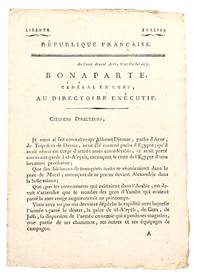
17992197<p><em><strong>Printed in Alexandria: Napoleon admits his first defeat</strong></em></p><p>Napoléon Bonaparte 1769-1821; Louis Antoine Fauvelet de Bourrienne 1769-1834.</p><p><strong>République française. Au camp devant Acre le 21 Floréal an 7. Bonaparte Générale en chef au Directoire exécutif. </strong>incipit: <strong>Je vous ai fait connaître qu' Ahhmet Djezzar Pacha d'Acre de Tripoli et de Damas avait été nommé Pacha d'Egypte.</strong></p><p>including:</p><p><strong>République française. Au quartier-général devant Acre le 8 Floréal </strong>sic<strong> an 7. Bonaparte Générale en chef au Directoire exécutif. </strong>incipit: <strong>Je vous ai fait connaître par le courrier que je vous ai expédié le 27 floréal les événements glorieux pour la République qui se sont passés depuis trois mois en Syrie.</strong></p><p>Alexandria <em>Imprimerie orientale et française</em> after May 16 1799.</p><p>4°. 8 pp. Collates: A-A4.</p><p>Two reports by General Napoleon from the battlefields in current Israel printed in Alexandria. Although the imprint is missing material characteristics strongly indicate that this was printed in Alexandria after October 1798 when the better printing equipment moved to Cairo. For instance the publication uses the same thick paper as <em>Expedition de Syrie jusqu'a la prise de Jaffa</em> kept by us. Additionally the absence of a capital "É" in the title led to the use of an apostrophe ' a solution also employed in <em>Expedition de Syrie jusqu'a la prise de Jaffa</em> where various methods were used to address this issue. Another edition of these reports was printed at the Imprimerie Nationale in Cairo now only found at the Bibliotheque nationale de France.</p><p>General Napoleon embarked on his Syria Campaign after securing control of Cairo engaging in several battles across what is now Egypt Gaza and Israel. The campaign culminated in his defeat at the fort of Acre modern-day Akko Israel. To keep his people informed and maintain control of the narrative Napoleon regularly sent military reports back to Egypt where they were printed to disseminate propagandist information.</p><p>The present publication contains two such reports. The first dated May 10th 1799 was written from Acre by Napoleon's secretary Fauvelet de Bourrienne. In this report Napoleon admits to his first defeat as a military leader. He was defeated by Ahmed Pasha al-Jazzar who successfully defended the fort of Acre for the Ottomans. This victory brought Jazzar significant fame in the Muslim world earning him the sobriquet "the slave who defeated Napoleon." The report also notes that as a result of this victory "Ahhmet Djezzar Pasha of Acre Tripoli and Damascus had been appointed Pasha of Egypt by the Ottomans" thereby challenging Napoleon's hold on the territory.</p><p><br />After this news Napoleon describes in the present report the campaign's progress since his last dispatch two months earlier detailing various military engagements in the Gaza/Israel/Palestine region including the Battles of Nazareth Cana and Mount Tabor.</p><p>In the second report dated May 16th Napoleon explains the reasons for his defeat at Acre and outlines his strategy for retreating to Egypt including his intention to destroy Jaffa near present-day Tel Aviv Israel on his way back.</p><p><strong>Condition: </strong>first and last pages very slightly rubbed otherwise in excellent condition.</p><p><strong>Copies:</strong> none only one copy of the Cairo editon in BnF: FRBNF33764485.</p> Imprimerie orientale et française
1800177962Paris: Imprimerie de la république 1800. The end of Napoleon's invasion of Egypt Sole edition of this rare document published shortly before Napoleon's forces withdrew from Egypt in which Cairo's council the diwan attempts to create an impression of continuing allegiance to France at a time of great political instability foreshadowing the eventual rejection of colonial rule. We locate only three copies of this document in institutions Leiden BnF and Bayerische Staatsbibliothek. In Paris where it was published the declaration would have been interpreted as a sign of Egyptian loyalty to Napoleon and his general in chief Jacques-François de Menou also known as Abdallah J. Menou d. 1810 but the reality was somewhat different. Napoleon's invasion of Egypt had begun in 1798 inspired by a desire to counteract Britain's influence in the Middle East and to 'liberate' the country from Ottoman rule. He took Cairo late in July 1798. However Nelson's victory at the Battle of the Nile in August 1798 left the French without a fleet and Napoleon was forced to halt his expansion into Syria in 1799. Napoleon managed to hold advancing Ottoman forces at the Battle of Abukir in June 1799 but news soon reached him that his gains in Europe had been reversed and he resolved to abandon his own forces and return to France which he did in complete secrecy on 23rd August 1799. He left behind him General Kléber who would soon be murdered and de Menou who succeeded Kléber as general in chief in June 1800. The Convention of El Arish signed in January 1800 by the French and the Ottomans at the instigation of the British intended to bring the French presence in Egypt to an end but only after de Menou's defeat at the Battle of Alexandria in March 1801 were the French forces ultimately repatriated. Written in November 1800 after the Convention had been signed but before the withdrawal was finalized this declaration was signed by the leading members of the council including the Grand Imam of al-Azhar Shaykh Abdallah al-Sharqawi d. 1812 and witnessed by de Menou. The translators were the renowned orientalists Silvestre de Sacy and Pierre Jaubert. The latter acted as Napoleon's interpreter in Egypt. Bifolium leaf size 463 x 585 mm black letterpress across four pages. Text in French and Arabic. Creased where folded small chips to lower edge light foxing and dust soiling: a very good example of a fragile document. unknown
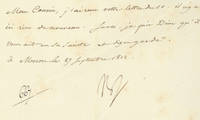
18083045219/12/1808. <blockquote><p>A letter never before offered for sale acquired from the direct US-based descendants of the recipient; it does not appear in the published works of Napoleon or online at the Fondation Napoleon</p><p> </p><p>Napoleon's letters mentioning the surrender at Bailen are great rarities and we have not seen one having been sold publicly</p></blockquote><p>The Battle of Bailén was fought in 1808 between the Spanish Army of Andalusia led by General Francisco Javier Castaños and the Imperial French Army's II corps d'observation de la Gironde under General Pierre Dupont de l'Étang. This battle was the first open-field defeat of a Napoleonic army. The heaviest fighting took place near Bailén sometimes anglicized Baylen a village by the Guadalquivir River in the Jaén province of southern Spain.</p><p>The defeat was total. Dupont surrendered all his forces those who were not killed instead of fighting his way out. Napoleon considered it a great treachery the biggest blow to his ego to date. Apart from the blow to French prestige Bailén threw the French invasion forces—faltering after their failure to secure Gerona Zaragoza Valencia Barcelona and Santander and with the country rapidly arming and mobilizing against them—into panic and disarray. With the sudden loss of 20000 troops Napoleon's military machine abruptly fell apart and had to be put back together.</p><p>The fate of the prisoners was tragic in most cases. Dupont had surrendered with the understanding that his men would be allowed back to France. But his Spanish opponents once the surrender occurred did not honor the agreement and instead most of the 20000 or so captured were sent west and ended on vessels the vast majority eventually dying. A few among them Dupont were sent back to France to Rochefort and from there made their way back to the front lines to be incorporated into the ranks.</p><p>General Mouton the Count of Lobau was a prominent general and later Marshall of the Empire for Napoleon. Mouton means ""lamb"" in French the source of Napoleon's now famous statement on Mouton: ""My lamb is a lion."" Napoleon valued Mouton to the extent that for his great Russia campaign he made him senior aide to camp. In 1806 Mouton was a Brigade General. He would remain in Napoleon's service until the end of the Empire during which time he showed himself to be forthright direct “he's no fawner†Napoleon is noted to have said but also disciplined loyal meticulous and highly organized. He was at Austerlitz with Napoleon and was charged with the preparation of the campaigns in Spain 1808 Russia 1812 Germany 1813 and Belgium 1815. Napoleon also wrote “Mouton is the best colonel to have ever commanded a French regiment.â€</p><p><strong>Letter signed</strong> Chamartin Madrid December 19 1808 to General Mouton. <em>""There are at Retiro 4 depots of isolated men one from the 1st corps one from 4th one from the 6th and another of isolated French prisoners of Dupont's corps which is returning. You will conduct a review and report back to me with their state. There is also a clothing store at Retiro. You will find attached here an account of its status. Go to visit it and acquaint me of the use we could make of the 2300 habits 2300 vests 3000 culottes and the 800 pants located there. You will bring to me tomorrow at 10 o'clock in the morning the state of the depots and the state of the stores along with that of the men we could clothes in the four depots.""</em></p><p>Never before offered for sale acquired from the direct descendants of the recipient now residing in the United States. It does not appear in the published works of Napoleon or online at the Fondation Napoleon.</p><p><img class=""alignnone size-post-window wp-image-25018"" src=""https://cdn.raabcollection.com/wp-content/uploads/20231204144051/Folder-site-11-1600x1327.jpg"" alt="""" width=""1600"" height=""1327"" /></p> hardcover
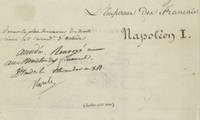
18092158723/09/1809. <blockquote><p>A rare full signed order by Bonaparte</p></blockquote><p>In 1809 a formation known as the Reserve Corps of the Army of Germany was assembled. This later became a new VIII Corps that served in Spain in 1810. The Reserve Corps was under the command of Marshal François Christophe de Kellermann. Its three divisions were led by Generals Olivier Rivaud de la Raffinière Eloi Laurent Despeaux and Joseph Lagrange.</p><p>The siege of Astorga was an attempt by French forces to capture that town as part of a campaign of the Peninsular War. Astorga was located on the flank of the French invasion path to Spain and Portugal and was meant to be used as a headquarters during the campaign. The French overpowered the Spanish garrison inside and took the city on April 20 1810 with a loss of 160 men. It took however the arrival of ammunition and weapons for the attack to begin.</p><p>The 8th corps was ordered to march to Spain and its first units reached Burgos.</p><p><strong>Order signed</strong> Schonbrunn September 23 1809.</p><p><em>""His Majesty Orders:</em></p><p><em>1 The 22nd regiment of line infantry and the 65th of the line which are part of the 8th corps of the army will each have their 8 stores of ammunition for infantry and 8 for their military transports. The quartermaster general will take the necessary measures to ensure that those regiments that do not have proper munitions and have not exhausted the funds allowed to each regiment for this object that he will contact them without delay and procure the munitions necessary. The quartermaster general of the artillery will take responsibility for those measures that relate to the artillery.</em></p><p><em>2 The 8 4th battalions that form the Rivaud division will each have their own infantry and military transport munitions supplies. The necessary funds for the creation of these will be placed at the disposition of the authorized officer of the 8th corps to be made at Nuremberg Bareuth or Wurtsbourg. The horses will be furnished by the administration as we order below.</em></p><p><em>3 The artillery of the 8th corps will be composed of 4 pieces of 12; 16 pieces of 6; 6 pieces of 3 and 6 howitzers having a double approvisionnement harness. The Saxon artillery of General St. Cyr's division will have its cannon piece including 4 of 12 which forms for the 8th Corps 60 pieces of cannon independently of the regimental pieces.</em></p><p><em>4 The engineers will have after the 8th corps at least 1500 tools which will be carried on harnessed carriages as well as the ropes and tools necessary for the prompt repair of a bridge.</em></p><p><em>5 Three hundred horses shall be raised in the land of Bareuth a hundred in the land of Erfurth and a hundred in the land of Hanau in all five hundred which will be distributed in the 8th corps as follows namely: for the artillery 300 for the transports of the 8 battalions of the Rivaud 50 division for the transports of the engineers 50 for the three provisional regiments of dragoons 100. The price of these horses will be set from the inhabitants according to the tariff which will be regulated by the general steward.</em></p><p><em>6 An advance of two thousand francs will be made to each of the squadrons which form part of the six provisional regiments of dragoons. These 2000 francs will be taken from the regiment's casks by the Minister of War Administration. The distribution between the different mannes will be made by General Fouler for the 1st 5th and 4th. One and the other of these generals will assure the Minister of War Administration of the distribution they have made between the mannes. The squadron leaders and captains commanding the squadrons of the six provisional regiments will immediately use this fund to prepare their squadron.""</em></p><p>Complete orders of Napoleon are very uncommon.</p> unknown
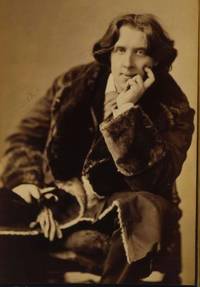
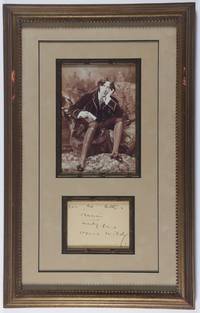
18825<p></p><p><strong>Oscar Wilde</strong></p><p><strong>Photographic portrait by Napoléon Sarony</strong></p><p>Vintage silver print.</p><p>12 x 7.2 inches.</p><p>Mounted on the photographer's box.</p><p><strong>Iconic portrait of Oscar Wilde: one of the images from his legend.</strong></p><p>This photograph belongs to a famous series of 27 taken by Napoléon Sarony in New York on January 5 1882 during Oscar Wilde's first trip to the American capital for a series of conferences.</p><p>Napoléon Sarony 1821-1896 then owned the most prominent studio in New York</p><p>This is the eighth. Wilde poses seated in his large coat with a wide collar and large brown fur sleeves. It is a pelisse to which he was particularly attached. <em>"I carried her during the entire trip to America she attended all my premieres she knows me perfectly" </em>he wrote.</p><p>His head slightly inclined rests on his left hand the ring and little fingers at the level of the chin the middle finger lightly pressing the cheek. In the other hand he holds his pair of gloves.</p><p>Long hair is neatly divided with a middle part and waves on either side. The look is extraordinarily clear the oval of the face perfect. Wilde has in this image something of a Madonna hinting at a gentle smile.</p><p>The writer is then at the peak of his beauty. The image is as much his creation as that of the photographer. This photograph almost as much as his books and his witticisms contributed to creating the character he created for himself. As such the term iconic is not usurped.</p><p>Magnificent print in warm tones large format.</p>
1925140947492Cleveland OH: Napoleon Hill 1925. First Edition. Near Fine. Incomplete. First edition of the incredibly rare 1925 version of Napoleon Hill's Law of Success. An incomplete set with three volumes only of 15 according to Wikipedia; other sources mention 16 including Lessons 11 13 14. Bound in publisher's original black pebbled semi-flexible boards. Very Good with relatively uniform wear to each volume light soiling and heavy rubbing to lettering. Light tanning to contents occasional corner crease and slight waviness to Lesson 13. Prior to the 8-volume 1928 expanded edition Hill self-published this work as found here in fifteen volumes. It is rumored that only 118 sets were originally printed. Volumes from these 1925 sets are extremely rare to market. Napoleon Hill unknown
1928140945092Meriden CT: The Ralston University Press 1928. First Edition. Very Good. First Edition. Complete eight volume set bound in dark blue variant cloth decorated in blind and stamped in gilt. Ranging from Very Good to Near Fine with light soiling and light wear to covers light worming to textblock edges former owner name to front endhseet of several volumes marking to text in several volumes though pages mostly clean one long tear to top edge of page 21/22 in Volume 3. A rare set which has become increasing hard to obtain. The Ralston University Press unknown
1937150615Meriden Conn.: The Ralston Society 1937. Rare first edition of this classic bestseller which has sold over 100 million copies. Octavo original cloth. Boldly signed by Napoleon Hill on the front free endpaper. Near fine in a very good dust jacket with various original ephemera relating to the original release of this title. Rare and desirable in the original dust jacket and signed. Think and Grow Rich was written in 1937 by Napoleon Hill promoted as a personal development and self-improvement book. Hill writes that he was inspired by a suggestion from business magnate and later philanthropist Andrew Carnegie. While the book's title and much of the text concerns increased income the author insists that the philosophy taught in the book can help people succeed in any line of work to do and be anything they can imagine. First published during the Great Depression at the time of Hill's death in 1970 Think and Grow Rich had sold more than 20 million copies and by 2015 over 100 million copies had been sold worldwide. It remains the biggest seller of Napoleon Hill's books. BusinessWeek magazine's Best-Seller List ranked it the sixth best-selling paperback business book 70 years after it was published. The Ralston Society paperback
1937140943908Meriden CT: The Ralston Society 1937. First Edition. Near Fine/Near Fine. First edition first printing. Bound in publisher's maroon cloth stamped in gilt. Near Fine with slight dulling to spine cloth slight rubbing to gilt slight wear to extremities. Light pencil marking throughout text and repair to rear inner hinge. In a Near Fine unclipped dust jacket with light edge wear. The Ralston Society unknown
18042327822/08/1804. <blockquote><p>This is earliest document we found having reached the market bearing the title ""Napoleon I"" Emperor of the French on it; it was signed just weeks after he gave himself the title and months before his coronation in front of the Pope.</p></blockquote><div dir=""ltr""><span style=""color: #3366ff;""> </span></div><p><span style=""color: #3366ff;""><em>Reference for research publication and institutions: Raab B</em>13.105</span></p><p>The Corsican-born Napoleon one of the greatest military strategists in history rapidly rose in the ranks of the French Revolutionary Army during the late 1790s. By 1799 France was at war with most of Europe and Napoleon returned home from his Egyptian campaign to take over the reigns of the French government and save his nation from collapse. After becoming first consul in February 1800 he reorganized his armies and defeated Austria. In 1802 he established the Napoleonic Code a new system of French law and in 1804 he established the French empire.</p><p>On May 18 1804 Napoleon proclaimed himself emperor and made Josephine Empress. His coronation ceremony took place on December 2 1804 in the Cathedral of Notre-Dame in Paris with incredible splendor and at considerable expense. Napoleon even paid for Pope Pius VII who had signed the Concordat of Rome defining the status of the Roman Catholic Church in France and ending the breach caused by the church reforms and confiscations enacted during the French Revolution to travel to France for the occasion believing that his presence would imbue the event with a solemn religious feeling. Pius agreed to come hoping to win Napoleon's goodwill towards Rome and the Papal States.</p><p>As a perfect reflection of the time in which he lived Napoleon was “obsessed with history."" He would draw references symbols and examples from it to justify his position and his politics and thus give his reign its place in the history of France from the Gauls right up to his immediate predecessors including the Bourbons. Of all the references wielded by the French Emperor Charlemagne is if not one of the most important then at least one of the most consistent. During the same period the Russian Ambassador Markov wrote to his government saying that in his opinion Bonaparte would soon take the title of “Emperor of the Gauls †whilst the Prussian Lucchesini sent word to Berlin that the Consul wanted to “be a second Charlemagne †but “enlightened by the geniuses of our century †adding “No-one doubts he has a plan; it is just the timing that has yet to be decided."" On becoming emperor Napoleon thought it time to visit his “predecessor â€. This pilgrimage had become virtually a tradition with the kings of France then the Germanic emperors. So he went to Aix-la-Chapelle to tie his historical legitimacy with the memory of Charlemagne – as Thiers put it the old emperor had been “awakened by Napoleon with ill-disguised intent â€.</p><p>On July 18 the new Emperor began a great inspection tour from Boulogne to Treves through Calais Dunkirk Ostend Arras Mons Aachen Cologne and Mainz. It was to end in Aix and cement his position of Emperor. He would return from this and receive the crown.</p><p><strong>Autograph document signed</strong> with a very early example of his new title the head reading <em>""To his Majesty the Emperor of the French Napoleon I""</em> August 22 1804 Ostend granting a senior civil position to a resident of Ostend on his great tour by endorsing the request <em>""Agreed. Returned to the Ministry of Finance Ostend 6 Thermidor in the 12th August 22 1804.â€</em> The approval its in response to an appeal from citizen Michel Jean Pruyssenaere resident of Ostende to serve as collector of that area.</p><p>We have found just one other document of Napoleon during this grand tour having reached the public market and that was part of the great Sang Collection. That did not have his new letterhead as Emperor. This must be one of the earliest with his ""Napoleon I"" letterhead.</p><p><img class=""alignnone wp-image-23121 size-post-window"" src=""https://cdn.raabcollection.com/wp-content/uploads/20231204155902/Folder-site-3-1600x1327.jpg"" alt="""" width=""1600"" height=""1327"" /></p> unknown
18123546227/09/1812. <p>In 1812 Napoleon was still at the height of his fortunes. The Peninsular War in Spain against Britain he believed would soon end in triumph. All that remained to complete his “Continental Systemâ€â€“a unilateral European blockade designed to economically isolate Britain and force its subjugation–was the cooperation of Russia. Czar Alexander I kept a tenuous peace but was unwilling to submit to the Continental System which would be ruinous to the Russian economy. To intimidate Alexander Napoleon massed his forces in Poland in the spring of 1812 but still the Czar resisted.</p><p>Napoleon determined to act. On June 24 Napoleon commenced his famed campaign in Russia ordering his Grande Armée the largest European military force ever assembled to that date into Russia. The enormous army featured more than 500000 soldiers and staff and included contingents from Prussia Austria and other countries under the sway of the French empire. The campaign would be characterized by the massive toll on human life: in less than six months Napoleon lost near half of his men because of the extreme weather conditions battle disease and hunger. On both sides nearly a million soldiers and civilians died.</p><p>Napoleon’s military successes traditionally lay in his ability to move his armies rapidly and strike quickly but he was instead forced to pursue the Russian army which was refusing to give in and was falling back. The fleeing Russian forces adopted a “scorched earth†strategy seizing or burning any supplies that the French might utilize as they pillaged from the countryside. Meanwhile Napoleon’s supply lines became overextended as he advanced deeper and deeper into the Russian expanse.</p><p>Many in Russia were critical of the Russian army’s refusal to engage Napoleon in a more direct confrontation. Under public pressure in late August Alexander named General Mikhail Kutuzov supreme commander but initially the veteran of earlier defeats against Napoleon continued the retreat. Finally Kutuzov agreed to halt at the town of Borodino about 70 miles west of Moscow and engage the French. The Russians built fortifications and on September 7 the Grande Armée attacked. Napoleon was uncharacteristically cautious that day; he didn’t try to outflank the Russians and he declined to send much-needed reinforcements into the fray. His exhausted Grand Armée was unable to encircle and destroy the opposing force as it had done in Napoleon’s earlier campaigns. Instead Napoleon’s direct attacks against entrenchments resulted in heavy losses. He failed to destroy the Russian army and as a result he was not in the position of overwhelming superiority he had hoped to achieve. After the battle Kutuzov decided not to defend Moscow but to launch a general withdrawal to save the Russian army.</p><p>Napoleon was sure that once Moscow was taken Alexander would be forced to capitulate. On September 14 the French entered Moscow only to find it abandoned. All but a few thousand of the city’s 275000 people were gone. Napoleon retired to a house on the outskirts of the city for the night but two hours after midnight he was informed that a fire had broken out in the city. He went to the Kremlin where he watched the flames continue to grow. Reports began to come in telling of Russians starting the fires and stoking the flames. Suddenly a fire broke out within the Kremlin apparently set by a Russian military policeman who was immediately executed. With the firestorm spreading Napoleon and his entourage were forced to flee down burning streets to Moscow’s outskirts and narrowly avoided being asphyxiated. When the flames died down three days later more than two-thirds of the city was destroyed.</p><p>On September 18 Napoleon wrote Jean-Jacques Régis de Cambacérès his trusted advisor who was constantly consulted for advice saying the fires were calming down and “I have taken up lodging in the residence of the Tsars the Kremlin…â€</p><p>Nine days later he updated his advisor. <strong>Letter signed</strong> Moscow September 27. 1812 to Jean-Jacques Régis de Cambacérès. <em>“My cousin I have received your letter. There is nothing new at present. I pray that God keeps you in his holy and worth guard.â€</em></p><p>A very uncommon letter of Napoleon in Moscow during the great invasion.</p><p><img class=""alignnone wp-image-25018 size-post-window"" src=""https://cdn.raabcollection.com/wp-content/uploads/20231204144051/Folder-site-11-1600x1327.jpg"" alt="""" width=""1600"" height=""1327"" /></p> unknown
39568Géraud-Christophe-Michel Duroc 1772-1813 General and Diplomat one of Napoleon's closest advisers saying that he has been told that the wages of "the Lancers of the Guard is 666. f. and that of the second infantrymen of 765. f. - I understand very well that the old infantrymen who do their service by me have 765. f but my intention is that the second infantrymen who are only ordinary soldiers who do not do the service by me have for first wage only 450. f. - would you draft for me a report and a project of decree. Second infantrymen and spearmen should not cost me more than 450. What is sufficient for hussar regiments should be for lancers and second hussars as well." 1 side 4to. Fontainbleau 27th January With the stamp of the Bibliotheca Lindesiana which had been planned by Alexander LINDSAY 25th Earl of Crawford 1812-1880 and his eldest son James 1847-1913 Astronomer Politician Ornithologist Bibliophile and Philatelist. He was a member of the Royal Society president of the Royal Astronomical Society and a prominent Freemason. Father and son were instrumental in building the library up to such an extent that it was one of the most impressive private collections in Britain at the time both for its size and for the rarity of some of the materials it contained. In 1796 Napoleon took Duroc as his aide and made him a major in Egypt a colonel in Syria and then senior aide-de-camp. From 1804 he was a grand marshal and was often sent on diplomatic missions and he signed the treaties of Fontainebleau and Bayonne 180708 determining the French intervention in Spain. He led a division at the Battle of Austerlitz and was in all the campaigns. He was usually consulted by Napoleon on questions of promotion and became the best channel by which Napoleon's lieutenants could approach him. On his journey back from Russia in 1812 the emperor chose Armand de Caulaincourt as his immediate companion and Duroc followed in another sledge. Back in France Duroc was made a senator in 1813. He was heavily involved in the organisation of the new French army and was with it at the battles of Lützen and Bautzen. Only a couple of months after this letter he was in the outposts in Silesia and came under artillery fire and was killed. Napoleon's invasion of Russia has been described as among the most lethal military operations in world history and this letter was written only months after the retreat. Transcription Monsieur le Duc de Frioul Le ministre de la Guerre me rend compte que la 1ère mise des lanciers de la garde est de 666. f. et celle des seconds chasseurs de 765. f. - Je conçois très bien que les vieux chasseurs qui font leur service près de moi aient 765. f mais mon intention est que les seconds chasseurs qui ne sont que des soldats ordinaires et qui ne font pas le service près de moi n'aient pour première mise que 450. faites-moi là de plus un rapport et un projet de décret. Les seconds chasseurs et les lanciers ne doivent pas me coûter plus de 450. Ce qui est suf sant pour les régiments de hussards doit l'être pour les lanciers et les seconds hussards. - Sur ce je prie Dieu qu'il vous ait en sa sainte garde. -Fontainebleau le 27. janvier 1813. Seizième Cote cent cinquante cinq Translation The Duke of Friuli The Minister of War makes me informed that the 1st wage of the Lancers of the Guard is 666. f. and that of the second infantrymen of 765. f. - I understand very well that the old infantrymen who do their service by me have 765. f but my intention is that the second infantrymen who are only ordinary soldiers who do not do the service by me have for first wage only 450. f. - would you draft for me a report and a project of decree. Second infantrymen and spearmen should not cost me more than 450. What is sufficient for hussar regiments should be for lancers and second hussars as well. - Then I pray to God that he keeps you in his holy guard. - Fontainebleau January 27 1813. unknown
188255660NP: Napoléon Sarony 1882. Framed. Very good to fine. Fine photo-mechanical image of Oscar Wilde after the original by photographer Napoléon Sarony 1821-1896. With brief inscription signed Oscar Wilde. Photo and note framed behind glass within larger frame 19 5/8 12 5/8". <br /> <br /> Portrait of Oscar Wilde 7 x 5" in decorative gilt frame: Frontal of Oscar Wilde seated clothed in jacket and knee breeches leaning forward with elbow resting on knee head supported by left hand holding a book in right hand with elbow resting on armrest. <br /> <br /> The six word inked note 3 x 4 1/8" also in decorative gilt frame both matted within larger wooden gilt frame with decorative inside border. Gilt frame with two scuffs 4 1/4" below top of frame one on each side. Napoléon Sarony unknown