17 080 résultats
185290365Saint-Germain-en-Laye: H. Picault 1852. Fine. H. Picault Saint-Germain-en-Laye 1852 14 x 21.2 cm Relié Rare first edition cf. Tulard 275 and 1453.Contemporary half tan goatskin binding spine with four false raised bands decorated with gilt chains and a central fleur gilt initials at foot marbled paper boards corners rubbed and canvas-tipped late 19th-century binding.Scattered foxing.The only edition extremely scarce as issued in a small print run and not offered commercially like most of the works of the Dutch historian Sirtema van Grotestins 17911874 who was based in France.The two figures whose memoirs he published were Dutchmen of contrasting political destinies: while the former refused to serve Louis Bonaparte the latter went so far as to join his ministry; in fact references to the imperial period remain limited the greater part relating to the policy of William I King of the Netherlands and its failure following the Belgian Revolution of 1830.Bound at the end is a review of the work by Saint-Marc Girardin consisting of an extract from the Journal des débats of 23 October 1852. N.p. n.d. Paris 1852 11 pp.Provenance: copy from the library of the Belgian diplomat André de Kerchove de Denterghem 18851945 bearing his bookplate and his gilt monogram A.K.D. stamped at the foot of the spine. H. Picault hardcover
1812AQ20594Montpellier: l'Imprimerie de Mme. Picot 1812. Single leaf broadside. With the Imperial eagle vignette to head. Early vertical and horizontal folds edges uncut. A trifle browned single small hole touching text without loss of sense. An original example published in Montpelier of the twentieth bulletin of the Grand Armée in Russia. These bulletins were issued by Napoleon in order to communicate progress of his most significant military campaign to date to the French public. Immensely significant propaganda tools these bulletins explained the prevailing conditions; in this case reporting on the French capture of Moscow in the preceding days. Although not the political capital of Russia the city's fall represented a severe blow to defending army. As the bulletin notes 'Moscou est l'entreport de l'Asie et de l'Europe; ses magasins etaient immenses; toutes les maisons etaient approvisionnees de tout pour huit mois'. Somewhat ominously given the benefit of hindsight the bulletin closes somewhat bombastically with a reference to the temperature and the availability of coats and furs: 'La temperature est encore celle de l'automne: le soldat a trouve et trouve beaucoup de pelisses et des fourrures pour l'hiver. Moscou en est le magasin'. Within three months in the now infamous XXIXe. Bulletin Napoleon was to report the full extent of the calamitous failure of the Russian campaign - blaming his military failure almost entirely upon the weather. . Dimensions 460 x 360 mm. l'Imprimerie de Mme. Picot unknown
18235757144Henry Colburn and Co 1823. Volume 1-4 and 3 volumes of corresponding historical miscellanies. This is an ex-library book and may have the usual library/used-book markings inside.This book has hardback covers. In good all round condition. Medium brown leather 8vo with decorative blind border on boards and gilt motif on front board. Ornate decorative gilt patterning on backstrip along with gilt lettering and borders in a black panel. Gilt inner dentelles. Lightly bumped corners and light general wear. Marbled edges and end papers. Fold out frontispiece. Interior is secure clean and clear save for a fair amount of foxing. Contains several fold out plates and maps. Please note the Image in this listing is a stock photo and may not match the covers of the actual item4800grams ISBN: Henry Colburn and Co hardcover
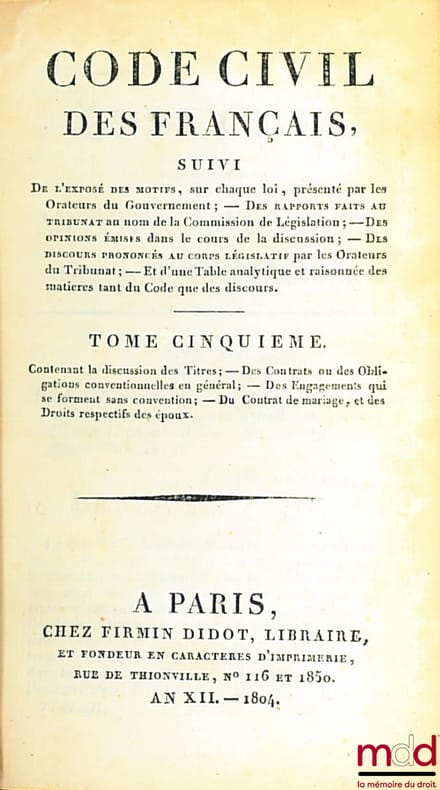
In-16 (100 x 62 mm), demi-veau marbré de l'époque à coins, dos lisse orné de filets gras dorés en place des nerfs et d'un petit fleuron répété, pièce de titre de veau corail, tranches mouchetées, (4), 556 p. Edition originale du Code Civil in-16°. Trois formats de la première édition du Code Civil parurent simultanément: in-4°, in-8° et cette édition in-16°, "de poche" imprimée sur papier vergé pur fil fin, destinée aux praticiens, avocats et magistrats. Elle est la plus rare des trois pour n'avoir été ni conservée ni transmise. (Dramard, n° 18. En français dans le texte, 210). Bel exemplaire, frais, imprimé sur papier vergé fin, bien relié à l'époque.
1837wq669Paris, au bureau central, rue des filles-Saint-Thomas, n° 5 Relié 1837 Première édition in-4 (28 x 19,5 cm). Faux-titre, titre, 112 pages : demi-veau brun, filets dorés sur le dos, plats de papier marbré. (Reliure de l’époque). Issue du premier dictionnaire illustré d’iconophores, lettrines ornées à mi-page avec des représentations débutant par la même initiale. Une pour chaque lettre de l’alphabet, y compris le W, et conçu par le lexicographe et grammairien Napoléon Landais (1804-1852). L’auteur tira de son Dictionnaire général et grammatical (1834) ce manuel dont les gravures aideront à l’apprentissage. L’alphabet gravé est précédé de “Principes de lecture” composés d’alphabets, de syllabaires, d’exercices, de chiffres et de premières lectures sur 8 pages, 12 exercices. L’initiale ornée est soulignée de la lettre en différentes typographies, légendées, et d’un lexique de mots choisis propres à l’étude — faune, flore, peuples, etc. Le N fait la part belle à Napoléon Bonaparte avec plus de six pages historiques. Les riches ornements portent les signatures de Wattier et Tellier et sont gravés sur bois par V. Duplat et Andrew Best & Leloir, atelier de gravure parisien. Première garde volante manquante, angles inférieurs de certains feuillet pliés, quelques-uns avec petits manques sans atteinte du texte. Pâles rousseurs éparses. Provenance : Bibliothèque du Château de Laplagne, avec ex-libris ; Livraison a domicile (La Poste) ou en Mondial Relay sur simple demande.
Four volumes bound in six. Small octavo. With a total of 16 engraved or etched plates, some as frontispiece. Pp. Vol. I: lxxvi, 257; 40; 108, plus 6 plates; Vol. II: xxxviii, 456, plus 2 plates; Vol. III: cxxxvi, 326, plus 2 plates; Vol. IV: 336, plus 2 plates; Vol. V: clx, 332, plus 2 plates; Vol. VI: 398, ccxvi (extended chronology), plus 2 plates. Hardcover, uniformly bound in contemporary duo-tint boards, spines gilt, each spine with volume number within gilt shield and with black lettering-piece in gilt. Some superficial rubbing to boards, some endpapers browned, minor age related blemished here and there, persistent dampmark to top edge of one volume. Withal a lovely set in good condition. ~ Various editions. Vol. I: second edition, 1792; II: fourth edition, 1815; Vol. III-IV: second edition, 1806; Vol. V-VI: third edition, 1815. The charming plates were made by Antoine Cosme Giraud (etcher) and Vincent Marie Langlois (engraver), after originals by Jean Michel Moreau and Jean Baptiste Simonet. Jean-Paul Rabaut Saint-Étienne (1743-1793) was a leader of the French Protestants and a moderate French revolutionary. He was guillotined in December 1793. Jean Charles Dominique de Lacretelle (1766-1855) was historian and journalist. He continued Rabaut's work and completed most of it while in prison. Very rare in its completeness.
1810910146CGAugsburg:, Rugendas, J. L., nach 1810. Altkolorierte Aquatinta 38,5 x 54 cm, Blattgröße 48 x 59 cm.
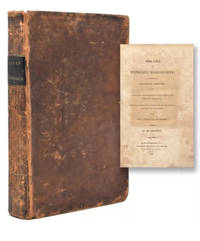
182024.08.Napoleon<p><strong>The Life of Napoleon Buonaparte. </strong><br />Containing Historical Sketches and Anecdotes Illustrative of His Public and Private Character. <br />Impartially Selected and Arranged from the Most Authentic Documents and Publications. <br />With a Portrait of the Emperor. <br />By an American.</p><p>FIRST EDITION. <br />Printed in 1820.</p><p>Complete in one volume.</p><p>Binding is original. <br />Printed on high quality rag paper. <br />Frontisplate present.</p><p>Elizabeth-town N.J.: Allen and Bryant 1820. <br />First Edition.</p><p>Frontispece bust engraving of Napoleon engraved by Peter Maverick after a portrait by Vauthier.</p><p>vii 8-503pp. 8vo.</p><p>Original mottled calf leather spine label. Text gentlty toned/foxed. A very good copy. First Edition. Frontispece bust engraving of Napoleon engraved by Peter Maverick after a portrait by Vauthier. vii 8-503pp. 8vo.</p><p>Reference: Felcone "New Jersey Books 1801-1860" #839; Shoermaker AI # 1964</p><p><br />This will be well protected for shipping via Priority Mail.</p><p>Please see my other listings for similar books.</p><p>24.08</p>
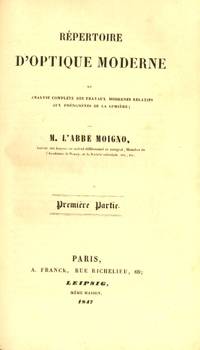
185053204Paris; Leipzig: A. Franck 1850. First editions. 4 volumes. 8vos. vol. 1 viii iv 404 pp.; vol. 2 vi 401-902 pp.; vol. 3 iv 903-1301 pp.; vol. 4 iv 1297-1856 pp.; illustrated with diagrams and figures formulas etc. Later quarter calf and cloth over boards. Intermittent foxing; p. 49 - 80 in volume one are deeply toned. A very good set. Formerly of the Society of Jesuits Moigno 1804 - 1884 left in 1844 to become a school chaplain. An associate of David Brewster and the founder of the popular science magazine LE COSMOS in 1852. After a visit to the Royal Polytechnic in London in 1854 he began his lifelong enthusiasm for the use of projected images to illustrate lectures; hence his nickname "the Apostle of Projection." <br /> <br /> This work was the culmination of all previous knowledge of optics including photographic lenses. His research included the mathematical theory of light color etc. It is the foundation work for photographic optics. <br /> <br /> Roosens and Salu No. 5263. A. Franck unknown
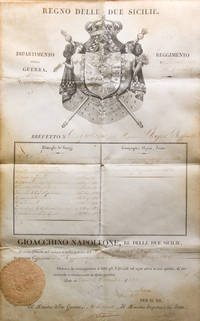
1813247608Naples 1813. Engraved royal arms of the Kingdom of the Two Sicilies. One page. Folio. Slightly faded and soiled. Matted and framed. Engraved royal arms of the Kingdom of the Two Sicilies. One page. Folio. Handsome document signed by the gallant and flamboyant brother-in-law of Napoleon. Murat was one of Napoleon's boldest marshals who played a prominent role in each of the major campaigns; nonetheless at the time this document was signed Murat was negotiating with the Allies and eventually agreed to provide troops to fight against France in exchange for a guarantee of his throne and possessions. Ultimately however after Waterloo he was captured by the Allies executed and shot. It is said that as he faced the firing squad he shouted:<br/><br/><br/><br/> "Soldiers do your duty! Straight to the heart - but spare the face. Fire!"<br/><br/><br/><br/>"Murat was one of the most colorful figures of his time. His military talents on the battlefield at the head of the cavalry were considerable but his rash initiatives robbed him of any chance of earning repute as a strategist. A vain and rather brainless man given to devising splendid uniforms he had many enemies among the marshalate but was greatly admired by the rank and file for his dash and undoubted charisma ." Chandler DICTIONARY OF THE NAPOLEONIC WARS pp. 294-296. unknown books
1844053992Cairo Kahire-Bulaq: Bulaq Printing House. Hegira: 1260 1844. 1st Edition . Hardcover. Very Good. 8vo - over 7¾ - 9¾" tall. n original cloth bdg. Large roy. 8vo. 25 x 17 cm. In Ottoman script. 90 p. Hegira: 1260 = Gregorian: 144. First only and extremely rare Ottoman Turkish translation and 'Bulaq Edition' of this account of Napoleon described as 'Extrait du Memorial de Sainte-Helene. The Bulaq or El-Amiriya Press is the first official and governmental printing press to be established in Egypt and function according to industrial printing basis causing not just a qualitative but also a quantitative and knowledgeable leap in science throughout the Arab region. The Bulaq Press was part of Mohamed Aly's inclusive development plans for the modernization of Egypt. The Khedive first initiated his plans by establishing a strong Egyptian army; one that is capable of strengthening his grip on the country. It thus became essential that this army be provided with the necessary instructive and educational books and material by which to learn military plans and techniques as well as the different types of artillery and laws that define a soldier's duties and rights. A pressing need eventually developed for establishing a governmental press; one that should provide such material. By 1815 CE. Mohamed Aly initiated the process of bringing the art of printing to Egypt by sending the first official delegation headed by Nicole El Masabki to Milan in Italy to learn the principles of printing. The same delegation was later able to return and establish the first official press in Egypt. This rare and unusual book published and printed in Bulaq Press shortly after the foundation of the printing house. After his final defeat at Waterloo and his subsequent second exile Napoleon Bonaparte spent 10 weeks on board the HMS Northumberland as it sailed him to the far-flung reaches of the South Atlantic. His destination was St. Helena a small and windswept island under British control. Almost 2000 kilometers west of Africa St. Helena measured only 122 square kilometers 47 square miles - half the size of his former home-in-exile Elba. His intended home Longwood was not finished by the time he arrived and so Bonaparte stayed with a British family - the Balcombes- at their residence The Briars. He made a great friend of the family's younger daughter Betsy and the pair got on famously. Napoleon was given very few privileges. Once he met a slave and desired to free him the English government denied his request on the grounds that he was trying to align with the slaves and start an insurrection. Napoleon spent most of his days dictating his memoirs to his generals reading plays novels and the latest books from Europe that his captors would allow him. He spent six years there though there are really only anecdotes to describe his life at the time which for the most part carry expressions of loneliness and boredom. Extremely rare. Only six paper copies found in OCLC: 777091409. Cairo FKT 185.; Özege 10976. First Edition. <br/> <br/> Bulaq Printing House., [Hegira: 1260] hardcover
8vo., Fourth Edition, with two large folding engraved maps COLOURED BY HAND (one map with short tear in one fold); handsomely bound in contemporary tan full straight-grained morocco BY [Francis] JULLION, sides with multiple frame borders in decorative gilt and blind enclosing blind frame border stopped at corners with floral sprays, back with five raised bands tooled in gilt, second compartment lettered in gilt, all other compartments richly tooled in gilt with stylised sprays, gilt doublures, all edges gilt, rose endpapers, a splendid copy in wholly unrestored period binding with virtually no trace of the usual offsetting and age-staining. A SPLENDID COPY WITH THE ENGRAVED HERALDIC BOOKPLATE OF CAROLINE, COUNTESS OF KINGSTON, AND THE EMBOSSED COLOURED BOOKPLATE OF MAX SALOMON, ON FRONT PASTE-DOWN. WITH THE TRADE TICKET OF JULLION OF LONDON ON FRONT FREE ENDPAPER VERSO. The maps are coloured to depict the various armies' battle-positions. Caroline King, nee FitzGerald {1754-1823) was wife to Robert King, 2nd Earl of Kingston. Francis Jullion was binder to HRH the Duke of Gloucester. Sandler 2400.
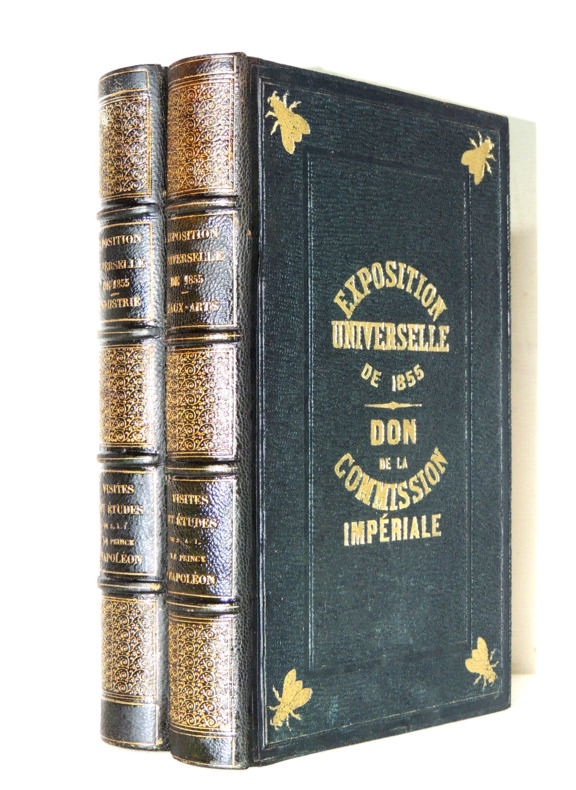
CZC-9775Bonaparte (Napoléon Joseph Charles Paul)]. Visites et études de H. A. I. Prince Napoléon au Palais de l’Industrie ou guide pratique et complet de l’Exposition universelle de 1955. Y compris les vingt-sept classes de l’industrie. Paris : Perrotin, 1855. Visites et études de S.S. le Prince Napoléon au Palais des Beaux-Arts ou description complète de cette exposition (Peinture, Sculpture, Gravure, Architecture) avec la liste des prix, suivi par les visites du prince aux produits collectifs Nations qui ont participé à l’exposition 1855. Paris : Henri et Charles Noblet, 1856. 2 volumes in8, 18x12, relié demi cuir, abeilles sur les couvertures, dos à nerfs, toutes tranches dorées. 427, 392pp. Rares premières éditions donnant la description des visites du Prince Napoléon aux Palais de l’Industrie et des Beaux-Arts lors de l’Exposition Universelle de 1855. Il s’agit de la deuxième exposition de ce type dans le monde et la première organisée en France. C’est le prince Napoléon, c’est-à-dire Napoléon Joseph Charles Paul Bonaparte (1822-1891), cousin germain de l’empereur Napoléon III, qui a présidé à l’organisation de cet événement. Ces deux œuvres ont été conçues pour donner toutes les informations nécessaires aux visiteurs et aux chercheurs pour naviguer dans les galeries des palais construits pour l’occasion. En plus du compte rendu des visites du prince, il y a aussi des décrets et des documents officiels, la liste des jurys, exposants et prix, une histoire des expositions, diverses statistiques, etc.
CZC-9775Bonaparte (Napoléon Joseph Charles Paul)]. Visites et études de H. A. I. Prince Napoléon au Palais de l’Industrie ou guide pratique et complet de l’Exposition universelle de 1955. Y compris les vingt-sept classes de l’industrie. Paris : Perrotin, 1855. Visites et études de S.S. le Prince Napoléon au Palais des Beaux-Arts ou description complète de cette exposition (Peinture, Sculpture, Gravure, Architecture) avec la liste des prix, suivi par les visites du prince aux produits collectifs Nations qui ont participé à l’exposition 1855. Paris : Henri et Charles Noblet, 1856. 2 volumes in8, 18x12, relié demi cuir, abeilles sur les couvertures, dos à nerfs, toutes tranches dorées. 427, 392pp. Rares premières éditions donnant la description des visites du Prince Napoléon aux Palais de l’Industrie et des Beaux-Arts lors de l’Exposition Universelle de 1855. Il s’agit de la deuxième exposition de ce type dans le monde et la première organisée en France. C’est le prince Napoléon, c’est-à-dire Napoléon Joseph Charles Paul Bonaparte (1822-1891), cousin germain de l’empereur Napoléon III, qui a présidé à l’organisation de cet événement. Ces deux œuvres ont été conçues pour donner toutes les informations nécessaires aux visiteurs et aux chercheurs pour naviguer dans les galeries des palais construits pour l’occasion. En plus du compte rendu des visites du prince, il y a aussi des décrets et des documents officiels, la liste des jurys, exposants et prix, une histoire des expositions, diverses statistiques, etc.
1823108482Seven vols. London: Printed for Henry Colburn and Co. and Martin Bossange and Co. 1823. Seven vols. 8vo. xvi 408; viii 1-395; xvi 1-423; viii 1-483 1 errata; viii 377; viii 1-471; x 1-389 pp. 18 fold-out plates five of which are used as frontispieces. Contemporary half green calf roll-tooled in gilt marbled paper boards backstrip with four raised bands decorated in gilt lettered in gilt with blind and gilt stamped decorations to panels all edges marbled marbled endpapers with binder’s stamp “R. Storr†to lower pastedown. Boards are a bit rubbed with some chipping at edges and bumps to corners volume two has a large chunk of the upper board’s paper torn away; otherwise good a handsome set complete with plates; very good. § Second edition. Plates include detailed maps charts campaigns battle plans naval action attacks Theaters of the War and several facsimile manuscripts. Printed for Henry Colburn and Co. and Martin Bossange and Co hardcover books
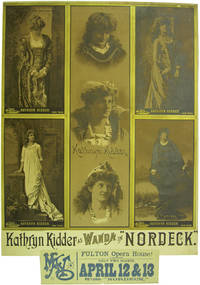
188543296Buffalo: The Courier Lith. Co. 1885. First edition. A very good copy restored at top edge text banner affixed to bottom Condition B. 33 x 23 1/4 inches 83.75 x 59 cm. Three portraits of the young Belle Époque actress Kathryn Kidder flanked by four full length photographs of her in costume taken by Napoleon Sarony the greatest photographer of the American theater. Frank Mayo and John G. Wilson's play based on "Vineta the Phantom City" a translation of a novel by E. Werner opened in 1884 in Chicago with Laura Don as Wanda but when Don left for California Kidder was given the role as the play moved to New York and Mayo went all out to promote her. Kathryn Kidder 1867-1839 was born In Newark or Evanston Ill various reports and was privately educated until she attended the North Western Female College where Emma Willard received her degree. Her early rise was described in 1885 at the time of this poster: "Frank Mayo meantime had heard of this promising pupil and at once hunted her up with a view to offering her the character of the Countess Wanda in his play of 'Nordeck.' After a careful study of the character and its possibilities she accepted Mr. Mayo's offer and spoke of the character to a friend in these words: 'It is a part I would have chosen if I had been consulted and given my choice; and whatever the future may bring much shall be ascribed to the very fortunate opportunity afforded me in the character of the lovely Countess Wanda.' This character in 'Nordeck' is indeed lovely as Miss Kidder says. The author has suggested a character that is quite ideal and the young actress has clothed it with life and naturalness while portraying the romantic possibilities of the creation with all the enthusiasm of a young girl in the first flower of fulfillment. And it is not too much to say that the character of Wanda is due largely to Miss Kidder's efforts whether unaided or otherwise; for her lines allow rather than demand the character that she portrays. Miss Kidder is tall with a bright rather than simply beautiful face a figure that is willowy and lithe and motions that are at one and the same time impetuous and graceful. She realizes and feels as well as looks the young and impulsive character." Folio Boston vol. xxvii June 1885 pp. 222-3. "Afterwards she followed this with several Shakespeare seasons playing Ophelia Desdemona Hermione and Perdita Lady Macbeth then Madame Sans-Gene; further Shakespeare revivals and old English comedy; School for Scandal The Rivals The Country Girl then Salambo of Flaubert and following this several modern plays including The Embarrassment of Riches Wallack's; The Woman of Impulse Herald Square; and The Glass House." She had her own production company wrote 'The Heart of her Husband a domestic drama in three acts and two scenes' helped fund-raise for Women's Suffrage and was married to Louis Kaufman Anspacher an American playwright and director. Rare. OCLC and other databases show no copies of this nor any other posters for Nordeck nor for Kidder. The Library of Congress has an archive of her scrapbooks of news clippings relating to her stage career 1883-1909 and the NYPL has a promptbook of her play. The Courier Lith. Co. hardcover books
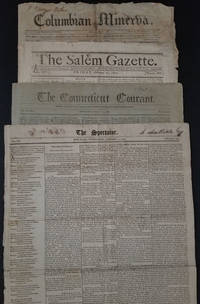
185723362American & British 1857. Very good condition. An archive of Napoleonic war accounts in mostly American newspapers reporting important world events from 1798 through to 1857. These vivid contemporary accounts span the entire period of the Napoleonic era. <br /> <br /> Starting with the 1798 article in a Connecticut newspaper there is a description of Napoleon's campaign the Egyptian campaign and the mystery which surrounded its goal and destination: "Nothing certain is yet known relative to the destination of Buonaparte's sic armament . Never was a political secret more inviolably kept nor was the curiosity of Europe ever more excited than on this occasion. Among the various destinations assigned by rumor to the expedition Candia sic Cyprus Constantinople and Alexandria are mentioned . See item 1 p3 col. 1.<br /> <br /> The archive ends with Napoleon's defeat at the Battle of Waterloo and the new balance of power which resulted in Europe. In the December 16 1818 issue of 'The Morning Chronicle' a letter to the editors remarks on the vast changes in Europe: <br /> "After a state of warfare which has lasted above twenty years and which has entirely changed the face of Europe the reverses which Bonaparte has experienced within the last twelvemonth have at least placed him more on a level with his antagonists in point of power; the terror which attended the prospect of his reducing all Europe to one power is in a great measure dissipated; his motions are neither so rapid nor his advantages so decided as they formerly were. . No state of things can be more desirable nor more advantageous to this country England than that a balance were established in Europe by which a general peace would be maintained for the longest possible period." See item 26 p3 col. 4.<br /> <br /> Each article roughly over 10 column inches in length. The articles range from very good to rough condition and are mostly in good order. The archive includes:<br /> 1. The Connecticut Courant Hartford. P3 col. I. Oct. 15 1798<br /> 2. The Spectator New York. P2 col. 5. Nov. 24 1798<br /> 3. The Spectator. P1 col. 3 & 4. Jan. 9 1799<br /> 4. The Connecticut Courant. P2 col. 1; p3 col. 1. Sept. 23 1799<br /> 5. The Salem Gazette Mass. P1 col. 4. Feb. 21 1800<br /> 6. The Connecticut Courant. P1 & p2. April 7 1800<br /> 7. Weekly Museum New York. P3 col. 2. Aug. 9 1800<br /> 8. The Connecticut Courant. P2 col. 1. Mar. 30 1801<br /> 9. The Connecticut Courant. P3 col. 1. June 8 1801<br /> 10. The Connecticut Courant. P1 col. 4 & p2 col. 4. June 29 1801<br /> 11. The Connecticut Courant. P2 col. 2 & 4. July 13 1801<br /> 12. The Connecticut Courant. P1 col. 5; p3 col. 1. Sept. 7 1801<br /> 13. The Connecticut Courant. P2 col. 1. Oct. 5 1801<br /> 14. The Connecticut Courant. P1 col. 5 & p2. Oct. 19 1801<br /> 15. The Connecticut Courant. P3 col. 1. Dec. 14 1801<br /> 16. Columbian Minerva Dedham. P2 col. 1 & 2; p3 col. 1. Jun 12 1804. <br /> An important article on the Battle of Suriname northeastern Atlantic coast of South America which took place in May 1804 and in which the Dutch colony was captured by the British under Sir Samuel Hood.<br /> 17. Columbian Centinel Boston. P1 & 2. Damaged. Aug. 1 1806<br /> 18. Columbian Centinel. P1 col. 2. Aug. 16 1808<br /> 19. The Repertory Boston. P1 col. 2. Aug. 16 1808<br /> 20. The Repertory. P1 col. 4; p1 col. 2. Aug. 30 1808<br /> An article criticizing President Thomas Jefferson's actions Embargo Act of 1807 in which American shipping to both Britain and France was cut off; it accuses Jefferson of destroying American commerce.<br /> 21. The Repertory. P1 col. 5. Sept. 20 1808<br /> 22. The Repertory. P2 col. 2. Oct. 31 1809<br /> 23. Columbian Centinel. P2 col. 1. May 22 1811<br /> 24. The Morning Chronicle London. P2 col. 1. Dec. 8 1813<br /> An important article on the terrible conditions in Newgate prison and the necessity of transporting convicts as soon as possible to New South Wales in order to ease the overcrowding.<br /> 25. The Morning Chronicle. P3 col. 4. Dec. 16 1813<br /> 26. The Morning Chronicle. P3 col. 4. Dec. 16 1818<br /> 27. The Dollar Newspaper Philadelphia. P2 col. 1. Oct. 21 1857<br /> <br /> An archive of accounts of the vast changes sweeping Europe during the Napoleonic era. unknown
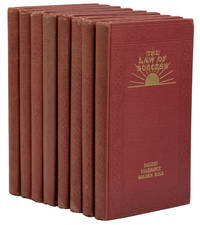
1949140941401Meriden CT: The Ralston University Press 1949. Reprint. Very Good. Early reprint. Sixteen lessons complete in eight volumes bound in publisher's red cloth decorated in blind and stamped in gilt. Very Good. Spines sunned and lightly frayed at ends cup ring to cover of Volume III. Pages toned. A nice set. The Ralston University Press unknown books
1954441H4453Chicago: Napoleon Hill Associates 1954. Book. Good. Hardcover. Reprint. 8vo - over 7¾" - 9¾" tall. 7 8-309 pages. Index. Black and white photographic portraits of Napoleon Hill and Andrew Carnegie. Third printing of the 1953 first edition. "The only work by Napoleon Hill 1883-1970 which gives the verbatim success talks he had with his sponsor Andrew Carnegie 1835-1919 who it has been said helped more men to raise their own salaries than did any other great industrialist. The success formula presented in the chapters which follow will prove to you that 'Whatever the mind can conceive and BELIEVE the mind can ACHIEVE.'" - title page. Moderate wear to publisher's maroon cloth. Binding tight. Please note: ink scribbling on front free and fixed endpapers page 123 and back free endpaper Handsome replica dust jacket now preserved in glossy new archival Brodart. A sound copy of this Napoleon Hill classic. Napoleon Hill Associates Hardcover
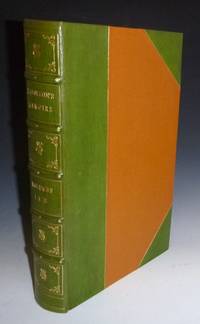
1945027577London: The Golden Cockerel Press 1945. Limited Edtion. Thick Quarto. Two volumes in one limited to 500 copies. Volume I is #366; portrait frontispiece 422pp. with a detailed map placed before Volume II which is #466 78pp and is devoted entirely to the Battle of Waterloo the beautiful paper type design and issues inherent in the work of the Golden Cockerel Press are present as well as a gathering of the memoirs of his staff which had been out of print for a century. Here Somerset de Chair has assembled them in proper order and edited them to race his career his military triumphs and his return from Elba and Waterloo. Beautifully bound in 3/4 green morocco over orange cloth marbled endpapers raised bands with compartments lettered and decorated with "bees" used as Napoleon's emblem to represent his status as Emperor top edge gilt all others uncut. The Golden Cockerel Press unknown books
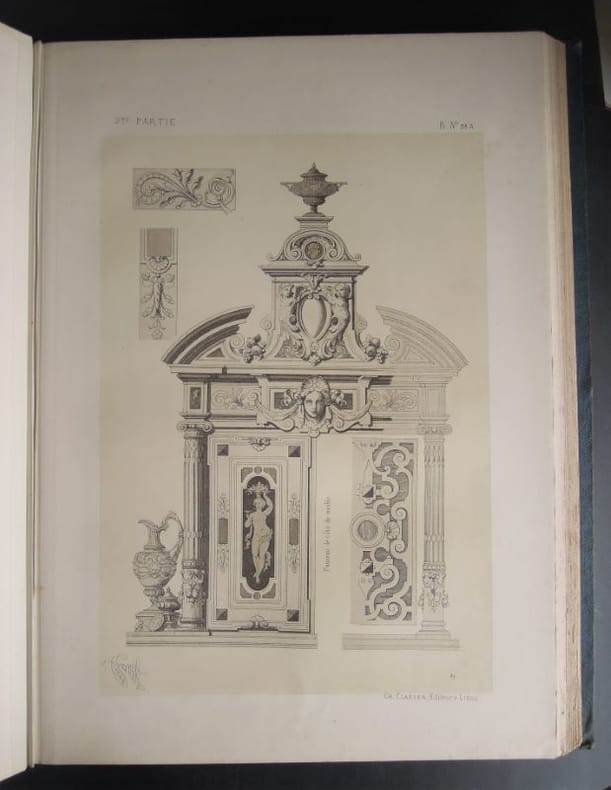
18661721866 Liège et Leipzig, Ch. Claesen éditeur à Liège, 1866, 1 vol. in-plano (32,2 x 42,4 cm) : 1 db-garde, 1 f. de faux-titre rouge, 1 f. de titre orné, 2 f. d'avant-propos, 125 planches en trois parties, 2 f. de table. Ouvrage approuvé par le Conseil de perfectionnement de l'enseignement des arts du dessin en Belgique et inscrit sur la liste officielle des modèles susceptibles d'être recommandés aux Académies et Écoles de dessin. Lithographies monochromes pleine page, chacune montée sur onglet. Vaste répertoire décoratif et ornemental de l'architecture du XIXème siècle. Michel Liénard (1810-1870) : sculpteur ornemaniste, élève de Jean-Baptiste Plantar, actif entre 1830 et 1860 environ. Acteur majeur des styles néo-gothique, néo-renaissance et Second Empire. Le présent recueil d'ornements est son ouvrage principal.
ORD-18913et de peinture, et les Illuminations les plus remarquables auxquelles ce mariage a donné lieu. Avec une Description par M. Goulet, Architecte, Membre de plusieurs Société des Arts, et Adjoint-Maire du 6e arrondissement de Paris.- Paris. Soyer. 1810. In-8 (135 x 220 mm) cartonnage bradel vert, pièce de titre maroquin rouge, 48 pages de texte et 54 planches hors texte, dont une dépliante, la planche 11 placée en frontispice. 2 traces marginales de doigt, rares et faibles rousseurs. Bel exemplaire dans une sobre mais élégante reliure postérieure.
42675, Paris, Firmin Didot 1807 / 1804, 8 vol. in-12, plein veau caramel, tit. & tom. dorés sur pc. blondes, dos lisses ornés de dentelles, fers et filets encadrants dorés, tr. jaunes mouchetées, (mors fendus au t. I, V, VI, coiffes accidentées aux t. I, III, V, VI, VIII, un mq. en tête du t. V, coins émoussés avec quelques épidermures, qq. rousseurs).
plein veau caramel, tit. & tom. dorés sur pc. blondes, dos lisses ornés de dentelles, fers et filets encadrants dorés, tr. jaunes mouchetées, (mors fendus au t. I, V, VI, coiffes accidentées aux t. I, III, V, VI, VIII, un mq. en tête du t. V, coins émoussés avec quelques épidermures, qq. rousseurs) C’est Dupin (réf. 1860) qui nous informe de la paternité de ces travaux préparatoires du Code civil qu’il attribue à Favard de Langlade, alors tribun, puis président à la Cour de cassation et conseiller d’État. Recueil antérieur d’une année aux Conférences du Code civil du même auteur. La mention de l’éditeur nous renseigne considérablement sur l’utilité et la qualité de ce texte : « Cette collection dirigée par un Jurisconsulte qui a concouru à la confection du Code civil, est aussi complète qu’il soit possible de la désirer. Elle a déjà obtenu le plus grand succès et le suffrage des premiers Magistrats. (...) Cet ouvrage, où l’on trouve toute la pensée du législateur, est le seul commentaire que l’on puisse consulter avec confiance. » Notre exemplaire offre la particularité que son premier volume est issue de la seconde édition titrée « Code Napoléon » ; elle indique en particulier toutes les modifications apportées entre les deux éditions, notamment le remplacement des mots « le Gouvernement » par « l’Empereur », « la Nation » par « l’État », « l’État » par « l’Empereur » ou encore cette magnifique formule « Le Gouvernement pourra néanmoins » par « Néanmoins il est loisible à l’Empereur d’accorder… » !
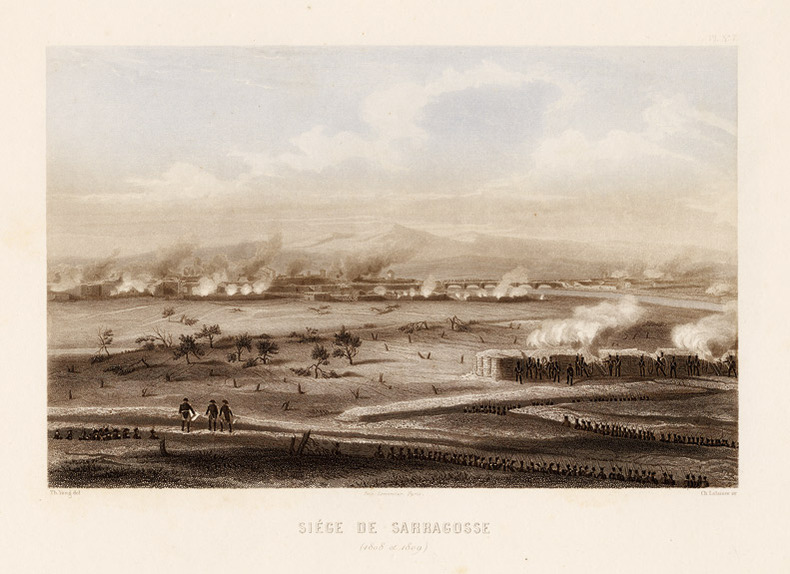
14536S.l. (Paris), s.n. (Plon et Lemercier), s.d. ; in-folio oblong (29 x 43 cm) ; cartonnage de percaline noire, grand décor à froid à la plaque sur les deux plats, grand titre doré sur le premier plat ; recueil de 20 planches gravées sur acier par Rouargue, Laloisse et Duron, d'après Th. Yung. Exemplaire finement aquarellé. Les batailles représentées sont celles de : Siège de Toulon (1793), Ste Euphémie (1806), Prise de Gaëte (1806), Combat de Somo-Sierra (1808), La Corogne (1809), Prise d'Oporto (1809), Siège de Saragosse (1809), Talavera (1809), Ocaña (1809), Passage de la Sierra-Morena (1810), Fuentes d'Oroño (1811), Affaire de Brienne (1814), Combat de Champaubert (1814), Montmirail (1814), Montereau (1814), Craonne (1814), Arcis-sur-Aube (1814), Paris (1814), Ligny (1815)- et Waterloo (1815).