1 561 résultats
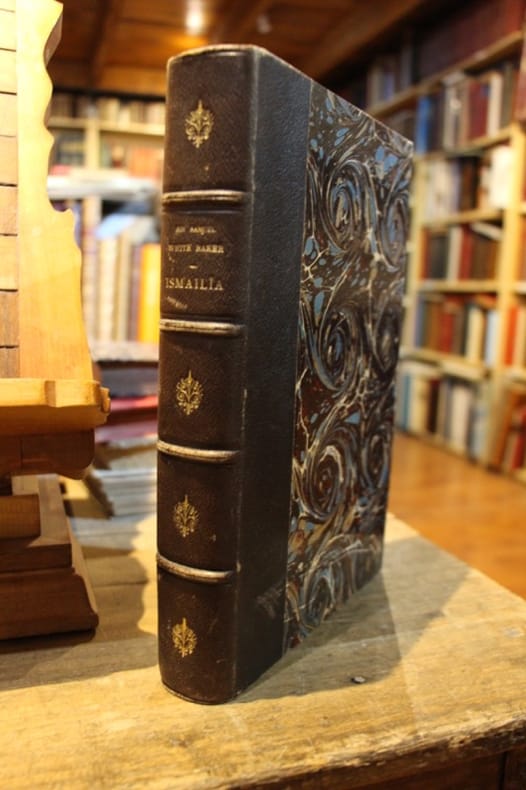
2519in 8 demi-chagrin vert à nerfs titre et caissons dorés plats percaline verte quadruple filet à froid en encadrement. Faux-titre,titre,III,carte en couleurs du bassin du Nil.Nombreuses gravures sur bois hors-texte Hachette & Cie 1875 Sans la carte dépliante en fin de volume.rousseurs éparses habituelles
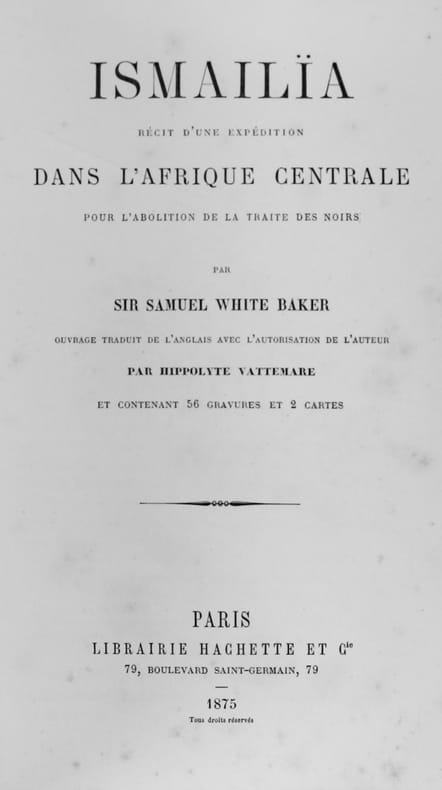
87845aafParis, Hachette, 1875, in-8vo, 1 frontispice + 439 p. , contenant 56 gravures et 2 cartes, rousseurs par-ci par-là, cachet rouge ‘Nico Blanc’ sur garde, belle reliure en demi-chagrin rouge, dos à nerfs orné de caissons dorés, titre et auteur or, 3 tranches dorées. Bel exemplaire.
91077aafParis, Hachette, 1875, in-8vo, 1 frontispice + 2 ff. (faux-titre et titre) + III (+ 1 bl.) + 439 p. , contenant 56 gravures et 2 cartes, tache d’eau marginale au début et rousseurs, reliure demi-cuir d’époque, pièce de titre rouge au dos. Bel exemplar.
187526975Librairie Hachette et Cie 1875 Traduit de l’anglais par Hippolyte Vattemare. Contenant 56 gravures et 2 cartes. In-4, demi-chagrin brun, Dos ornés de 4 faux-nerfs avec fers à froids encadrés de fleurons dorés. Tête marbrée. Avec carte rempliée en fin d’ouvrage. Brunissures éparses. Bon état.
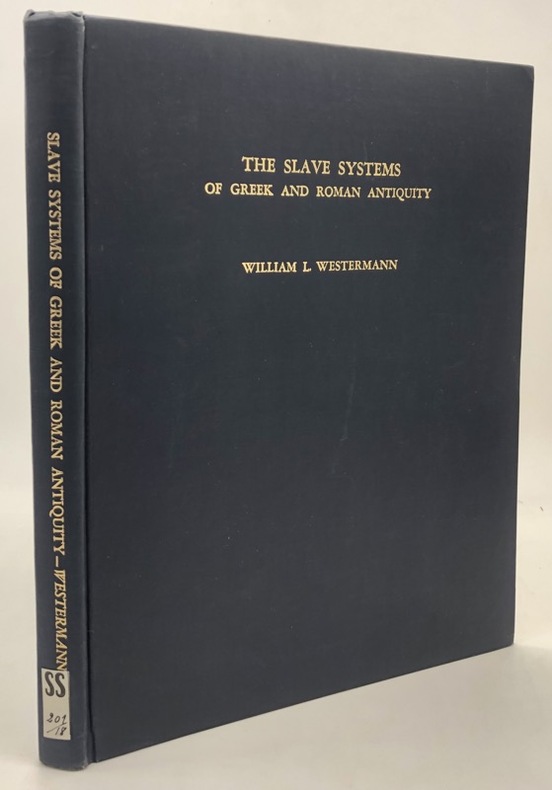
231551Philadelphie, The American philosophical society, 1957 in-4, xii pp., 180 pp., texte sur deux colonnes, toile Bradel marine, titre poussé en lettres dorées au centre du plat supérieur (reliure de l'éditeur).
2005192317Puf Puf, 2005. Fort In-8 carré broché de 627 pages. Traces de scotch ancien au verso de la couverture. Bon état
Second Edition, with additions, 12mo, [5], 6-100pp., folding engraved map of the town of Leicester, 5 nineteenth-century mounted actual photographs tipped-in, and 6 engraved plates tipped, modern cloth, uncut, spine faded. Susanna Watts was born in Leicester and was dedicated to bringing about the immediate abolition of slavery. She started one of the first fair trade campaigns, wrote hymns and pamphlets and even locked horns with William Wilberforce. When her father died, her wealthy family's finances became tight and she had to find a way to support herself and her mother. At the age of 15 or 16 she began writing to earn money, and as well as penning the first guide to Leicester, she wrote poetry to promote the emancipation of slaves. To be a young woman and a published author in the late 18th Century would not have been an easy task, so the fact that she prevailed shows how passionate Susanna was in her desire to make her antislavery views known. "They dared to stand up in front of all these men and say what they thought was right ? two women from the provincial town of Leicester." According to Shirley Aucott, a local historian and author, Susanna worked on a periodical called 'The Hummingbird', which brought together different ideas on the antislavery moment, and she organised what must have been one of the first fair trade campaigns! She visited local households and shops to persuade them not to use sugar produced in the Caribbean, claiming that, "abstinence from sugar would sign the death warrant of West Indian slavery."
1984Ge1324New York/London, W.W. Norton, 1984. Kartoniert. Ebd. u. Schnitt mit minimalen Gerbrauchs- u. Lagerspuren.- Sonst sehr gut erhaltenes Expl. 8° Buch Softcover
8vo [22 x 14 cm]; [iv], 106 pp, complete with map and 6 engraved aquatint plates, includes the advertisement leaf sometimes removed. later brown cloth with printed title label on spine, leaning a bit, map has very light stain in corner, slightly foxed on few margins, interior is clean, unmarked and near fine. A picture of this book is available upon request by email. A narrative of the author's travels in Barbados, Surinam, Santa Cruz, and other islands in West Indies with comments on life their, condition of slaves, etc. Ragatz, Guide For The Study Of British Caribbean History 1763-1834, p. 235: 'The author was a surgeon assigned to the naval hospital in Barbados in 1807 and later to a war vessel cruising through the islands. He spent about four years in Caribbean service and became thoroughly familiar with colonial society. His book presents an interesting picture of the rushing business conducted by the slave traders in Barbados on the eve of abolition and gives accounts of encounters with the Spanish and French during the course of the Napoleonic wars. The author . . . was greatly shocked by the general prevalence of immorality'. Cundall 2150. Sabin 101114. The map is of the Caribbee or Leeward Islands, with South America shown at bottom. The detailed and attractive plates include: Carlisle Bay and Bridge Town Baradoes, showing harbour, boats, buildings; Slaves in Barbadoes; A Spanish Planter of Porto Rico; City of Paramarino, Surinam, showing fort, boats, etc; Indian Implements, showing 14 items including spears, musical instruments, etc; A Chief of the Bosjesmans or Bush Negroes on a Visti to the Governor of Paramaribo.
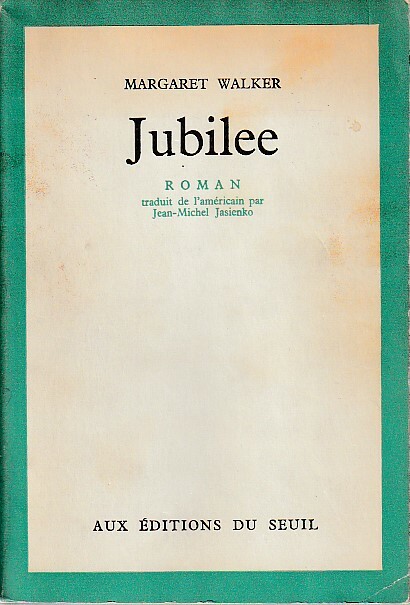
Seuil, 1968, 480 pp., broché, couverture un peu défraîchie, dos en gouttière , état correct.
2020800842020 Paris, La Découverte, 2020, in 8° broché, 286 pages ; couvetrure illustrée.
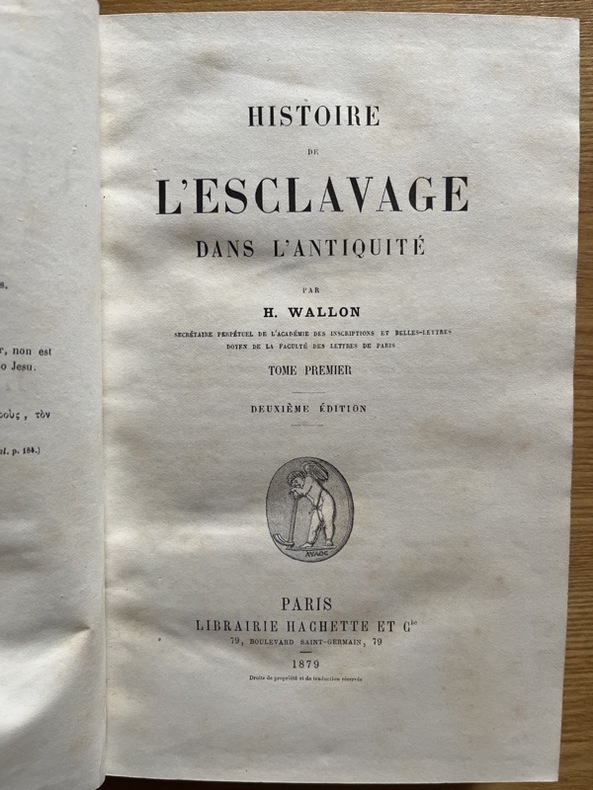
108201Paris, Librairie Hachette et Cie, 1879, 3 volumes in-8 de 220x135 mm environ, tome I : De l'Esclage en Orient et en Grèce : clxvii-487 pages, tome II : De l'Esclavage à Rome depuis les origines jusqu'à l'Epoque des Antonins : 517 pages, 1f. (table), - tome III : De l'Esclavage et du Travail libre sous l'Empire : 559 pages, 2ff. (table, errata), demi reliure à coins cerise, dos à faux-nerfs portant titres et tomaisons dorés, date en queue, gardes vert amande, tranches finement mouchetées. Des rousseurs, mors en partie fendus (tome 1) mais structure solide, petites auréoles et traces brunes sur les plats, des coins dénudés, cuir frotté sur les coiffes, rares passages soulignés. Deuxième Edition.
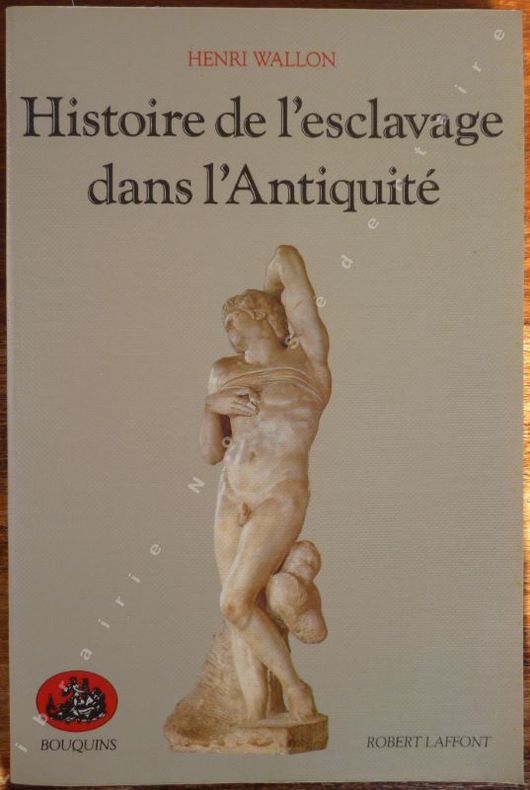
12801Robert Laffont Collection Bouquins, 1988 - Fort violume broché au format In-8, 1101 pages, ensemble un peu fané et en très bon état.
237736Paris, Hachette et Cie, 1879 3 vol. in-8, CLXVII-487 pp., 517 pp. et 559 pp., demi-chagrin vert, dos à nerfs orné de fleurons dorés (reliure de l'époque). Quelques rousseurs.
57291Seuil, 1968, 480 pp., broché, couverture un peu défraîchie, dos en gouttière , état correct.
1973RO20014226Pensée Moderne. 1973. In-12. Broché. Etat d'usage, Tâchée, Dos satisfaisant, Intérieur frais. 250p, jaquette illustré d'un dessin de Milibar est abimée.. Avec Jaquette. . . Classification Dewey : 326-Esclavage
Light damage to rear inner cover. Minor shelfwear. Minor creasing to first few pages. Typed script. ; 181 pages
1377467Paris: L'Harmattan, 2024 in-8, 157 pages, illustrations. Bibliographie. Broché, TBE.
365, Leiden, P. Somerwil, 1893., Gebonden, linnen metr verzilverde titel op de voorplat en de rug, gemarmerde schutbladen, losse binding, 15x22,5cm, 87pp.
1981RO80073142A.M METAILIE. 1981. In-12. Broché. Bon état, Couv. convenable, Dos satisfaisant, Intérieur frais. 177 pages.. . . . Classification Dewey : 326-Esclavage
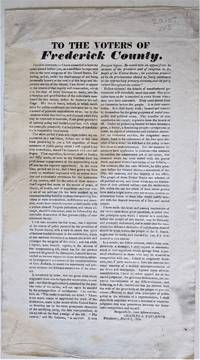
1833713Winchester Va. 1833. Broadside 4to. 290 x 160 mm. 11 ¼ x 6 ¼ inches.  Printed in two columns signed in type by Charles J. Faulkner at Winchester dated March 8 1833 at conclusion. Lightly dust-soiled pale stain affecting perhaps one-third of the left-hand margin and column of text. Neatly silked on verso. Withal about very good. Following the August 1831 Nat Turner rebellion in Southampton County a last effort was made by moderate Virginians to gradually abolish slavery. Faulkner a 26-year-old lawyer and assemblyman along with Thomas Jefferson Randolph sponsored legislation to free all children born of slave parents after July 4 1840. His speech emphasized the evil of slavery for Southern white labor noting that slavery "converts the energy of the community into indolence--its power into imbecility--its efficiency into weakness.Shall society suffer that the slave-holder may continue to gather his crop of human flesh" As the Assembly was malapportioned in favor of the Tidewater slaveocracy the proposal lost rather narrowly and nearly thirty years later the Confederacy was assured of Virginia's succession. It is perhaps not surprising that Faulkner "comparatively a stranger" to the county but a member of the Virginia House of Delegates at this time 1831-34 was not successful in his campaign to represent Virginia in the U.S. Senate. However Faulkner was elected to three terms in Congress from Virginia in the 1850s. He was elected to Congress from West Virginia after the Civil War. In the interim he served as Minister to France during the Buchanan administration and on the staff of Stonewall Jackson. Dictionary of American Biography.  Not in Hummel. Not found in American Imprints for 1833 and not in the 1830-1839 title index. OCLC records four copies at The Library of Virginia University of Virginia Virginia Historical Society and American Antiquarian Society. unknown books
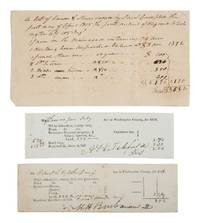
1815201561815. Manuscript fiscal records from antebellum Virginia demonstrate how enslaved people were formally incorporated into legal and economic systems as taxable property. These documents record enslaved individuals not as citizens but as items of assessed value within the personal property systems that structured the slave economy. Such records provide direct evidence of the bureaucratic mechanisms through which slavery functioned in the United States revealing how local governments and property holders catalogued enslaved African Americans alongside land livestock and other assets. The present group of Virginia documents dating from 1815 to 1854 records the ownership and taxation of enslaved people in Washington County during the decades preceding the Civil War.<br /> <br /> Archive of three manuscript fiscal documents from Washington County Virginia dated between 1815 and 1854. The earliest document dated 1 April 1815 records "A list of land & slaves owned by Jacob Campbell the first day of April 1815. The first district of Virginia Washington City." A second associated receipt enumerates eight enslaved persons identified by gender and age categories with assigned monetary values totaling 2170 dollars. A later tax receipt dated 1848 documents revenue obligations for Robert L. Berry and John Berry and includes "Slaves" among taxable property categories alongside horses clocks and land. The third document a tax receipt issued to Miss Francis Jane Irby in 1854 records taxable categories including "Black" titheables in addition to land salary and road levies reflecting the legal classification of enslaved African Americans within Virginia's tax system. Together the documents demonstrate the routine administrative recording of enslaved people as financial assets within county taxation and property accounting.<br /> <br /> Virginia occupied a central role in the history of American slavery. The first documented Africans arrived in the English colony of Virginia in 1619 and by the mid nineteenth century enslaved African Americans constituted a substantial portion of the state's population. By the 1860 census more than one third of Virginia's inhabitants were enslaved people whose labor sustained the agricultural economy of the region. Manuscript tax records such as these provide stark evidence of the legal and economic framework that reduced human beings to taxable property within local government systems. Three manuscript documents measuring approximately 6.75 x 2 inches to standard letter size. Original folds present with minor foxing and a small chip to the lower left corner of one document; docketing on versos; text clear and legible. Overall condition very good. unknown
185931775Duvernay Frères Couverture souple Montréal 1859
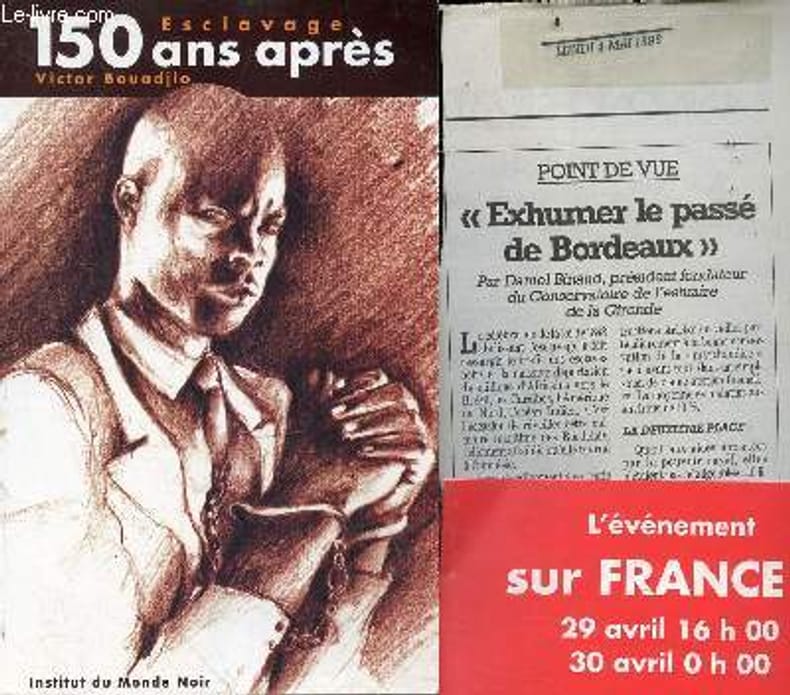
1998RO20253695"INSTITUT DU MONDE NOIR. 1998. In-12. Broché. Bon état, Couv. convenable, Dos satisfaisant, Intérieur frais. 115 pages + bandeau d'editeur + coupure de presse ""exhumer le passe de bordeaux, par daniel binaud, lundi 4 mai 1998"" : "" la celebration de la loi de 1848 abolissant l'esclavage a fait ressurgir le trafic des esclaves noirs et la massive deportation de millions d'africains [...] reveiller cette memoire maritime des bordelais, tellement affaiblie qu'elle tourne a l'amnesie..."". . . . Classification Dewey : 326-Esclavage"
500357973Nelson Editeurs Sans date. Ce recueil regroupe trois œuvres de Victor Hugo : 'Bug-Jargal' qui se déroule lors de la révolution haïtienne et raconte l'amitié entre un colon et un esclave 'Le Dernier Jour d'un condamné' un plaidoyer contre la peine de mort et 'Claude Gueux' une critique sociale inspirée d'un fait divers