(SLAVERY - ABOLITION). CLARKSON, THOMASBiblio.com
239 résultats
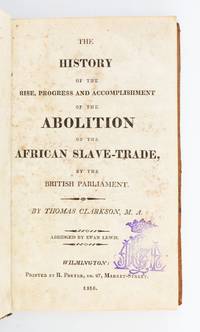
1816ST19567-131<p>Wilmington: Printed by R. Porter 1816. Abridged Edition. 180 x 115 mm. 7 x 4 1/2". 348 pp.Abridged by Evan Lewis. <br />Contemporary tree calf smooth spine with double gilt rules tan leather label with gilt lettering. With one small illustration of a seal in text. Title with crowned monogram stamp in purple ink. Sabin 13486. Calf with significant wear front hinge exposed but the binding very tight; text as expected with varying sometimes noticeable degrees of foxing and browning because of quality of paper.<br /><br />First published in two volumes in 1808 this important work on the history of the slave trade is an "invaluable" resource and "contains much essential autobiographical and other information." DNB The present edition was condensed into one volume in order to "be more generally diffused among the people of the United States" where slavery would not be abolished for another half a century. Thomas Clarkson 1760-1846 was a leading English abolitionist who advocated for an end to slavery world-wide and was an original founder of the Committee for the Abolition of the Slave Trade as well as the pacifist Society for the Promotion of Permanent and Universal Peace.</p> Printed by R. Porter
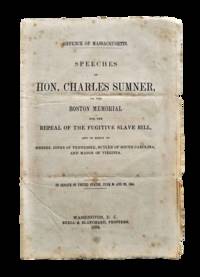
1854176351854. Abolition African Americana SUMNER Charles. Defence of Massachusetts. Speeches of Hon. Charles Sumner on the Boston Memorial for the Repeal of the Fugitive Slave Bill and in Reply To Messrs. Jones of Tennessee Butler of South Carolina And Mason of Virginia in the Senate of the United States June 26 and 28 1854. Washington D.C.: Buell & Blanchard Printers 1854. At the time that this description is being written just three copies are recorded in American institutions. OCLC search results are at best an estimate and can vary over time. The Memorial referred to in the title was a request by 2900 undersigners chiefly men of Boston Mass. to repeal the Fugitive Slave Bill of 1850. What follows is a transcription of Massachusetts Senator and famous abolitionist Charles Sumner's speeches in the ensuing debate: "Mr Jones. asks 'Can anyone suppose that if the Fugitive Slave Act be repealed this Union can exist' To which I reply at once that if the Union in any way be dependent on an Act-- I cannot call it a law-- so revolting in every regard as to that which he refers then it ought not to exist." Sumner goes on to argue amongst other things that the Fugitive Slave Act is parallel to the hated Stamp Act that sparked the Revolutionary War as well as to make spirited rebukes against the pro-slavery Senators Butler Mason and Jones: "The veteran Senator from Virginia Mr. Mason complained that I had characterized one of his "constituents" a person who went all the way from Virginia to Boston in pursuit of a slave as a Slave-Hunter. Sire I choose to call things by their right names. White I call white and black I call black. And where a person degrades himself to the work of chasing a fellow man who under the guidance of the north star has saught a freeman's home far away from the cofle and the chain that person whomsoever he may be I call a Slave-Hunter." Eight sheets folded to make one sixteen-page signature which is stitched along the left edge. Foxing throguhout pages chipped along margins. Dampstaining along two page edges. Delicate but in good condition. <br /> <br /> Charles Sumner January 6 1811 - March 11 1874 was an American statesman and United States Senator from Massachusetts. As an academic lawyer and a powerful orator Sumner was the leader of the anti-slavery forces in the state and a leader of the Radical Republicans in the U.S. Senate during the American Civil War. During Reconstruction he fought to minimize the power of the ex-Confederates and guarantee equal rights to the freedmen. During the war he was a leader of the Radical Republican faction that criticized President Lincoln for being too moderate on the South. Sumner specialized in foreign affairs and worked closely with Lincoln to ensure the British and the French refrained from intervening on the side of the Confederacy during the Civil War. As the chief Radical leader in the Senate during Reconstruction Sumner fought hard to provide equal civil and voting rights for the freedmen on the grounds that "consent of the governed" was a basic principle of American republicanism and to block ex-Confederates from power so they would not reverse the gains made from the Union's victory in the Civil War. unknown
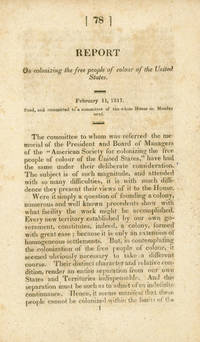
18179350Washington City 1817. First Edition. 5 pp. 1 vols. 8vo. Disbound. Some foxing. First Edition. 5 pp. 1 vols. 8vo. First edition of the government's reply to the request of a group of Virginia planters for a "colony" to essentially rid them of the problem of "free coloured people." In December of 1816 a group of Virginia planters approached the government with a request asking for a location where freed blacks might be sent. In January this "memorial" was presented and in February it was answered with this "Report." This reply discusses location etc. In the end the government officially refused to have anything to do with the plan - thus the American Colonization Society was born. For a detailed account of these events see Dumond Anti-Slavery pp. 126-127. S&S 42738 2 copies unknown
184657411Boston: Anti-Slavery Office 1846. Sixth Edition. Two volumes bound in one; small octavo 20cm.; publisher's embossed cloth titled in gilt on spine1231115pp. Slight rubbing and wear to cloth heavier at board corners and with small loss at crown of spine; text tight and unmarked but moderately foxed; sound and Good. Contemporary ownership signature "Lucia A Haynes" to front free endpaper. <br /> <br /> A popular and much-reprinted anti-slavery novel though its sensational portrayal of an incestuous triangle between the protagonist Archy his sister Cassy and their father Colonel Moore generally inspired disgust more than abolitionist sympathy among contemporary reviewers. However the novel did provide "first-hand observation of Southern plantation life and slavery conditions" Friedland p. 129 based on the two years the author spent in Florida for the benefit of his health. For additional information see Louis S. Friedland "Richard Hildreth's Minor Works" in "The Papers of the Bibliographical Society of America" Vol. 40 no. 2 2nd Quarter 1946. LCP AFRO-AMERICANA 4798-4800 for other editions; SABIN 31790; WRIGHT I 1189. Anti-Slavery Office unknown
18361005398vo pamphlet marbeled wrappers with printed label on front cover 32 pp.some minor spine snd edge wear slight aging; very good or better.The work begins with the original source of funds for its "Charitable Fund" which began with estate of Robert Boyle in 1691. Since the 500000 Negro Slaves in the West Indies were mostly "infidels and heathens" converting them to Christianity would be doing them a favor and help the empire.Converting the slaves to Christianity would make them more virtuous more comfortable offer them a prospect of eternall happines and even make them better servants. Richard Clay,
183094792Circa 1830s. 1830s. Good . - The close of a letter on a 3-1/4 inch high by approximately 6 inch wide piece of note paper is signed "Geo Thompson". The paper is darkened with some staining not affecting the signature. The paper is mounted on a sheet of yellow paper and has been folded twice for mailing. Good. <p>The British antislavery orator and activist George Donisthorpe Thompson 1804-1878 worked toward the abolition of slavery through lecture tours and by introducing legislation while serving as a member of Parliament. An able orator he was hired by the London Anti-Slavery Society in 1831. While in Scotland in 1832 where he became interested in abolishing slavery in the United States as well as other parts of the world he met William Lloyd Garrison and the African-American abolitionist Nathaniel Paul. Invited to visit New England by Garrison he traveled to the US in 1834 where he drew the attention of pro-slavery supporters and was forced to flee for his life. The Hobart Town Courier later printed a letter in which Thompson stated that he had ".left the United Sates to escape the assassins knife." the editor noting that attempts had been made to "burn and murder" him in several US towns. He returned to the US following the passing of the Fugitive Slave Law in 1850. By then the abolitionist movement having substantially grown and gained in influence Thompson found a warmer welcome. Returning to London he and his son founded the London Emancipation Society which supported the Union during the Civil War. Returning to America he allied himself with William Wells Brown and met President Abraham Lincoln. Throughout his life Thompson was a powerful voice for emancipation. He supported East Indian reform free trade Chartism non-resistance and the peace movement often protesting legislation that offered only limited restrictions on slavery.<p>RARE. Circa [1830s]. unknown
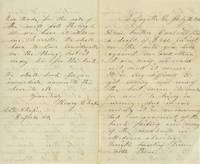
1861Cat338Lafayette Ohio 1861. Autograph letter signed 2 pp. Addressed to D. T. Chapin of Enfield Connecticut. Good condition with normal folds and light wear. A concise but revealing early Civil War letter combining financial anxiety agricultural reporting and clear-eyed political commentary on slavery and the future course of the conflict. Writing amid the first months of the American Civil War Chapin opens with the immediate purpose of the letter—forwarding “a draft of $240 for int. on the noteâ€â€”before situating the payment within a deteriorating economic landscape: “It is very difficult to get money now even of the best men.†He describes a local economy under strain noting “no market for wool to bring in money†compounded by regional instability “on account of the bank failing and many of the merchants in Medina closing†concluding bluntly: “Terrible bursting times with them.†Even the act of sending funds carries uncertainty as he cautions that “in these times I consider there is a risk in the best of banks.†Alongside these concerns Chapin provides a snapshot of agricultural conditions: “Corn is very backward and short wheat nearly middling grass rather below middling†summing up the situation as “rather tight times as well as troubled times.â€<br /> <br /> The most significant portion of the letter however turns to the war itself and the unresolved question of slavery. He writes:<br /> <br /> “We hope the end will be well but our nation will have to be humbled. It is well to put down rebellion but it is rather queer that the cause of the trouble must be let entirely alone. The nation will get their eyes open after a while. The President possesses the war power to abolish slavery and Congress possess the power also in my humble opinion and the time will come when they will have to do it unless the south run their heads so hard against the rock as to do it themselves.â€<br /> <br /> The letter closes with a brief note on a failed business transaction—“our trade for the sale of the mill fell throughâ€â€”underscoring the economic uncertainty of the moment before returning to family matters. Overall an evocative early Civil War letter by a merchant expressing fears and anxiety for the pending conflict. unknown
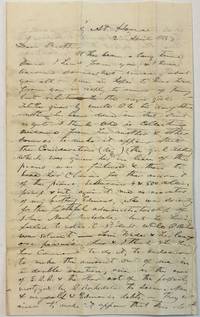
184740201Stewartsboro TN 1847. Folio 15" x 12-3/4" sheet folded to 7-1/2" x 12-3/4". 4 pp. Completely in ink manuscript integral address leave bearing Stewartsboro Tennessee April 3 1847 manuscript postal marking. mailing address on last page. The initials of the writer's name are difficult to decipher; this is our best guess. Old folds two short fold splits and a few tiny holes at fold corners. Wax seal remnant with tear at edge loss of a few letters some toning. Good to Very Good. <br /> <br /> The writer is concerned that Thomas had not responded to his letter "relating to the negro girl Tabitha given by Uncle R. to his daughter- nothing has been done in that suit as yet. I think she is collecting evidence from her mother & other sources to make it appear that the consideration viz the girl Tabitha which was given her in lieu of the piano was a failure & then to base her claim for the amount of the piano between 4 and 500 dollars princp. & int. against me as executor of my brother Edmond who was security for the faithful administrationship of John Nash Barksdale but he having failed to collect sd. debt while R. Barksdale was solvent. Levi Wade & her lawyer are persuading her. . . " He gives Thomas permission to "calculate on receiving a portion of the money for which Paulina sold. . . Negroes have advanced within 3 or 4 months but I fear one diseased as your boy Phil will command but a small price."<br /> Dr. Thomas Hill Read 1798-1874 of Tennessee settled in Macon County Illinois in 1831. He was the brother-in-law of Capt. David L. Allen one of the most prominent early citizens having married his sister. Dr. Read became known for his success in the treatment of children's ailments and was considered an expert in cholera infantum. He had a reputation for honesty and was said to have acted as administrator of more estates than anyone else in Macon County. Dr. Read was a member of the Decatur Board of Trustees in 1839 1841 1846 and 1847; County Treasurer from 1845-1846 and County Probate Judge from 1846-1849.<br /> John Nash Barksdale 1818-1844 Thomas Read's maternal cousin was born in Tennessee graduated from the University of North Carolina and became a lawyer. He practiced law in Tennessee for a few years and then moved to Columbus Mississippi and entered the law firm of his cousin Gen. William Barksdale. The Columbus bar announced that its members would wear the badge of mourning for thirty days following his death. "Death of John N. Barksdale" Republican Banner Nashville TN Dec. 6 1844 Page 2.<br /> Uncle R was likely Randolph Barksdale 1795-1844 Thomas H. Read's maternal uncle and John Nash Barksdale's father. Randolph settled in Tennessee with his father in 1808 and later established his own plantation. He was married three times and became the owner of a large estate and several slaves in Rutherford County Tennessee thanks to the wealth of his first wife. He also owned an estate near Chulahoma in Marshall County Mississippi. unknown