1 560 résultats
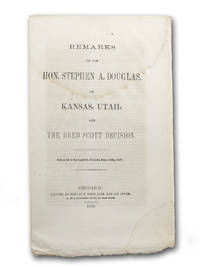
185718536Chicago: Printed at the Daily Times Book and Job Office 1857. First Chicago edition. Light damp-stain to the upper third of the sheet small stain to the lower outer corner; a very good copy. Original self-wrappers 10.25 x 6 inches 15 pages untrimmed. Unopened. Per Byrd "This speech was the first public expression of his views on the Dred Scott decision. In it he accepted the decision and insisted that 'the whole principle of Popular Sovereignty and self-government is sustained and firmly established by the authority of this decision.' " Byrd also notes this pamphlet was intended to lay the groundwork for his 1858 re-election. An edition printed in Springfield and an 8-page edition without an imprint also appeared the same year as well as an edition in German. Flake Mormon Bibliography 2985; Ante-Fire Imprints 250; Byrd 2635. Printed at the Daily Times Book and Job Office, unknown books
186223579<p><i>"It is a fact that the enslavement of human beings has so far infused its insidious poison into the very hearts of the Southern people that they have come to believe and declare the evil of slavery to be a good and to require the power of Government to be exerted to maintain extend and perpetuate an institution that enables thousands to sell their own children to be enslaved with all their posterity into hopeless bondage." </i></p><p>The founder of New York City's Cooper Union for the Advancement of Science and Art echoes the language and logic of the Emancipation Proclamation as well as citing some Southern pro-slavery arguments to demonstrate their ridiculousness in this open letter to President Lincoln. Cooper and the Cooper Union had long been advocates of abolition and both Lincoln and Frederick Douglass had famously lectured at the institution.</p> <b>PETER COOPER. SLAVERY.</b>Pamphlet. <i>Letter of Peter Cooper on Slave Emancipation</i> Loyal Publication Society New York 1862 8pp. disbound.<p><b><br /></b></p><p><b>Excerpts:</b></p><p><i>"It is a fact that the enslavement of human beings has so far infused its insidious poison into the very hearts of the Southern people that they have come to believe and declare the evil of slavery to be a good and to require the power of Government to be exerted to maintain extend and perpetuate an institution that enables thousands to sell their own children to be enslaved with all their posterity into hopeless bondage." </i></p><p><i>"In the original formation of that Constitution it became absolutely necessary to make a compromise with that great and all pervading interest which had then already entered into the very life-blood of the nation rendering the formation of an union of States hopeless without such a compromise."</i></p><p><i>"The constitutional requirement to return fugitive slaves on their being demanded by Southern men having been acknowledged and performed by the States has been reaffirmed by an almost unanimous vote in Congress.These honest efforts on the part of the North to maintain peace and friendship were met by a relentless war waged for the destruction of the Constitution and the dissolution of the Union.<i>"</i></i></p><p><i>"The time has now come when Southern men must know that the Union must be preserved and it is for them to determine whether they will persevere in their rebellion until the North shall be compelled in the most reluctant self defence to render contraband of war the slaves and property of all persons found in arms against the laws and Government of the country."</i></p><p><b>Condition</b></p><p>Fine. Disbound and lacking front wrap.</p>
186223579<p><i>"It is a fact that the enslavement of human beings has so far infused its insidious poison into the very hearts of the Southern people that they have come to believe and declare the evil of slavery to be a good and to require the power of Government to be exerted to maintain extend and perpetuate an institution that enables thousands to sell their own children to be enslaved with all their posterity into hopeless bondage." </i></p><p>The founder of New York City's Cooper Union for the Advancement of Science and Art echoes the language and logic of the Emancipation Proclamation as well as citing some Southern pro-slavery arguments to demonstrate their ridiculousness in this open letter to President Lincoln. Cooper and the Cooper Union had long been advocates of abolition and both Lincoln and Frederick Douglass had famously lectured at the institution.</p> <b>PETER COOPER. SLAVERY.</b>Pamphlet. <i>Letter of Peter Cooper on Slave Emancipation</i> Loyal Publication Society New York 1862 8pp. disbound.<p><b><br /></b></p><p><b>Excerpts:</b></p><p><i>"It is a fact that the enslavement of human beings has so far infused its insidious poison into the very hearts of the Southern people that they have come to believe and declare the evil of slavery to be a good and to require the power of Government to be exerted to maintain extend and perpetuate an institution that enables thousands to sell their own children to be enslaved with all their posterity into hopeless bondage." </i></p><p><i>"In the original formation of that Constitution it became absolutely necessary to make a compromise with that great and all pervading interest which had then already entered into the very life-blood of the nation rendering the formation of an union of States hopeless without such a compromise."</i></p><p><i>"The constitutional requirement to return fugitive slaves on their being demanded by Southern men having been acknowledged and performed by the States has been reaffirmed by an almost unanimous vote in Congress.These honest efforts on the part of the North to maintain peace and friendship were met by a relentless war waged for the destruction of the Constitution and the dissolution of the Union.<i>"</i></i></p><p><i>"The time has now come when Southern men must know that the Union must be preserved and it is for them to determine whether they will persevere in their rebellion until the North shall be compelled in the most reluctant self defence to render contraband of war the slaves and property of all persons found in arms against the laws and Government of the country."</i></p><p><b>Condition</b></p><p>Fine. Disbound and lacking front wrap.</p> books
1827213910London: John Hatchard and Son 1827. Illustrated by 9 etchings. viii 464 pp. 1 vols. 8vo. Full calf spine gilt. Upper board missing 8 leaves damp-stained else Near Fine. Illustrated by 9 etchings. viii 464 pp. 1 vols. 8vo. John Hatchard and Son unknown books
1855CAT0116Peterboro: Self-Published 1855. First Edition. Single sheet folded 10 x 10 inches. Very Good. One of several public letters by Smith to Seward this one discussing the Fugitive Slave Law. Smith by the mid-1850s had grown increasingly frustrated by the abolitionist movement's willingness to compromise. Seward an early figure in the Republican party sought more gradual measures. Smith writes: "Instead of interpreting constitutions and statutes in the light of human rights you interpret human rights in the light of constitutions and statutes. I own that you stand as an antislavery man very far above most of our statesmen. but I would have you stand farther above them." Smith's growing impatience with the compromising nature of the abolitionist movement would later lead him to support the efforts of John Brown and the free-state movement in Kansas. "When most Liberty party leaders agreed to merge with more moderate antislavery factions to form the Free Soil party in 1848 Smith balked at what he regarded as abandonment of the abolitionist commitment to immediate emancipation." - ANB. A very good copy with a light stain to margin else near fine. Six copies in OCLC. Self-Published unknown books
1864106405<p>Single 8vo sized sheet 5 1/2" x 8 1/2" duplicate receipt signature printed and hand written some aging; but very good or better. This receipt is signed by A.M. Kennedy for John D. Kennedy. Printed and Handwritten Document Signed. Columbia South Carolina. Jan. 18 1864 "Duplicate Receipt" for $2000 paid by the state to Confederate commander John D. Kennedy as "compensation for his slave named Robert lost by reason of the employment of said slave by the authorities of the Confederate Government upon the military fortification in this State." John Doby Kennedy was born on January 5 1840 in Camden South Carolina the son of a Scots immigrant. John was a student at South Carolina College. He was a wealthy man and reportedly owned 60 slaves. On the day this receipt was issued to his brother 24 year-old John Doby Kennedy was on the battlefield commanding his South Carolina Infantry regiment having fought in the battles of Chancellorsville and Gettysburg and that year in the Shenandoah Campaigns after which he was given the rank of Brigadier General. Opposing General Sherman's advance until the bitter end he did not surrender until two weeks after Lee met Grant at Appomattox. civilwarintheeast website. </p> books
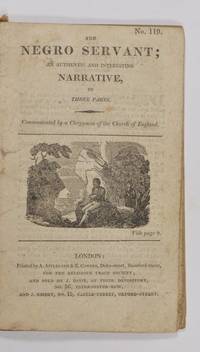
41475London: Printed by A. Applegath & E. Cooper for the Religious Tract Society c. 1825. 12mo 24pp. woodcut vignette to title-page disbound. London: Printed by A. Applegath & E. Cooper, for the Religious Tract Society, [c. 1825.] unknown
iv, [5]-186, [2]pp. 3 Works bound in one, 12mo (170 x 100 mm), cont. calf, gilt, a nice copy.
120398aafParis, Arnould Seneuze, 1687, in-4°, sans frontispiece ou portrait du traducteur. Tome 1: 23 ff. + 621 p. (+ 1) + 2 ff. / Tome 2: 2 ff. + 304 p. + 197 p. + 2 p., galerie de vers dans les marges sup., reliures en plein veau très usées, plat du vol. 1 détaché, ex. a restaurer.
51920Paris Chez Pillet Ainé, Imprimeur Libraire 1820 in 8 (24x15,5) 1 volume reliure demi basane fauve de l'époque, dos lisse, pièce de titre de cuir noir, [3] ,157 pages [1], avec 2 portraits de Dumont en frontispice, dont un en pied, et 1 fac-similé hors texte d'écriture de Dumont, petite auréole brune sur un feuillet (pages 153-154). Exemplaire enrichi d'un portrait photographique contrecollé à l'intérieur du premier plat: tirage papier salé: portrait de L. de la Bédollière ? 1873. Pierre Joseph Dumont. Signature manucrite de Quesné au verso du faux-titre. Troisième édition augmentée et corrigée. Bon exemplaire
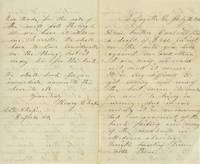
1861Cat338Lafayette Ohio 1861. Autograph letter signed 2 pp. Addressed to D. T. Chapin of Enfield Connecticut. Good condition with normal folds and light wear. A concise but revealing early Civil War letter combining financial anxiety agricultural reporting and clear-eyed political commentary on slavery and the future course of the conflict. Writing amid the first months of the American Civil War Chapin opens with the immediate purpose of the letter—forwarding “a draft of $240 for int. on the noteâ€â€”before situating the payment within a deteriorating economic landscape: “It is very difficult to get money now even of the best men.†He describes a local economy under strain noting “no market for wool to bring in money†compounded by regional instability “on account of the bank failing and many of the merchants in Medina closing†concluding bluntly: “Terrible bursting times with them.†Even the act of sending funds carries uncertainty as he cautions that “in these times I consider there is a risk in the best of banks.†Alongside these concerns Chapin provides a snapshot of agricultural conditions: “Corn is very backward and short wheat nearly middling grass rather below middling†summing up the situation as “rather tight times as well as troubled times.â€<br /> <br /> The most significant portion of the letter however turns to the war itself and the unresolved question of slavery. He writes:<br /> <br /> “We hope the end will be well but our nation will have to be humbled. It is well to put down rebellion but it is rather queer that the cause of the trouble must be let entirely alone. The nation will get their eyes open after a while. The President possesses the war power to abolish slavery and Congress possess the power also in my humble opinion and the time will come when they will have to do it unless the south run their heads so hard against the rock as to do it themselves.â€<br /> <br /> The letter closes with a brief note on a failed business transaction—“our trade for the sale of the mill fell throughâ€â€”underscoring the economic uncertainty of the moment before returning to family matters. Overall an evocative early Civil War letter by a merchant expressing fears and anxiety for the pending conflict. unknown
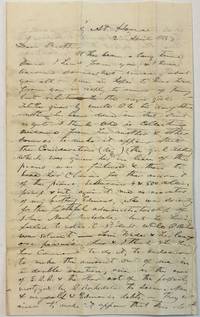
184740201Stewartsboro TN 1847. Folio 15" x 12-3/4" sheet folded to 7-1/2" x 12-3/4". 4 pp. Completely in ink manuscript integral address leave bearing Stewartsboro Tennessee April 3 1847 manuscript postal marking. mailing address on last page. The initials of the writer's name are difficult to decipher; this is our best guess. Old folds two short fold splits and a few tiny holes at fold corners. Wax seal remnant with tear at edge loss of a few letters some toning. Good to Very Good. <br /> <br /> The writer is concerned that Thomas had not responded to his letter "relating to the negro girl Tabitha given by Uncle R. to his daughter- nothing has been done in that suit as yet. I think she is collecting evidence from her mother & other sources to make it appear that the consideration viz the girl Tabitha which was given her in lieu of the piano was a failure & then to base her claim for the amount of the piano between 4 and 500 dollars princp. & int. against me as executor of my brother Edmond who was security for the faithful administrationship of John Nash Barksdale but he having failed to collect sd. debt while R. Barksdale was solvent. Levi Wade & her lawyer are persuading her. . . " He gives Thomas permission to "calculate on receiving a portion of the money for which Paulina sold. . . Negroes have advanced within 3 or 4 months but I fear one diseased as your boy Phil will command but a small price."<br /> Dr. Thomas Hill Read 1798-1874 of Tennessee settled in Macon County Illinois in 1831. He was the brother-in-law of Capt. David L. Allen one of the most prominent early citizens having married his sister. Dr. Read became known for his success in the treatment of children's ailments and was considered an expert in cholera infantum. He had a reputation for honesty and was said to have acted as administrator of more estates than anyone else in Macon County. Dr. Read was a member of the Decatur Board of Trustees in 1839 1841 1846 and 1847; County Treasurer from 1845-1846 and County Probate Judge from 1846-1849.<br /> John Nash Barksdale 1818-1844 Thomas Read's maternal cousin was born in Tennessee graduated from the University of North Carolina and became a lawyer. He practiced law in Tennessee for a few years and then moved to Columbus Mississippi and entered the law firm of his cousin Gen. William Barksdale. The Columbus bar announced that its members would wear the badge of mourning for thirty days following his death. "Death of John N. Barksdale" Republican Banner Nashville TN Dec. 6 1844 Page 2.<br /> Uncle R was likely Randolph Barksdale 1795-1844 Thomas H. Read's maternal uncle and John Nash Barksdale's father. Randolph settled in Tennessee with his father in 1808 and later established his own plantation. He was married three times and became the owner of a large estate and several slaves in Rutherford County Tennessee thanks to the wealth of his first wife. He also owned an estate near Chulahoma in Marshall County Mississippi. unknown
1836216961836. Slavery & Abolition CHILD Lydia Marie. An Appeal in Favor of That Class of Americans Called Africans. New York: Published by John S. Taylor 1836. Second edition. Illustrated with 2 plates. Coleridge quote on title page. In original blue cloth boards with embossing and gilt to spine. 8vo 216 pages. Child was a vocal abolitionist women's rights activist anti-American expansionist and proponent of racial equality amongst African and Native Americans. An Appeal in Favor of That Class of Americans Called Africans was the first written by a white woman in support of the immediate emancipation of slaves without compensation to their enslavers. Child begins by writing about the history of the slave trade as well as harrowing stories on it's detrimental and immoral faculties in order to engage readers to action. One illustrated plate showcases shackles and chains used on enslaved individuals. First published in 1833 Child's work was a prominent contribution to the abolitionist movement and her writing influenced many notable figures including Harriet Beecher Stowe and Frederick Douglass. Missing frontispiece some foxing to pages some wear to covers. Small tear affecting a few words in the fist first sentence on page 127. Binding is tight and text is clean and legible. Overall very good condition. unknown
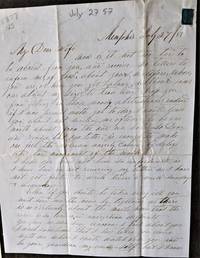
1857708Memphis 1857. 4to. letter sheet. 250 x 195 mm. 9 ¾ x 15 ½ inches. 4 pp. about 840 words. Folded in thirds. Written in black ink faded brown in very legible hand. Jesse McCallum was a hay dealer from Cincinnati Ohio who travelled away from his family on business forays. In this case he writes from Memphis Tennessee complaining about the heat and commenting on the "darkies" as follows: ". the sun is scorching from 10 am to 4 pm the difference is very perceptible I think the heat is greater on account of the drought the ground is parched up and dry.the streets are deserted in the middle of the day but the darkies will be down in the hottest part of the day in the sun and sleep with the sun shining full in their face and appear to enjoy it as much as a white man would in the shade what a difference collar sic makes.the south could not get along well without its black population one months work in the sun of the south would cure the bitterest abolitionist of the north of his bitter oposition sic to institutions of slavery and come over without a groan to be a slave owner if compelled to earn his living by cultivating the soil." McCallum thinks "we will do well on this load of hay.as hay is advancing" and also comments about his wife's lack of correspondence and reminds her that he writes twice a week. The last page is particularly affectionate--he remarks about being a "bachelor husband" and adds ; ". the only true enjoyment I have had was when I recd your letter since I left you and now Elly if you wish me to enjoy myself write often." Jesse McCallum often spelled Mc Collum in historical records was born in Ohio in 1819. In 1850 he was working as a stone cutter. By 1860 he was living with wife Eleanor Welsh and  six children in Marysville Yuba California. In the Civil War he was a Union Corporal 81st Illinois Infantry Company A. In 1870 he was making "gas machines". He died in Marysville in 1880. unknown books
1836WRCAM46521Pittsburgh: Alexander Jaynes 1836. 8pp. Dbd. Lightly and evenly tanned. Very good. "The question of Slavery being before the General Assembly of 1836 on petition from many members of the church that the Assembly would bear their testimony against the practice of slaveholding as a SIN it has been thought proper to reprint the testimonies and acts of former Assemblies on the same subject from the official Minutes without note or comment." Only three copies located in OCLC at Princeton Oberlin and the Library Company of Philadelphia. Alexander Jaynes unknown books
1836WRCAM46520Pittsburgh: Alexander Jaynes 1836. 36pp. Dbd. Light foxing and toning contemporary pencil notations. About very good. A discourse given on the great evils of slavery and the polarization it is causing among the northern and southern states. Relatively scarce though the titlepage indicates that it was printed "For Gratuitous Distribution." Alexander Jaynes unknown books
182919216Albany: Printed by Websters and Skinners 1829. First edition. Some wear to the untrimmed edges; long closed tear to one leaf from the upper edge no loss; some light soiling and a few small stains; a very good copy. Unbound pamphlet stitched as issued 6 x 9.13 inches untrimmed 24 pages. When therefore the fetters whether gradually or suddenly shall be stricken off and stricken off they will be from those accumulating millions yet to be born in bondage it is evident that this land unless some outlet be provided will be flooded with a population as useless as it will be wretched. . . . Whether bond or free their presence will be for ever a calamity." The organizational proceedings of the first iteration of the New-York State Colonization Society intended to help the national organization settle free blacks in Africa. Lib. Co. Afro-Americana 7116; American Imprints 39836. Printed by Websters and Skinners, unknown books
8vo., First Edition, with a portrait frontispiece in photogravure (original tissue guard present) and a plate in photogravure (original tissue guard present); handsomely bound in burgundy full morocco, back gilt with five raised bands, second and fourth compartments lettered and ruled in gilt, all other compartments tooled and ruled in gilt, uncut, a most attractive copy ideal as a gift or for presentation. A lovely copy.
1369764Paris: Imprimerie Nationale, 1891 4to. 514 + 164 pp. Half morocco, raised bands gilt, spine chipped, rubbed, t.e.g.
15776No place, 1789. (2), 36 pp. 8vo. Modern half morocco. Martin & Walter, Anonymes, 3496. First edition. One of the very few cahier de doléances which deals with the treatment and position of black people 'avec toute l'attention qu'exige l'humanité appliquée à un aussi important objet' (page 7).
ORD-13067N°12792 et N° 12793 du Bulletin des Lois N°1302. 4 et 5 juin 1846. In-8 (ca 145 x 215mm) sans couverture, non rogné, tel que paru. Les 2 ordonnances occupent les pages 440 à 447 du bulletin. Des rousseurs sinon bon état.
238361Paris, L. Pelletier, an XII - 1804 in-8, [2] ff. n. ch., VIII pp., pp. 5-194, dérelié.
184235503593Paris, Imprimerie Royale, 1842 ; in-8, cartonnage bleu de l’éditeur. 2 ff. n. ch., VI pp., 315 pp.État du personnel du ministère de la Marine, des inspections Générales, du Dépôt général des cartes et des plans, Conseil d’état, Commission sup. des Invalides de la marine, Notaire imprimeur et horloger de la marine, Liste générale des officiers de la marine (Amiraux, Vice-Amiraux, Contre-amiraux, Capitaines de vaisseau, Cap. de frégate, Cap. de corvette, Lieutenants de vaisseau, Lieutenants de frégate, élèves de la marine), Commission chargée des questions d’esclavage, Commission formée à la répression de la traite des Noirs, Avocats de la marine, École navale de Brest, artillerie de marine, Infanterie, Officiers de gendarmerie maritime, Officiers du génie maritime, corps du commissariat de la marine, Administration des subsistances, Architectes, Opticiens, Peintres, Service de santé, Tribunaux maritimes, Aumôniers de la marine, Examinateurs et prof. de navigation, Trésoriers des Invalides, Ingénieurs des Ponts et Chaussées au service de la marine, Arrondissements maritimes, Service de la marine en Afrique du Nord, Forges et fonderies, Surveillance des fabrications de projectiles, Surveillance des fournitures de bois, Colonies françaises, Consuls généraux... table.
184335503594Paris, Imprimerie Royale, 1843 ; in-8, cartonnage bleu de l’éditeur. VIII pp., 325 pp.État du personnel du ministère de la Marine, des inspections Générales, du Dépôt général des cartes et des plans, Conseil d’état, Commission sup. des Invalides de la marine, Notaire imprimeur et horloger de la marine, Liste générale des officiers de la marine (Amiraux, Vice-Amiraux, Contre-amiraux, Capitaines de vaisseau, Cap. de frégate, Cap. de corvette, Lieutenants de vaisseau, Lieutenants de frégate, élèves de la marine), Commission chargée des questions d’esclavage, Commission formée à la répression de la traite des Noirs, Gouverneurs des colonies, Avocats de la marine, École navale de Brest, artillerie de marine, Infanterie, Officiers de gendarmerie maritime, Officiers du génie maritime, corps du commissariat de la marine, Administration des subsistances, Architectes, Opticiens, Peintres, Service de santé, Tribunaux maritimes, Aumôniers de la marine, Examinateurs et prof. de navigation, Trésoriers des Invalides, Ingénieurs des Ponts et Chaussées au service de la marine, Arrondissements maritimes, Service de la marine en Afrique du Nord, Forges et fonderies, Surveillance des fabrications de projectiles, Surveillance des fournitures de bois, Colonies françaises, Consuls généraux... table. Couv. un peu salie, intérieur très frais.
184135503592Paris, Imprimerie Royale, 1841 ; in-8, cartonnage bleu de l’éditeur. 1 ff. n. ch., IV pp., 292 pp.État du personnel du ministère de la Marine, des inspections Générales, du Dépôt général des cartes et des plans, Conseil d’état, Commission sup. des Invalides de la marine, Notaire imprimeur et horloger de la marine, Liste générale des officiers de la marine (Amiraux, Vice-Amiraux, Contre-amiraux, Capitaines de vaisseau, Cap. de frégate, Cap. de corvette, Lieutenants de vaisseau, Lieutenants de frégate, élèves de la marine), Commission chargée des questions d’esclavage, Commission formée à la répression de la traite des Noirs, Avocats de la marine, École navale de Brest, artillerie de marine, Infanterie, Officiers de gendarmerie maritime, Officiers du génie maritime, corps du commissariat de la marine, Administration des subsistances, Service de santé, Tribunaux maritimes, Aumôniers de la marine, Examinateurs et prof. de navigation, Trésoriers des Invalides, Ingénieurs des Ponts et Chaussées au service de la marine, Arrondissements maritimes, Service de la marine en Afrique du Nord, Forges et fonderies, Surveillance des fabrications de projectiles, Surveillance des fournitures de bois, Colonies françaises, Consuls généraux, table.