Abolition Bill Outlawing SlaveryBiblio.com

1 560 résultats
1862127191862. Front Page Headline reads "The Bill Abolishing Slavery in the District of Columbia Passed the House." Newspaper "The Detroit Free Press" April 12 1862. 19" x 26" 2 pages. Has a blow by blow account of the debate among the members of the House and the various amendments associated with the bill. It concludes "The bill was passed 93 agains 39." Also includes local national and international news as well as "News From the South." Some small tears at the left hand margin not affecting text. A diagonal crease runs across the top half of the paper and a small piece of yellow tape has adhered to the top margin. Overall in very good condition. unknown
185019425Philadelphia March 20 1850. Portion of the blank leaf clipped traces of a partially-removed decal from the blank verso; a little foxed in very good condition. Quite legible. 1.5 pages in autograph ink on a lined blue folio approx. 250 words. Integral address. On the negotiation for and Methodist process of returning the missionary Seys to Liberia as a colonization agent: "I this morning presented your communication and also Mr. PinneyÃs to my colleagues. Their conclusion was expressed as follows. 'Agreed that we still abide by our decision of last year ñ That we have authority to make appointments to agencies for the Colonization cause ñ 2d That we are not willing to advise Br. Seys as to the expediency of his accepting such an agency but leave that to his own discretion. 3d That at present we see no insuperable difficulty in the way of his appointment as Agent of the Colonization Society of Maryland at the next session of the New York Conference provided that previous to that time he receives a commission from said society and decides to accept the appointment.' In order to relieve your mind on the other point I will inform you that I see no way of deciding the question of a Superintendent to Liberia for some time to come. We do not just it safe and proper to give personal advice to brethren in regard to such appointments." Seys was a native of Trinidad and according to later accounts of colonization societies had been an overseer on a family plantation until a conversion experience led him to Methodism abolition and emigration to the United States. Seys here appears to have been angling for a return to Liberia as a colonization agent a goal at which he seems to have succeeded; he would be named Minister and Consul to Liberia in 1866. With a preliminary typescript. March 20, unknown books
10137Slavery Handwritten letter signed. Silvanus Patch 1 page March 1823 in which Mr. Hatch writes in somewhat phonetic English to a John Bourding concerning the sale of one of his slaves in part ".I wish you to assist Mr. Nicholson in the gitten sic of the money from the sale of Davis and the 50 of Collens as I am in det debt to Mr. Nicholson.use every excursion to git sic that from him and you will obliage sic your well wisher." Foxing in very good condition. unknown books
15101This rare pamphlet "Act No. XIX of 1929 Passed by the Indian Legislature.An Act to Restrain the Solemnisation of Child Marriages" was a critical step in protecting girls. No other copies in OCLC Worldcat<br/><br/>Child marriage was historically prevalent in India where the International Center for Research on Women reported that 47% of Indian weddings in the early 20th century involved brides under the age of 18. Poverty was a driving factor in child marriage as families in financial straits could improve their economic standing by marrying their daughters to wealthier older men. Yet as other countries began making improvements for women and girls India too recognized the dangers inherent to girls' health and well-being when they were married and became mothers while still in their own childhoods. This pamphlet which is the only known copy according to OCLC Worldcat details the "punishment for male adult below twenty one years of age marrying a child punishment for male adults over twenty one years of age marrying a child and punishment for solemnizing a child marriage." While child marriage does persist in India its rates have gone down and modern India has joined the South Asian Initiative to End Violence Against Children SAIEVAC which adopted a regional action plan to enforce the marriage bans and end child marriage in and beyond its own borders. unknown books
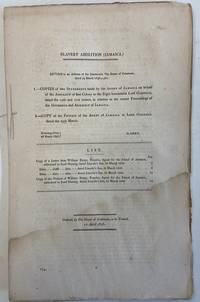
1836175381836. This pamphlet is a return to an Address of the House of Commons from March 25 1836 whereby the Agent of Jamaica William Burge protests against the unilateral abolition of slavery in the British Empire. Ordered to be printed by the House of Commons in London April 1836. 13 pages. 13" x 8.25" inches. Included within is a copy of three letters from the Agent to Lord Glenelg the British colonial secretary as well Burge's protest to Glenelg. Burge states: He is desirous that His Majesty's Government should understand that this Protest is made not as the performance of a formal act of official duty but from his conviction that the proposed legislation for Jamaica is a direct violation of the constitutional rights of that Colony rights coeval with its establishment and which have hitherto been respected." The Agent was a colonial official who was the official representative of a British colony who was based in London and acted as lobbyists and trade negotiators for the affairs of the colony. While Burge had at other times claimed to "hate" slavery he employs the British analogue of the "states rights'" argument that many moderate politicians in the United States used to signal personal distaste for slavery but to nonetheless protect the institution's existence on the basis of constitutionality. When the institution of slavery died out in the British Empire after 1836 the abolitionist movement in the US gained tremendous momentum despite the protests of our own William Burge's. This piece is overall in very good condition. unknown
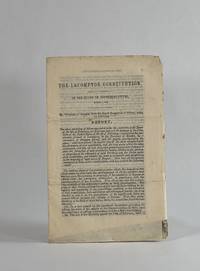
18589866Washington 1858. Unbound. near Very Good binding. Octavo. 16 pp. First edition. Unbound folded sheet forming 8 leaves. Old folds with some closed tears/silverfishing along a couple the creases; staining to the bottom margin of a a few leaves not touching text; otherwise generally a very good copy. <br /> <br /> Circumstances surrounding Kansas's Lecompton Constitution brought the tension surrounding the confluence of statehood and slavery to a new level. A pro-slavery document the Lecompton Constitution and subsequent votes on it were a fraught and dishonest affair complete with subterfuge false choices boycotted votes and more all in service of establishing a pro-slavery constitution in a state that's populace had a clear and before the end demonstrable antislavery majority. This report before the House by Georgia's Alexander Stephens soon to be Vice President of the Confederate State of America defends a December election that was widely boycotted by antislavery voters because the options presented to the electorate both allowed for slavery to persist in Kansas despite the misleading language of the referendum. By August of this same year 1858 a new vote would be held to keep or toss out the Lecompton Constitution. In a vote that demonstrated the antislavery sentiment of Kansas residents the Constitution would be thrown out by a 7 to 1 margin. Leaving space for a constitution to be drafted and ratified prohibiting slavery in Kansas. Krdlicka James F. Colonists Citizens Constitutions: Creating the American Republic. Sabin 91261. unknown
Scholar's bookplate to inner cover (G. P. Goold). Foxing to top of textblock. DJ spine is sunned. DJ has 2 tear to base of front panel and some creasing (2 cm) and 1 small tear to head of DJ spine. ; Reprint of the 1908 edition. This book was the first comprehensive study of the Roman law of slavery when it was published in 1908. It is still the standard work. ; 750 pages
Light scuffing to front board; Beiträge Zur Altertumskunde 93; 329 pages
Former owner's name neatly stamped on ffep (P. Stork). Very light browning to spine else Fine. ; Beiträge Zur Altertumskunde 93; 329 pages
178513753A Londres, s.é., 1785. 2 vol. au format in-12 étroit (166 x 98 mm) de 154 et 158 pp. Reliures uniformes de l'époque de pleine basane marbrée havane, plats jansénistes, dos lisses ornés d'un double filet d'encadrement doré, triples filets dorés, larges fleurons dorés, semis de points dorés, pièces de titre de maroquin vieux-rouge, titre doré, tomaison dorée, filet doré sur les coupes, toutes tranches rouges.
057470Paris Librairie de L. Hachette et Cie 1875 in 8 (24x16,5) 1 volume reliure demi chagrin rouge de l'époque, dos à nerfs orné de caisson dorés à fleuron central, plats de percaline rouge ornés d'un encadrement à froid, tranches dorées, portrait gravé en frontispice, III et 436 pages. Ouvrage illustré de 56 gravures et de 2 cartes en couleurs dont une dépliante en couleurs in fine (fine restauration ancienne d'une déchirure sans manque au papier de soie, au verso de la carte), des rousseurs éparses sur les premières et les dernières pages. Ouvrage traduit de l'anglais avec l'autorisation de l'auteur par Hippolyte Vattemare. Sir Samuel White Baker, Londres 1821 - Newton Abbot 1893, explorateur anglais. Bon exemplaire, reliure fraîche ( Photographies sur demande / We can send pictures of this book on simple request )
ORD-698Ouvrage traduit de l'anglais par Hippolyte Vattemare et contenant 56 gravures et 2 cartes. Hachette. 1875. Grand in-8 dos chagrin rouge orné, tranches dorées, portrait de l'auteur en frontispice, 439pp. gravures h.-t. et 2 cartes couleurs dont une dépliante (Bassin du Nil et Carte de l'Albert Nyanza). Reliure lgt épidermée mais bon état intérieur pratiquement sans rousseurs.|Autre exemplaire mêmes caractéristiques, dos basane noire, 5 nerfs, tranches mouchetées, Lycée Henri IV sur le 1°plat, rousseurs en début d'ouvrage, mais bon exemplaire, même prix.
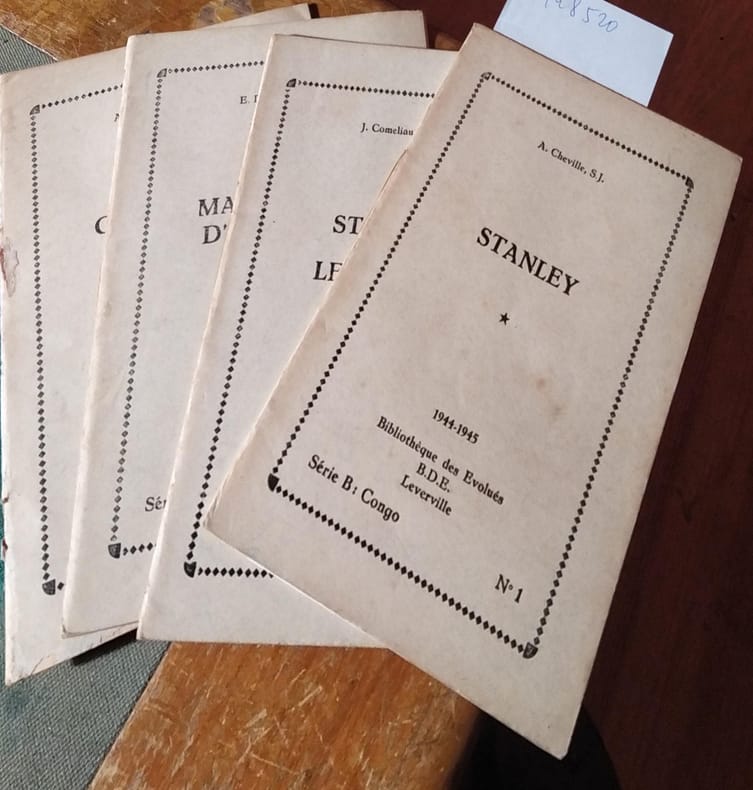
1945148520Couverture souple. 4 brochures de 32 pages. 12 x 17 cm.
15147In-8, broché, couverture de papier moderne, 15 p. Paris, Baudouin, 1789.
In-8, broché, couverture de papier moderne, 15 p. Edition originale. Le député de la Guadeloupe soumet son projet de création d'un Comité colonial composé de députés des colonies, de colons et de négociants blancs, afin d'élaborer une constitution coloniale spécifique. Par la suite, Curt émigra en Angleterre. Il y négocia le traité de Whitehall (1793) entre les Anglais et les grands planteurs français des Antilles pour permettre à ces derniers de combattre les troupes révolutionnaires et de s'opposer à l'émancipation des Noirs. (cf. Pluchon, "Histoire de la colonisation française", p. 813). (Martin & Walter, 911. Sabin, 18017). Bon exemplaire, très frais.
5924In 8 broché,faux-titre,portrait de l’auteur,titre,carte sur double page,501 pages,18 gravures d’après les dessins de RIOU,3 gravures de THIRIAT d’après les photographies,hors-texte.5 cartes ou plans.Paris Librairie Hachette & Cie 1889.Rousseurs éparses,plus concentrées à certaines pages. Une restauration dans la partie en marge extérieure du premier,plat de couverture ainsi qu’un petit manque en pied,réparé,sinon bon exemplaire à grandes marges
6717P., Delay, 1846. In 8 broché, 114 pp. (manque second plat, trace de brûlure au bas).
1376061Paris: Pillet, 1820 in-8, [2]-157-[3] pages, 2 portraits frontispice dessinés et gravés par Ambroise Tardieu, planche hors texte avec fac similé d'un autographe de P. J. Dumont. Demi reliure postérieure chagrin vert, dos à 5 nerfs, fleurons et filets dorés, couv. conservées (la couverture porte l'année 1819), légère mouillure sur qq pages, cachet d'un ancien propriétaire sur la page de titre, bel exemplaire. Dumont, marin dans la marine française, fut fait prisonnier par des pirates Arabes d'Algérie en 1782 et demeura esclave 34 ans.
7129P., Imprimerie Nationale, 1791. 12 pp. in 8 déreliées.
ORD-17726Paris. Imprimerie Royale. 1846. In-8 (132 x 211 mm) dos lisse basane fauve, pièces de titre et de tomaison noires, XX, 504 pages. Contient: 1. Ordonnance du Roi qui prescrit la publication de la Convention conclue le 29 mai 1845, entre la France et la Grande-Bretagne, pour la suppression de la Traite des Noirs, pages 93 à 98 incluse, bulletin 1274. 2. Plusieurs articles à la rubrique Esclaves pages 437 à 446 incluse, bulletin 1302. Des rousseurs mais assez bon exemplaire.
Second Edition, with additions, 12mo, [5], 6-100pp., folding engraved map of the town of Leicester, 5 nineteenth-century mounted actual photographs tipped-in, and 6 engraved plates tipped, modern cloth, uncut, spine faded. Susanna Watts was born in Leicester and was dedicated to bringing about the immediate abolition of slavery. She started one of the first fair trade campaigns, wrote hymns and pamphlets and even locked horns with William Wilberforce. When her father died, her wealthy family's finances became tight and she had to find a way to support herself and her mother. At the age of 15 or 16 she began writing to earn money, and as well as penning the first guide to Leicester, she wrote poetry to promote the emancipation of slaves. To be a young woman and a published author in the late 18th Century would not have been an easy task, so the fact that she prevailed shows how passionate Susanna was in her desire to make her antislavery views known. "They dared to stand up in front of all these men and say what they thought was right ? two women from the provincial town of Leicester." According to Shirley Aucott, a local historian and author, Susanna worked on a periodical called 'The Hummingbird', which brought together different ideas on the antislavery moment, and she organised what must have been one of the first fair trade campaigns! She visited local households and shops to persuade them not to use sugar produced in the Caribbean, claiming that, "abstinence from sugar would sign the death warrant of West Indian slavery."
24264ONE: ‘Coloured Emigrants from United States’ Downing Street 16 October 1850. TWO: ‘Immigration’ Downing Street 30 October 1850. Two interesting items from the period leading up to the American Civil War. Both items are scarce: no other copy of either traced. In good condition lightly aged. Extracted from a volume of Parliamentary Circulars with the ownership signature "Frederick Peel" Member of Parliament from Feb. 1849 dated 1839-1851 very good condition. The context makes it plain that this Circular was sent to all Colonial Governors a gap in the text indicating where the name of a specific Governor would appear in MS. Disbound from a volume and paginated in manuscript.Both printed in copperplate font. ONE: Printed ‘Circular’ dated from Downing Street 16 October 1850. Headed in manuscript ‘Colonial Emigrants from United States’. In manuscript at end not in Grey’s hand ‘/sd/ Grey’. 2pp 8vo. Paginated in manuscript 239-240. Begins: ‘Sir / I have to acquaint you that it has been suggested to me that a desirable Class of Emigrants for the West India Colonies might be induced to come to them from among the Black and Colored Population of the United States whose arrival and location if they chose to come would I have no doubt be advantageous to themselves and to the Colonies.’ TWO: Printed ‘Circular’ dated Downing Street 30 October 1850. Headed in manuscript ‘Immigration’. In manuscript at end again not in Grey’s hand: ‘/sd/ Grey’. 7pp 8vo. Not paginated in type; paginated in manuscript 239-245. Divided into eleven numbered sections the first of which reads: ‘In the course of the long correspondence which it has devolved upon me to conduct with the Governors of the Sugar Colonies and others on the subject of the Immigration of Labourers it has been my endeavour to promote the establishment of such laws and regulations respecting Immigrants introduced at the public expence as should make the Immigration most conducive to the well being of the Immigrants themselves of the Colonists by whom their labour was required and of the Populations at large of the Colonies in which they were to be placed.’ The chief ‘descriptions of Immigrants’ discussed in the correspondence are: ‘1st Coolies brought or about to be brought from the East Indies to some of the West Indian Colonies by the aid of Colonial Revenues or Loans raised by the Colonies and guaranteed by this Country. - 2nd. Kroomen or Africans from Sierra Leone and those parts of Africa where Slavery does not exist brought to the West Indies by the same means. - 3rd. Africans taken from captured Slavers liberated under sentences of the Mixed Commission Courts and brought to the West Indies at the sole cost of this Country.’Printed ‘Circular’ dated from Downing Street 16 December 1842. Headed in manuscript ‘Crime in the high Seas’. At bottom in manuscript not Stanley’s hand: ‘/sd/ Stanley’. Twenty-nine lines in copperplate font. The first of four paragraphs reads: ‘The attention of Her Majesty’s Government has been recently called to various Laws enacted in the British Colonies for the prevention regulation or punishment of acts done in the High Seas as on the Seas within one League of the Shore of the Colonies in which such Laws have originated. After consultation with the Queen’s Advocate and the Attorney and Solicitor General Her Majesty’s Government have adopted the following conclusions on the subject.’ ONE: ‘Coloured Emigrants from United States’, Downing Street, 16 October 1850. TWO: ‘Immigration’, Downing Street, 30 Oc unknown
184212540Paris Gosselin 1842 Un volume in-8 demi chagrin bordeau, reliure XXe, dos à nerfs, titre doré, couverture conservée, 588 pages. Quelques passages soulignés au crayon, néanmoins bel exemplaire.
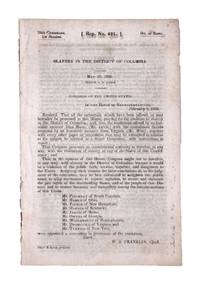
1836346520Washington D.C. 1836. 24th Congress 1st Session House Rep. No. 691. 24pp. 8vo. Disbound. 24th Congress 1st Session House Rep. No. 691. 24pp. 8vo. Many of the early anti-slavery efforts focussed on the abolition of slavery in the District of Columbia as Congress had full control over the laws within the District thus obviating any argument over state's rights. Until "retroceded" back to Virginia in 1846 the city of Alexandria and its notorious slave market was considered part of the District of Columbia making slavery in the District of particular importance. Inundated with petitions calling for the abolition of slavery in the District in 1836 Congress passed the so-called Pinckney Resolution which asserted that Congress "ought not" to consider slavery in the District and created a gag rule whereby all petitions memorials or other resolutions on the subject would be automatically tabled. unknown
185562372Boston: Bela Marsh 1855. Second printing. Frontispiece portrait. 122 pp. 1 vols. Small 8vo. Brown cloth stamped in blind and gilt. Upper half of spine shaky else a nice tight copy. Second printing. Frontispiece portrait. 122 pp. 1 vols. Small 8vo. The author was convicted of aiding slaves to escape from Washinton D.C.--Blockson. Sabin 20912 Blockson 9838 for first ed. Bela Marsh unknown