Anti SlaveryABAA

1 561 résultats
18379Used; Like New/Used; Like New. An English tobacco box bearing the kneeling slave iconography of the abolitionist movement dating to the mid-19th Century. Height 4 x width 3.75 x depth 5.5 inches 10 x 9.5 x 14 cm. Oxidation and pitting from age handle is old but may not be original to the box else fine.<br style="">Josiah Wedgewood 1730-1795 a dedicated abolitionist and close friend of Thomas Clarkson designed the "logo" of the kneeling slave for the Society for the Abolition of Slavery in 1787. This was taken up by the American abolitionists and in 1835 Patrick Reason a young black engraver created a version of a kneeling woman that bore the caption "Am I not a Woman and a Sister" This image together with that of the infamous slave ship's hold are without question the most iconic of the anti-slavery movement on both sides of the Atlantic. unknown books
18003062751800. Wrought iron two semicircular wrist pieces approx. 4 inch in diameter attached to an 11-inch long bar. Oxidization consistent with age and material. Wrought iron two semicircular wrist pieces approx. 4 inch in diameter attached to an 11-inch long bar. A set of shackles of the type used in the Middle Passage slave route from Africa to the Americas in the 18th century. An illustration of this type of shackle appears on page 16 of Lydia Maria Child's Appeal in Behalf of that Class of Americans Called Africans Boston 1833 where she notes that these shackles were used to secure the ankles of adjacent slaves. "Yet even thus secured they do often jump into the sea and wave their hands in triumph at the approach of death unknown books
183431598Philadelphia 1834. 3pp. Later annotation at head of first page. Scarce letter on the Liberian colonization movement by one of its founders.<br/> <br/>Writing to Hawes a member of Parliament and a committee member of the Society for the Extinction of the Slave Trade Cresson wishes for success in the British anti-slavery action off the coast of Sierra Leone writing "I hope that you may yet enjoy the satisfaction of crushing one of the worst & most unacceptable of the slave markets in existence that at Gallinas." After mentioning the travels of the colonial governor of Liberia he writes: ". I have been gratified to learn from several highly respectable sources that such a Colony as you propose located either at the mouth of the Cape Mount River or even a little more to the Northward say at Sugaree & provided with a good supply of trade goods to exchange with the natives would have a powerful tendency to break up the monopoly now enjoyed by the Spanish Slavers. My letters from Africa state that the demand is so great in Cuba from the ravages of Cholera among their ill-fed human cattle as to have rendered the shipments from the Gallinas during the past year almost unprecedented. It appears that the benevolent efforts of your Govt. are not likely to extirpate the evil until commercial & agricultural colonies shall be substituted for cruisers." The letter continues with news from their consul at Liberia before turning to American politics: ". political affairs engrossing the entire energies of the nation. The excitement is painfully great . Our military chieftan Jackson by his acts of unauthorized assumption has called forth a burst of indignation which cannot subside until we get rid of the offender." The letter concludes with an introduction for Gerard Ralston. Cresson a noted Philadelphia businessman and philanthropist was among the most ardent supports of colonization the movement to relocate former slaves and free African Americans to colonies in Liberia. In 1833 Cresson and the Philadelphia Young Men's Colonization Society a branch of the American Colonization Society founded Port Cresson in Liberia. However the colony was attacked in 1835 by Bassa tribesmen incited by Spanish slave traders and destroyed. unknown books
183431598Philadelphia 1834. 3pp. Later annotation at head of first page. Scarce letter on the Liberian colonization movement by one of its founders.<br/> <br/> Writing to Hawes a member of Parliament and a committee member of the Society for the Extinction of the Slave Trade Cresson wishes for success in the British anti-slavery action off the coast of Sierra Leone writing "I hope that you may yet enjoy the satisfaction of crushing one of the worst & most unacceptable of the slave markets in existence that at Gallinas." After mentioning the travels of the colonial governor of Liberia he writes: ". I have been gratified to learn from several highly respectable sources that such a Colony as you propose located either at the mouth of the Cape Mount River or even a little more to the Northward say at Sugaree & provided with a good supply of trade goods to exchange with the natives would have a powerful tendency to break up the monopoly now enjoyed by the Spanish Slavers. My letters from Africa state that the demand is so great in Cuba from the ravages of Cholera among their ill-fed human cattle as to have rendered the shipments from the Gallinas during the past year almost unprecedented. It appears that the benevolent efforts of your Govt. are not likely to extirpate the evil until commercial & agricultural colonies shall be substituted for cruisers." The letter continues with news from their consul at Liberia before turning to American politics: ". political affairs engrossing the entire energies of the nation. The excitement is painfully great . Our military chieftan Jackson by his acts of unauthorized assumption has called forth a burst of indignation which cannot subside until we get rid of the offender." The letter concludes with an introduction for Gerard Ralston. Cresson a noted Philadelphia businessman and philanthropist was among the most ardent supports of colonization the movement to relocate former slaves and free African Americans to colonies in Liberia. In 1833 Cresson and the Philadelphia Young Men's Colonization Society a branch of the American Colonization Society founded Port Cresson in Liberia. However the colony was attacked in 1835 by Bassa tribesmen incited by Spanish slave traders and destroyed. unknown
1789R240004234IMP D'AIME DE LA ROCHE. 1789. In-4. Relié demi-cuir. Etat d'usage, Plats abîmés, Dos abîmé, Mouillures. 367 pages. Dos cuir marron avec filets et pièce de titre (manquante) doré. Manque coiffe en tête et en pied, revêtement sur le 1er platde couverture.. . . . Classification Dewey : 326-Esclavage
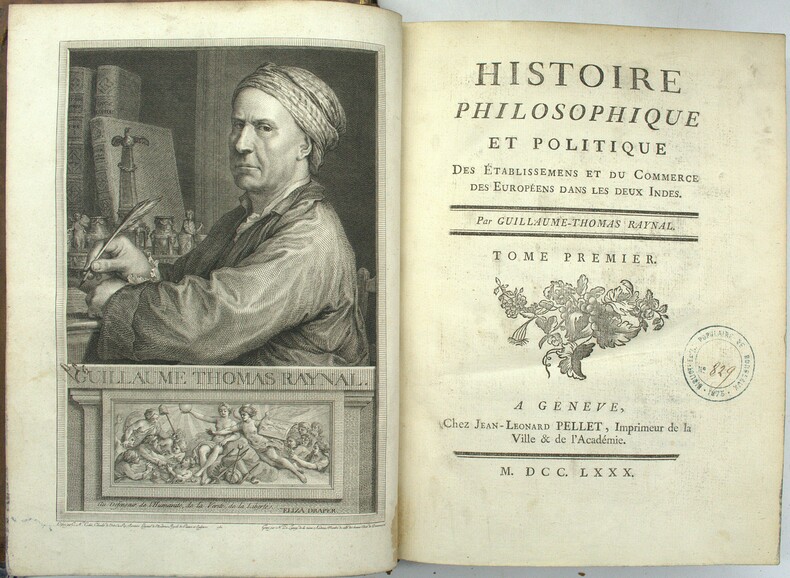
1780PHO-1926Genève, Pellet, 1780, 5 volumes in-4, 4 de texte et un atlas in-4, Texte ; portrait, XVI, 741 pp., 1 pl.; front., (2 ff.), VIII, 485 pp.; front., XV, 629 pp.; front., (2 ff.), VIII, 770 pp., (1 f.), Atlas ; 2f., 28pp. ; illustré complet des 50 cartes (chiffrées 1-49 et 17 bis) ; quelques cartes mal chiffrées et 23 tableaux de statistiques in fine, la plupart dépliants. Rousseurs éparses, feuillets légèrement brunis par places. Tampons humides "Bibliothèque populaire de Bordeaux". Reliure Texte ; Basane fauve marbrée de l'époque, dos à nerfs ornés, triple filet doré encadrant les plats, Atlas ; veau brun marbré de l'époque, dos à nerfs orné, fleurons tulipes entre caissons, tranches marbrées, filet à froid encadrant les plats, double filet doré sur coupes 2 coiffes arasées, une arrachée, petits chocs à 2 autres, frottements et épidermures, coins très émoussés, mors fendillés aux entrées, coins émoussés, tranches marbrées (atlas).
1728100536Pamphlet 8vo modern full calf in the style of an 18th century “Cambridge†binding 32 pp.Very slight aging; in excellent condition. This is a rare first edition of a work that presents a complaint by British planters in the West Indies concerning the Assiento or “agreement’ with Spain that gave Britain a virtual monopoly on the African slave trade. This agreement came out of the Treaty of Utrecht which ended the War of the Spanish Succession. This pamphlet indicates that the planters feared as a result of this agreement British slavers might be required to provide African slaves to the Spanish colonies which could result in insufficient numbers available for the West India plantations. The Assiento with Spain would mark the beginning of the Atlantic slave trade as a very powerful economic growth engine. Unfortunately this would translate into millions of Africans being taken from their homes. H. Whitridge unknown books
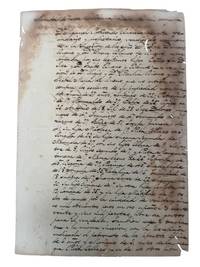
1875231241875. Slavery Cuba Spanish colonial slave sale manuscript recording the transfer of thirty-eight enslaved individuals in Cuba in 1875 materializing the sheer scale and organization of enslaved labor within the island's plantation economy during the final decade before abolition. The document enumerates a large group of enslaved people including multiple family units with young children demonstrating how slavery functioned as both an economic system and a hereditary condition sustained through the sale and reproduction of enslaved populations. Created eleven years prior to the abolition of slavery in Cuba in 1886 the manuscript documents the continued legality and normalization of large-scale slave transactions despite decades of international pressure and earlier prohibitions on the transatlantic trade offering concrete evidence of how internal markets sustained the institution in its final phase.<br /> <br /> Official Cuban slave contract documenting the sale of thirty-eight enslaved individuals for the sum of 126000 pesetas formalized before a public notary or legal authority. Single manuscript leaf written in Spanish cursive in black ink on both recto and verso densely filled with names ages and relational identifiers. Measures 8.5" x 12.25". The text lists individuals sequentially including men women and children with repeated references to kinship structures such as mothers with multiple children indicating the sale of family groupings rather than isolated individuals. The script reflects extended passages detailing ownership exclusions and conditions of transfer. A partial watermark of the official coat of arms of Cuba is visible. <br /> By 1875 Cuba remained one of the last major slave societies in the Atlantic world with sugar production driving demand for large controlled labor forces. Even after Spain curtailed the official slave trade earlier in the century illegal importation persisted into the 1860s and alternative systems of coerced labor including Chinese indenture supplemented plantation workforces. The scale of this transaction demonstrates the consolidation and redistribution of enslaved labor within domestic markets while the inclusion of children underscores the long-term economic logic of slavery as a self-reproducing system. Moderate toning and foxing concentrated along the edges with numerous small closed wormholes a few affecting portions of the text. Light edge wear present. Overall in good condition. This document provides unusually extensive nominal data on a large enslaved population encompassing the roles of kinship valuation and labor organization in late Spanish colonial Cuba. unknown
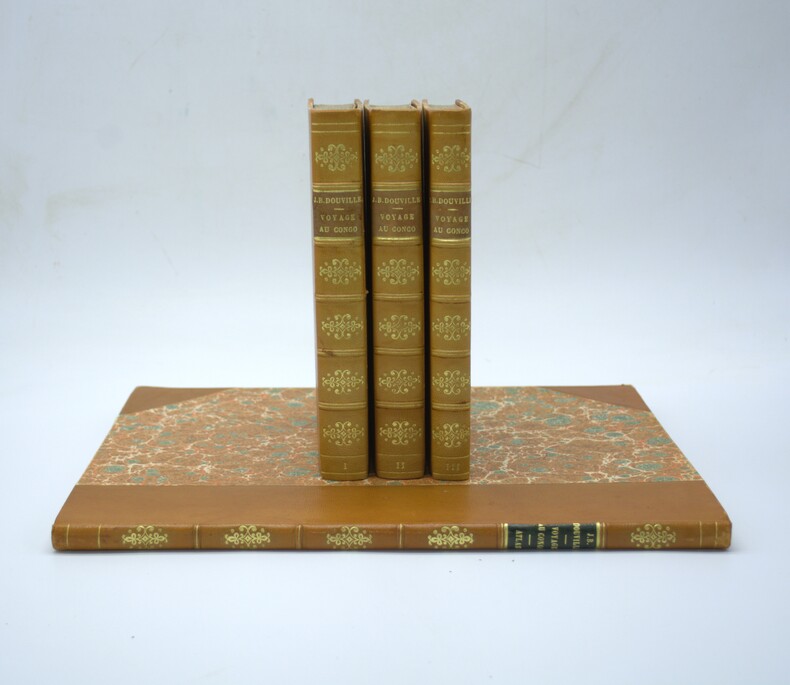
1832PHO-2260Paris, Jules Renouard, 1832. 3 vol. in-8° (21,5x14cm) de xxxj, 1 bl., 328 pp. ; 380 pp. ; 272 pp. et son Atlas in-folio (37x29cm) de titre, [1] p., 1 grande carte dépliante et 21 planches lithographiées (la n° 6 en double). Demi-chagrin miel à coins, dos à 5 faux-nerfs orné, p. de t. en maroquin fauve, tomaison dorée en pied, tête dorée, couverture et dos conservé (Reliure moderne). Des rousseurs, quelques pl. de l'Atlas légèrement brunies, coiffe sup. de l’atlas légèrement frottée. Étiquette de librairie, le frontispice figurant la médaille reçue par l’auteur est en déficit. Bel ensemble.
178640654Philadelphia: London printed: Philadelphia: re-printed by Joseph Crukshank 1786. 8vo. 8 1/2 x 5 inches. xix 2 22-155 pp. Publisher's advertisement at rear. Original blue paper wrappers<br/> <br/> Exceedingly rare first American edition of Clarkson's first work. A landmark work by the writer who helped abolish slavery in the British Empire.<br/> <br/> First American edition of Clarkson's rare first published work preceded by the same years first English edition his famous prize essay on the abolition of slavery igniting the campaign for one of the fundamental rights of man PMM 232. In 1770s England as "rebellious Americans were severing ties with their former British motherland a strenuous battle occurred that spawned the noble civil- and human-rights fight that eventually ended Britain's participation in the African slave trade." With this Essay on the Slavery and Commerce of the Human Species Thomas Clarkson "became the official whistle-blower of the horrors of transatlantic slavery the driving force behind the abolition of African slavery and the slave trade" Smith Thomas Clarkson 17. Clarkson's "famous prize essay was the prelude to parliamentary action" on the abolition of slavery. Clarkson together with William Wilberforce led the "campaign carried on by word of mouth and by means of the printing press for one of the fundamental rights of man" PMM 232. Clarkson had been completing his studies at Cambridge when he entered an essay competition and came across an "advertisement for Benezet's Historical Account of Guinea. He was profoundly struck by the title and 'hastened to London to buy it'. Overwhelmed by the horror and brutality of transatlantic slavery his goal of merely winning the prize for its own sake" shifted to creating a work of wider impact. On winning the 1785 Cambridge prize Clarkson translated the essay his Latin dissertation into English for publication. He documents the long history of slavery the devastating Middle Passage and the inhumanity of slavery in the colonies. Clarkson is renowned as "the man who spawned the British Abolitionist Movement and the first Briton to devote his entire adult life to ending African slavery… the moral conscience of American slavery proponents well into the 19th century" Smith 9-30 43. "He never ceased to work for anti-slavery lending his pen and his prestige particularly to the cause of abolition in the United States" DNB.<br/> <br/> Evans 19561; Library Company of Philadelphia. Afro-Americana 1553-1906 2nd ed. 2384; Kress B1028; ESTC W32021; PMM 232a; Sabin 13484. London, printed: Philadelphia: re-printed by Joseph Crukshank unknown
1730PHO-2325Paris, Guérin, 1730-1731. 2 volumes in-4 (25,5 × 20 cm). XXVIII, 482 p., 29 ff. ; XIV, 506 p., 30 ff., reliures postérieures en demi-veau, pièces de titre et tomaison, coins et coupes légèrement frottés et émoussés, petits manques aux coiffes. Légèrement bruni, légères galeries de vers et traces d’humidité dans la marge intérieure au début du tome I ; les pages 17-20, 221/222, *19/*20 du tome I ainsi que les plans « Plan de la ville de San-Domingo » (tome I) et « Plan du Cap François » (tome II) sont déreliés ; petit déchirement restauré au pli de la garde de la « Carte de l’Isle de Saint-Domingue » (tome II). Ex-libris Jack Grout.
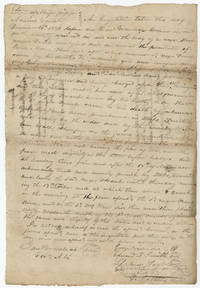
182122479<p>A Mississippi inquest holds a slave overseer accountable for killing a slave.</p> <b>SLAVERY.</b>Manuscript Document Signed by George Newman Edward T. Smith Sheppard Taylor Elijah Norman Hezekiah Kibbee David Collins and Daniel Greenleaf. Adams County Mississippi December 16 1821 1p. 8 5/8 x 12 3/8 in.<p><b><br /></b></p><p><b>Partial Transcript:</b></p><p><i>"the sd negro Frank came to his death by inhuman treatment and severe punishment in stocks starvation and lashes by the order and by the hand of William Wall.and so the sd Wm. Wall did then and there feloniously cause the death of the sd Negro Frank against the peace and dignity of the state and so we say all."</i></p> books
1728100536<p>Pamphlet 8vo modern full calf in the style of an 18th century Cambridge binding 32 pp.Very slight aging; in excellent condition. This is a rare first edition of a work that presents a complaint by British planters in the West Indies concerning the Assiento or agreement with Spain that gave Britain a virtual monopoly on the African slave trade. This agreement came out of the Treaty of Utrecht which ended the War of the Spanish Succession. This pamphlet indicates that the planters feared as a result of this agreement British slavers might be required to provide African slaves to the Spanish colonies which could result in insufficient numbers available for the West India plantations. The Assiento with Spain would mark the beginning of the Atlantic slave trade as a very powerful economic growth engine. Unfortunately this would translate into millions of Africans being taken from their homes.</p> H. Whitridge
18091187761809. First Edition. SLAVERYABOLITION MONTGOMERY James GRAHAME James and BENGER Elizabeth. Poems on the Abolition of the Slave Trade. London: Printed for R. Bowyer 1809 i.e. 1810. Tall quarto contemporary brown calf gilt rebacked with original spine laid down raised bands marbled endpapers and edges. $2000.First edition of famed publisher and artist Bowyers richly illustrated volume featuring eloquent anti-slavery poems by Montgomery Grahame and Benger a major antislavery work issued shortly after Britains abolition of the slave trade with engraved portraits of abolitionists Sharpe Clarkson and Wilberforce engraved allegorical title page and nine full-page engravings after paintings by artist Sir Robert Smirke a handsome wide-margined copy in contemporary boards.This handsomely illustrated volume features three epic poemsMontgomery's The West Indies Grahame's Africa Delivered and Elizabeth Benger's A Poem Occasioned by the Abolition of the Slave Trade in 1806. All were ""commissioned by the London publisher Robert Bowyer for inclusion in a lavish volume of antislavery poetry timed to celebrate the abolition of the slave trade"" Basker Amazing Grace 612. With biographies and engraved full-page medallion portraits of leading British abolitionists Sharpe Clarkson and Wilberforce Poems on the Abolition of the Slave Trade is especially noted for its nine full-page engravings and the allegorical title page vignette engraved by Scriven and Worthington after paintings by renowned artist Sir Robert Smirke whose works were considered ""gems in the art of history painting"" American Daily Advertiser. On presenting a copy to George III Bowyer described this as a ""most beautifully embellished volume of Poems which have been written expressly for the occasion on the Abolition of the Slave Trade"" Baptist Quarterly 35. Poems won early critical praise as an ""elegant publication on the Abolition of this traffic and we congratulate the poets the artist and the editor"" Monthly Review. First edition: plates dated ""Dec. 1 1809""; portraits dated ""Jan 1 1810."" With engraved and letterpress title pages. With directions to the binder leaf bound in at rear. Lowndes 1591. Goldsmiths 19923. Kress B5549. Sabin 50145. Benezit IX:656. Occasional faint foxing chiefly marginal. A near-fine copy scarce and desirable in contemporary binding. hardcover
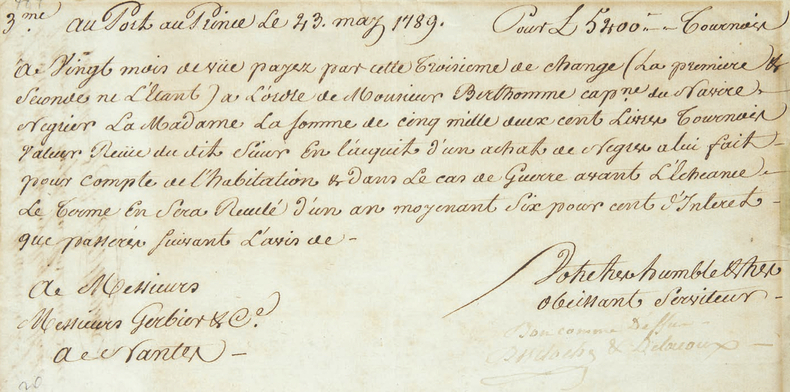
1789YQV-13Port-au-Prince, 23 mars 1789 Un billet in-8 oblong (128 × 243 mm), manuscrit à la plume au recto (11 lignes) et au verso (4 lignes), encre noire.
18407120Paris, Imprimerie Royale, 1840-1841. 4 volumes in-8 (225 x 114 mm), (10)-XXXII-343 pp. + (4)-V-(3)-430 pp. + (4)-XVI-546 pp. + (4)-504 pp., reliure d'époque demi-veau, coiffes frottées, un mors fendu en tête sur 5 cm ( tome II), frottements aux mors du tome IV, coins frottés, sur tous les volumes un cachet de la bibliothèque de la Société des études coloniales et maritimes sur le feuillet de garde et sur la première page de texte.
1863101890Letterpress broadside 18 7/8" x 11 3/4" bold black type for highlighted words. Paper evenly toned some wrinkling considerable archival conservation and restoration with archival paper repair; despite the imperfections it is still a decent copy with a nice impression. This appears to fall into the political dirty tricks department in an election between John Brodhead and Henry Bumm for city treasurer in Philadelphia. The broadside is supposed to highlight a letter from John Brodhead to Jefferson Davis in 1860. It has strong racist overtones as Brodhead supposedly requests a position in Nicaragua so he can "help open it up to civilization and Niggers." He goes on to state he is "tired of being a white slave at the North and long for a home in the sunny South." These kinds of political tricks were not uncommon during the Civil War period perhaps that's still true today and the racist overtones would certainly not help one's chances in a Northern election.
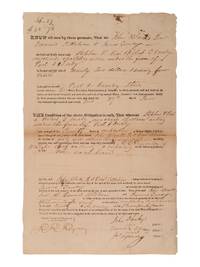
1822215261822. Manuscript debt bonds created in Mecklenburg County North Carolina during the early 1820s document the use of enslaved people as collateral within the financial system of the antebellum South. These legal instruments record obligations owed between creditors and debtors while identifying enslaved individuals as property subject to seizure in the event of nonpayment. Such documents illustrate the legal framework through which slavery operated as both a labor system and an economic structure where enslaved men women and children were routinely mortgaged pledged and sold to satisfy financial claims. Surviving manuscript bonds naming enslaved individuals provide direct evidence of the mechanisms through which courts and creditors enforced debt within slaveholding societies.<br /> <br /> Archive of three partially printed manuscript bonds completed in ink each measuring approximately 12 x 8 inches and bearing signatures of the involved parties. 1 Blanks John; Tillotson Edward; and Turney James. Debt bond to Stephen P. Pool and Robert O. Courby. Mecklenburg County North Carolina: 27 June 1822. The document binds the debtors for "ninety five dollars and seventy four cents" secured against property including "one land horse" with a notation on the reverse indicating the obligation was later settled by payment. 2 Carter Charles and Bullock John P. Bond to Thomas Howerton and John F. Howerton. Mecklenburg County North Carolina: 21 March 1823. The bond records a debt of $2214.67 associated with a writ of fieri facias issued against the estate of Charles Carter and identifies "one Negro man named Manuel Jack" as collateral subject to seizure if the debt remained unpaid. 3 Lenton Charles. Bond to James and John H. Irwin for the benefit of Michael Newton. Mecklenburg County North Carolina: 23 April 1823. This document binds Lenton for $337.42 and identifies "one Negro boy by the name of Peter" as property pledged to secure the obligation specifying that the enslaved child must be produced for sale if required under the terms of the writ.<br /> <br /> During the nineteenth century enslaved people were legally classified as chattel property under the laws of slaveholding states allowing them to be mortgaged seized by courts and transferred between owners as part of debt enforcement procedures. Legal instruments such as bonds and writs of fieri facias formed part of the judicial process through which creditors pursued unpaid obligations and frequently resulted in the forced sale of enslaved individuals. Documents naming individuals such as Manuel Jack and Peter provide stark evidence of how the legal and financial systems of the American South treated human lives as collateral within commercial transactions. Three manuscript bonds written on partially printed forms with handwritten text and signatures. Light creasing toning and handling wear consistent with age; text remains clear and legible. Overall very good condition. The archive preserves primary documentary evidence of the legal and economic structures sustaining slavery in the early nineteenth century United States. unknown
1863101890Letterpress broadside 18 7/8" x 11 3/4" bold black type for highlighted words. Paper evenly toned some wrinkling considerable archival conservation and restoration with archival paper repair; despite the imperfections it is still a decent copy with a nice impression. This appears to fall into the political dirty tricks department in an election between John Brodhead and Henry Bumm for city treasurer in Philadelphia. The broadside is supposed to highlight a letter from John Brodhead to Jefferson Davis in 1860. It has strong racist overtones as Brodhead supposedly requests a position in Nicaragua so he can "help open it up to civilization and Niggers." He goes on to state he is "tired of being a white slave at the North and long for a home in the sunny South." These kinds of political tricks were not uncommon during the Civil War period perhaps that's still true today and the racist overtones would certainly not help one's chances in a Northern election. books
18161138361816. First Edition. SLAVERY. The Interference of the British Legislature in the Internal Concerns of the West India Islands Respecting Their Slaves Deprecated. London: J. Mawman 1816. Slim octavo modern blue-gray paper wrappers; pp. 58. $1800.First edition of this defense of the West Indian slave trade arguing against emancipation.Cloaked in pro-abolition language and anonymously written by a person claiming to be an abolitionist this work is actually a zealous condemnation of British interference in the slave trade of the West Indies. After briefly discussing the abolition movement the 1807 act abolishing slavery in britain and prominent anti-slavery organization the author sets out to make his main argument: that a bill requiring registry of slaves in the West Indies would infringe on the rights of those colonies. The author swiftly aligns himself with the interests of the West Indian Planters arguing that abolishing slavery is a different cause from emancipating people of African descent. He points out that this bill is merely the first in a projected series of measures meant to emancipate the Black population of the West Indies. Set in the awkward period between 1807 and 1833 when slavery in Britain was illegal but the slave trade still thrived abroad this work makes sense of obvious hypocrisy by arguing that slavery was permitted by God and that Blacks of African descent were better off as slaves than in Africa. The will of those against slavery proved stronger and complete abolition eventually became the law of the land. Sabin 34904. Kress 21649. This work last appeared at auction over 25 years ago; prior to that it had not been seen since the 1940s.Interior quite clean with only slight pressure offsetting toning to spine of modern wrappers. A beautiful copy in fine condition. unknown
17921262151792. HAITI SLAVERY. A Particular Account of the Insurrection of the Negroes of St. Domingo Begun in August 1791: Translated from the French caption title as issued. London: 1792. Slim octavo modern green cloth; pp. 32. $1800.Fourth edition published one year after the very rare first of this sensationalistic account of the early months of the Slave Rebellion in Haiti the beginnings of the Haitian Revolution which ultimately led to the establishment of the first independent black state in the New World. The publishers of this polemic hoped to frighten the British public and turn them away from the abolitionists Wilberforce and Clarkson who were trying to put and end to slavery in the British colonies in the West Indies.Translated into English this is a speech to France's National Assembly ""by the Deputies from the General Assembly of the French part of St. Domingo."" The tract provides a frightening and grisly account of the August 1791 Slave Rebellion the result of ""a plot to set fire to the plantations and to murder all the whites."" The start of the insurrection by its ""perfidious"" leaders resulted in a catalogue of horrors and atrocities as the rebels ""spread over the plain with dreadful shouts set fires to houses and canes and massacred the inhabitants."" The ""fury of the cannibals"" is recounted in gory detail. The Speech is signed at the bottom of page 19 by six Deputies who call the insurrection ""the greatest calamity that has visited the human race in the course of the eighteenth century."" An Appendix records Letters and Speeches concerning the Rebellion. ESTC T110428. Goldsmiths' 15167. See Sabin 58932 1791 first edition; LCP 7460 2nd edition 1792; Work 349 1832 printing. First and last leaf slightly darkened text quite clean. Trimmed irregularly along upper margin affecting page numbers on two leaves but not any text. A very good copy of this scarce item. hardcover
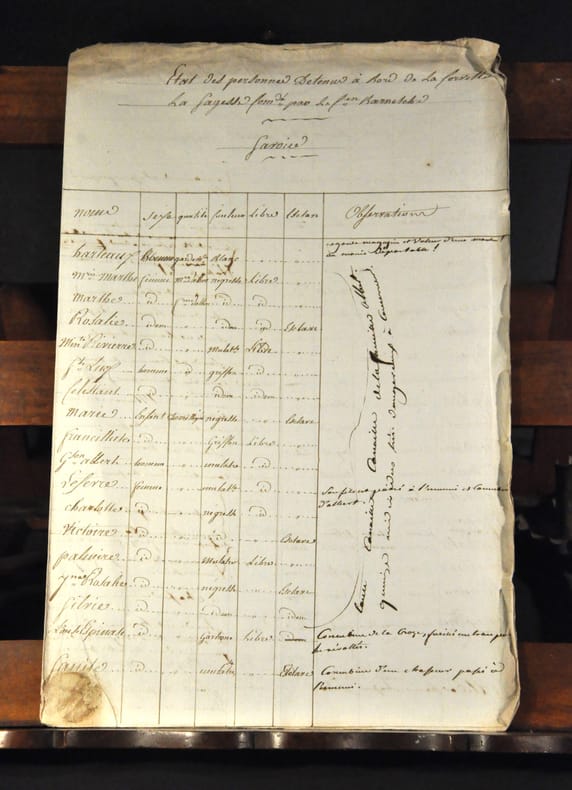
1803301729 germinal An 11 (19 avril 1803) 1803 Trois pages in-folio sur papier filigrané « Texier Ponbreton » aux armes du bonnet frégien (An 2). Manuscrit à l’encre brune, se composant d’un tableau détaillant la condition des personnes détenues à bord de la corvette. Les catégories sont : nom / sexe / qualité / couleur / libre / esclave / observations. Il s’agit de l’état dressé des prisonniers, libres et esclaves, détenus à bord de la corvette « La Sagesse » le 29 germinal an 11 (19 avril 1803) en rade du Fort « Dhauphin » (Fort liberté). Le document est signé par le capitaine commandant Barnetche et l’agent comptable Peychaud. La liste contient quarante-quatre noms dans lesquels on ne relève que quatre blancs, les catégories font frémir : blanc, négresse libre, négresse esclave, mulâtre libre, griffon (enfant issu d’un.e mulâtre et d’un.e noir.e), gartron , nergilion … Les observations portées en marge sont explicites. En voici quelques exemples. "Harteaux", homme, blanc , « vagabond magasin et voleur d’une montre ! Au moins déportation ! »Tous les membres proches de la famille d’Albert qu’ils soient libres ou esclaves sont affublés du commentaire suivant « Canaille Canaille de la famille Albert. Quinze individus très dangereux à conserver (gouverner ?) »Leferve, femme mulâtre, libre : « Son fils est passé à l’ennemi et carabinier d’Albert »On note le nom de Marie, domestique, caractéristique : « enfant, négresse et esclave. » Plus loin Louis d’Espinase, une femme quarteronne, libre : « Concubine de La Croze, fusillé (…) » La majorité des détenus sont des femmes comme cette Cassile, mulâtresse esclave qualifiée de « Concubine d’un chasseur passé à l’ennemi ». Un autre blanc se glisse au milieu de cette sinistre liste, il s’appelle Bassidaux, c’est « un lâche et un traitre », il écrit « fusillable » souligné deux fois, puis encore « Ce Bassidaux est fusillable ! » Sur d’autres « Je ne veux point de ces hommes chasseurs » « Concubine de chasseur » Fanchonelle, femme, négresse, esclave « Concubine d’un chasseur passé à l’ennemi ».Sophie, blanche, taxée de « Concubine de l’Univers et d’un chasseur ennemi » Quasiment tous les prisonniers ont le droit à ces commentaires cinglants « coquinissime », « déportable », « ce français italien de nation » , « parente des deux babys fusillées hier » « à chasser ». Sur des négrillons, esclaves : « enfants : très petits enfants »
ORD-12743Paris. Imprimerie Royale. Juin 1844. In-4 (220 x 270mm) cartonnage vert de l'éditeur, 2ff., 668 pages. Cachet de bibliothèque au fx-titre, qq. pages brunies, couverture un peu tachée mais exemplaire solide en plutôt bon état. Ouvrage rare et d'une grande importance sur la condition des esclaves dans les colonies françaises, paru avant l'acte d'émancipation en Avril 1848. Sabin, 14712.
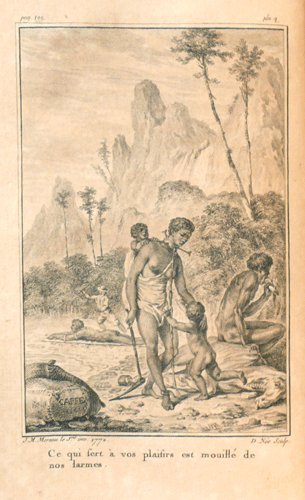
17730034671773 Amsterdam, et se trouve à Paris, Chez Merlin, 1773. Deux volumes in-8 (134 X 205 mm) veau fauve marbré, encadrement de filet à froid sur les plats, dos cinq nerfs, caissons dorés avec fleuron central, large dentelle en queue et tête, coupes et coiffes ornées, pièces de titre et de tomaison maroquin rouge, tranches rouges (reliure de l'époque). Tome I : (1) f. blanc, faux-titre, frontispice, titre, 328 pages, 3 planches et 4 tableaux dépliants, (1) f. blanc ; Tome II : faux-titre, titre, 278 pages, 2 planches, (1) f. blanc. Notice ancienne collée sur le premier contreplat du tome I. Les planches de Moreau sont brunies.
243 pages. Tissue-protected frontis photo portrait of author. Attractively decorated maroon cloth-covered front board. All seventeen black and white plates present. "An autobiographical account of the author's first twelve years (from 1862 to September 1873) as a Methodist missionary among the Cowichan and Nanaimo Indians." - Lowther. Average wear. Prior owner's name in light pencil upon front free endpaper. Faint moisture marks to fore-edge of first twenty-five pages. Hinges starting. Issued without dust jacket. LOWTHER 1556, RICKS p.75, AMTMANN 3499, SMITH 2134, WALLACE p.52, MATTHEWS 295, TOD & CORDINGLEY p.85. Book