111 résultats
12719Front Page Headline reads "The Bill Abolishing Slavery in the District of Columbia Passed the House." Newspaper "The Detroit Free Press" April 12 1862. 19" x 26" 2 pages. Has a blow by blow account of the debate among the members of the House and the various amendments associated with the bill. It concludes "The bill was passed 93 agains 39." Also includes local national and international news as well as "News From the South." Some small tears at the left hand margin not affecting text. A diagonal crease runs across the top half of the paper and a small piece of yellow tape has adhered to the top margin. Overall in very good condition. unknown books
18361691Boston: Isaac Knapp 1836. About very good. xvi13-238pp. 12mo. Original publisher's blue boards with black sheep spine gilt. Boards rubbed corners and spine moderately worn. Text lightly foxed. Scarce work addressing the anti-slavery work of George Thompson following his visit to America. Thompson 1804-1878 was British lecturer and reformer who worked as a commercial clerk.<br/><br/>"Thompson first came to prominence in 1831 when he was recruited by the London Anti-Slavery Society's Agency Committee as an itinerant lecturer. In the run up to the Emancipation Act of 1833 he became the most effective British anti-slavery lecturer since Thomas Clarkson. With the struggle against British slavery apparently won Thompson was instrumental in reorienting anti-slavery effort towards the Americas and particularly the United States. . In 1834 he encountered the charismatic American abolitionist William Lloyd Garrison. Recognizing Thompson's talent Garrison invited him to travel to the United States with his growing family to labour there on behalf of the enslaved people of America" - DNB. Thompson employed sarcasm and vitriol in his orations attacking anti-abolitionist sentiment across the northern states. In the process he failed to make very many friends or converts and alienated those with more moderate views.<br/><br/>"Opponents attacked him as a foreign interloper and an anti-American agitator. They also discovered a scandal in Thompson's past alleging that in 1829 he had absconded with £80 embezzled from his employer. His supporters angrily rejected this charge though Thompson later privately admitted it was true he eventually repaid the sum in full. Hostility increasingly turned violent and in fear of his life he was smuggled out of the country in October 1835 returning to a hero's welcome in Britain" - DNB.<br/><br/>This work is a rebuttal made by Thompson's American supporters aggregating information from British sources to defend his good name and abolitionist efforts after fleeing America for his homeland. It includes some of Thompson's speeches on slavery in America given before audiences in Scotland and England and discusses his work with the American Anti-Slavery Society. Though there are a handful of institutional copies the work is scarce on the market and does not appear in auction records over the pasty forty years.<br/> Sabin 9324. American Imprints 36449. Isaac Knapp unknown books
46418Liverpool: 1843. Quarto sheet folded once to make 4pp. Signed in three places "Emily Taylor"; marked "Private;" and "for Mrs. Chapman." Mild cover soil; small loss at right margin from opening; slight fading to ink. Very Good. Includes brief introductory followed by an anti-slavery poem of 67 lines "For the Liberty Bell" submitted for publication in the American gift annual of that name. Numerous ink corrections to the text in the author's hand. English poet and hymnist Emily Taylor 1795-1872 was the author of more than twenty books including the book-length anti-slavery poem The Vision of Las Casas 1825. Though best-known as an author of historical works for children she was also a prolific hymnist contributing more than a dozen works to various Unitarian hymnals in the first decades of the 19th century possibly providing her connection to Follen also a well-known hymnist. The present letter is addressed to the prominent abolitionist author Eliza Lee Follen of Boston and opens: "My dear Madam Our mutual friend Harriet Martineau assures me of a kind reception from you and accordingly I transcribe for you a few lines written immediately on reading your Liberty Bell for 1843. If you are to enroll my name among those which I hold so holy & dear as your contributors in the Abolition cause please to accept them." The substantial 67-line poem which follows begins with the prologue: "To a friend who asked the author's aid and prayers for the slave;" and continues: "Pity & prayers and pleading for the Slaves! / Them thou didst ask and soon as ask'd I gave." The poem goes on to extend the by-then familiar argument that the institution of slavery makes slaves not only of its subjects but of its perpetrators as well. Taylor concludes as a postscript on the final leaf: "Would you dear Mrs. Follen forward the enclosed to Mrs. Chapman Maria Weston Chapman editor of The Liberty Bell .I am sorry but do not know Mrs. C's address." <br/><br/>The poem was in fact published without revisions as "To A Friend" in the 1844 edition of Chapman's important anti-slavery gift annual The Liberty Bell; other contributors to this edition included James Russell Lowell Lydia Maria Child Harriet Martineau Amasa Walker William Llloyd Garrison and others. The recipient of the letter Eliza Lee Cabot Follen was herself a prominent and prolific abolitionist author scion of the Cabots of Boston and part of the Boston social circle that included William Ellery Channing Henry Ware George Ticknor and other patrician intellectuals of the period. An excellent and representative letter and manuscript involving three key women figures in the abolitionist movement during a particularly heady period for the cause. unknown books
184045421Mobile AL Aug. 10 1840. Autograph letter signed on first and second panels of single bifolium sheet 25.5cm.; approx. 370 words. Previous folds the whole rather wrinkled postally used on rear panel else Very Good. Letter from Jesse Bemis 1808-1843 a Mobile transplant to his brother David of Spencer Worcester Co. Massachusetts where Jesse was born. The author thanks his brother for some fly nets sent him "I have sold about half of them at some profit" later noting that "they are not only worn on horses but they are used to spread over the cradles of the Negro Children as a screen the Negro women also wear them to Church & on dressy occasions. I hope the Abolition Missionarys wont find it out before I can dispose of all that I have for frear that they will glut the market." Bemis goes on to describe the election of 1840 "the tightes sic election in the State that ever was it took place the 3d of this month in this County we elected the whig ticket throughout" and goes so far to mention that "The women say out with Van Buren & give us the credit system." Indeed the women had their way as Van Buren lost to Harrison in large part thanks to the efforts of the Whig Party. unknown books
D16245London: Printed for Harvey and Darton Gracechurch-Street. 1827. Hardcover. Good. 8vo 185 x 115mm. Pagination: xi 88pp. Signatures: 4-b2 B-D12 E8. Title page with four-line excerpt of poem The Negroes Complaint by William Cowper written in 1788 and printed in an English anti-slavery pamphlet: Fleecy looks and black complexion Cannot forfeit natures claim: Skins may differ but affection Dwells in white and black the same. Contemporary possibly original boards backed with modern cloth edges uncut; title with loss at top some light marginal staining mostly at front and rear leaves and to covers; otherwise good. <br/><br/>Anonymously published signed only A lover of Africa the Anecdotes of Africans expressed the human identity of African slaves through a selection of stories and travels which largely related to the slavery at the Cape of Good Hope. Throughout the late 18th and early 19th-centuries an increasingly vocal anti-slavery sentiment rippled through both sides of the Atlantic. Authors who published anti-slavery works - hymns poems and anecdotes - believed that by arousing the feelings of human fellowship they could win the argument for racial equality. This book is exceedingly rare OCLC locates scarce print copies at Drew University Library Haverford College Library and the source library for widely held digitized copies is Goldsmiths Library University of London. See Goldsmiths-Kress Library of Economic Literature no. 25379. Printed for Harvey and Darton hardcover books
183612488New York September 1836. Used; Like New/Used; Like New. Folio. 4 pp printed in four columns per page. Tears around edges creased and with significant toning to the upper front half and extensive foxing throughout. <br><br><br />This rare monthly an organ of the American Anti-Slavery Society began in July 1835 and ended with the February 1839 issue. Among other interesting features the present issue prints a "Form of a Petition for the Abolition of Slavery in the District of Columbia. To The Congress of the United States." Not in Lomazow Mott Sabin. OCLC records copies from all the other years but no copies of this issue. <br><br><br />While there was opposition to slavery in the nation's capital the greater forces against slavery came from the outside through newspapers and petitions. Many petitioned Congress to end slavery in the nation's capital and the organizing efforts in the District included the Washington Abolition Society which was organized in 1827. But the opposition to ending slavery and the slave trade in the District was such a contested issue that a gag rule instituted in 1836 prohibited a discussion of slavery on the floor of Congress. Though Abolitionists including John Quincy Adams vehemently opposed the gag rule standard-bearers of slavery in the District fought tirelessly for it. Eventually in 1848 the House of Representative passed a resolution to prohibit the slave trade in the District of Columbia. Although the resolution did not gain enough traction to end the slave trade in the District it played an influential role in the congressional debates over slavery and the slave trade. The Compromise of 1850 admitted California in the Union as a free state; the former Mexican territories were admitted as part slaveholding states and part free soilers states; and the slave trade in the District of Columbia was abolished. The 1850 Compromise provided the necessary momentum for the enactment of the District of Columbia Compensated Emancipation Act of April 16 1862 that abolished slavery in the Nation's Capital. unknown books
17680Used; Like New/Used; Like New. Rare pair of Anti-Slavery tokens produced for the Society for Effecting the Abolition of the Slave Trade established by Granville Sharp and Thomas Clarkson in 1787. The first shows the society's emblem of a chained African man naked and kneeling "Am I not a Man and a Brother" around the perimeter on obverse "May Slavery & Oppression Cease Throughout the World" around the perimeter and clasped hands in print formats generally one is black and one white in the center on reverse. The other example shows a kneeling woman and "Am I not a Woman & a Sister" 1838" on obverse "United States of America" with backwards "N" olive wreath with "Liberty / 1838" in center on reverse. These were commissioned by the American Anti-Slavery society to evoke pity for enslaved women as well as to foster equal rights for women.  Bronze. Diam. 1 5/16 inches 30 mm.  First somewhat worn and the "Sister" is slightly worn on recto just a few high points and the date below "Liberty" on the verso; the "Brother" with a loss on the recto. Not formally "graded" but overall very good.<br>Josiah Wedgewood 1730-1795 a dedicated abolitionist and close friend of Thomas Clarkson designed the "logo" of the kneeling slave for the Society for the Abolition of Slavery in 1787. This was taken up by the American abolitionists and in 1835 Patrick Reason a young black engraver created a version of a kneeling woman that bore the caption "Am I not a Woman and a Sister" This image together with that of the infamous slave ship's hold are without question the most iconic of the anti-slavery movement on both sides of the Atlantic. unknown books
18379Used; Like New/Used; Like New. An English tobacco box bearing the kneeling slave iconography of the abolitionist movement dating to the mid-19th Century. Height 4 x width 3.75 x depth 5.5 inches 10 x 9.5 x 14 cm. Oxidation and pitting from age handle is old but may not be original to the box else fine.<br style="">Josiah Wedgewood 1730-1795 a dedicated abolitionist and close friend of Thomas Clarkson designed the "logo" of the kneeling slave for the Society for the Abolition of Slavery in 1787. This was taken up by the American abolitionists and in 1835 Patrick Reason a young black engraver created a version of a kneeling woman that bore the caption "Am I not a Woman and a Sister" This image together with that of the infamous slave ship's hold are without question the most iconic of the anti-slavery movement on both sides of the Atlantic. unknown books
185327110Washington: C. Alexander Printer 1853. 1st thus Dumond p. 13. Disbound lacking wrappers. Overall VG occasional spot of foxing. 36 pp. 8vo. <br/><br/> C. Alexander, Printer unknown books
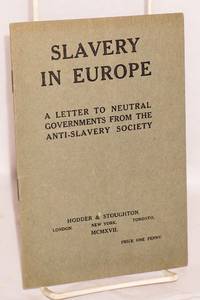
191795392London: Hodder & Stoughton 1917. Pamphlet. 8p. 4.75x7.25 inches very good in original stapled wraps. A call to denounce the actions of Germany in Belgium and the north of France during World War One where the Germans deported large numbers of Belgians and French to slave-labor sites in Germany. Hodder & Stoughton unknown books
194225070London: Anti-Slavery and Aborigines Protection Society 1942. First Edition. Octavo 24.5cm.; staplebound self-wrappers; 53-66pp. Dust-soiling edge wear from handling with very shallow separation at spine crown; about Very Good. Anti-Slavery and Aborigines Protection Society unknown books
196942016NY: Negro Universities Press 1969. Reprint of the 1861 edition. 8vo pp. 337. Appendix index. Top edge spotted o/w a VG tight copy. Negro Universities Press unknown books
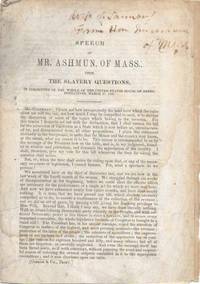
185027010Washington: Gideon & Co. Print 1850. 1st separate. INSCRIBED by Ashmun in the top margin. Self wrappers. Gd outer leaves soiled/some staining. 16 pp. Unopened. 8vo. <br/><br/>Not in Dumond. Gideon & Co., Print unknown books
186027124Washington DC: Buell & Blanchard Printers 1860. 1st separate. Not in Dumond. Disbound. VG some soiling. 15 1 pp. Last page with printer imprint/date. 8vo. <br/><br/> Buell & Blanchard, Printers unknown books
1818568111818. Calhoun signed the Revolutionary War pension claim of Robert Hamilton of Massachusetts who had been a Lieutenant in the Army of the Revolution. Some marginal chiping and tears at the fold affecting the "J" in the signature of J.C. Calhoun. A good copy. Wikipedia: "John Caldwell Calhoun:March 18 1782 - March 31 1850 was an American statesman and political theorist from South Carolina who is best remembered for his strong defense of slavery and for advancing the concept of minority rights in politics which he did in the context of defending Southern values from perceived Northern threats. He began his political career as a nationalist modernizer and proponent of a strong national government and protective tariffs. By the late 1820s his views reversed and he became a leading proponent of states' rights limited government nullification and opposition to high tariffs-he saw Northern acceptance of these policies as the only way to keep the South in the Union. His beliefs and warnings heavily influenced the South's secession from the Union in 1860-61. Calhoun began his political career with election to the House of Representatives. As a prominent leader of the war hawk faction Calhoun strongly supported the War of 1812 to defend American honor against Britain. He then served as Secretary of War under President James Monroe and in his position reorganized and modernized the War Department. In the 1824 presidential election he was the overwhelming choice of the electoral college for Vice President of the United States. He served under John Quincy Adams and continued under Andrew Jackson who defeated Adams in 1828. unknown books
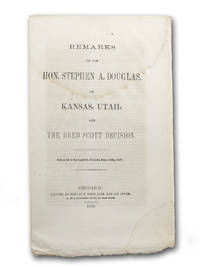
185718536Chicago: Printed at the Daily Times Book and Job Office 1857. First Chicago edition. Light damp-stain to the upper third of the sheet small stain to the lower outer corner; a very good copy. Original self-wrappers 10.25 x 6 inches 15 pages untrimmed. Unopened. Per Byrd "This speech was the first public expression of his views on the Dred Scott decision. In it he accepted the decision and insisted that 'the whole principle of Popular Sovereignty and self-government is sustained and firmly established by the authority of this decision.' " Byrd also notes this pamphlet was intended to lay the groundwork for his 1858 re-election. An edition printed in Springfield and an 8-page edition without an imprint also appeared the same year as well as an edition in German. Flake Mormon Bibliography 2985; Ante-Fire Imprints 250; Byrd 2635. Printed at the Daily Times Book and Job Office, unknown books
1864WRCAM53096Richmond 1864. Broadside 18 x 12 inches. Printed in three columns. Previously folded with a couple small separations along old fold lines. Light toning and foxing. About very good. A very scarce and quite interesting broadside circular printing of the act which allowed slaves and free blacks to be used in certain tasks by the Confederate Army during the Civil War as well as instructions for the conscription and induction of those men into the armed forces. The Confederacy was loath to arm any of its slave population but by 1864 could not spare any further manpower from their infantry to perform menial tasks and the government therefore passed a law allowing slaves to be used "in certain capacities" such as the construction of fortification the production of arms and the transport of materiel. The first column of this broadside comprises a full printing of that law while the remainder sets forth the rules for the impressment of slaves into military service for their care while in service and for the compensation of their owners. <br> <br> A fascinating piece that lays bare the desperation of the Confederacy for labor and supplies in early 1864. Not in Parrish & Willingham. unknown books
185019425Philadelphia March 20 1850. Portion of the blank leaf clipped traces of a partially-removed decal from the blank verso; a little foxed in very good condition. Quite legible. 1.5 pages in autograph ink on a lined blue folio approx. 250 words. Integral address. On the negotiation for and Methodist process of returning the missionary Seys to Liberia as a colonization agent: "I this morning presented your communication and also Mr. PinneyÃs to my colleagues. Their conclusion was expressed as follows. 'Agreed that we still abide by our decision of last year ñ That we have authority to make appointments to agencies for the Colonization cause ñ 2d That we are not willing to advise Br. Seys as to the expediency of his accepting such an agency but leave that to his own discretion. 3d That at present we see no insuperable difficulty in the way of his appointment as Agent of the Colonization Society of Maryland at the next session of the New York Conference provided that previous to that time he receives a commission from said society and decides to accept the appointment.' In order to relieve your mind on the other point I will inform you that I see no way of deciding the question of a Superintendent to Liberia for some time to come. We do not just it safe and proper to give personal advice to brethren in regard to such appointments." Seys was a native of Trinidad and according to later accounts of colonization societies had been an overseer on a family plantation until a conversion experience led him to Methodism abolition and emigration to the United States. Seys here appears to have been angling for a return to Liberia as a colonization agent a goal at which he seems to have succeeded; he would be named Minister and Consul to Liberia in 1866. With a preliminary typescript. March 20, unknown books
182532015London: Knight and Bagster 1825. One of several editions issued in 1825. Folio 4pp. Self wraps some marginal soiling and nicks bent at folds a very good copy. Library Company Afro-Americana 4293. OCLC lists just the Library Company copy; not in Dumond or Work. Formed because the 1807 Act to abolish the slave trade had failed to diminish "the prevalence of the very evils which it was one great object of the Abolition to remedy" the Society reviews the stranglehold that West Indian slavery is gaining. Its proceedings examine conditions in each of the West Indian colonies including "the threat of Jamaica to renounce her allegiance" to Britain. Information is also presented concerning Haiti and the effect of that country's upheavals on the British colonies. Knight and Bagster unknown books
18732024Cuba 1873. About very good. 3 folio leaves. Light wear at edges a couple of small chips at lower left edge of each leaf. Light tanning and foxing. Accomplished in a neat legible script. Scarce manuscript listing of slaves and indentured servants from a Cuban sugar plantation. The present list was made in January 1873 on the Ingenio Tartesio east of Havana near the small village of Las Pozas. On two separate sheets nine Chinese and twenty-eight African or Criollo men are listed as rented to the farm; on a third sheet eighteen slave births for 1873 and 1874 are recorded giving names mothers and dates of birth. The Chinese men are identified simply by first name and owner; the African and other slaves are listed with additional details such as nationality age owner. A section for additional observations notes which slaves have run away and at least one death. A fascinating document of slave hires on an isolated Cuban plantation during the 1870s. unknown books
1865974Santiago de Cuba 1865. Very good. 10 leaves. Removed from a larger volume and restitched. Minor wear and one small area of worming at edges. Light tanning and foxing. Accomplished in several legible hands. A fantastic set of manuscript records for a slave auction house the General Slave Depository in Santiago de Cuba dating to January 1865. Santiago along with Havana and Cienfuegos was one of three major sites for slave sales on the island during the 19th century. The first leaf of the document provides a statement that the documents were assembled in accordance with the rules established for slave auctions which had been updated and approved at the end of the previous year. The second two documents lay out mortgage agreements and financial obligations between the slave house and the Real Sociedad Economica de Amigos de Pais of the city in which the auction owners acknowledge debts and forthcoming payments on the order of several thousand pesos. Following these are two leaves containing a "Relacion de los esclavos ecsistentes en el deposito de esta Ciudad en el dia de la fecha" that is a list of slaves at the depository on the day of the auction and their owners and renters which perhaps were a part of the collateral for securing the loan. A total of twenty-nine slaves are listed and the leaf that follows certifies that the list is correct according the to the director and the auctioneer of the depository. The final two leaves provide official recognition of the loan from two distinct government offices. All documents are signed by the relevant parties and government officials involved in the agreement. In all the present group of documents provides a detailed assessment of debts and human assets of the slave auction house in Santiago de Cuba in the mid-1860s and is a fascinating and valuable document of the bureaucracy and regulation surrounding the financial realities of selling slaves in Cuba during this period. unknown books
18772027Havana 1877. Very good. 1p. on a bifolium. Removed from a a bound volume with unobtrusive stabholes at gutter margin. Light wear at edges; light dust soiling and damp staining. Remarkable bidsheet submitted by a Cuban business in response to a newspaper advertisement for an auction of slaves for hire held in Havana during November 1877. The firm Jado Sarasúa y Compañia writes that "Enterada del anuncio publicado en la Gaceta fecha 9 del corriente para el arrendamineto en publica subasta de los esclavos existentes en el Asilo de San Jose pertenecientesa Bienes Embargados y sujentadose en un todo al pliego de Condiciones inserto en la misma Gaceta hace la siguente proposicion." Below is a list of fourteen slaves mostly women and the prices that the company is willing to offer for the slaves being rented ranging from ten to seventeen pesos per month. Signed and dated at the bottom "Habana Noviembre 14 de 1877. unknown books
18842025Matanzas 1884. Still very good. 3 leaves plus 4pp. pamphlet in original plain wrappers string tied. Light wear at edges. A few very small worm holes. Contemporary ink stamps. Light tanning and foxing. The Spanish Cortes approved a gradual manumission law in 1880 for slaves in Cuba that provided for an eight-year period of patronato tutelage for all slaves liberated according to the law which essentially amounted to indentured servitude. The transition to the patronato system was overseen by a provincial network of government agencies called Juntas de Patronato. Most of the workings of the slave system were preserved but patrocinados as former slaves came to be known received a minimal set of legal rights and were to be paid a token wage. <br/><br/>This fascinating set of Cuban manumission documents from the Junta de Patronato of Matanzas records this process and contains a rare cedula de patrocinado an identification booklet stating a slave is now a freedman with a supporting sponsor. The cedula completed in manuscript states that "Moreno Luis Morejon Natural de Africa.Vecino del Potrero Miraflores.Patrocinado de Da Josefa Morejon de Rodriguez" is "Gratis Sin Enmienda" as of September 15 1881. The second leaf of the pamphlet prints the rights of the freedman and the responsibilities of the sponsor such as the provision of food clothing and nominal salary. <br/><br/>The second document present here is a contemporaneous manuscript letter from Josefa Morejon de Rodriguez confirming that she will act as sponsor for the freedman and the final document dated January 28 1884 and signed by Rodriguez and the relevant local magistrates states that the sponsorship has been completed and is now legally concluded. With the ink stamp of the Matanzas Junta Provincial on first page and the contemporary stamps of several other relevant authorities. An outstanding record of the process of gradual manumission in Cuba during the last years of legal slavery on the island with a rare surviving freedman's identification book. unknown books
18562026Remedios 1856. About very good. 4pp. on a large bifolium. Printed form completed in manuscript. Separated at fold repaired with tissue. Light wear at edges. Light tanning and foxing. Rare Cuban population census form listing the number of residents in and around the town of Remedios located on the northern central coast of Cuba in 1856. The present document completed in manuscript lists the population according to various categories such as ethnicity and race age range occupations marital status location of residence and several others. The census includes slaves of African origin newly arrived Chinese indentured servants "colonos Asiaticos" immigrant laborers from Yucatan freedmen and free white residents "Blancos". In all there are just over 2000 people living in and around Remedios at this time comprising just over 1300 free whites over 300 free people of color 460 slaves and 19 Chinese laborers. One of the most interesting sections records the population by place of residence which shows that the great majority people in the area lived on estancias with a good part of the remaining population living on livestock farms and sugar plantations. On the final page are two additional sections which enumerate the types of property farms and other enterprises in the regions and provide statistics on agricultural and industrial production and land usage along with some manuscript notes with the signatures of the census takers or local magistrates. An interesting document of slavery agriculture and population in rural Cuba during the mid-19th century. unknown books
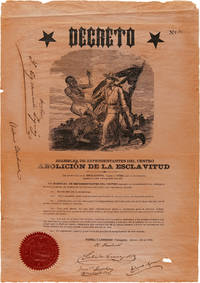
1869WRCAM56566Camagüey Cuba 1869. Pictorial letterpress broadside 18 1/2 x 13 inches. Numbered "54" in manuscript bearing the embossed red seal of the Republica Cubana and signed in ink by Salvador Cisneros y Betancourt Eduardo Agramonte Ignacio Agramonte Loyn áz Francisco Sánchez y Betancourt and Antonio Zambrana. Old horizontal folds minor creasing handful of small edge chips. Small hole in bottom margin just touching one ink signature. Very good condition. A rare and significant pictorial Cuban decree from the provisional rebel government abolishing slavery on the part of the island they controlled issued by the radical faction of the Cuban nationalists fighting against Spanish rule in the first months of the Ten Years' War. <br> <br> This proclamation is illustrated with a dramatic woodcut signed "LFR" depicting an ill-clad but exultant freed slave and a rebel celebrating in front of the Cuban flag. This decree stipulated freedom for all the enslaved people of Cuba in hopes that they would join the revolutionary struggle. The decree also provided for eventual compensation to slaveholders and ordered that freed individuals must serve the revolution either through military service or by continuing with their previous work. Among the important leaders who signed the present document were Salvador Cisneros y Betancourt as president just below the printed text and Ignacio Agramonte y Loynáz as secretary to the left of the engraving. <br> <br> The practical effect of this decree was modest as the rebels only controlled limited territory before their ultimate defeat and their territory was generally under the control of more conservative military commanders but such a proclamation joined a growing chorus of abolitionist sentiment in Cuba which finally realized the end of slavery in 1886. A powerful statement of anti-slavery policy in mid-19th century Cuba with a striking illustration of a jubilant slave celebrating his short-lived freedom. Rare with no copies recorded in OCLC. unknown books