111 résultats
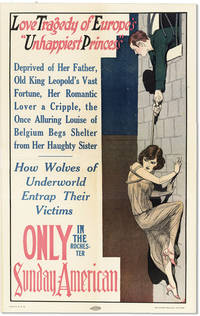
190415411Rochester: Office of the American 1904. Broadside extra lithographed in colors; 18" x 11". Single fold else fine. Colorful graphic depicting Princess Louise escaping from her asylum cell with the help of her illegitimate lover Geza Mattattich. The caption tempts readers with a White Slavery theme suggesting that Princess Louise has been lured to her ruin by a "Wolf of the Underworld." Unlocated. Office of the American unknown books
191026265Chicago and Boston: The Christian Witness Company 1910. First edition. Cloth. Good . Cloth-covered ocatvo with color illustration tipped on to the front panel. 418 pp. Illustrated frontis. Written and edited by Rev. F. M. Lehman with slum data furnished by Rev. N. K. Clarkson. With illustrations and a photograph. Covers lightly worn. Pages are somewhat darkened with age. The Christian Witness Company unknown books
191225858New York: The MacMillan Company 1912. First edition. Hardcover. Very Good. Hardbound 8vo. 219 pp plus ads at rear of volume. Gentle ex-libris copy with handsome Hartwick College Library illustrated bookplate afixed to thie inside front pastedown and a couple of tiny inked number notations to the copyright page. Otherwise a handsome very good copy. Book discusses the problems associated with "white slavery" and the treatment of young women of lesser means. The MacMillan Company hardcover books
16453The Light. September-October 1915. La Crosse Wisconsin: World's Purity Federation 1915. The World's Purity Federation focused on fighting public vice such as prostitution and sought to ensure proper morals in society. During the Progressive period reforming public vice was a growing movement that saw victories with the passage of prohibition and other regulations on public decency. Due in part of organziations like the World'd Purity Federation in 1910 the White Slave Trade Act also known as the Mann Act passed in US Congress outlawing the transport of women typically European immigrants across state lines for the purpose of prostitution. Activists continued to meet strategize and organize tactics to ensure that the new legislation would be upheld and expanded. Photo-illustrated portrait of president of Oxford College for Women Jane Sherzer PhD in academic cap and gown. Very good condition. unknown books
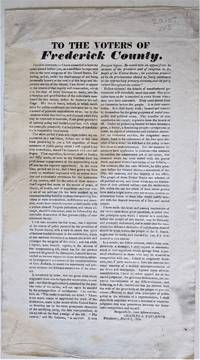
1833713Winchester Va. 1833. Broadside 4to. 290 x 160 mm. 11 ¼ x 6 ¼ inches.  Printed in two columns signed in type by Charles J. Faulkner at Winchester dated March 8 1833 at conclusion. Lightly dust-soiled pale stain affecting perhaps one-third of the left-hand margin and column of text. Neatly silked on verso. Withal about very good. Following the August 1831 Nat Turner rebellion in Southampton County a last effort was made by moderate Virginians to gradually abolish slavery. Faulkner a 26-year-old lawyer and assemblyman along with Thomas Jefferson Randolph sponsored legislation to free all children born of slave parents after July 4 1840. His speech emphasized the evil of slavery for Southern white labor noting that slavery "converts the energy of the community into indolence--its power into imbecility--its efficiency into weakness.Shall society suffer that the slave-holder may continue to gather his crop of human flesh" As the Assembly was malapportioned in favor of the Tidewater slaveocracy the proposal lost rather narrowly and nearly thirty years later the Confederacy was assured of Virginia's succession. It is perhaps not surprising that Faulkner "comparatively a stranger" to the county but a member of the Virginia House of Delegates at this time 1831-34 was not successful in his campaign to represent Virginia in the U.S. Senate. However Faulkner was elected to three terms in Congress from Virginia in the 1850s. He was elected to Congress from West Virginia after the Civil War. In the interim he served as Minister to France during the Buchanan administration and on the staff of Stonewall Jackson. Dictionary of American Biography.  Not in Hummel. Not found in American Imprints for 1833 and not in the 1830-1839 title index. OCLC records four copies at The Library of Virginia University of Virginia Virginia Historical Society and American Antiquarian Society. unknown books
1858WRCAM53597Charleston 1858. 16pp. Original printed wrappers. Spine perished held together with brass tacks; light chipping and soiling. Paper lightly and evenly toned. Good. Report submitted to the South Carolina Senate which concludes that slavery is essential to the agricultural production of the South. Additionally the committee felt that the slave trade helped relieve Africa from "the pressure of a redundant population as might be afforded by emigration in the only form in which its benefits can be extended to them." unknown books
188814044New York: Metropolitan Pub. Co 1888. First Edition. Octavo 19cm. Publisher's decorated deep mustard cloth stamped in gilt on spine; viii 431pp. First issue per Wright with no printer's statement on verso of title page. Bit of grubbiness to boards; donation bookplate and private ownership stamp to prelims; else a tight unmarked copy on the better side of VG. Thomas Manson Norwood 1830-1913 was a U.S. Senator and later a Democratic Member of the House from Georgia. In this his only novel he assails the trusts the stock market and the unequal distribution of wealth as the source of vice in America. The setting is New York City with much of the action set on Wall Street. WRIGHT III:3999. Metropolitan Pub. Co unknown books
192543939Portland: By the Author / Press of A.E. Kern 1925. Second edition same year as first. Octavo 19cm. Original illustrated wrappers; 127pp. Covers moderately dusted and darkened; a few faint corner-creases to text; Very Good. Written as an expose of the bootlegging and white slavery rackets of Oregon the novel chronicles the fall and rise of an innocent country girl who comes to Portland from the cheese-making village of Tillamook. The author's foreword announces that "Law enforcement is the burning topic of the hour and will continue to be while merchant princes as well as members of the United States Senate Conress public officials apologetic judges and parasitical bootleg attorneys keep stocks of fancy liquors in their homes and serve the same to their friends." Uncommon in commerce; this is a tight attractive copy. OCLC finds 15 locations nearly all in Oregon. By the Author / Press of A.E. Kern unknown books
1858660371858. Dividing Prize Money After the Capture of a Slave Ship Slavery. United States. In the Senate of the United States. February 21 1858-Ordered to Be Printed. Mr. Polk Made the Following Adverse Report To Accompany Bill S. C. of C. 108.: The Committee of Claims To Whom was Referred the Opinion of the Court of Claims in the Case of O.H. Berryman and Others Report: The Claimants in this Case are the Officers and Crew of the United States Schooner "On-Ka-Hy-E" drop-head title. Washington DC: S.n. 1858. 13 pp. Octavo 9" x 5-1/2". Disbound light rubbing to extremities some toning and light foxing. $100. 35th Congress 1st Session Senate Rep. Com. No. 33. This speech disputes the distribution of prize money between the Federal government and the crew that captured the slave ship Laurens. unknown books
1864106405<p>Single 8vo sized sheet 5 1/2" x 8 1/2" duplicate receipt signature printed and hand written some aging; but very good or better. This receipt is signed by A.M. Kennedy for John D. Kennedy. Printed and Handwritten Document Signed. Columbia South Carolina. Jan. 18 1864 "Duplicate Receipt" for $2000 paid by the state to Confederate commander John D. Kennedy as "compensation for his slave named Robert lost by reason of the employment of said slave by the authorities of the Confederate Government upon the military fortification in this State." John Doby Kennedy was born on January 5 1840 in Camden South Carolina the son of a Scots immigrant. John was a student at South Carolina College. He was a wealthy man and reportedly owned 60 slaves. On the day this receipt was issued to his brother 24 year-old John Doby Kennedy was on the battlefield commanding his South Carolina Infantry regiment having fought in the battles of Chancellorsville and Gettysburg and that year in the Shenandoah Campaigns after which he was given the rank of Brigadier General. Opposing General Sherman's advance until the bitter end he did not surrender until two weeks after Lee met Grant at Appomattox. civilwarintheeast website. </p> books
186021436San Francisco: T.C. Boyd ca. 1860. Near fine. Broadside 8.5" by 4.5". Printed from type and wood engraving. Very near fine with trivial crease to edges. <br/><br/>Racist slavery-era broadside printed and designed by one T.C. Boyd featuring a drawing and lyrics to a ballad which begins: "Massa's gone to town de news to hear / And he has left the overseer / To look over all de nrs here / While I make love to Sally!" Boyd notes he had 10000 such sheets for sale at his shop. T.C. Boyd unknown books
186014411New-York John A. Gray Printer 1860. First edition. Some foxing; a couple of small spots of light staining; a very good copy. 16mo original printed self-wrappers 29 pages. In the wake of John Brown's Harpers Ferry raid long-time abolitionist Gerrit Smith who had been one of the covert backers of the raid--the "Secret Six" was evidently so horrified once he realized the scope of the violence the raid unleashed that he had a breakdown and entered an asylum. Smith returned from his insensibility to find that--perhaps not surprisingly--some northern Democrats had published attacks on his links to the raid. Smith responded by suing for libel and this pamphlet reproduces correspondence between his son-in-law Charles D. Miller and the subjects of the suit with extracts from Smith's writings and abolitionist polemics. Sabin 82609; LCP Afro-Americana 9498. John A. Gray, Printer unknown books
182919216Albany: Printed by Websters and Skinners 1829. First edition. Some wear to the untrimmed edges; long closed tear to one leaf from the upper edge no loss; some light soiling and a few small stains; a very good copy. Unbound pamphlet stitched as issued 6 x 9.13 inches untrimmed 24 pages. When therefore the fetters whether gradually or suddenly shall be stricken off and stricken off they will be from those accumulating millions yet to be born in bondage it is evident that this land unless some outlet be provided will be flooded with a population as useless as it will be wretched. . . . Whether bond or free their presence will be for ever a calamity." The organizational proceedings of the first iteration of the New-York State Colonization Society intended to help the national organization settle free blacks in Africa. Lib. Co. Afro-Americana 7116; American Imprints 39836. Printed by Websters and Skinners, unknown books
184524737<p>Mary B. Selden was the grandmother of Eleanor Love Selden who married John Augustine Washington III in 1843. She regrets not being able to furnish Washington with the services of one of her slaves as a stacker for the upcoming wheat harvest.</p><p>Still a faithful employee West Ford worked for the Washington family well into the nineteenth century including delivering this letter.</p><p>The letter includes a list of two dozen slaves written in pencil by John Augustine Washington III.</p> <b>SLAVERY. MOUNT VERNON. WEST FORD. MARY BOWLES ARMISTEAD SELDEN.</b>Autograph Letter Signed to John Augustine Washington III hand delivered by West Ford; <b>JOHN AUGUSTINE WASHINGTON III</b>. Autograph List of Slaves. Single folio leaf with autograph address on verso. Alexandria Virginia 1845.<p><b>Complete Transcript</b></p><p><i>My dear Augustine</i></p><p><i> I am very sorry to be unable to render you the service you require. I have a very fine stacker but he is hired by the year to M<u>r</u> Young as I did not expect to have employment enough for him at M<u>t</u>Ida. Another year if you wish it you can have him I receive very small wages for him and as a stacker I have never known any one equal to him.</i></p><p><i>I am very sorry to hear that Nelly is sick. I hope she will be well enough to come up and meet the bridal party on thursday.</i><i> I received a letter from Eliza to day in which she says they will be at M<u>t</u> Ida that day but will bring no company with them. It will give great pleasure to them and to me if M<u>rs</u> Washington</i><i> Nelly and yourself will come up on that day. M<u>rs</u> Lippitt</i><i> will have a room ready for any of the party that will favour her with their company she must by no means be left behind.</i></p><p><i> Most truly and affectionately / yrs</i></p><p><i>M. B. Selden</i></p><p><2></p><p>Address: <i>John A. Washington Esq. / M<u>t</u> Vernon / By West Ford</i></p><p>Docketing by John Augustine Washington III: <i>Mrs. M. B. Selden</i></p><p>List of slaves in pencil by John Augustine Washington III:</p><p><i>Phil</i> b. 1790</p><p><i>Hannah</i> b. 1826</p><p><i>Gabe</i> b. 1820 <i>Eliza</i> b. 1811</p><p><i>Ned</i> b. 1827 <i>Jim</i>Michum b. 1795</p><p><i>Edmund</i> b. 1827 <i>John</i> b. 1833</p><p><i>Betty</i> b. 1833 <i>Mary</i> b. 1819</p><p><i>West</i> <i>Fanny</i> "Belongs to my wife"</p><p><i>Sarah </i> b. 1809 <i>Dennis</i> b. 1838</p><p><i>Hannah</i> <i>Nelly</i> b. 1836</p><p><i>William</i> b. 1830 <i>Jim</i>Starks b. 1805</p><p><i>Joe</i> b. 1832 <i>Sally</i> b. 1827</p><p><i>Ephraim</i> b. 1834 <i>Tom</i> b. 1835 "bound to me till Oct 1856"</p><p><i>West</i> b. 1838</p><p><i>Jesse</i> b. 1785</p><p><b>Historical Background</b></p><p>Farmers in mid-nineteenth-century Virginia typically planted winter wheat in September and October and harvested it in the following June. After wheat had been cut a stacker tied the wheat into bundles and piled the bundles in shocks to dry in the field. After the shocks dried they would be stored in a barn or carefully built stack capped with grass to shed the rain until threshing time. Even after Cyrus McCormick developed his mechanical grain reaper in the 1830s men needed to follow the machine to bundle and stack the wheat. Building a good stack was an important skill and those workers free or enslaved who knew how to do so were very valuable at harvest time.</p><p><b>Mary Bowles Armistead Alexander Selden</b> 1783-1846 was born in Hanover Virginia. She married Charles Alexander Jr. 1772-1812 with whom she had five children including Louisa Elizabeth Fontaine Alexander 1802-1827. After her first husband's death she married Dr. Wilson Cary Selden 1761-1835. She was his third wife and they had three children. By his first wife Dr. Selden was the father of Wilson Cary Selden Jr. 1796-1843. In 1822 Wilson Cary Selden Jr. married Louisa Elizabeth Fontaine Alexander and they became the parents of Eleanor Love Selden 1824-1860 who married John A. Washington III. Thus Mary Bowles Selden was both the grandmother and step-grandmother of Eleanor Nelly Washington. At the time she wrote this letter she was living at Mount Ida a 6000-acre plantation that stretched along two miles of the Potomac River north of Alexandria Virginia and fewer than ten miles from Mount Vernon. Her first husband built the neoclassical mansion of Mount Ida in 1808.</p><p><b>John Augustine Washington III</b> 1821-1861 was born in Blakeley West Virginia the son of John Augustine Washington II and Jane Charlotte Blackburn Washington and graduated from the University of Virginia in 1840. His father inherited George Washington's Mount Vernon estate in 1829 but it passed to his wife at his death in 1832. In 1841 Augustine Washington proposed to manage Mount Vernon for his mother. When she died in 1855 the plantation passed to him. In 1858 after offering the property to both the federal government and to the State of Virginia he sold 200 acres of the Mount Vernon estate including the mansion outbuildings and family tomb to the Mount Vernon Ladies' Association for $200000. Washington married Eleanor Nelly Love Selden 1824-1860 in 1843 and they had seven children. In 1860 he owned 22 slaves. In 1861 Washington joined the Confederate Army as a lieutenant colonel and served as an aide-de-camp to General Robert E. Lee. He was killed while conducting reconnaissance at the Battle of Cheat Mountain in September 1861.</p><p><b>West Ford</b> ca. 1784-1863 was born on the Bushfield Plantation in Westmoreland County Virginia to an enslaved woman owned by George Washington's brother John Augustine Washington. When George Washington visited West Ford was his personal attendant. When John Augustine Washington's widow Hannah died in 1802 she granted Ford his freedom at age 21. Bushrod Washington George Washington's nephew and heir to Mount Vernon freed Ford in 1806 and Ford continued working for the Washington family. According to family oral history Ford's mother Venus told her mistress Hannah Washington that he was George Washington's son. Nearly all historians doubt the claim though one of Washington's nephews certainly could have been the father.</p><p>In 1812 West Ford married Priscella Bell a free woman. Their four children—William Daniel Jane and Julia—were educated on the Mount Vernon Plantation despite laws which restricted the instruction of African Americans. When Bushrod Washington died in 1829 he willed 160 acres of land adjacent to Mount Vernon to West Ford who continued to live on the Mount Vernon estate.</p><p>Over the next several years West Ford was frequently highlighted in the media making his private life a matter of public record. In 1850 two Virginia newspapers—the <i>Alexandria Gazette</i> and the <i>Virginia Advertiser</i>—carried articles describing his prestigious position and authority at Mount Vernon. In 1857 an entry in the Fairfax County Deed Books noted that Ford divided his land among his four children. In 1858 Ford was sketched a second time this time by historian and artist Benson Lossing. In March 1859 <i>Harper's New Monthly Magazine</i> published Lossing's feature on Mount Vernon and included his sketch of Ford. Ford told the reporter of his property on Little Hunting Creek where he planned to retire after the Washington estate was no longer in the Washington family.</p><p>In June 1863 an ailing West Ford was brought back to the Mount Vernon estate by the Mount Vernon Ladies' Association. The association cared for West Ford until his death on July 20 1863.</p><p><b>Condition</b></p><p>Foxing and show through particularly near the signature.</p> books
1858714Jefferson County State of Mississippi 1858. 4to. 315 x 200mm. 12 ½ x 8 inches. 2 pp. Docket on verso. Blue legal paper; folds edges browned and slightly frayed; top page cut 2 inches shorter no loss. The first page dated July 27 1858 shows the value of two slaves Juda and Emma owned by the named wards to be valued at $40 together. The three appraisers of the above slave property signed their names on the first page. The second page is an application of Mary Shaw dated April 9 guardian of the four Killingsworth wards to appoint the appraisers for the slaves. It is signed by Albert N. Ford clerk. There is an interesting story behind these records. William Anderson Killingsworth owner of about thirty slaves was born 1821 in Tennessee. He married Nancy Ann Shaw who was born 1820 in Mississippi and died 23 June 1853 in Jefferson County MS. Their children were Francis Horace Valencia William and Albert. On July 19 1854 William Killingsworth was murdered by two of his slaves named Jesse and Albert. Two more slaves Bill and Charles were accused of torching the house. Unnamed slaves retrieved William's body and his three children from the burning house. The slaves' trial was in the fall of 1854. Jesse and Albert were hung November 21 1854. Jesse confessed that he alone committed the murder. This information is recorded in a diary written by Susan Sillers Darden which began in January 1854.  Darden was thirty-eight years old when she wrote the diary. The diary reads in part; "July 20 1854: There was an awful murder committed at Killingsworth's last night. He was murdered by his negroes and the house burned down; he had four children but the house was discovered and taken out." "November 21 1854: Our negroes went to Fayette to see Jesse and Albert hung for murdering their master W. Killingsworth. Jesse confessed that he had done it all that no one helped to do it; exhorted his fellow servants to be faithful and do their duty." Since both parents were deceased the Killingsworth children were the wards of their grandmother Mary Shaw and Uncle William Shaw. Frances Chalmers Killingsworth 1842-1910 was the oldest child.  See The Diary of Susan Sillers Darden on-line at the Mississippi Department of Archives and History Jackson Mississippi. . unknown books
183519491Boston: James Munroe and Company 1835. First edition. Spine and portions of the rear board sunned and faded; some spotting to the cloth; some foxing and light staining; front hinge just tender; a very good copy. 8vo original embossed purple cloth printed spine label iv 167 1 pages. An important anti-slavery work from the pioneering New England Unitarian. Lib. Company. Afro-Americana 2185; American Imprints 2185. James Munroe and Company, unknown books
183319436New-Haven: Published and Sold by A. H. Maltby; Boston: Pierce and Parker 1833. Evident first edition. Wrappers quite foxed; some scattered internal foxing and a little light soiling and wear; a good copy. Original printed yellow wrappers stitched 9.5 x 5.75 inches 24 pages untrimmed. From the Congregationalist clergyman and polemicist gradual emancipationist and advocate of colonization see the ANB an attack on Garrison; per the LCP catalog description "Articles reviewed are William Lloyd GarrisonÃs Thoughts on African colonization; James CropperÃs Letter to Thomas Clarkson; and Abolition of Negro slavery published in American quarterly review September 1832." The edition statement would seem to have been more accurately rendered with a comma "second separate edition" as there appears to be no other edition besides this supposed second separate edition published besides the periodical appearance in the Christian Spectator. Lib. Company. Afro-Americana 759; Dumond page 23; Sabin 2671 & 70214; American Imprints 17489. Published and Sold by A. H. Maltby; Boston: Pierce and Parker, unknown books
185519759N. p.: Jan. 4th 1855. Autograph address in ink on an unbound fascicle of 15 folia 30 leaves stitched. These arguments it is believed fairly prove that a man can be at the same time both a slave-holder and a Christian or stated in the abstract that the particular relation of superior & inferior known as slavery is not in itself necessarily sinful." An extensive detailed legal and ethical apology for American slavery arguing that a reciprocal relationship exists between the enslaver and the slave; the speak tentatively argues that Congress does have power to regulate slavery in the territories and had words against the doctrine of Popular Sovereignty. The anonymity of this argument and the popular setting of the lyceum stage perhaps as a student production seems altogether fitting as a reflection of the widespread currency of legalistic equivocation over chattel slavery in America prior to the Civil War. With revisions and interpolations and corrections to the text throughout. Jan. 4th, books
181619598Winchester Va.: J. Foster Printer 1816. First edition. Fragile sheep rubbed but sound; some light foxing and spotting; front joint just a trifle tender; a good sound copy of a moderately crude American book. Small 8vo original sheep red leather label gilt lettering 219 1 pages. An eccentric book-length poem from Elder Joseph Thomas 1791-1835 the wide-ranging charismatic North Carolina itinerant preacher known as the White Pilgrim for his habit of attiring himself in white apparel in all seasons and climes. Thomas includes a fairly lengthy and graphic section here leveled against slavery and its e suggesting those who endorse slavery might "Let them be bound and torn away / From wives and friends to Africa. / Let them be starv'd and beat one year / Then say 'tis right I'll say 'tis queer; / Or whip their wives before their eye-- / Is that all right O no they cry." Thomas also suggests abstaining from the product of slave labor "In sugar works where Negroes toil / A leg and arm they often boil; / They grind them up and mix the sweet / Of all that luxury we eat. / O temp'rate man use not that food / That's stain'd or mix'd with negro blood! / That taste luxur'ous now forego / Which causes human gore to flow." Stoddard & Whitesell 1148; Sabin 63639. Early ink autograph ownership signatures to the front free endpaper and to a rear blank and endpapers. Small tear from the lower margin of one leaf with loss of a few letters but no loss of sense. J. Foster, Printer, unknown books
182719400Mount Vernon Alabama April 20 '27 i.e. 1827. Separating at spots along old folds; some staining browning and light soiling; in good condition legible. One page on a lined bifolium 9.75 x 7.75 inches approx. 250 words. A prelude to flush times in Alabama and representative bit of evidence of the growth of the internal slave trade from the soon-to-be commander of the Mount Vernon Arsenal authorized by Congress in May 1828. Harding appears to have had roots in Montgomery County Maryland; this letter includes references to inheritance complications and to Maria's recent misfortunes: "I recd. a letter some days ago from Mr. R. Burdine communicating the disturbing intelligence at the loss of yr. house & effects by fire and by this days post I enclose here a draft on the Bank of the Metropolis for $100 for yr. benefit. ñ this amount althoà small is all I can well afford ñ I have four children to educate who are at very expensive schools and their Mother is now abroad in Pennsylvania superintending their education. . . . I think those who have surreptitiously obtained possession of your Grandfathers property ought to contribute liberally to yr. relief. ñ From that estate you know I have nothing but 5 Negroes the land left me by my father and which I shall ever believe my children were swindled out of. I have long since abandoned the idea of ever being able to recover." Harding notes further "I suppose you are aware my brother H. purchased for me last fall Old Sall and her daughter who joined me in December last. They with the rest of the Negroes are around me & doing well." Maria Queen appears in public records petitioning for compensation in May 1862 for the emancipation of the enslaved Ellen Hanson freed under the Washington D. C. compensated emancipation act: "Said Ellen was given to Me at the age of Ten years by My Grand father Edward Harding of Montgomery County Md Said Ellen has been in my immediate service ever since." Franked by Harding as the postmaster of Mount Vernon. With a preliminary transcript. April 20, '27, [i.e.,] unknown books
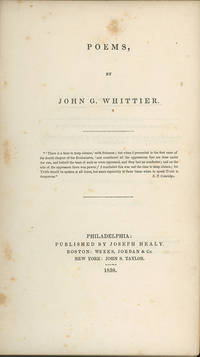
183828115Philadelphia: Joseph Healy; Boston: Weeks Jordan; New York: John S. Taylor 1838 1838. First edition. BAL 21710 binding A; American Imprints 53638. Edges a little rubbed; light foxing; very good copy. 12mo original floral patterned blue-green cloth gilt lettering on the upper board. ¶ An early and substantial collection of over 50 poems by John Greenleaf Whittier 1807-1891. The first part contains 24 of his memorable abolitionist poems collected for the first time with his approval. In 1837 Isaac Knapp of Boston published Whittier's Poems Written During the Progress of Abolition Question but it was issued without Whittier's permission and according to the poet was riddled with errors. Lending library label of the Suffolk Lyceum Library with their rules on the front paste-down. On the front free endpaper is an intriguing faint pencil inscription to a "Mrs. Mary Lincoln / a present from / Mr. Lincoln / March 10th 1845." Extensive research on this has led . . . nowhere. <br/><br/> Philadelphia: Joseph Healy; Boston: Weeks, Jordan; New York: John S. Taylor, 1838 unknown books
1837101441Pamphlet small 8vo removed dbd 11 pp. Removed some minor foxing normal aging and browning; otherwise very good. This pamphlet was prepared for the New York chapter of the Religious Society of Friends Quakers for their annual meeting to oppose slavery. Not surprisingly this tract encourages people to help end "this stain upon our national character." While there are religious sentiments in this work much of the discussion relates to social injustice and morality. Mahlon Day (and New York Quakers), books
1840100899Pamphlet leaflet 8vo 4 33-36 pp. Some aging and browning and a small stain at the bottom let margin; otherwise very good plus. Basically this short pamphlet provides "abridged selections" of various slave statutes from states around the country prior to the Civil War .The statutes consistently explain that a slave should be considered a thing not a person and of course has no right to own property. It also outlines various punishments such as 25 lashes for riding a horse without permission 21 lashes if more than six slaves meet together and death for striking a white person 3rd offense. The Anti-Slavery Bugle, books
1850106404<p>Folio manuscript legal sheets 11 pp. plus docketing on final back sheet. Traces of wax in some margins. Paper is browned and aged some minor creasing at folds margin hole on a couple of pages not affecting text; otherwise very good. This is a very complex legal case about the ownership of two slaves. These manuscript documents are signed by the three Constables deposed as witnesses. The testimony is taken at the law offices of Lysander G. Gordon. It seems that an individual who owed people money was forced to give the slaves to a sheriff and were then sold to William Knox in Southern Tennessee. However it appears that the slaves actually belonged to someone else. These documents try to sort though this mess. </p> books
1793106470<p>12 lines in brown ink with paper seal on sheet of paper 34x21 cm 13½x8¼". Signed by Thomas Hamilton clerk. Remnant of seal old folds with splitting along them normal aging and browning some offsetting very good overall. Amazing little document relating to the enforcement of Pennsylvania's groundbreaking effort to begin the abolition of slavery "An Act for the Gradual Abolition of Slavery" passed by the Pennsylvania legislature in 1780. The Act prohibited further importation of slaves into the state required Pennsylvania slaveholders to annually register their slaves with forfeiture for noncompliance and manumission for the enslaved and established that all children born in Pennsylvania were free persons regardless of the condition or race of their parents. Those enslaved in Pennsylvania before the 1780 law entered effect remained enslaved for life. The present document seems to reveal non-compliance with the law by Hugh Neilly in part: "I hereby certify on application of Ralph Cherry that a careful search hath been made by me among the Records of Negro's sic entered on the Records of Westmoreland County and that on such search it doth not appear that any Negro's hath been registered in the name of Peter or any other name as his property by Hugh Neilly of Westmoreland County aforesaid under the laws passes for the gradual abolition of slavery. Thomas Hamilton clerk." Docketed on the back "Certificate that no Negro's hath been registered in Westmoreland as the property of Hugh Neilly." </p> books