1 561 résultats
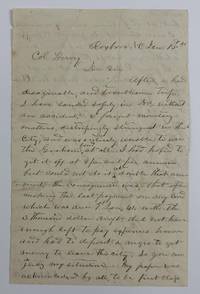
18605563Roxboro N.C.: January 15 1860. Good. 2pp. Wrinkled previously folded. A few minor losses at folds not affecting text. Two half-inch closed tears from edges. Light toning and foxing. After arriving in Roxboro North Carolina in mid-January 1860 planter J.C. Barnett writes to his friend and business partner a Colonel Henry to complain about the tight money situation in the state which has forced him essentially to pawn a slave in order to raise cash: "I found monetary matters distressingly stringent in the City and was entirely unable to use the Graham bond at all. I had hoped to get it off at 8 per cent per annum but could not do it at double that amount the consequence was that after making the last payment on my land which was due 1st Jan 61 with the 3 thousand dollar draft I did not have enough left to pay expenses home and had to deposit a negro to get money to leave the city. So you can judge my situation." Furthermore he has other unpaid debts that he hopes to settle with future cotton sales: "I gave R.H. Williams a draft for 93 dollars also Messrs Lea & Cheatham of Louisville one for 111 dollars and owing to the circumstances just mentioned was unable to meet them. You will do me a favor when you see these gentlemen to explain the reason. When you sell my cotton after paying Mr. Batt and yourself the expenses if there is a remainder please apply it to my Louisville and Williams debt. Also Mr. Gratiot has a claim of an hundred dollars. I will write to these gentlemen and tell to apply to you when you sell my cotton." Interesting detail on economic difficulties in the south just prior to the Civil War. January 15 unknown
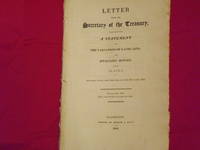
1816100537Pamphlet formate folio disbound first pamphlet 3 leaves printed on recto only second 7pp. third 6 pages and folding chart. Pamphlet extracted from larger volumne chipping along spine and edges not affecting text second papmple completely disbound paper browned and somewhat dry These pamphlets are rare and represent an important source of information on the numbers and values of slaves in early 19th century America. The first title presents the value assigned to slaves in 11 states including New York. The second lists the number and values of slaves in the various counties in the state of Maryland. The final pamphlet presents real estate values and values on dwellings including slaves in the counties of Pennsylvania. The information in these reports was compiled by Alexander James Dallas 1759-1817 who was the Secretary of the Treasury. Dallas born in Kingston Jamaica settled in Pennsylvania and practiced law there. Eventually he would become Secretary of the Treasury in 1814 when the nation was almost bankrupt. He managed to reorganize the department get the country out of debt created a surplus and even helped promote what would become the Second Bank of the United States. ANB. William A. Davis, books
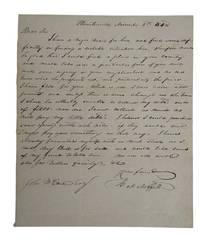
1842209651842. Slavery North Carolina Letter signed offering a "negro man" to settle debts. Letter signed by "H.M. Moffett" of Huntersville Virginia now West Virginia. Dated November 8th 1842. Measures 9.5" by 7.75". The letter reads in full: "Dear Sir I have a negro man for hire and find some difficulty in finding a suitable situation here therefore would be glad that I could find a place in your country and would take in as a particular favor if you will make some inquiring in your neighborhood and let me know what the prospects are and particularly the price- I have $200 for you which is all I can raise at present and unless their is some change in the times I shall be utterly unable to collect my debts of $1600 now due. I can't collect as much as will pay my little debts. I believe I could purchase some young cattle with notes if they would . I might pay you something in that negro sic. I have already furnished myself with as much stock as I need my Bull is for sale and would like some of my friends to take him. We are all well also Jan sic Millers family - . -- your friend H.M. Moffett." The letter was likely penned by Henry Hiller Moffett second Clerk of Pocahontas county Virginia present day West Virginia. Moffett is listed in the 1850 census with eight enslaved persons. Original folds some minor foxing. Overall very good condition. unknown
1855CAT0116Peterboro: Self-Published 1855. First Edition. Single sheet folded 10 x 10 inches. Very Good. One of several public letters by Smith to Seward this one discussing the Fugitive Slave Law. Smith by the mid-1850s had grown increasingly frustrated by the abolitionist movement's willingness to compromise. Seward an early figure in the Republican party sought more gradual measures. Smith writes: "Instead of interpreting constitutions and statutes in the light of human rights you interpret human rights in the light of constitutions and statutes. I own that you stand as an antislavery man very far above most of our statesmen. but I would have you stand farther above them." Smith's growing impatience with the compromising nature of the abolitionist movement would later lead him to support the efforts of John Brown and the free-state movement in Kansas. "When most Liberty party leaders agreed to merge with more moderate antislavery factions to form the Free Soil party in 1848 Smith balked at what he regarded as abandonment of the abolitionist commitment to immediate emancipation." - ANB. A very good copy with a light stain to margin else near fine. Six copies in OCLC. Self-Published unknown books
183384791Lexington KY: Abraham Skillman 1833. First Edition. First printing. 12mo 18.5cm; original brown cloth-covered boards; viii207pp. Respined to style with facsimile printed spine label; Bookplate of the Young Men's Christian Institute New Haven to front pastedown; bookseller's ticket Williams' Bookstore Under the Old South Meeting House Boston at base of front flyleaf; pencil signature faded and illegible to front endpaper. Complete sound and Good. <br /> <br /> One of a tiny number of pre-Civil War abolitionist texts to have been written by a Virginia author. Paxton 1784-1868 was a Presbyterian minister born in Rockbridge County Virginia and educated at Princeton Theological Seminary; it is likely his mentorship there under Charles Hodge helped develop Paxton's antislavery sentiments. In 1826 after publishing an essay asserting the institution of slavery to be incompatible with the teachings of the Bible Paxton was expelled from his pastorship of Cumberland Presbyterian Church near Farmville in south-central Virginia. The present text addressed to his former congregation recounts the events of his expulsion reprints the essay in question and adds a series of epistolary essays supporting his theological position in oppostion to slavery. <br /> <br /> The existence of any abolitionist sentiment during this period in Virginia's history is remarkable in itself. For a native-born minister to willfully preach the gospel of antislavery even the relatively conservative version of abolitionism professed by Paxton before a congregation whose sentiments on the subject would have been diametrically opposed - and which doubtless included a number of slaveholding families - must have amounted to apostasy in some congregants' eyes. By publishing the present work Paxton essentially doubled down on his unpopular beliefs making him in this cataloguer's eyes a rather remarkable figure. We find it surprising that so little biographical information exists regarding Paxton. His name barely appears in the scholarly literature on the period; perhaps because no mention of abolition is made in either the title nor the sub-title of his book the work is rarely discussed in articles on the antebellum southern antislavery movement. Though reasonably available institutionally Letters on Slavery is perenially scarce in commerce having appeared at auction only three times in the current century. This a quite decent copy in a discreetly restored binding. SABIN 59264. DUMOND Antislavery Bibliography p.89. LCP AFRO-AMERICANA 7501. Abraham Skillman unknown
180158147<p>ELOQUENT ARGUMENT FOR ABOLITION OF THE SLAVE TRADE BY A WEST INDIES SLAVE OWNER - WITH A DESCRIPTION OF SUGAR PLANTATIONS</p><p>Full title: 'Letters on the Cultivation of the Otaheite Cane; the Manufacture of Sugar and Rum; the Saving of Molasses; the Care and Preservation of Stock; with the Attention and Anxiety which is due to Negroes. To these Topics are added a few other Particulars analogous to the Subject of the Letters; and also Speech on the Slave Trade the most important Feature in West Indian Cultivation.'</p><p>first edition 8vo. xvi 248 248 1 blank 249-290 291-301 prospectus with detailed contents for book on Leeward Islands 1 blankpp large folding table at p.247 modern quarter rich tan calf spine panelled by raised bands with the panels richly gilt tooled red morocco title label marbled sides scattered foxing some light old water staining to lower and fore margins most noticeable in gatherings B and L and never obtrusive else a nice copy in a very handsome binding.</p><p>SABIN 9850 Goldsmiths'-Kress no. 18156.4 Rare Books Hub records none at auction. <br />Clement Caines d. 1817-1822 trained as a barrister in London inherited his family's sugar plantations in St. Kitts around 1778 and became the largest slave owner in the island. In the General Assembly of the Leeward Islands in 1798 he advocated the abolition of the slave trade better treatment for enslaved workers and an end to the slave trade. He wrote extensively on the desirability of humane treatment for plantation slaves and the abolition of the slave trade as well as political topics including his support for the Embargo. <br />The first part of this book effectively a detailed description the workings of a West Indian sugar cane plantation benefits from Caines's first hand experience of the topic. The second part p.249-288 contains his 'Speech on the Slave Trade' delivered to the General Assembly of the Leeward Islands in March 1798 which was discussing a resolution that the abolition of slave trade 'would be oppressive to the British planter destructive to the sugar colonies and consequently to the British Revenue and of no benefit to the Africans themselves'. Caines unambiguously stated "the slave-trade ought to be abolished. It ought to be abolished immediately. It ought immediately to be abolished for the sake and benefit of the planter". Caines argued that the slave trade was injurious not only to the slaves but to their owners. Having observed the death rates from exposure overwork and disease involved in forest clearing he bluntly stated that slave labour "cements with blood the walls of every sugar-work that is raised where forests grew". He stated that his business had "never been delegated to others. The slaves who were committed to my care performed their work under my own eyes. My time was passed with them and my attention devoted to them and their condition. I could not fail then to become acquainted with their wants and sufferings - to remark their sickness disability and premature decay: - the diseases among their men the sterility of their women and the death among their children". He directly challenged his hearers for their calculation "that a hardy African can be purchased for less than a Creole infant can be reared" and their consequent failure to provide adequate housing for mothers and children. He reports that about a quarter of newly arrived slaves on discovering their situation "pine and droop linger rather than live and shortly sink into the grave". Only an end to the importation of new slaves could disrupt the planters' callous calculation that they could "run our Negroes for two or three years" in the certainty that they could be then be replaced. Caines's familiarity with the actuality of slave life and his eloquent and direct illustration of it give this work an especial power.</p><p><br />Interestingly in 1811 Caines wrote to both Thomas Jefferson and James Madison sending copies of his publications vide https://founders.archives.gov/documents/Jefferson/03-03-02-0394 .</p> Printed for Messrs Robinson hardcover
ORD-3633Au clergé de son diocèse sur l'Esclavage. Orléans. Georges Jacob.1862. In-8 br.pp.387 à 399.
26786Paris de l'imprimerie du Patriote Français 1790 in 8 (20x13) 1 fascicule broché, 3 pages, non rogné. Avec la liste des noms de Colons Américains signataires qui attestent de leur soumission à l'Assemblée Nationale. Cette lettre datée du premier Août 1790 est leur réponse à un arrêté de l'île de Saint-Domingue, par lequel cette colonie déclare n'entendre soumettre les loix relatives au régime intérieur de la colonie, qu'à la seule sanction du Roi. Elle précéde aussi les importants débats de la Constituante sur les droits politiques des hommes de couleur dans les colonies du mois de mai 1791. Bel exemplaire ( Photographies sur demande / We can send pictures of this book on simple request )
RO20256076HACHETTE LIVRE / BNF / GALLICA BIBLIOTHEQUE NUMERIQUE. non daté. In-8. Broché. Bon état, Couv. convenable, Dos satisfaisant, Intérieur frais. 79 PAGES - 3 planches en noir/blanc ( 1 portrait, 2 cartes). . . . Classification Dewey : 326-Esclavage
178515723Genève, Paris, [], 1785. In-8 de 14-(2)-292 pp., veau fauve, dos lisse orné, pièce de titre en maroquin (reliure de l'époque).
210609[Paris], Imprimerie du Patriote François, s.d. (1791) in-4, 3 pp., broché sous couverture d'attente de papier marbré.
17270par Monseigneur Dugoujon, Préfet apostolique de la Guadeloupe, et Monseigneur Castelli, Préfet apostolique de la Martinique. P. 1935. In-8 (23/14cm). IX-147 pages. Broché (la 2ème couverture et le dos manquent).
2015114575L’Harmattan 2015 In-8 broché 21,5 cm sur 13,6. 254 pages. Bon état d’occasion.
184324068Utica 1843. 4pp. 1 vols. 8vo. Disbound spotted and soiled separated along spine else a good copy of this rare piece. 4pp. 1 vols. 8vo. Rare. An "Extra" to the "Liberty Press" relating to slavery and the "deep distress" and idleness caused by slavery. The author signed "Truth-Teller" attributes most of the labor problems and many of the economic ones to the instution of slavery. He recommends allowing Florida a place in the Union as a free state and Congress guaranteeing each state a republican form of government which he feels would bring about the end of slavery. <br/><br/> unknown
1371653Abidjan: Les Nouvelles Editions Africaines, 1976 in-8, 240 pages, bibliographie, index. Reliure basane rouge, dos à nerfs, bel exemplaire.
201905214Paris, Fayard, 2009 ; in-8, 238 pp., br. Broché très bon état.
1974_201700958S. l., S. é., 1974 ; in-8, 26 pp., feuilles agrafées. Reprinted of Race and Class - XVI, 2 (1974).
S. l., S. é., 1974; in-8, 26 pp., feuilles agrafées. Reprinted of Race and Class - XVI, 2 (1974).
In 12°; due tomi in un volume: 249, (3) pp. e 4 c. di tav. fuori testo compresi l'antiporta ed il frontespizio incisi, 286, (2) pp. e 4 c. di tav. fuori testo compresi l'antiporta ed il frontespizio incisi. Bella legatura coeva in mezza-pelle scura con titolo, numeri dei volumi e filetti in oro al dorso. Un piccolo difetto alla parte bassa della cerniera del piatto anteriore. Piatti foderati con carta marmorizzata coeva, qualche strofinatura. All'interno in buone-ottime condizioni di conservazione. Traduzione di Gaspare Aureggio. Senza data ma 1825, la Libreria Viscontini non stampò nulla dopo il 1826. Prima edizione italiana, una seconda fu stampata solo nel 1853 da Borroni e Scotti, di questo romanzo "abolizionista", scritta dal noto giornalista, storico e scrittore americano, Richard Hildreth (Deerfield, Massachusetts 28 giugno 1807 - Firenze 11 luglio 1865). È meglio conosciuto per aver scritto una nota Storia degli Stati Uniti d'America in sei volumi che copre il periodo 1497-1821 che venne pubblicata nel 1840-1853. Gli storici la considerano una storia politica molto accurata della prima Repubblica ma con un forte pregiudizio a favore del Partito Federalista e dell'abolizione della schiavitù. L'autore frequentò la Phillips Exeter Academy, a partire dal 1816, e rimanendo per sette anni. Nel 1826 si laureò all'Harvard College. Dopo aver studiato legge a Newburyport, fu ammesso all'Ordine degli Avvocati di Boston nel 1830. Nel 1832, Hildreth divenne co-fondatore ed editore del quotidiano "Boston Atlas". Nel 1834, scrisse questo popolare romanzo contro la schiavitù "The Slave: or Memoir of Archy Moore" pubblicato nel 1836, poi ampliato nel 1852. Nel 1837 scrisse per l'"Atlas" una serie di articoli che si opponevano con forza all'annessione del Texas. Nello stesso anno pubblicò un importante scritto sulle banche e la valuta cartacea, opera che ha contribuito a promuovere la crescita del sistema bancario libero in America. Nel 1838 riprese i suoi doveri editoriali sull'Atlas, ma nel 1840 si trasferì, a causa della sua salute, nella Guyana britannica, dove visse per tre anni e fu redattore di due settimanali che uscivano in contemporanea a Georgetown. Nello stesso anno pubblicò in questo un volume in opposizione alla schiavitù, Dispotismo in America (2a ed., 1854). Tra il 1857 e il 1860 Hildreth lavorò per il New York Tribune e nello stesso periodo scrisse diversi trattati contro la schiavitù per il nascente partito repubblicano sotto vari pseudonimi. La cattiva salute lo costrinse a ritirarsi dalla sua carriera di scrittore nel 1860. In qualità di governatore del Massachusetts, Nathaniel Prentiss Banks e il senatore Charles Sumner, fecero pressioni per la nomina di Hildreth come console degli Stati Uniti a Trieste, carica che ottenne, nel 1861. Nel 1865 si dimise da quella posizione e si trasferì a Firenze, dove morì l'11 luglio 1865. È sepolto vicino a Theodore Parker nel Cimitero degli Inglesi, Firenze. Questa prima edizione italiana è assai rara.
ORD-13282N°3937 du Bulletin des Lois N°206. 15 Avril 1818. In-8 (ca 135 x 210mm) sans couverture, non rogné, tel que paru. Pages 234 et 235 du bulletin. Papier lgt bruni, rares rousseurs, bon état.
9546Valence, Pierre Aurel, (1791). 8 pp. in 4.
203291Clermont-Ferrand, Imprimerie d'Antoine Delcros, 1791 in-4, 12 pp., en feuilles.
24264ONE: ‘Coloured Emigrants from United States’ Downing Street 16 October 1850. TWO: ‘Immigration’ Downing Street 30 October 1850. Two interesting items from the period leading up to the American Civil War. Both items are scarce: no other copy of either traced. In good condition lightly aged. Extracted from a volume of Parliamentary Circulars with the ownership signature "Frederick Peel" Member of Parliament from Feb. 1849 dated 1839-1851 very good condition. The context makes it plain that this Circular was sent to all Colonial Governors a gap in the text indicating where the name of a specific Governor would appear in MS. Disbound from a volume and paginated in manuscript.Both printed in copperplate font. ONE: Printed ‘Circular’ dated from Downing Street 16 October 1850. Headed in manuscript ‘Colonial Emigrants from United States’. In manuscript at end not in Grey’s hand ‘/sd/ Grey’. 2pp 8vo. Paginated in manuscript 239-240. Begins: ‘Sir / I have to acquaint you that it has been suggested to me that a desirable Class of Emigrants for the West India Colonies might be induced to come to them from among the Black and Colored Population of the United States whose arrival and location if they chose to come would I have no doubt be advantageous to themselves and to the Colonies.’ TWO: Printed ‘Circular’ dated Downing Street 30 October 1850. Headed in manuscript ‘Immigration’. In manuscript at end again not in Grey’s hand: ‘/sd/ Grey’. 7pp 8vo. Not paginated in type; paginated in manuscript 239-245. Divided into eleven numbered sections the first of which reads: ‘In the course of the long correspondence which it has devolved upon me to conduct with the Governors of the Sugar Colonies and others on the subject of the Immigration of Labourers it has been my endeavour to promote the establishment of such laws and regulations respecting Immigrants introduced at the public expence as should make the Immigration most conducive to the well being of the Immigrants themselves of the Colonists by whom their labour was required and of the Populations at large of the Colonies in which they were to be placed.’ The chief ‘descriptions of Immigrants’ discussed in the correspondence are: ‘1st Coolies brought or about to be brought from the East Indies to some of the West Indian Colonies by the aid of Colonial Revenues or Loans raised by the Colonies and guaranteed by this Country. - 2nd. Kroomen or Africans from Sierra Leone and those parts of Africa where Slavery does not exist brought to the West Indies by the same means. - 3rd. Africans taken from captured Slavers liberated under sentences of the Mixed Commission Courts and brought to the West Indies at the sole cost of this Country.’Printed ‘Circular’ dated from Downing Street 16 December 1842. Headed in manuscript ‘Crime in the high Seas’. At bottom in manuscript not Stanley’s hand: ‘/sd/ Stanley’. Twenty-nine lines in copperplate font. The first of four paragraphs reads: ‘The attention of Her Majesty’s Government has been recently called to various Laws enacted in the British Colonies for the prevention regulation or punishment of acts done in the High Seas as on the Seas within one League of the Shore of the Colonies in which such Laws have originated. After consultation with the Queen’s Advocate and the Attorney and Solicitor General Her Majesty’s Government have adopted the following conclusions on the subject.’ ONE: ‘Coloured Emigrants from United States’, Downing Street, 16 October 1850. TWO: ‘Immigration’, Downing Street, 30 Oc unknown
60085aafLa Habana, Ed. de Ciencias Sociales, 1988, lg. in-8vo, 526 p., illustrated with 67 plates, some after photos, mainly cruel drawing, orig. clothbound, ill. jackett.
1945148520Couverture souple. 4 brochures de 32 pages. 12 x 17 cm.