1 267 résultats
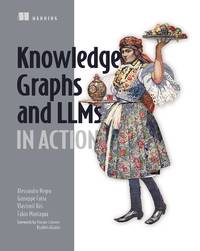
2025SKU1728513Manning 2025-11-18. paperback. New. 7x1x9. New Book Ships with Tracking Manning paperback
2025SKU1735770Manning 2025-11-18. paperback. New. 7x1x9. New Textbook Ships with Tracking Manning paperback
2025SKU1739958Manning 2025-11-18. paperback. New. 7x1x9. New Book Ships with Tracking Manning paperback
1917970099.Ghardcover. Good. Access codes and supplements are not guaranteed with used items. May be an ex-library book. hardcover
52204876-nnew. unknown
52204876like new. unknown
194068113Springfield: Negro Youth Improvement League 1940. Paperback. Very Good. 11p. Wrapper. 16cm. This uncommon pamphlet attacked the Dunbar Community League claiming that it was elitist refused to hire local African Americans and disproportionately emphasized on Camp Atwater although only 10-15% of its campers were from the local area. <br/><br/> Negro Youth Improvement League paperback books
194068113Springfield: Negro Youth Improvement League 1940. Paperback. Very Good. 11p. Wrapper. 16cm. The Negro Youth Improvement League is identified in this pamphlet as ". composed of young Negro men and women of Springfield who feel that they have suffered certain social injustices long enough." This uncommon pamphlet attacks the Dunbar Community League claiming that it is elitist refuses to hire local African Americans and disproportionately emphasizes support for Camp Atwater although only 10-15% of its campers are from Springfield.The Dunbar Community League was headed by William Nelson DeBerry a nationally prominent African American cleric who had been pastor of St. John's Congregational Church in Springfield. The Dunbar Community League established around 1930 to take over activities started by DeBerry's church changed its name to Urban League of Springfield Inc. in 1950. Camp Atwater appears to still operate identifying itself online the oldest African American camp in the USA. and as owned and operated by the Urban League of Springfield Mass. We don't know if the complaints in this pamphlet had any effect on the operations and activities of the Dunbar Community League but the pamphlet appears to have been an honest effort by interested youth to make sure that their needs were not being ignaored. Negro Youth Improvement League paperback
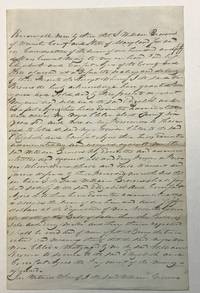
184941786Worcester County Maryland 1849. Single pale blue sheet 8" x 12-1/2" recto and verso entirely in ink manuscript. Signed by Brown with facsimile seal and witnessed. Acknowledgment by Justice of the Peace. Very Good. unknown
194682469Anderson 1946. Paperback. Good. 6p. Stapled softcover item. 28cm. Mimeo. Vertical crease. Printed on one side. Address and a few figures in pencil on blank last page. Membership listed as including 346 African Americans and 126 whites. <br/><br/> paperback books
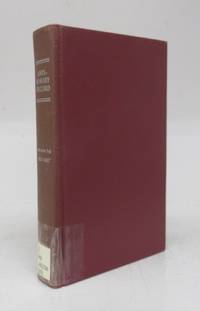
1970140624Westport CT 1970. Reprint edition. Vol. I No. 1 January 1835 - Vol. III No. XII. Whole No. 36 December 1837. Hardcover. ex library-good. Originally published R. G. Williams New York for the American Anti-Slavery Society. Negro Periodicals in the United States series. Various paginations. Small b&w line drawings. Burgundy buckram. Ex library with labels on lower spine and endpapers ink stamps to title page and top edge. Spine faded. <br/><br/>Articles on topics such as slave auctions emancipated slaves equality remedies for slavery separation of families slavery as a sin etc. hardcover
19595504Blandford Press Ltd., London 1959. 125 Seiten, Noten und Texte. Gr.-8°, 19 cm x 25 cm, f gebundene Ausgabe, Hardcover/Pappeinband, Einband etwas angestaubt und gebräunt, sonst guter Zustand
1976278493Naples: Editrice Napoletana 1976. paperback. very good. Preface by mario Rotili. 51 plates some in color. 220pp. 4to printed wrappers glossy pictorial dust wrapper. Napoli: Societa' Editrice Napoletana 1976. Inernally fine a very good copy.<br/><br/> Editrice Napoletana unknown books
1976278493Naples: Editrice Napoletana 1976. paperback. very good. Preface by mario Rotili. 51 plates some in color. 220pp. 4to printed wrappers glossy pictorial dust wrapper. Napoli: Societa' Editrice Napoletana 1976. Inernally fine a very good copy.<br/> <br/> Editrice Napoletana unknown
140939269Detroit: Negro Retail Store Employees Association / The Inner City Organizing Committee. Broadside. Very Good. ca. 1940-1960. Single sheet measuring 9-7/8" x 10 printed on recto only. Top edge rough cut perhaps as issued or with blank margin partially missing. Moderately toned and with a faint vertical crease down the center. Beginning in the 1930s the Don't Buy Where You Can't Work campaign sprung up in northern American cities with black community members protesting against discriminatory hiring practices of targeted white-owned businesses. Such businesses would typically be picketed in order to increase job opportunities and harness the economic power of the community to affect change. This broadside appears to be boycotting three Sears locations in the Detroit area which had "75% negro patronage and less than 10% negro employees in lower paying jobs." Locally this movement was supported by the Detroit Housewives' League activist African American housewives who tirelessly worked to promote black-owned businesses and in turn increase employment opportunities for black workers. Negro Retail Store Employees Association / The Inner City Organizing Committee unknown books
4-21344Torino Paravia 1928 8vo meza tela pp. 126 con num. ill. fotografiche. unknown
8474909619.Gpaperback. Good. Access codes and supplements are not guaranteed with used items. May be an ex-library book. paperback
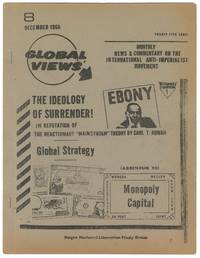
196613499San Francisco: Global Views 1966. The final issue of this short-lived theoretical journal of the Negro National Liberation Study Group NNLSG which published “news and commentary on the international anti-imperialist movement.†It appears as though eight issues were published monthly between May-December 1966. Almost nothing is available on the journal or the NNLSG at least under that name although the Labadie record states that in 1967 Global Views merged with Black Marketer and Burning Spear the newsletter of Omali Yeshitela’s JOMO Junta of Militant Organizations to form Black Power which was the journal of House of Umoja and the Black Panther Party Northern California two groups formed by RAM members and Soulbook editors Ken Freeman and Ernie Allen. <br /> <br /> Content for this issue includes an article titled “The Ideology of Surrender: In Refutation of the Reactionary ‘Mainstream’ Theory by Carl T. Rowan†in which Rowan is described as an “ideologist of the black bourgeois clique†for attacking Black Power as a separatist movement. This article is followed by an expanded version of an article on “Monopoly Capital†printed in issue 2 of Global Views includes six new appendices. The issue concludes with an editorial and excerpts from Dr. Ira S. Cohen’s address before the Commonwealth Club on U.S. imperialism’s drive to rule the world. <br /> <br /> Side-stapled mimeographed sheets 11†x 8 ½†26 p. Some toning to covers else a fine copy. Only two libraries hold any issues in WorldCat. The Labadie has a complete run and Northwestern holds two issues 5 8. In DANKY. Global Views unknown
196181979n.p. 1961. Very Good. 4p. on two legal sized sheet with two shorter sheets for certification and Proof of publication. Blue-backed. Fastened at top. 36cm. Later folds when filed. Some wear. Intended to be an organization of African American Tavern and hotel owners. Frank Ellis was listed as President and Vivian Mason Lane as Secretary. <br/><br/> unknown books
19613987Pittsburgh: Shields Watson & Washington Attorneys at Law 1961. Very good. Together 4 leaves 7 pp. the first two legal-size 14" x 8 1/2" the others slightly shorter; brad bound inside a 14.74 x 9" printed chemise folded to 9" x 3.75". Creases at folds; chemise moderately worn; leaves lightly dust-soiled with one small stain. APPLICATION TO CHARTER AN AFRICAN AMERICAN NON-PROFIT BUSINESS ASSOCIATION. IT WAS CREATED IN RESPONSE TO JIM CROW LAWS THAT REMAINED IN FORCE IN WESTERN PENNSYLVANIA AND ELSEWHERE. THIS SCARCE PRIMARY SOURCE MATERIAL DOCUMENTS THE NEEDS OF AFRICAN AMERICAN BUSINESS OWNERS TO UNITE IN ORDER TO SURVIVE. <br /> <br /> Our charter shows that the "Negro Licensed Beverage Association of Western Pennsylvania" NLBAWP was a group of African American hotel owners restaurant owners and tavern owners. Lingering Jim Crow laws and other societal forces made it exceptionally difficult for such businesses to succeed in the Pittsburgh area and of course elsewhere. The late 1950s and early 1960s saw the development of similar organizations in Philadelphia National Negro Licensed Beverage Association and New Orleans Negro Tavern Owners Association. <br /> <br /> Importantly this document lists the goals of the NLBAWP organization:<br /> <br /> "To foster strengthen and improve business within the Negro community." <br /> "To advance the cause of the Negro tavern and hotel owner as a whole." <br /> "To give service to members to do things for them which they cannot do for themselves or which can be done better or less expensively if done collectively." <br /> "To create and project the proper image of a tavern or hotel owner in the community." <br /> "To sponsor aid and assist any charitable or civic project approved by the members."<br /> <br /> One noteworthy incorporator listed here was Vivian Mason Lane. Lane owned four Pittsburgh taverns in the 1960s and was a community leader through at least the 1980s. She led a neighborhood Chamber of Commerce and ran unsuccessfully for County Commissioner and the State House.<br /> <br /> The 1966-67 Negro Traveler's Green Book "For Vacation Without Aggravation!" lists a grand total of eight suitable motels tourist homes and restaurants in Pittsburgh. In any event we have been unable to determine what -- if anything -- became of the Negro Licensed Beverage Association of Western Pennsylvania. Shields, Watson & Washington, Attorneys at Law unknown
1948072130International Publishers 1948. Hardcover. Very Good. Original 1948 hardcover in VG condition: excellent unmarked pages slight wear slight darkening at the lower spine and adjacent area. The dust jacket is fair-minus with two long tears and pieces missing on the front and spine yet is mostly intact and protected by a new clear removeable cover. 245 pages slightly age-yellowed. 15oz International Publishers hardcover
183557663Northampton MA 1835. Whole number 293. folio pp. 4. Page 3 contains a story about a "negro insurrection in Mississippi". Paper toned folded good. unknown books
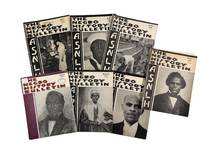
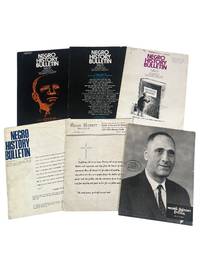
1941211681941. Woodson Carter G. The Negro History Bulletin. These mid-twentieth century periodicals document the institutionalization of African American historical scholarship and pedagogy under the leadership of Carter G. Woodson whose work established Black history as a formal field of study in the United States. Issued between 1941 and 1949 these issues provide primary evidence of how African American history was researched interpreted and disseminated during a period shaped by World War II migration and ongoing struggles for civil rights. Founded in 1937 at the urging of Mary McLeod Bethune the Negro History Bulletin functioned as an educational tool for teachers and students presenting accessible scholarship on African American life the African diaspora and global Black history. Editorial direction under Woodson emphasized correcting omissions in dominant historical narratives and foregrounding Black agency with content ranging from slavery and Reconstruction to contemporary wartime contributions and cultural production.<br /> <br /> Woodson Carter G. ed. The Negro History Bulletin. Washington D.C.: Association for the Study of Negro Life and History 1941-1949. Seven issues. Quarto. Stapled wrappers.<br /> Archive of seven issues spanning April 1941 through June 1949 each approximately 20-22 pages and measuring 8.5 x 11 inches illustrated with black and white photographs and line drawings. Contents include: 1 April 1941 issue with articles on the Underground Railroad Black communities in Canada and book reviews; 2 May 1944 issue addressing World War II and African American participation across military and civilian life; 3 March 1945 issue featuring Sojourner Truth labor equality free Black populations in antebellum Alabama and racial violence; 4 May 1945 issue examining the Department of Negro Affairs and early American attitudes toward slavery; 5 May 1947 issue including studies of formerly enslaved families such as the Loguens and Tanners suffrage in the South and profiles of Black educators; 6 January 1949 issue with articles on education in Haiti the Negro Little Theatre Movement Negro spirituals and a biography of Frederick Douglass; 7 June 1949 issue addressing intersections of Jewish and Black history modernization in the Virgin Islands regional Black history in Maryland and Virginia and educational policy.<br /> <br /> These issues were produced during a formative period in the expansion of African American historical consciousness when Woodson's efforts challenged the exclusion of Black experiences from mainstream curricula and scholarly discourse. The Negro History Bulletin operated as a bridge between academic research and classroom instruction shaping generations of teachers and students and contributing to the eventual institutionalization of Black Studies programs in the later twentieth century. The publication continues today as the Black History Bulletin recognized as the longest continuously published journal for practitioners in the field. Clean pages with light handling wear; fragile binding to the earliest issue and a punch hole to the upper corner of the June 1949 issue; overall very good condition. The archive provides a concentrated record of early African American historiography and educational practice during a critical period of intellectual and social transformation. unknown
1964212461964. Woodson Carter G. ed. The Negro History Bulletin. These mid-twentieth century periodicals document the expansion of African American historical scholarship and pedagogy during the Civil Rights era when educational institutions activists and scholars increasingly challenged the exclusion of Black history from mainstream curricula. Issued between 1964 and 1971 these issues reflect the evolving intellectual priorities of the period including the emergence of Black Studies programs renewed attention to Reconstruction and slavery and the growing influence of Black Power thought. Founded in 1937 at the urging of Mary McLeod Bethune the Negro History Bulletin functioned as a teaching-oriented publication under the direction of Carter G. Woodson and the Association for the Study of Negro Life and History providing accessible but research-informed content for educators students and general readers. The issues in this group demonstrate how African American history was interpreted and taught during a period of legislative change cultural transformation and increased institutional recognition.<br /> <br /> Woodson Carter G. ed. The Negro History Bulletin. Washington D.C.: Association for the Study of Negro Life and History 1964-1971. Archive of six issues. Quarto. Stapled wrappers.<br /> Archive includes: 1 May 1964 issue with a dedication to Albert N. D. Brooks; 2 December 1964 issue featuring articles on John Willis Menard African American education and Black military service; 3 January 1969 issue including content on Wiley College Library poetry book reviews and contemporary educational policy developments; 4 January 1971 issue addressing music W. E. B. Du Bois's The Souls of Black Folk and the expansion of Black Studies programs; 5 October 1971 issue including discussions of Freedmen's schools antebellum Black separatist rhetoric Southern Black political organizations and housing and social policy; 6 November 1971 issue featuring articles on Black Power five years after its emergence the Gabriel Insurrection of 1800 Southern integration and prominent Black professionals. Each issue approximately 20-22 pages measuring 8.5 x 11 inches illustrated with black and white photographs and line drawings.<br /> <br /> These issues were produced during a period in which African American history moved from the margins toward institutional recognition particularly through the establishment of Black Studies programs and curriculum reforms in schools and universities. The Negro History Bulletin played a central role in translating scholarly research into classroom practice shaping how history was taught during a decade of social and political transformation. Its continued publication now under the title Black History Bulletin reflects its long-standing influence within the field. Light wear to covers; bindings generally sound with clean interiors; overall very good condition. The archive provides a focused record of African American historiography and educational practice during the Civil Rights era. unknown
1920171801920. Club teaches African-American girls about Home Economics Gardening Social and Civic Responsibility. C. 1920s. Negro Girls' Club Record Book. Published by Georgia State College of Agriculture in Athens Georgia. 20 pages. 9 x 5.75 in. Original printed wrappers. "Use this book to keep a record of al the club work done during the entire year." Printed as workbook with pages to take notes on numerous domestic projects including planning a garden canning produce cooking sewing and balancing a budget. Includes a rubric where a member's annual work will be evaluated. "Each club member is expected to make an exhibit at some fair or public meeting." Most of the pages are not filled in. 5 pages have child-like scribbles and doodles in pencil. Originally belonged to Sarah G. Daniel a girl in 6th Grade. Thumb-soiling to wrappers. In good condition. unknown