32 résultats
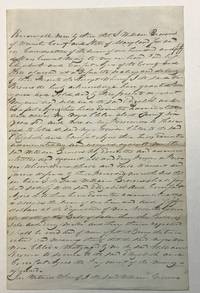
184834983Hinds County MS 1848. Folio 8" x 13" blue unlined paper completely in ink manuscript. Very Good. <br/><br/> In addition to the slaves the inventory lists many household items The verso is a sworn statement from C.R. Clifton that he posted notices of the Sale. Attested to and signed by J.T. Aldham as Justice of the Peace. Docketed: "Exhibit B - Administrators Sale/ Filed February 13th 1849 W.H. Hampton Clk."<br/> Col. William Campbell Demoss 1790-1845 born in Virginia owned plantations simultaneously in Madison County Louisiana and Hinds County Mississippi. He was appointed Associate Justice of the Hinds County Court in 1830 elected to the Mississippi House of Representatives in 1833 and was county sheriff. He was a partner in the mercantile firm of A. Coleman & Co. D.M. Dancy was a physician in Raymond Hinds County Mississippi. The Clerk of the Probate Court William H. Hampton was 2nd Lieutenant with the "Raymond Fencibles" Company G of the First Regiment Mississippi Rifles at the Battles of Monterey and Buena Vista during the Mexican American War. Caswell R. Clifton became Judge of the Circuit Court and Clerk of the High Court of Appeals. unknown books
187752662Kinsale Ireland: printed at the 50th Regimental Press 1877. Bifolium program 8.5 x 13 cm pp. 4 the last blank; minor foxing previous fold formerly from an album the remains of a card and an engraved illustration on the final blank. Also a manuscript caption: "Programme Garrison Nigger Troupe Camden Fort Feb. 9 1877." With manuscript notes and corrections in a contemporary hand. The Negro Troupe was led by Lieutenant Yaldwyn. Provenance: Major-General Sir Francis Walter de Winton 1835-1901. printed at the 50th Regimental Press unknown
187752662Kinsale Ireland: printed at the 50th Regimental Press 1877. Bifolium program 8.5 x 13 cm pp. 4 the last blank; minor foxing previous fold formerly from an album the remains of a card and an engraved illustration on the final blank. Also a manuscript caption: "Programme Garrison Nigger Troupe Camden Fort Feb. 9 1877." With manuscript notes and corrections in a contemporary hand. The Negro Troupe was led by Lieutenant Yaldwyn. Provenance: Major-General Sir Francis Walter de Winton 1835-1901. <br/><br/> printed at the 50th Regimental Press unknown books
1893010081Paris Alphonse Lemerre 1893 Demi-reliure
184941786Worcester County Maryland 1849. Single pale blue sheet 8" x 12-1/2" recto and verso entirely in ink manuscript. Signed by Brown with facsimile seal and witnessed. Acknowledgment by Justice of the Peace. Very Good. unknown
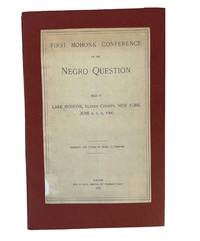
1890196721890. Barrows Isabel C. ed. First Mohonk Conference on the Negro Question Held at Lake Mohonk Ulster County New York June 4 5 6 1890 1890 records one of the earliest organized national discussions among white reformers politicians and intellectuals addressing the status of African Americans in the decades following Reconstruction. Convened at a moment when Black political rights were being systematically dismantled across the South through disenfranchisement and violence the conference brought together predominantly white Northern and Southern participants to debate labor education and civil status. The proceedings include the intervention of Reconstruction advocate Albion W. Tourgée whose address "The Negro's View of the Race Problem" directly challenged the exclusion of Black voices and concluded with a proposed resolution that failed to gain support. Statements within the conference reflect prevailing racial barriers including the observation that in Philadelphia "a colored man may carry mortar up a ladder but he is not allowed to lay the bricks" underscoring systemic exclusion from skilled labor and economic advancement.<br /> <br /> Barrows Isabel C. ed. First Mohonk Conference on the Negro Question Held at Lake Mohonk Ulster County New York June 4 5 6 1890. Boston: Geo. H. Ellis 1890. Softcover pamphlet format 142 pages measuring approximately 24 cm. Original front cover preserved and laid in with a color facsimile wrapper supplied for protection. Text printed as conference proceedings compiling speeches discussions and resolutions delivered across the three-day meeting.<br /> <br /> Produced during the consolidation of Jim Crow policies and the retreat from Reconstruction-era protections this document provides direct evidence of how white-led reform movements framed and debated Black citizenship at the national level. The absence of substantive Black participation alongside Tourgée's protest highlights tensions between advocacy and paternalism within late nineteenth-century reform discourse. As a printed record of policy-oriented discussion the volume supports research into labor exclusion education policy and the ideological foundations of segregation-era governance. Minor staining to lower margins; otherwise very good condition. unknown
186120085Paris: the Author 1861. Sepia lithographed frontispiece and 6 full-page sepia lithographed plates. Contemporary gilt black sheep-backed marbled boards. Minor foxing otherwise a very good copy in original condition. First edition of this privately published manual of freemasonry by the founder of the Rite of Memphis a Templar-based branch of the practice. Intended for use by novices the text covers the history of the Order from the initiation of King Solomon lists the Grand Lodges with their masters number of members and dates of foundation explains the symbols numbers and letters used in masonry iconography and details the 95 rites that members must exercise. The author describes the chants and responses said during rituals clothing to be worn for various levels of membership calendar of events insular legal system process for promotions religious concordances financial structure and differences in orders depending on their rites and locations. One of the final chapters outlines the five stages of initiation for women to become members. The ornate bistre plates illustrate legends and allegories of freemason foundational lore. <br /> Jacques-Etienne Marconis 1795-1868 was a French author and freemason. His father served in the Napoleonic army where he became obsessed with Egyptian religion and myth. Upon his return to France in 1815 he founded a freemasonry lodge called the Pilgrims of Memphis but the chapter was disbanded only one year later. He entrusted the archives to his son who reformed and revived the charter in 1839 but his small group of pilgrims failed to receive dispensation from the freemasonry governing body the Grand Orient of France. In 1859 Marconis applied again to the Grand Orient for masonic chapterhood and it was finally granted. This book represents the final iteration of the foundation of the Rite of Memphis a project that took over 40 years to come to fruition.<br /> OCLC locates no copies in U.S. libraries.<br /> Caillet 7116; Dorbon 689. the Author unknown