(Baseball, Negro League) Stott, HaroldBiblio.com
414 résultats
1925346509Philadelphia 1925. Panoramic photograph of both teams with the names of each player in the negative taken by Harold Stott Philadelphia. Approx. 8 x 35 inches. Expert restoration with some retouching archivally mounted. Panoramic photograph of both teams with the names of each player in the negative taken by Harold Stott Philadelphia. Approx. 8 x 35 inches. An extraordinarily rare image of the second Colored World Series. Taken in the Baker Bowl in Philadelphia prior to Game 5 of the series a rematch of the 1924 first World Series featuring the Kansas City Monarchs Champions of the Negro National League and the Hilldale Club the Eastern Colored Champions the panoramic photograph depicts 18 members of the Hilldale team and 15 Kansas City Monarch players with four league executives in the center. Included on the Hilldale team sometimes known as the Darby Daisies are Hall of fame catcher Biz Mackey Hall of Fame third basemen "Judy" Johnson player/manger Francis Warfield Hall of Fame slugger Louis Santop and southpaw ace "Nip" Winters. Notable players on the Monarchs included pitcher/manger Jose Mendez and second basemen Newt Allen; not pictured on the Monarchs was their ace Hall of Famer Bullet Rogan who injured himself prior to the series. Between the two teams in the center of the image stands Andrew "Rube" Foster the founder of the Negro National League and the "Father of the Negro Leagues." Hilldale would redeem their loss in the first world series wining this one 5-1. <br /> <br /> The last example of this photograph we could locate on the market appeared in the sale of the collection of Jeff Eastland selling at Robert Edwards Auctions in their Spring 2004 sale for $13800 said at the time to be one of two known copies. unknown
199894008Artioli. New. 1998. Hardcover. 8877920572 . FREE UPGRADE to Courier/Priority Shipping Upon Request - IN STOCK AND IMMEDIATELY AVAILABLE FOR SHIPMENT - Flawless copy brand new pristine never opened -- Text in Italian. 352 pages; 686 illustrations. Catalogue Raisonne Catalog Raisonné Complete Works Catalogo Ragionato Catalogo delle Opere L'Opera Completa Raisonnee -- with a bonus offer . Artioli hardcover
1998C94008Artioli. As New. 1998. Hardcover. 8877920572 . FREE UPGRADE to Courier/Priority Shipping Upon Request - IN STOCK AND IMMEDIATELY AVAILABLE FOR SHIPMENT - Flawless copy brand new pristine never opened -- Text in Italian. 352 pages; 686 illustrations. Catalogue Raisonne Catalog Raisonné Complete Works Catalogo Ragionato Catalogo delle Opere L'Opera Completa Raisonnee -- with a bonus offer-- - May be EITHER: out of print OOP and extremely rare in this pristine condition; signed by author or contributor; or a first or special edition; inquire for details . Artioli hardcover
19613987Pittsburgh: Shields Watson & Washington Attorneys at Law 1961. Very good. Together 4 leaves 7 pp. the first two legal-size 14" x 8 1/2" the others slightly shorter; brad bound inside a 14.74 x 9" printed chemise folded to 9" x 3.75". Creases at folds; chemise moderately worn; leaves lightly dust-soiled with one small stain. APPLICATION TO CHARTER AN AFRICAN AMERICAN NON-PROFIT BUSINESS ASSOCIATION. IT WAS CREATED IN RESPONSE TO JIM CROW LAWS THAT REMAINED IN FORCE IN WESTERN PENNSYLVANIA AND ELSEWHERE. THIS SCARCE PRIMARY SOURCE MATERIAL DOCUMENTS THE NEEDS OF AFRICAN AMERICAN BUSINESS OWNERS TO UNITE IN ORDER TO SURVIVE. <br /> <br /> Our charter shows that the "Negro Licensed Beverage Association of Western Pennsylvania" NLBAWP was a group of African American hotel owners restaurant owners and tavern owners. Lingering Jim Crow laws and other societal forces made it exceptionally difficult for such businesses to succeed in the Pittsburgh area and of course elsewhere. The late 1950s and early 1960s saw the development of similar organizations in Philadelphia National Negro Licensed Beverage Association and New Orleans Negro Tavern Owners Association. <br /> <br /> Importantly this document lists the goals of the NLBAWP organization:<br /> <br /> "To foster strengthen and improve business within the Negro community." <br /> "To advance the cause of the Negro tavern and hotel owner as a whole." <br /> "To give service to members to do things for them which they cannot do for themselves or which can be done better or less expensively if done collectively." <br /> "To create and project the proper image of a tavern or hotel owner in the community." <br /> "To sponsor aid and assist any charitable or civic project approved by the members."<br /> <br /> One noteworthy incorporator listed here was Vivian Mason Lane. Lane owned four Pittsburgh taverns in the 1960s and was a community leader through at least the 1980s. She led a neighborhood Chamber of Commerce and ran unsuccessfully for County Commissioner and the State House.<br /> <br /> The 1966-67 Negro Traveler's Green Book "For Vacation Without Aggravation!" lists a grand total of eight suitable motels tourist homes and restaurants in Pittsburgh. In any event we have been unable to determine what -- if anything -- became of the Negro Licensed Beverage Association of Western Pennsylvania. Shields, Watson & Washington, Attorneys at Law unknown
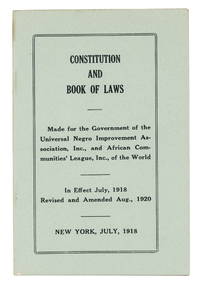
1920140945266New York: No Publisher 1920. 40 pp. Bound in publisher's pale green stapled wraps. Near Fine rear wrap toned along upper edge staples slightly rusted. A bright attractive copy of the guidelines of Marcus Garvey's pan-African Black Power UNIA organization. Revised and amended as of August 1920 according to front wrap. Uncommon. [No Publisher] unknown
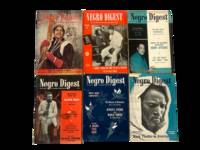
1947223891947. Johnson John H. founder. Negro Digest 1947-1969 documents African American political thought literary production and cultural criticism across the postwar period the Civil Rights Movement and the emergence of the Black Arts Movement. Published as a digest format periodical the magazine brought together essays fiction journalism and commentary by leading Black writers and public intellectuals establishing a widely circulated forum for debate on race identity labor international politics and the arts. The issues in this archive include contributions by figures such as LeRoi Jones Alice Childress C. Eric Lincoln Arna Bontemps and Barbara Ann Teer supporting research into African American intellectual history Black theater and mid twentieth century print culture.<br /> <br /> Negro Digest. Chicago: Johnson Publishing Company 1947-1969. Archive of six issues in printed wrappers each approximately 7.5 x 5.5 inches. Issues included are: 1 January 1947 with articles including Richard Wright's "How Jim Crow Feels" Eleanor Roosevelt's contributions and "How Jackie Robinson Took It"; 2 February 1951 featuring "I Didn't Raise My Boy to Be a Fighter" by Lillie Brooks and articles by Walter White and Roi Ottley; 3 November 1961 including "The New Black Renaissance" by Arna Bontemps and commentary by Duke Ellington and C. Eric Lincoln; 4 December 1962 featuring "The Menace of Mediocrity" by C. Eric Lincoln and essays on African American urban life and global politics; 5 April 1967 Second Annual Theater Issue including LeRoi Jones's play Slave Ship and essays by Alice Childress Ronald Milner and others on Black theater and performance; 6 April 1969 Annual Report on Black Theater in America with contributions by Barbara Ann Teer Woodie King Jr. and a roundtable including Sam Greenlee and Hoyt W. Fuller. The issues include essays reportage literary excerpts and visual material documenting cultural and political developments.<br /> <br /> Published during a period of expanding Black media and activism Negro Digest functioned as a central platform connecting literary production with political discourse tracing shifts from integrationist arguments in the postwar years to the cultural nationalism and artistic experimentation of the late 1960s. The inclusion of theater-focused issues reflects the increasing importance of performance as a site of political expression within the Black Arts Movement while earlier issues address labor segregation and international Black identity. Light edge wear and rubbing particularly to earlier issues; covers remain vibrant with pages clean and intact; overall very good condition. This archive provides sustained documentation of African American intellectual and cultural life across a critical period of twentieth century history. unknown
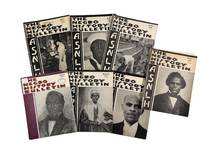
1941211681941. Woodson Carter G. The Negro History Bulletin. These mid-twentieth century periodicals document the institutionalization of African American historical scholarship and pedagogy under the leadership of Carter G. Woodson whose work established Black history as a formal field of study in the United States. Issued between 1941 and 1949 these issues provide primary evidence of how African American history was researched interpreted and disseminated during a period shaped by World War II migration and ongoing struggles for civil rights. Founded in 1937 at the urging of Mary McLeod Bethune the Negro History Bulletin functioned as an educational tool for teachers and students presenting accessible scholarship on African American life the African diaspora and global Black history. Editorial direction under Woodson emphasized correcting omissions in dominant historical narratives and foregrounding Black agency with content ranging from slavery and Reconstruction to contemporary wartime contributions and cultural production.<br /> <br /> Woodson Carter G. ed. The Negro History Bulletin. Washington D.C.: Association for the Study of Negro Life and History 1941-1949. Seven issues. Quarto. Stapled wrappers.<br /> Archive of seven issues spanning April 1941 through June 1949 each approximately 20-22 pages and measuring 8.5 x 11 inches illustrated with black and white photographs and line drawings. Contents include: 1 April 1941 issue with articles on the Underground Railroad Black communities in Canada and book reviews; 2 May 1944 issue addressing World War II and African American participation across military and civilian life; 3 March 1945 issue featuring Sojourner Truth labor equality free Black populations in antebellum Alabama and racial violence; 4 May 1945 issue examining the Department of Negro Affairs and early American attitudes toward slavery; 5 May 1947 issue including studies of formerly enslaved families such as the Loguens and Tanners suffrage in the South and profiles of Black educators; 6 January 1949 issue with articles on education in Haiti the Negro Little Theatre Movement Negro spirituals and a biography of Frederick Douglass; 7 June 1949 issue addressing intersections of Jewish and Black history modernization in the Virgin Islands regional Black history in Maryland and Virginia and educational policy.<br /> <br /> These issues were produced during a formative period in the expansion of African American historical consciousness when Woodson's efforts challenged the exclusion of Black experiences from mainstream curricula and scholarly discourse. The Negro History Bulletin operated as a bridge between academic research and classroom instruction shaping generations of teachers and students and contributing to the eventual institutionalization of Black Studies programs in the later twentieth century. The publication continues today as the Black History Bulletin recognized as the longest continuously published journal for practitioners in the field. Clean pages with light handling wear; fragile binding to the earliest issue and a punch hole to the upper corner of the June 1949 issue; overall very good condition. The archive provides a concentrated record of early African American historiography and educational practice during a critical period of intellectual and social transformation. unknown
1915002118New York: George H. Doran Company 1915. First Edition. Hardcover. Very Good/very good. New York: George H. Doran Company 1915. First Edition second-state binding. VG in VG- jacket. Exceptionally rare in dustjacket. DJ has a single shallow chip off the spine crown cutting off about 1/3 of the word Tennis. Period bookseller price tag $2.50 on the spine. Minor soiling and a few closed tears. These defects noted the jacket is still attractive in the mylar sleeve. The book itself has a neat POS on the title page otherwise completely free of markings pages very clean and bright no foxing. Endpapers foxing and some spotting to top edge and front paper edge bottom edge clean. Cloth boards have virtually no wear and are bright and clean sharp cloth corners. Preface by Richard Norris Williams. Illustrated from photographs. 9x6 gilt-lettered green cloth. Ghost-written by Sinclair Lewis when he was a struggling writer about 5 years before Main Street was published. Lewis was working for George Doran at the time. <br/><br/> George H. Doran Company hardcover
1968WALTER-FILM004175No binding. Very Good. Fine Art Print Richard Wright playwright Vintage original 22 x 14" 56 x 36 cm. theatre window card poster with a few light diagonal scratches minor rubbing and wear at extreme edges VERY GOOD. New York: Negro Ensemble Company June 4-July 7 1968. <br /><br />Richard Wright adapted a play by French author Louis Sapin. This posthumous production occurred in the first season of the Negro Ensemble Company and appears to have been its first in New York City eight years after Wright's death. Moses Gunn made a strong impression in the lead role of "Daddy" an aging old drunk who may or may not be God. Negro Ensemble Co. books
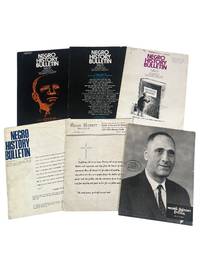
1964212461964. Woodson Carter G. ed. The Negro History Bulletin. These mid-twentieth century periodicals document the expansion of African American historical scholarship and pedagogy during the Civil Rights era when educational institutions activists and scholars increasingly challenged the exclusion of Black history from mainstream curricula. Issued between 1964 and 1971 these issues reflect the evolving intellectual priorities of the period including the emergence of Black Studies programs renewed attention to Reconstruction and slavery and the growing influence of Black Power thought. Founded in 1937 at the urging of Mary McLeod Bethune the Negro History Bulletin functioned as a teaching-oriented publication under the direction of Carter G. Woodson and the Association for the Study of Negro Life and History providing accessible but research-informed content for educators students and general readers. The issues in this group demonstrate how African American history was interpreted and taught during a period of legislative change cultural transformation and increased institutional recognition.<br /> <br /> Woodson Carter G. ed. The Negro History Bulletin. Washington D.C.: Association for the Study of Negro Life and History 1964-1971. Archive of six issues. Quarto. Stapled wrappers.<br /> Archive includes: 1 May 1964 issue with a dedication to Albert N. D. Brooks; 2 December 1964 issue featuring articles on John Willis Menard African American education and Black military service; 3 January 1969 issue including content on Wiley College Library poetry book reviews and contemporary educational policy developments; 4 January 1971 issue addressing music W. E. B. Du Bois's The Souls of Black Folk and the expansion of Black Studies programs; 5 October 1971 issue including discussions of Freedmen's schools antebellum Black separatist rhetoric Southern Black political organizations and housing and social policy; 6 November 1971 issue featuring articles on Black Power five years after its emergence the Gabriel Insurrection of 1800 Southern integration and prominent Black professionals. Each issue approximately 20-22 pages measuring 8.5 x 11 inches illustrated with black and white photographs and line drawings.<br /> <br /> These issues were produced during a period in which African American history moved from the margins toward institutional recognition particularly through the establishment of Black Studies programs and curriculum reforms in schools and universities. The Negro History Bulletin played a central role in translating scholarly research into classroom practice shaping how history was taught during a decade of social and political transformation. Its continued publication now under the title Black History Bulletin reflects its long-standing influence within the field. Light wear to covers; bindings generally sound with clean interiors; overall very good condition. The archive provides a focused record of African American historiography and educational practice during the Civil Rights era. unknown
1944WRCAM55481Detroit 1944. Illustrated broadside printed on thick cardstock 21 3/4 x 13 3/4 inches. Soiling chipping closed edge tears and creasing. Good condition. An extraordinary survival - a large-format illustrated fundraising poster for the Detroit chapter of the United Negro College Fund UNCF in the first year of the organization's existence. Though the poster is undated it likely emanates from 1944 the founding and initial fundraising year for UNCF when its national fundraising goal was $1.5 million and the number of schools involved with the group was twenty-seven. The fundraising "quota" for the Detroit area was $75000 as stated here. The poster is printed in brown and green urging potential donors to "help maintain 27 Negro Colleges." Three photographs are printed in brown in the middle of the poster showing a young African- American man in a laboratory "Training for Scientific Production in War and Peace" a young man on a tractor "Education in Action - Training for Food Production" and an image of several men standing on the steps of a government building captioned "Lord Halifax Observes Training for Leadership." Both national committee members including John D. Rockefeller Jr. and the local "Detroit Committee" are listed at the bottom just above a notice that "Workers are Needed" and listings of the address and phone number for the Detroit office. <br> <br> The United Negro College Fund was founded in 1944 to address inequities in higher education funding and opportunities for African-American youth by appealing to the "national conscience." The organization focused on private historically-black colleges and universities and initially sought funding solely from the African- American community. Over the last seventy- five years the organization has grown to assist almost forty schools of higher education and advocate for K-12 education and has raised more than $5 billion to help over half a million students earn college degrees. <br> <br> No copies of this fundraising poster are listed in OCLC nor in any source we can locate. It is a rare surviving artifact from the founding year of one of the most important organizations devoted to African- American higher education. Marybeth Gasman ENVISIONING BLACK COLLEGES: A HISTORY OF THE UNITED NEGRO COLLEGE FUND Baltimore: The Johns Hopkins University Press 2007. unknown books
1915010048New York: Doran 1915 First Edition 1915. Green cloth binding gilt titles. 8vo. Illustrated with seventy-two reproduction photographs in action black and white including frontispiece portrait of McLoughlin the 1913-14 National Champion. 347 pp. Sinclair Lewis was the ghost writer for the book which pre-dated Main Street by some five years. A heavy book this has rubbing but not damage along top and bottom of spine; rear hinge just starting. Unusually clean internals. Near fine. Doran hardcover
19791062615Office du livre / Harvard, 1979. / - 1989. 281 S.; Abb. / 350 S.; Abb. / 325 S.; Abb. / 281 S.; Abb. / 379 S.; Abb. und 306 S. mit Abb.; ca. 25 cm. Originalleinenbände mit Schutzumschlag.
1976192297New York: Ballantine Books 1976. A long time ago in a publishing house far far away. First edition signed by the ghostwriter Alan Dean Foster on the title page though solely credited to George Lucas. Published five months before the film's release this popular novelization was the world's first encounter with a long-form story from the galaxy far far away. The cover bears one of Ralph McQuarrie's famous concept illustrations a critical element in 20th Century Fox's decision to greenlight the Star Wars project. Before audiences had seen the special effects heard the sound design or absorbed John Williams's orchestral score Lucas's fast and intense story sold millions of copies. This book version is "perhaps most notable for allowing its readers to experience the interiority of characters from the film. Although the film establishes Leia's willingness to shoot the stormtroopers the novelization allows its readers to imagine the consequences of her act more vividly by narrating the stormtrooper's thoughts and aspirations" Webster p. 51. The novelization includes several key details omitted from the finished 1977 film but later retconned into the series including Palpatine p. 1 the Sith p. 8 and a medal for Chewbacca p. 219. By contrast the most famous opening line in film is here given as "Another galaxy another time". Octavo. Original pictorial wrappers designed by Ralph McQuarrie edges yellow. Bookseller ink stamp to first leaf. Extremities of wrappers creased and rubbed rear wrapper and bottom edge warped occasional spotting. A very good copy. Jeremy W. Webster "Leia Shot First: Transmedia Storytelling and the National Public Radio Dramatization of Star Wars" Star Wars and the History of Transmedia Storytelling 2018. unknown
19761325591New York: Del Rey/Ballantine Books 1976. First Edition. Hardcover. Octavo 183 pages; VG/VG; spine blue with white lettering navy blue pictorial front cover with white lettering; dust jacket protected with a mylar covering very mild shelfwear to DJ; "BOOK CLUB EDITION" stated to bottom of front flap; The first edition was issued as a book club edition; shelved Case 8. A Novelization of the 1977 film released six months prior to the movie's release.;. 1325591. Shelved Dupont Bookstore. Del Rey/Ballantine Books hardcover books
19761394311New York: Del Rey/Ballantine Books 1976. First Edition. Hardcover. Octavo 183 pages. In Very Good condition with a Very Good minus dust jacket. Spine blue with white lettering navy blue pictorial front cover with white lettering. Dust jacket protected with a mylar covering light shelfwear to DJ primarily to head and tail of spine. "BOOK CLUB EDITION" stated to bottom of front flap. The first edition was issued as a book club edition. Shelved Case 8. A Novelization of the 1977 film released six months prior to the movie's release.;. 1394311. Shelved Dupont Bookstore. Del Rey/Ballantine Books hardcover
1996BN313102Edisud 1996. 1996. Hardcover. The Riviera Of Charles Negre <br/><br/>The Riviera Of Charles Negre Joseph Nègre Edisud hardcover
1967235281967. The Journal of Negro History traces Black historical scholarship from the civil rights movement of the late 1960s to the constitutional battles over affirmative action in the early 1980s. Kenneth B. Clark a psychologist whose work with Mamie Phipps Clark on children and racial segregation was cited in Brown v. Board of Education opens the January 1968 issue with "The Present Dilemma of the Negro" while other issues examine racial thought in colonial America Black sailors in the Navy and merchant service discipline under industrial slavery in the Old South antislavery agents working with free Black communities from 1833 to 1838 and the Bakke Weber and Fullilove affirmative-action cases. <br /> <br /> William M. Brewer and Alton Hornsby Jr. eds. The Journal of Negro History. Washington D.C.: The Association for the Study of Negro Life and History Inc. 1967-1982. Nine quarterly issues. Vol. LIII Nos. 3 and 4 July and October 1967; Vol. LIII Nos. 1 and 2 January and April 1968; Vol. LIV Nos. 1 2 3 and 4 January April July and October 1969; Vol. LV No. 1 January 1970; and Vol. LXVII No. 3 Fall 1982. Including writings "The Emergence of DuBois As An African Nationalist"; Max Welborn "Racial Massacre In Atlanta September 22 1906"; Valeria W. Weaver "The Failure Of Civil Rights 1875-1883 And Its Repercussions"; and "The Ethel Johns Report: Black Women In The Nursing Profession 1925." <br /> These issues show Woodson's program in the decades after civil rights activism brought Black historical scholarship into debates over school desegregation voting rights enforcement affirmative action and the recovery of African origins in Atlantic slavery. January 1969 number includes the annual report "The Mis-Education of The Negro" tying the Association's current work to Woodson's critique of American schooling while the 1982 number places King's memory Central African slavery Black women's nursing labor affirmative action and Civil War freedom claims in the same scholarly forum. A compact run of The Journal of Negro History that connects ASALH's Woodson-era mission to late twentieth-century scholarship on enslavement civil rights enforcement African Diaspora origins Black labor and affirmative action law. Wrappers show toning some scattered stains with some issues showing binding weakness; interiors remain readable. Overall very good condition. unknown
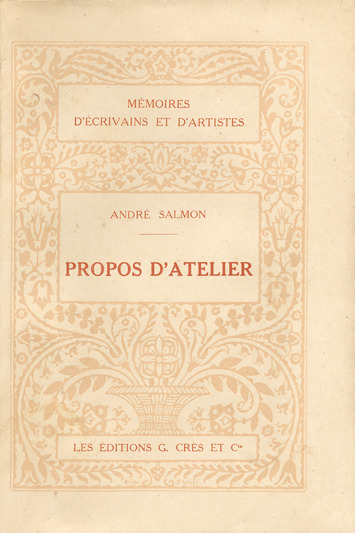
192216148Paris, Crès "Mémoires d’Ecrivains et d’Artistes", 1922 (Albi, Imprimerie Edouard Julien) ; in-16, broché ; 275, (2) pp., (1) f. blanc, portrait photographique en frontispice, couverture crème richement décorée par Nila d’Ivori en beige, titre en rouge.
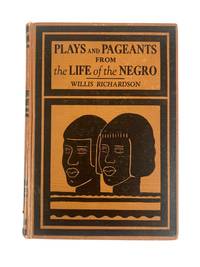
1930216541930. Richardson Willis. Plays and Pageants from the Life of the Negro. Washington D.C.: The Associated Publishers Inc. First Edition. 1930. Brown boards with black illustrations. Illustrated by James Lesesne Wells. 373 pages. 8vo. This anthology of plays written by African American playwrights from the late 1800s onward is a landmark anthology of African American drama compiled and edited by Harlem Renaissance playwright Willis Richardson. As one of the first dramatists to write plays specifically for Black actors and audiences Richardson sought to move beyond the stereotypical portrayals of African Americans that dominated mainstream theater. His works emphasized racial pride dignity and the richness of Black history helping to lay the foundation for later generations of Black playwrights. In the introduction Richardson gives credit for historical correctness of the facts to Dr. Carter G. Woodson. This compilation was created in order to praise the history and works of African American writers and inspire other African Americans to learn about their heritage and celebrate their culture. It features a selection of plays and pageants written by Richardson and other notable Black playwrights including Thelma Myrtle Duncan Maud Cuney-Hare and John Matheus May Miller Willis Richardson Inez M. Burke Dorothy C. Guinn Frances Gunn and Edward J. McCoo. These works explore themes of racial identity historical struggle and the resilience of African American communities. The book's striking cover is illustrated by James Lesesne Wells a renowned Harlem Renaissance printmaker known for his bold modernist style that captured African American life and heritage. Wells' design reflects the spirit of the era aligning with the movement's goal of celebrating Black artistry and cultural expression. The plates are also signed with Wells printed initials. This collection remains an important artifact in African American literary and theatrical history offering a glimpse into early 20th-century Black performance and storytelling. Ex library stamps on front and back pastedown back flyleaf bottom of spine and top and bottom fore edge. Some minor wear to covers and some penciled writing on title page. Binding is tight pages are crisp and clean. Overall very good condition. unknown
1919010045Paris A la Belle Edition 1919 In-8 broché, couverture illutrée
1967206701967. African American Education Archive of five issues of The Journal of Negro Education: A Quarterly Review of Problems Incident to the Education of Negroes published by The Howard University Press for the Bureau of Educational Research Washington D.C. between 1967 and 1973. Original printed blue wrappers. Founded in 1932 by educator and psychologist Charles Henry Thompson the first African American to earn a doctorate in educational psychology and later Dean of Howard University's School of Education the journal became one of the most influential scholarly publications devoted to the study of Black education in the United States.<br /> <br /> Established during the era of Jim Crow segregation and continuing through the Civil Rights and Black Power movements the journal sought to collect and disseminate research on the education of African Americans critically evaluate educational policies and practices and encourage scholarly investigation into issues affecting Black students and communities. By the 1960s and 1970s it had become a leading forum for examining school desegregation educational inequality Black identity poverty higher education and the social consequences of racial discrimination. The archive includes five substantial issues published during a transformative period in American education and race relations:<br /> <br /> Winter 1967 Vol. XXXVI No. 1. Articles include Some Effects of Deprivation on Intelligence Achievement and Cognitive Growth; Notes on the Education of Negroes in North Carolina During the Civil War; The Negro Undergraduate Student: Factors Relative to Performance in Predominantly White State Colleges and Universities in Tennessee; and Beyond Poverty of Income. Published amid the national debate surrounding the War on Poverty and educational inequality.<br /> <br /> Spring 1967 Vol. XXXVI No. 2. Features studies on school improvement unemployment emotional development among Black youth and contemporary trends in Black education reflecting growing concern over urban poverty and unequal educational opportunity.<br /> <br /> Summer 1967 Vol. XXXVI No. 3. The annual Yearbook Number devoted to The Higher Education of Negro Americans: Prospects and Programs. Essays examine graduate education the role of predominantly white institutions in educating Black students educational opportunity and the experiences of Black college students in the South. Issued during a period of rapidly expanding college enrollment and increasing demands for equal access to higher education.<br /> <br /> Fall 1969 Vol. XXXVIII No. 4. Published in the aftermath of major civil rights legislation and amid widespread school desegregation efforts. Articles analyze academic desegregation interracial attitudes among college students self-concept among Black and white youth in segregated environments and methodological questions surrounding social science research on race.<br /> <br /> Winter 1973 Vol. XLII No. 1. Reflecting the intellectual climate of the Black Power era this issue includes studies such as Differences Between Black Youth Who Support the Black Panthers and the NAACP; Do Black Studies Make a Difference in Ghetto Children's Achievements and Attitudes; The Children of Immigrants in the Schools; and School Desegregation Socioeconomic Status Sex and the Aspirations of Negro Adolescents. The issue captures scholarly efforts to evaluate the impact of Black Studies programs and evolving forms of Black political and educational activism.<br /> <br /> Taken together these volumes document some of the most significant debates in twentieth-century African American educational history including segregation and desegregation educational deprivation Black identity formation civil rights Black Power access to higher education and the continuing struggle for educational equality. The contributors represent a generation of educators psychologists sociologists and policy researchers whose work helped shape both academic scholarship and public discussion of race and education in the United States.<br /> <br /> Light fading to wrappers primarily along spines and edges with minor staining and handling wear. Bindings remain sound and contents clean. Overall very good condition. An important scholarly archive documenting the evolution of Black educational thought during the Civil Rights and Black Power eras. unknown
1948072130International Publishers 1948. Hardcover. Very Good. Original 1948 hardcover in VG condition: excellent unmarked pages slight wear slight darkening at the lower spine and adjacent area. The dust jacket is fair-minus with two long tears and pieces missing on the front and spine yet is mostly intact and protected by a new clear removeable cover. 245 pages slightly age-yellowed. 15oz International Publishers hardcover
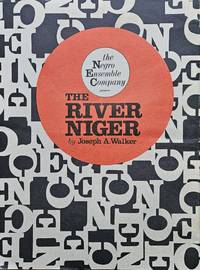
1973List2919New York City: George Fenmore Associates 1973. Sixteen page booklet measuring 9 x 12 inches. Some wrinkling some marginal damage overall excellent. The Negro Ensemble Company was opened in 1967 by actor and playwright Douglas Turner Ward actor and producer Robert Hooks and producer Gerald Krone with a grant from the Ford Foundation. It provided free theater training—both in acting and in behind-the-scenes work—to Black people in New York City and put on plays relevant to the community. Notable alumni of the NEC include Angela Bassett Samuel L. Jackson and Giancarlo Esposito among numerous others.<br /> <br /> Offered here is a booklet about the NEC’s production of Joseph A. Walker’s The River Niger which opened in 1972 in the small off-off-Broadway St. Marks Playhouse theater. The play was so popular that it played for weeks longer than planned at St. Marks and then opened on Broadway in 1973. Walker won a Tony for Best Play for The River Niger the first African-American to do so. The booklet includes photographs of the play and an article about it from Ebony magazine alongside photographs from the group’s many other productions. We find two copies of the booklet in OCLC both at the University of California Davis. George Fenmore Associates unknown
1963221701963. Civil Rights African American Slavery and Abolition A complete set of the Adventures in Negro History educational LP series created to promote Black history and culture during the Civil Rights era through dramatized narration and scholarly commentary. Adventures in Negro History: Volumes I-III. Highlight Radio Productions 1963 1966 1969. Three original 12-inch 33⅓ rpm vinyl LPs each record housed in original illustrated jacket. Commissioned by Pepsi-Cola and produced by the Chicago-based Highlight Radio Productions this project brought together historians actors and community leaders in an accessible audio-driven public history format. Each volume explores a distinct theme in African American experience with powerful graphic covers and scholarly liner notes by eminent historians John Hope Franklin and Elsie M. Lewis.<br /> <br /> 1 Volume I: Adventures in Negro History 1963. Illustrated in stark black and white the cover features a stylized portrait of a bound enslaved man visually evoking the violent conditions of enslavement and the struggle for freedom. The back cover provides capsule biographies of pivotal figures including Estevanico Crispus Attucks and W.E.B. Du Bois as well as dramatizations of "Douglass!" and "Pinchback!" The LP includes dramatized reenactments written and directed by Ossie Davis and is voiced by Ruby Dee Godfrey Cambridge Brock Peters and Roy Glenn. The liner text opens: "We cannot afford to let the story of Negro Americans-who they were how they lived what they did-go untold. This is a job that needs doing in all the classrooms of America." The tone is urgent and pedagogical designed to be played in schools libraries and community centers. <br /> <br /> 2 Volume II: The Frederick Douglass Years 1817-1895 1966.With a bold blue cover echoing the design of Volume I this LP focuses entirely on Douglass's life from enslavement to abolitionist leader. A full panel on the reverse contains the essay What the Douglass Years Mean to America by John Hope Franklin then Professor of American History at the University of Chicago. Franklin writes: "The Frederick Douglass story is the story of America in the nineteenth century. it is the story of man's struggle for justice and liberty in a society often committed more to self-interest than to high principle." The dramatizations include scenes from Douglass's escape from slavery his debates with white abolitionists and his role during Reconstruction. The same acclaimed voice cast from Volume I returns. <br /> <br /> 3 Volume III: The Afro-American's Quest for Education - A Black Odyssey 1969.This volume shifts focus to the historical struggle for Black educational access from slavery through desegregation. The cover rendered in burnt sienna and black features a graphic portrait of a bearded elder flanked by line drawings of teachers students and historic Black institutions. On the verso Dr. Elsie M. Lewis Professor of History at Howard University contributes a major essay declaring: "No phase of the American Negro's history is more crucial more dramatic or more moving than his long dogged quest for education." Her commentary frames education as both a right and revolutionary act for African Americans. Like earlier entries Volume III blends narrative scenes with documentary-style commentary. <br /> <br /> All three LPs are in very good condition with minor edge wear to sleeves. Vinyl appears clean with no visible scratches. These records were not mass-marketed and were distributed largely through educational and community networks making complete sets scarce. unknown