9 888 résultats
Paris, Lyon, Reinwald & Georg, 1885-87. Folio. All 5 parts uncut in orig. printed wrappers, unopened. XXXVI,93 226 134 284 pp., 2 color maps, 2 portraits and 144 plates (mostly tintet lithography, collotype and line-drawing). Many textillustrations in woodcut. Upper right corners of some of the last plates in vol. 4 water-stained. Otherwise absolutely clean and fine. (Plates numb. 1-6 1-67 + 11 bis 1-28 + 1 bis, 1-31).
London, Longman, Brown, Green etc., 1859. Fine recent full cloth. Gilt lettering on back. Small stamp on htitle, title, on a few pages and on verso of plates. XVII,455 pp. + Appendix, 8 chromolithographed plates (incl. frontispiece, Kane del., Vincent Brooks, lith.) and 1 folded engraved and coloured map. Plates as well as text exceptionally clean. Fine woodengravings in the text.
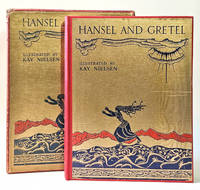
1925010664<p>New York: George H Doran 1925 310 pgs. Red cloth with pictorial pastedown in metallic gold black & red a few spots to edge of text block else a fine copy housed in the original pictorial box which is worn and soiled with a couple of breaks but complete. A gorgeous copy of Kay Nielsen's magnificent illustrated edition of Grimm's fairy tales featuring 12 tipped-in color plates and 10 full page b&w plates and decorative initials. This was the last of Nielsen's lavish gift books and no British trade edition was issued. . First Trade Edition. Pictorial Cover. Near Fine/No Jacket. Illus. by Kay Nielsen. Large Thick 4to.</p> George H Doran hardcover
Sorøe, Jonas Lindgren, 1760. Samtidigt hldrbd. Ryggen med blindtrykte dekorationer. Rygtitlen slidt. Hjørner lidt stødte. (8),383,(1) pp. samt 2 kobberstukne plancher. Spredte brunpletter og lettere brugsspor.Contemp. hcalf. Blindtooled decorations on spine. Titlelabel worn. Corners a bit bumped. Scattered brownspots and light traces of use.
In 8 (cm 18,5 x 27), pp. (2) + (24) numerate con le lettere dell'alfabeto + (2). Piccoli danni restaurati ai piatti. Timbro al piatto anteriore. Brossura editoriale illustrata da Cangiullo. Ritratto fotografico dell'A. a pagina 8 con dedica a Marinetti. Edizione originale del poema-partitura futurista di Francesco Cangiullo, costruito sull'universo acustico dell'omonima e chiassosa festa napoletana in chiave di provocatoria ironia avanguardista, restituito sulla pagina attraverso un'esplosione di tavole parolibere. Prima dell'uscita in volume nel 1916, nella galleria Sprovieri di Roma, nel marzo 1914, si era tenuta una delle piu' memorabili serate futuriste culminata proprio nella lettura di Piedigrotta da parte di Marinetti. Una sala illuminata da luci rosse esaltava il dinamismo di una tela sullo sfondo dipinta da Balla. Gli artisti portavano fantastici cappelli di carta: Balla aveva sulla testa un variopinto vascello, Cangiullo sedeva di tanto in tanto al pianoforte, gli altri suonavano strumenti tipici della tradizione napoletana, Marinetti declamava in una bagarre vertiginosa e caotica. Francesco Cangiullo (1884-1977) fu definito da Paolo Buzzi "re degli scugnizzi" che sposa "l'ode al lazzo". Per il critico Ugo Piscopo e' "folkloristico, clownesco, canzonettistico in chiave napoletana", il "pazzariello" che porto' la monelleria nella compagine futurista e insceno' nel 1914 i funerali di Benedetto Croce prendendo a schiaffi la grande testa del filosofo napoletano modellata in creta portata sulle spalle in processione. Cammarota, in "Bibliografia di Francesco Cangiullo", scrive "tiratura di 1500 copie, e non di 20000 come scritto in quarta di copertina". Gambetti-Vezzosi, p. Salaris, Bibliografia del Futurismo.
(Paris, ca. 1784-87). 4to. Series of 6 engraved plates in original handcolouring. 21x14,5 cm. (With broad margins: 25,5x19 cm.).
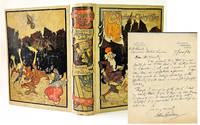
1892006542London: T. Fisher Unwin 1892. Book. Very Good. Decorative Cloth. HOLOGRAPH LETTER SIGNED. First Trade Edition. 4to - over 9¾" - 12" tall. The First Trade Edition there was also a limited edition of 100 copies. Very Good in the original salmon cloth with black decorations to boards; title in red on front and spine Unwin monogram likewise on rear. Color frontispiece. Spine darkened and red title dulled 3" tear top edge half-title page light foxing to end pages period interesting bookplate front pastedown. From the collection of the Richard M. Dorson Memorial Library Folklore Institute Indiana University the only library indicators being its stamp verso of frontispiece and blindstamp to title page. With RARE and important three page ALS tipped to front end page sent from Leland at the Hotel Victoria Florence Italy to Mr Sampson noted linguist John Sampson possiby dated 1899 with "99" after heading. "Dear Mr Sampson I have written and sent you separately by this mail that which I contribute to our book." He then discusses his wishes for the Preface and Introduction before adding "The Tinkers. This is quite unfinished. It needs a great deal from you. Please note that I have got some queer items as to the Tinkers of old times." In the next paragraph he mentions Shelta Shelta Thari being an esoteric language spoken by the tinkers which Leland had discovered in 1876. He goes on to ask "Can you send me an Old Irish alphabet' and later "I hope it will not take you long to put together what you and Professor Meyer will give" referring to Professor Kuno Meyer a German scholar distinguished in the field of Celtic philology and literature. Then an address in Hamburg Germany where he can be reached after June and "Sincerely Charle G. Leland". While I can find no book that these three men published together Sampson and Meyer did much work later to carry forward research and knowledge of the Shelta language and customs. A quite fascinating correspondence and ASSOCIATION COPY. T. Fisher Unwin Hardcover
17 annate consecutive in 8, da quinto volume - 1875 a ventunesimo volume - 1891 (3 fasc. ogni anno, 200 pp. ogni fasc. ). Serie completa dal 1875 al 1891, fatta eccezione per il fasc. 2 del volume ottavo - 1878. Raccolta in stato di nuovo, intonsa e con le br. ed. Rivista fondata dal Mantegazza nel 1871, che aveva da poco occupato a Firenze la prima cattedra di Antropologia in Italia. L'Archivio, peraltro tuttora esistente. Moltissimi furono gli apporti di autori quali Giglioli, Morselli, Issel, Zanetti, Regalia, Cavanna, De Stefani, Bellucci, Lombroso, Amadei, Beni ecc. Gli articoli riguardano sia studi originali di antropologia e antropometria con sconfinamenti in campo psichiatrico e psicologico (La capacita' del cranio negli alienati; L'uso e il rito della circoncisione negli Ebrei; Statura e condizione sociale nei bolognesi contemporanei; Superstizioni religiose nelle provincie di Treviso e Belluno; Pregiudizi popolari Putignanesi; Unma gita fra i Calabro - Albanesi; Le superstizioni di Portofino), viaggi antropologici (Appunti sulla etnologia del Madagascar; Gli strumenti musicali degli ostacchi; Note sugli indigeni delle isole Nicobar; Il bomerang) sia studi di archeologia preistorica (L'uomo della pietra nel perugino; L'uomo terziario in Portogallo; Scavi nell'antica citta' di Metaponto; Stazione presitorica della Bertarina - Forli'; Ricerche nella grotta di Bergeggi, Mazzuoli litici con bucio rinvenuti in Italia)
4 volumi, vol. I Comprenant les temps héroiques et l’histoire de l’Empire des Toltèques, XCII, pp 440; vol. II Comprenant l’histoire de l’Yucatan et du Guatémala, avec celle de l’Anahuac, durant le Moyen Age Aztèque, jusq’a la fondation de la royauté a Mexico, pp 616; vol III comprenant l’histoire des états du Michoacan et d’Oaxaca jusq’a l’arrivée des espagnols, astronomie, religion, sciences et arts des Aztèques, etc. pp 692; vol IV Conquéte des états du Mexique et du Guatémala, etc. Etablissement du gouvernement espagnol et de l’Eglise catholique. Ruine de l’idolatrie, déclin et abaissement de la race indigène, VI, pp 851 Rilegatura in mezza pelle con angoli, con titolo in oro al dorso Half calf binding with golden title at the back.
184563077ABLeipzig, Wigand, 1845. 2 Bände. IV, 376/411 S., 146 statt 150 Stahlstichtafeln u. 50 kolorierten Trachtentafeln., marmor.Schnitt. braune Schmuckeinbände , blindgperägte Deckel, reich ornamental-figürliche Rü.Vergoldung, Bindung angebrochen,stellenweise stock-, bzw. braunfleckig, insgesamt guter Zustand.
19922080202105101520Not Available 1992. Soft Cover. Fine. Number of books: 5 Not Available paperback
Very Good English Paperback. Pbo. Roy. 8vo. (24 x 17 cm). In Turkish. First Serie of this publication are full set. Rare as set. Ülkü Halkevleri dergisi. [First Serie]. 102 issues full set., 1933-1941. One of first periodicals published by Turkish Republican Public Houses. According to the Recep [Peker]'s article in the first issue of Ülkü, the main purpose of publication was to provide the mind, heart, and movement unity among those involved in the revolution; to promote the aims of the Public Houses working to serve the national language, national tarihe and national arts and culture. Güz 18-20 pp.
1943417464Schwarzenberg, Gärtner, 1915-1943. Meist in schönen Hlwdbdn,, wenige OHefte in Pp.-Umschl. gelegt. Teils m. St. bzw. Name. Teils m. TI. Wenige Tit. maschinenschriftlich ergänzt.
Colletion of 22 volumes (in total 24 volumes have been published ever, this collection lacks only vol.3 & 19), together more than 3700pp. with some illustrations in text and some folding maps and plates out-of-text, 24cm., most texts are in Catalan, uniform hardcover bindings with spine in green leather and title in gilt (except for vols.23-24: brown leather), few stamps (at blanco front endpaper and on titlepage), some traces of humidity on volumes 1 and 5 and 9 and 18 (mainly on cloth boards), good condition, rare and almost complete set, [contains a.o. Volume XII (1924): AMADES J. & ROIG E.: Vocabulari de l'Art de la navigacio i la pesca (116pp. with illustrations), vol.XIV (1926): ROIG E. & AMADES J.: Vocabulari de la pesca (83pp. with ills.), Vol.XV (1927): AMADES J.: Essers fantastics (80pp. with some ills.), vol.20 (1932): GRIERA A.: La casa catalana (pp.13-332 with ills. & plates out of text), vol.21 (1935): Indexs generals dels vint primeirs volums (xii + 356pp.), vol.22 (1934): AMADES J.: Vocabulari dels vells oficis de transport i llurs derivats (pp.59-239 with ills.), etc.], total weight is 15kg., T91037
Good Turkish, Ottoman (1500-1928) Contemporary burgundy cloth bdg. Marginal stains on the front board, foxing on pages, period repairs on some papers' margins. Otherwise a good copy. Stamp of "P. I. Kaia Bibliothek" on title page. With an exceptional provenance, from the collection of "S. Kiiliççioglu", who was a collector of books in Ottoman Turkish related to Asia and China. Roy. 8vo. (24 x 17 cm). In Ottoman script (Old Turkish with Arabic letters). 192 p. The very rare first Turkish edition of the narrative of a Hungarian-Jewish polyglot orientalist and traveler's first-hand account as a spy in the British service in disguise through Central Asia. This work was translated by Abdülhalim (1794-1882) who was the father of the famous Turkish writer Samipasazâde Sezai, fifteen years later he met Vambery first in the Rifat Pasha's Konak [ie. Mansion], while Vambery was teaching linguistics. With his journey paid for by Baron József Eötvös, in 1857 he set off for Istanbul, where there was a network of (quarrelsome) Hungarian émigrés. He survived, first, as a cook's lodger in Pera, then in a cold, damp cellar of the Hungarian Association. To make ends meet he sang Ottoman ballads in the meyhanes, wearing Turkish costumes and calling himself, eventually, Reshid Efendi. Then he climbed, went over to Stamboul, the old city, and was taken up by the Rifat Pasha family, to teach the sons (Raif Bey and his elder brother) Western ways. The journey lasted six months and was very dangerous. There were deserts to cross, with bandits, extreme thirst, and sandstorms. Vámbéry and his companions were holy beggars, dependent on charity for survival, but rumours went about that "hadjis" returning from Mecca had concealed treasure, and it was difficult to find boatmen who would take them across the Caspian without being well paid. All the while Vámbéry kept up his alias as a Turkish dervish, past Russians already suspicious of interlopers; and at the end of the road were emirs, in Bokhara, Samarkand, and Khiva, who put foreigners to death or threw them into a snake pit. However, Vámbéry had the presence of mind and the panache for which Budapest Jews are famous and passed himself off. He encountered the Emir of Khiva, who took an interest in him, and they discussed the possible links between the languages. Sorrowfully they concluded that there was nothing much in it - the music perhaps? The emir produced a court orchestra that made native noises. Vámbéry was asked to sing some of his own native music and produced excerpts from Don Giovanni. He went back via Samarkand and the tomb of Tamerlane to Iran, returned to Budapest, and then got himself to England. British representatives in Tehran had become very interested in his activities. Russian railway-building had gone ahead, and within a few years, the Russians had taken over Central Asia - Samarkand in 1868, and Khiva in 1873. The British were alarmed... (Cornucopia). Vámbéry met Dickens (they regularly lunched at the Athenaeum) and he seems to have inspired Matthew Arnold's most famous poem, Sohrab and Rustum. When he wrote his Travels in Central Asia, the publishers were Byron's and Scott's John Murray, the firm to be published by, though they drove a hard bargain. The Travels sold 24,000 copies. "Vámbéry became an instant celebrity in London and the public's fascination with his adventures and linguistic prowess created a huge demand for his original work upon publication in 1864." "I have divided the book into two parts; the first containing the description of my journey from Teheran to Samarcand and back, the second devoted to notices concerning the geography, statistics, politics, and social relations of Central Asia." (From the preface of Vambery for the original edition). Özege 2391.
Very Good Turkish, Ottoman (1500-1928) Paperback. 8vo. (18 x 12 cm). In Ottoman script (Old Turkish with Arabic letters). 80 p. Probably taken from a volume. Minor wear on spine. Light fading on pages. Otherwise a very good copy. This interesting, very rare, and also pseudo-historical first book penned specifically on the Yezîdî people by an Ottoman statesman, initially prepared as a report and then published in 1912, before WWI in Ottoman Cairo. One of only three written Eastern sources about this interesting community that has been subject to extremely controversial approaches throughout history. The first is the travel corpus of Evliya Çelebi, the second is 'Abede-i Iblis', and the third is "Al-Yazidiyya Kadîmen wa Hadisen", which was published in Arabic in Beirut in 1934. Yezîdîs, a member of a Kurdish religious minority found primarily in northern Iraq, southeastern Turkey, northern Syria, the Caucasus region and parts of Iran. The Yezîdî religion includes elements of ancient Iranian religions as well as elements of Judaism, Nestorian Christianity and Islam. Although scattered and probably numbering merely between 200,000 and 1,000,000, the Yezîdîs have a well-organized society, with a chief sheikh as the supreme religious head and an emir, or prince, as the secular head. The origins of the Yezîdî faith can be traced to areas of the Kurdish mountains of northern Iraq where pockets of devotion to the fallen Umayyad dynasty persisted long after the death of the last Umayyad caliph, the half-Kurdish Marwan II, in 750. Some descendants of the dynasty settled in the area, further encouraging the development of mystical traditions in which the Umayyad lineage was prominently figured. In the early 12th century, Sheikh 'Adî ibn Musâfir, a Sufi and a descendant of the Umayyads, settled in Lâlish, north of Mosul, and began a Sufi order known as the Adwiyyah. Although his own teachings were strictly orthodox, the beliefs of his followers soon blended with local traditions. A distinct Yezîdî community living in the environs of Mosul appears in historical sources as early as the middle of the 12th century. This book includes descriptions of the Yezîdîs , albeit all the prejudices within it, on their geography, origins, mythology, religions, cosmogony, etc. The book has a long chapter on Yezîdîs' chief divine Malak ?âûs [or, Tavus] ("Peacock Angel"). Malak Taus has often been identified by outsiders with the Judeo-Christian figure of Satan, causing the Yezîdîs to be inaccurately described as "Devil worshippers", as seen in this pseudo-historical book as well. Özege 24.; OCLC 83228795.
1904010920<p>Boston: Old Corner Book Store 1904 464 pgs. Beige cloth pictorially stamped in color on all panels mild surface rubbing light shelf wear overall a lovely clean copy. Originally published in this format in 1900 but this edition replaces the pictorial endpapers with plain all else is identical. Illustrated with a color frontis & title page the balance in b&w as full- and partial-page plus chapter heads and decorations. All iterations of Rackham's Grimm fairy tales are elusive. This one is made even more special by an autograph letter signed by Rackham addressed to Canadian author Howard Angus Kennedy declining an invite to a party held by the Candian Author's Association. Reprint. Pictorial Cloth. Very Good Plus/No Jacket. Illus. by Arthur Rackham. Thick 8vo.</p> Old Corner Book Store hardcover
Berlin, Fred. Dümmler's, 1850. 4to. In contemporary marbled paper covered boards. Spine loose and light wear to extremties, internally fine and clean. 86 pp.
Bremen, Brauer 1708. Folio. In contemporary full vellum. Two ex-libris pasted on to pasted down front end-paper. Light miscolouring throughout. A good copy. (20), 572 pp. With numerous vignettes, figurative initials and depictions of coats of arms in text.
19882080202102900240Daiichishobo 1988. Soft Cover. Fine. Books: 5 books Daiichishobo paperback
Very Good English 5 volumes in original bdg. and other issues; original paperback. Large 4to. (28 x 20 cm). In Turkish. Second Serie of this publication are full set. Rare as set. Ülkü Halkevleri dergisi. [2. Serie]. 126 issues full set, 1941-1947.
19882080202102600143Daiichishobo 1988. Soft Cover. Fine. The book is in fine condition. Daiichishobo paperback