107 résultats
17071673A Amsterdam: Aux depens d’Estienne Roger Marchand Libraire chez qui l’on trouve un assortiment general de toute sorte de Musique 1707. First Amsterdam edition. With Valentine de Laborde’s bookplate on inner front panel. Woodcut device on title page. Woodcut initials and tailpieces throughout. 19th century leather. Spine richly gilt with title vignettes. Marbled endpapers. Binding restored at hinges. Engraved frontispiece missing. Old entry of ownership on title page in faded ink. Some spots and stains occasionally throughout. L6 torn at lower corner with no effect to the text. Overall in very good condition. First Amsterdam edition. With Valentine de Laborde’s bookplate on inner front panel. Woodcut device on title page. Woodcut initials and tailpieces throughout. 19th century leather. Spine richly gilt with title vignettes. Marbled endpapers. 261 1 p. Frontispiece missing. <p><br /> First Amsterdam edition of this collection of oriental tales. <br /> <p><br /> <p><br /> Scarce edition of Histoire de la Sultane de Perse et des Visirs a collection of oriental tales partly corresponding with the stories of the book The Story of the Forty Viziers. Published first in the same year in Paris chez la veuve de C. Barbin translated by François Petit de la Croix however some sources attribute the translation to Antoine Galland the French translator of the Arabian Nights which was published three years earlier.<br /> <p><br /> <p><br /> Provenance: Valentine de Laborde 1806–1894 wife of Gabriel Delessert Prefect of Paris Police muse of Prosper Mérimée. <br /> <p>. Aux depens d’Estienne Roger Marchand Libraire chez qui l’on trouve un assortiment general de toute sorte de Musique unknown
17723031Paris, Saillant et Nyon, Michel Lambert, 1772-1773 ; six volumes in-4 ; demi-veau glacé fauve, dos à nerfs, caissons joliment décorés, pièces de titre et de tomaison havane, têtes dorées, tranches juste ébarbées (Sarazin, relieur parisien, première moitié du XIXe) ; I : 608 pp., (1) f. d'approbation ; II : 444 pp., CIV pp. (Epitre, Préface, Avertissement, Discours, Sonnets), 108 pp. (tables et errata) ; III : (2) ff., VIII pp. (Introduction), XLIII pp. (Préface et Sonnet), 698 pp., (1) f. d'approbation ; IV : (2) ff., 650 pp., (1) f. d'approbation ; V : (2) ff., 572 pp. ; VI : VIII pp., 359 pp., 118 pp. de tables, (1) f. d'errata.
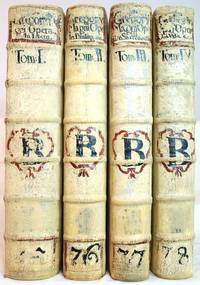
17051410030042Parisiis: Sumptibus Claudii Rigaud via Citharaea 1705-01-01. Hardcover. Very Good. Folio. 4 Volumes. Bound in contemporary full blind-stamped pigskin vellum. Black title on spine. Brass clasps to each volume. Original vellum tags on each title page for quick reference. Good bindings and covers with only minor Wear to extremities. Soiling to boards. Library markings on spine in contemporary gray black and red paint. Library bookplate of the Neander Library on inside boards. Owners inscriptions on inside boards detailing the set as a gift from Countess Marie-Margarite Waldstein upon her death in 1725. Presentation inscription on FEP to Dr. August Neander dated 1830 by Carl Hubner Carl Ferdinand Gustav Muller and Ludwig Wienfreiht Bath. Owners name of the Capuchin Monastery in Hradsite and date of 1725 on title page of each volume of Capuchin monastery in Hradiste. Lacking frontis of Pope Gregory I. Contemporary notation in ink and pencil on last blanks. Clean unmarked pages with minor tanning to extremities. Brunet II 1723/24. <br><br> Contents of each Volume are: Tomus primus. Libri moralium in Job XXXV. Libri duo in Ezechielem. Libri duo in Evangelia --Tomus secundus. Liber regulae pastoralis. Dialogorum libri IV. Registrum epistolarum. Epistolarum ordo restitutus. Index geographicus & varii alii indices --Tomus tertius. Liber sacramentorum S. Gregorii Papae ex editione D. Hugonis Menardi. Notae & observationes ejusdem D. Hugonis Menardi in Librum sacramentorum. Benedictiones quae in Libro sacramentorum desiderantur ex Lambecio. Benedictionum episcopalium aliud supplementum ex ms. Theodericensi. Liber antophonarius S. Gregorii Papae. Liber responsalis seu Antophonarius ex ms. Compendiensi. Variae expositiones in Librum I. Regum lib. VI. Expositio super Cantica canticorum. Expositio in septem psalmos poenitentiales. Concordia quorumdam testimoniorum sacrae scripturae --Tomos quartus. Vita S. Gregorii Papae auctore Paulo Diacono. Eadem auctore Johanne Diacono. Eadem ex ejusdem S. Gregorii Papae scriptis potissimum recens adornata. Sancti Paterii Liber de expositione Veteris & Novi Testamenti. Alulfi De expositione Novi Testamenti libe <br><br> Countess Mary Margaret Waldstein 1689-1725 was the wife of Prince Franz Josef of Waldstein 1680-1722 was an early supporter of the Capuchin Order and their monastery in Hradiste present-day Czechoslovakia. She is called the "mother of the Capuchins." <br> The House of Waldstein is a Czech noble family that received prominent state and civil positions beginning in the 17th century. It was one of the first among the Bohemian nobility to be promoted to Graf count in 1628 and two years later to the imperial court. Its most famous members include General Albrecht von Wallenstein and statesman Ferdinand Gabriel von Waldstein the patron of Ludwig van Beethoven. <br><br> The Order of the Capuchin Friars Minor is an Order of friars in the Catholic Church one of the chief offshoots of the Franciscan Order. The Order began in 1520 when Matteo da Bascio an Observant Franciscan friar said he had been inspired by God with the idea of that the manner of life led by the Franciscans at the time was not in keeping with their found St. Francis of Assisi had envisioned. He created the Capuchin Order to return to the primitive way of life solitude and penance as practiced by St. Francis. The name of their order comes from the Cappuccio a hood worn by the Camaldolese monks in gratitude for refuge given by the monks in the initial years of the order. <br><br> Dr. Johann August Wilhelm Neander 1789-1850 was a German theologian and church historian. Originally born into a Jewish family he changed his name to Neander when he became a Christian in 1806. A German Lutheran he studied with F D. Schleiermacher 1768-1834 in Berlin but soon switched his interest from speculative theology to church history. <br> His General History of the Christian Religion and Church Allgemeine Geschichte der christlichen Religion und Kirche remains the greatest monument of his genius. In this Neander's chief aim was everywhere to understand what was individual in history. In the principal figures of ecclesiastical history he tried to depict the representative tendencies of each age and also the types of the essential tendencies of human nature generally. His guiding principle in dealing both with the history and with the present condition of the church was "that Christianity has room for the various tendencies of human nature and aims at permeating and glorifying them all; that according to the divine plan these various tendencies are to occur successively and simultaneously and to counterbalance each other so that the freedom and variety of the development of the spiritual life ought not to be forced into a single dogmatic form" Otto Pfleiderer. <br> Neander had considerable influence not only in his own church and country but also further afield through the combination of scholarly excellence and personal interest that he achieved in his teaching and writing. Neander believed that church history is not just an academic pursuit but part of the mission and ministry of the church. <br><br>The Congregation of St. Maur often known as the Maurists were a congregation of French Benedictines established in 1621 and known for their high level of scholarship. The congregation and its members were called after Saint Maurus died 565 a disciple of Saint Benedict credited with introducing the Benedictine rule and life into Gaul. <br>The primary idea of the movement was not the undertaking of literary and historical work but the return to a strict monastic regime and the faithful carrying out of Benedictine life. <br>Their historical and critical school produced a number of works of scholarship which still are of permanent value. The foundations of this school were laid by Dom Tarisse the first superior-general who in 1632 issued instructions to the superiors of the monasteries to train the young monks in the habits of research and of organized work. The output was prodigious coming from a single society. The qualities that have made Maurist work proverbial for learning are its critical tact and its thoroughness. <br><br> Pope Gregory I Latin: Gregorius I; c. 540 - 12 March 604 commonly known as Saint Gregory the Great was Pope from 3 September 590 to his death in 604. Gregory is well known for his writings which were more prolific than those of any of his predecessors as pope. He is also known as St. Gregory the Dialogist in Eastern Orthodoxy because of his Dialogues. For this reason English translations of Orthodox texts will sometimes list him as Gregory Dialogus. <br> Throughout the Middle Ages he was known as the Father of Christian Worship because of his exceptional efforts in revising the Roman worship of his day. His contributions to the development of the Divine Liturgy of the Presanctified Gifts still in use in the Eastern Orthodox Church were so significant that he is generally recognized as its de facto author. <br> The Protestant reformer John Calvin admired Gregory and declared in his Institutes that Gregory was the last good pope. He is the patron saint of musicians singers students and teachers. The mainstream form of Western plainchant standardized in the late 9th century was attributed to Pope Gregory I and so took the name of Gregorian chant. <br> Gregory is commonly credited with founding the medieval papacy and so many attribute the beginning of medieval spirituality to him. Gregory is the only Pope between the fifth and the eleventh centuries whose correspondence and writings have survived enough to form a comprehensive corpus. GREGORIUS I MAGNUS 540-604. This is an oversized or heavy book that requires additional postage for international delivery outside of Canada and the US. Parisiis: Sumptibus Claudii Rigaud, via Citharaea hardcover
17687223Amsterdam & Paris, Desaint, 1768. Cinq ouvrages en un volume in-8 (195 x 124 mm), IV pp., 162 pp., 3 tables dépl.; 48 pp.(interversion du texte avec le quatrième ouvrage à partir du cahier C); 8 pp.; 8 pp.; un tableau dépl., 147 pp. et 1 p. n. ch.; 2 ff. n. ch., 314 pp., 1 f. n. ch. Veau porphyre, triple filet doré en encadrement sur les plats, dos à nerfs orné de caissons avec pièce d'armes au cerf doré répété, pièces de titre vert foncé et rouge, coupes filetées, tranches marbrées, habiles restaurations (reliure de l’époque).
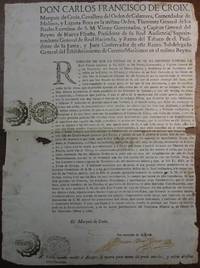
1768230014Mexico 1768. unbound. 2 pages in Spanish roughly translated 16.5 x 12 inches A Royal Proclamation: El Marquis de Croix March 9 1768 ordering the mine owners to make concessions and increase wages in small part: ".A decline in mining.the mines have the common enemy of water which has flooded them.the excessive construction cost of which the Kingdom has no wealth. Is the relief moderation the price you ask as the best mines are completely uninhabited and desolate Send my fatherly love to my vassals subjects.I'll strive by all means.that they are fruitful. I've visited the Council of the Indies. Faith issued.and the moderate price of quicksilver.which is distributed to the miners a part of the quarto has so far been given for relief to support the work.I command you with consequences that you publish and carefully observe that the above ceiling of a fourth part of the price at which would have been taken in quicksilver.be given to the miners.ending the embargo. Also by Royal Proclamation inserted within it is free of tax." Also signed by Manuel Rodriguez 1697 - 1772 -- military leader on the Coahuila-Texas frontier esteemed explorer and one of the greatest Indian fighters from Texas. After the departure of Jacinto de Barrios y Jaurequi in February of 1768 he became brief interim governor and military commandant of the Province. Rare signature as Commandant and Governor of the Province. According to the Texas State Historical Association "It was not until recently that archivists were aware that Rodriguez was a Governor.a fact scarcely noted by historians. Horizontal fold; two holes; smudges in the left margin. Very good- condition.<br/><br/> De Croix 1699 - 1786 was the Viceroy of New Spain Mexico who served during the period of Great Turbulence. The sole purpose of his five-year administration 1766 - 1771 was absolute obedience to the king whom he always referred to as "Mi amo." In 1767 he expelled the Jesuits from the colony removing them from their Monasteries and Colleges allowing them to leave with scarcely the clothes on their backs. These measures provoked a rebellion in which the Viceroy dealt severely with the rebels proclaiming censorship of literary and scientific publications 1768 and hanging the leaders of the uprising. No sooner had opposition been eliminated de Croix turned his attention toward the war-seeking Apache and Comanche Indian tribes financing and authorizing an expedition led by Captain de Galvez into Nueva Vizcaya whereby the Indians were soundly defeated. In March 1768 following the slow-downs boycotts and disturbances in the mines of Guanajuato and Pachuca over the low wages paid to the miners de Croix stunned the Colony by siding with the miners and forcing the mine owners to agree to an increase in wages. His actions were deemed "one of the most significant social reforms in the New World" at that time.<br/><br/> unknown books
1768230014Mexico 1768. unbound. 2 pages in Spanish roughly translated 16.5 x 12 inches A Royal Proclamation: El Marquis de Croix March 9 1768 ordering the mine owners to make concessions and increase wages in small part: ".A decline in mining.the mines have the common enemy of water which has flooded them.the excessive construction cost of which the Kingdom has no wealth. Is the relief moderation the price you ask as the best mines are completely uninhabited and desolate Send my fatherly love to my vassals subjects.I'll strive by all means.that they are fruitful. I've visited the Council of the Indies. Faith issued.and the moderate price of quicksilver.which is distributed to the miners a part of the quarto has so far been given for relief to support the work.I command you with consequences that you publish and carefully observe that the above ceiling of a fourth part of the price at which would have been taken in quicksilver.be given to the miners.ending the embargo. Also by Royal Proclamation inserted within it is free of tax." Also signed by Manuel Rodriguez 1697 - 1772 -- military leader on the Coahuila-Texas frontier esteemed explorer and one of the greatest Indian fighters from Texas. After the departure of Jacinto de Barrios y Jaurequi in February of 1768 he became brief interim governor and military commandant of the Province. Rare signature as Commandant and Governor of the Province. According to the Texas State Historical Association "It was not until recently that archivists were aware that Rodriguez was a Governor.a fact scarcely noted by historians. Horizontal fold; two holes; smudges in the left margin. Very good- condition.<br/> <br/> De Croix 1699 - 1786 was the Viceroy of New Spain Mexico who served during the period of Great Turbulence. The sole purpose of his five-year administration 1766 - 1771 was absolute obedience to the king whom he always referred to as "Mi amo." In 1767 he expelled the Jesuits from the colony removing them from their Monasteries and Colleges allowing them to leave with scarcely the clothes on their backs. These measures provoked a rebellion in which the Viceroy dealt severely with the rebels proclaiming censorship of literary and scientific publications 1768 and hanging the leaders of the uprising. No sooner had opposition been eliminated de Croix turned his attention toward the war-seeking Apache and Comanche Indian tribes financing and authorizing an expedition led by Captain de Galvez into Nueva Vizcaya whereby the Indians were soundly defeated. In March 1768 following the slow-downs boycotts and disturbances in the mines of Guanajuato and Pachuca over the low wages paid to the miners de Croix stunned the Colony by siding with the miners and forcing the mine owners to agree to an increase in wages. His actions were deemed "one of the most significant social reforms in the New World" at that time.<br/> <br/> unknown
1703B7089Paris: Chez Simon Langlois c 1703. near fine with text clean and crisp. . Edition: First Edition. Binding: Contemporary full paper boards expertly rebacked; raised spine with five 5 bands black ink title on vellum label on two; central black fleur de lis design on four. Notes: Provenance: Upper pasted endpaper with owner’s armorial bookplate: “Watkin Williams Esq of Penbedw // in the County of Denbighâ€. Concerning this name Archaeologia Cambrensis states: “1789. Watkin Williams Esq. of Penbedw in the county of Denbigh but owner of property in the parishes of Mallwyd and Llan-y-mowddwy in the county of Merioneth M.P. first for Montgomeryshire and afterwards during nearly thirty years for the Flint contributary boroughs was appointed lieutenant and custos rotulorum for Merionethshire.†Final free endpaper watermarked. <br>This edition of this Canadiana publication is unique in that we are not able to locate another copy of the same anywhere. The second last paragraph of the introduction to the priests clergy and missionaries in this edition states that this publication encloses at the end of the first part or 'Rituel' a second part entitled 'les Statuts Ordonnances & Mandemens.' instructions prepared at various times by the Church for the conduct of all including those entrusted to the clergy that these instructions may not be ignored. The recipient are advised that they are restatements of instructions previously given to be read often just as such given in the Ritual itself; they are to be followed with precisions including all the rules contained not to be lost sight of observed faithfully in all works and ones conduct. The inclusion of this paragraph is unlike the introduction of another edition published at the same time and same location but not including this paragraph or the 'Statuts.'. <br>The present work describing festivals sacraments statutes and ordinances for the use by priests in Quebec is extremely rare and was immediately followed by a second edition published the same year: Gagnon reports that in a copy of the second edition of 1703 now at the Laval University library and previously owned by Abbé Plante a note says that the first edition “would have been almost completely destroyed by the sinking of the ship …carrying it to Canada and for this reason a second edition was immediately made.†<br>On the “privilege†included as the final leaf in our first edition example it is stated that the work was registered on March 30 1703 and completed for print for the first time on March 31 1703; <br><br>Saint-Valier was a supporter of the Counter Reformation. His initial intent in the New World was to engage in the conversion of the indigenous residents. He introduced Jesuits and Recollects in an attempt to evangelize New France. Many of these missions Illinois Louisiana and Mississippi resulted in conflicts between Bishop Saint-Vallier the Jesuits and the seminary of Quebec.<br><br>His various construction projects reflect a desire to restore and renew the authority in the Catholic Church as the main institution of administrative organization. In 1697 Saint-Valier built a palace in Quebec for his clergy and as a place of hospitality. During the same year he also established a nuns monastery in Trois-Rivières Saint-Vallier’s zeal for religious activities and establishments stretched from Quebec Montreal Acadia and Louisiana. His way of life embodied that of the ideals of the Council of Trent.<br><br>The Diocese of Quebec was vast and its population diverse and widespread. It included the whole of French North America or what was called New France divided in seven colonies: Newfoundland Acadia ÃŽle Royale Louisiana Illinois Upper Country and Canada inhabited by Indigenous people and the European settlers. During the tenure of Saint-Vallier immigration from France was mostly over; the European colonists were farmers fishermen sailors merchants and ‘coureurs des bois’ overseen by a small elite of aristocratic leaders but a great demographic explosion occurred between 1685 and 1730 the white population in New France jumping from c. 12000 inhabitants to c. 41500.<br><br>During the same time the number of Amerindian fell from c. 163500 to c. 61500. That loss mainly in the tribes of Louisiana was attributed to warfare and diseases brought to the valley of the Mississippi. The number of Aboriginals compared to white settlers is one reason for the presence of so many religious orders in New France. The missions and conversions to Christianity were deemed very important.<br><br>Priests of the Missions Étrangères of Paris the Jesuits the Recollets and the Sulpicians often worked in collaboration with the nuns from different orders like the Congrégation de Notre-Dame or the Canonesses of St. Augustine of the Mercy of Jesus at l’Hôtel-Dieu de Québec. The arrival of Saint-Vallier and his strong views on what should be the duties of the priests created a shock wave in the orders especially for the Seminary of Quebec newly founded by his predecessor Bishop Laval. … Saint-Vallier's tenure as bishop was defined by interminable quarrels with governmental and religious institutions in French North America. … his active leadership style brought him into conflict with various groups who perceived him as at times domineering and micromanaging.<br>While subject to much criticism Saint-Vallier was also admired in his diocese for his dedication and self-sacrifice. Rather than staying in Quebec or Montreal he tirelessly traveled the back-country. The founding of the Hôpital Général and installation of Jesuits and Recollets at Montreal were also to his credit.<br><br>There was a very strong suspicion in the colonies and in France that the Bishop of Quebec was in fact a follower of Jansenism. . In the beginning of the 18th century the Bishop wrote 3 books; the Ritual the Catechism and the ‘Statuts et ordonnances’ – two of which are bound in the present volume. <br>…the Superior of the jesuite order decided to attack Saint-Vallier’s authority by writing a long critic of those three books seeing them as a "lapse into Arianism Pelagianism Jansenism Lutheranism and Calvinism". Father Bouvart based his accusations on different passages of the works of the Bishop … who eventually appealed to the Sorbonne to have his works rehabilitated. The doctors of the Faculty of Theology declared the Ritual and the Catechism perfectly orthodox and censured the critic of Bouvart. Nevertheless Saint-Vallier decided to re-edit in 1713 the Ritual so as to cast away all doubts about his pretended Jansenist ideas. This book remained in use in the parishes until the middle of the 19th century. The present work is the unedited original and first edition of his ritual and statuts. <br><br>The disputes with the religious orders of New France the government and the merchants gave way to a more peaceful period that lasted until his death. Austere throughout his life he became more and more humble in his way of living and turned toward contemplation and simple duties. .He also took very seriously his duties of Bishop and developed parishes in the farthest corners of the diocese.<br><br> Size: Octavo 213 x133mm. Illustration: Text in French; with some text in Latin<br>Achevé d'imprimer pour la premiere fois ce 31 mars 1703. Relié avec le Rituel du même. <br><br>Illustrated with two printer's devices representing the arms of the archdiocese of Quebec; various head and tail pieces incl. vignettes; in-text music notes on Qiiii-Si; Ggii-iiii. References: Philéas Gagnon: Essai de bibliographie canadienne: Inventaire d'une bibliothèque . Volume 1: 3138 & 3139 p.437; Archaeologia Cambrensis Volume 1 p.142. Pages: Ff. 2 bl. ill. title bl. author to priests on the use of the book 4 Fetes Observe’es 4 604 table 2 errata 3 bl.; ill. title bl. letter 3 8-146 table 2 privilege 2 bl.2; In leaf collation: bl. v A-Z8 Aa-Nn8 Oo-Rr4 iiiff. table; a1 a3-a8 e8 i8 o8 u8 aa8 ee8 ii2 oo8 uu8 aaa1 ii bl. Category: Book Canada; Book Religious Christianity; Chez Simon Langlois, hardcover