4 résultats
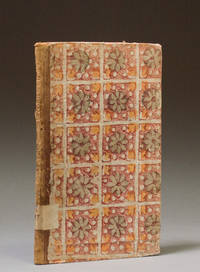
1771245629Rome: Typis. Sac. Congregationis de Propag. Fide 1771. First edition. Woodcut device on title. 37 1 pp. 1 vols. Small 8vo. Contemporary Italian decorated paper boards calf spine. Two small circular library stamps on title page. Fine beautiful copy. First edition. Woodcut device on title. 37 1 pp. 1 vols. Small 8vo. Typis. Sac. Congregationis de Propag. Fide unknown books
1764ST15125Augustae Vindelicorum Augsburg: Conradum Henricum Stage 1764. Second Edition in Latin. 208 x 160 mm. 8 1/8 x 6 1/4". 9 p.l. 262 pp.Translated from French into Latin by Joseph Claude Destouches. <br/> VERY ATTRACTIVE LATE 18TH CENTURY ETRUSCAN CALF IN THE STYLE OF EDWARDS OF HALIFAX covers with gilt border central panel framed by stencilled palmettes within double gilt rules an Etruscan-style vase at center within a stencilled sunburst raised bands spine panels with blind-stamped Etruscan vase black morocco label gilt-rolled turn-ins all edges gilt. With printer's elaborate engraved device on title page engraved portrait of Elector Maximilian-Joseph of Bavaria at the head of the dedication to him engraved allegorical headpiece at the opening of Book I wood-engraved tailpieces at end of each section. Small wormhole near head of front joint two corners a bit bumped minor foxing to title and final page other trivial imperfections but QUITE A FINE WIDE-MARGINED COPY clean fresh and bright internally and in a binding with only minor defects.<br/> <br/> This beautifully preserved and attractive Neoclassical binding is a fitting cover for a Latin edition of Fénelon's Homeric coming-of-age tale. Edwards of Halifax is credited with developing the process of acid staining calf by using stencils a method known most notably to produce as here their so-called Etruscan calf bindings after the Etruscan vase decoration they resembled. The process was also adopted by binders on the Continent and became a fashionable choice for bindings in the late 19th century when the present binding was surely produced. It is difficult to say whether this binding was done by the Edwards firm or by an imitator but in any case the quality of execution is very high. The popularity of Fénelon's account of the adventures of the son of Odysseus also spread in this case beyond his native France and it became a favorite of schoolboys far removed from the young Dauphin for whom it was originally composed. First printed in 1759 our Latin translation offered an opportunity for young men to practice reading that classical language. The engravings here were newly designed and executed for this edition by German painter and engraver Georg Sigmund Rösch d. 1766. Conradum Henricum Stage unknown
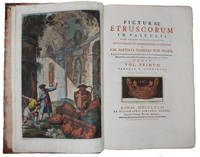
176750987Rome, Joannis Zempel, 1767. Folio. Contemp. hcalf. Spine gilt with gilt lettering. Spine slightly rubbed. the marbled paper on covers with some wear. Corners a bit bumped. A large, completely uncut copy. Htitle. Engraved handcoloured frontispiece.Title-page in red/black with handcoloured engraved vignette. LXXX (lacking 4 leaves (= XLIII-XLVI), XLVII-XLVIII in duplicate), 106,(2 - errat-leaf). Handcoloured textillustrations, handcoloured headpiece and initial and 100 fine handcoloured plates (10 double-page). Text as well as plates wide-margined (uncut) and clean, printed on thick paper. On verso of plate I a painting in watercolour.
176750987Rome Joannis Zempel 1767. Folio. Contemp. hcalf. Spine gilt with gilt lettering. Spine slightly rubbed. the marbled paper on covers with some wear. Corners a bit bumped. A large completely uncut copy. Htitle. Engraved handcoloured frontispiece.Title-page in red/black with handcoloured engraved vignette. LXXX lacking 4 leaves = XLIII-XLVI XLVII-XLVIII in duplicate 1062 - errat-leaf. Handcoloured textillustrations handcoloured headpiece and initial and 100 fine handcoloured plates 10 double-page. Text as well as plates wide-margined uncut and clean printed on thick paper. On verso of plate I a painting in watercolour. <br/><br/><em>First edition volume one only of this profusely illustrated and highly estimated work on etruscan vases coloured after the original vases in the Vatican and other museums in Italy. Giovanni Battista Passeri was archaeologist and antiquary to the Grand Duke of Tuscany. </em> unknown