Philippe PETAIN - Paul VALERYBiblio.com
945 résultats
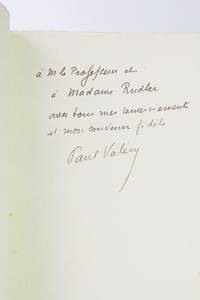
193164302Paris: Nrf 1931. Fine. Nrf Paris 1931 14.50 x 19.50 cm broché First edition one of numbered copies on alfa paper and reserved for advance distribution. Two small repairs on the spine and one bigger to foot of spine. Autograph inscription signed by Paul Valéry ro professor Rudler and his wife. Nrf unknown
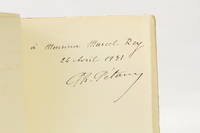
193164539Paris: NrfPlon 1931. Fine. Nrf Plon Paris 1931 14 x 19.50 cm broché First edition one of 570 numbered copies on pur fil paper. Endpapers partially shaded. Autograph inscription signed by Philippe Pétain to Marcel Rey. NrfPlon unknown
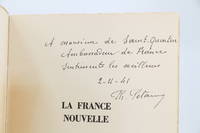
194187363Paris: Imprimerie Draeger 1941. Fine. Imprimerie Draeger Paris 1941 14 x 23.50 cm broché First edition one of 150 numbered copies on Holland paper the only deluxe copies after 1 on Montval laid paper and 50 on Japan paper. Spine sunned endpapers lightly shadowed and foxed half-title page lightly shadowed foxing on the second cover. Blind stamp ""chef de l'état français"" on the title page. We include a visiting card of Philippe Pétain on which these few words have been added: ""exemplaire N°131 destiné à monsieur l'ambassadeur de France au Brésil"". Rare autograph inscription dated and signed by Philippe Pétain: ""A monsieur de Sain-Quentin l'ambassadeur de France sentiment les meilleurs. 2.11.41. Ph Pétain."" To Mr. de Sain-Quentin Ambassador of France with best sentiments. 2.11.41. Ph Pétain. Imprimerie Draeger unknown
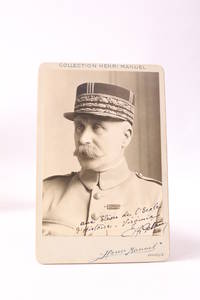
192769918Paris: Henri Manuel 1927. Fine. Henri Manuel Paris s. d. circa 1927 9.50 x 13 cm une photographie Original photograph on albumen paper laminated on cardboard and produced by the art gallery Henri Manuel and representing slightly in profile Marshal Philippe Pétain. Vintage print. Autograph signed by Philippe Pétain: ""To the students of the history school. Virginia. Ph. Pétain. This photograph was signed by Philippe Pétain for the students of the Matthew Fontaine Maury high school located in Norfolk in the state of Virginia. We are enclosing a typed letter from Philippe Pétain's orderly officer headed by his office of Inspector General of the Armies and the Vice-Presidency of the Superior War Council indicating that this autographed photograph has been sent. by post handwritten envelope attached. Henri Manuel unknown
77641Couverture crème souple et imprimée. Piqures sur la couverture. Papier jauni.
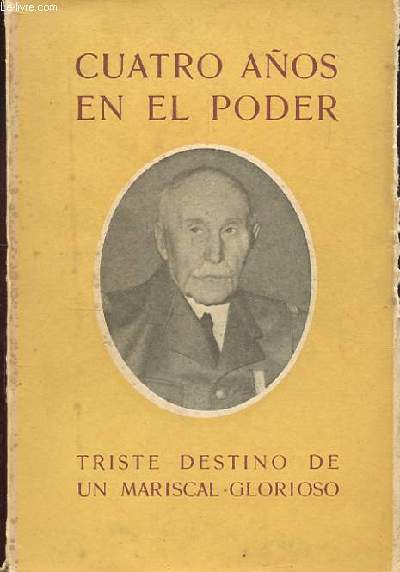
1949R160125590Non Renseigné. 1949. In-12. Broché. Etat d'usage, Plats abîmés, Dos abîmé, Rousseurs. 95 pages. Quelques illustrations et photos en noir et blanc hors texte. Texte en espagnol. Signature d'un particulier sur la page de faux titre et la page de titre. Coiffes un peu abimées.. . . . Classification Dewey : 460-Langues espagnole et portugaise
12931Edition spéciale de la légion, Sequana éditeur, 1941. In-12, broché.
19311009761931 Nouvelle Revue Française, Plon - 1931 - In-8 broché - 136 pages - N° 426/500 sur vélin pur fil
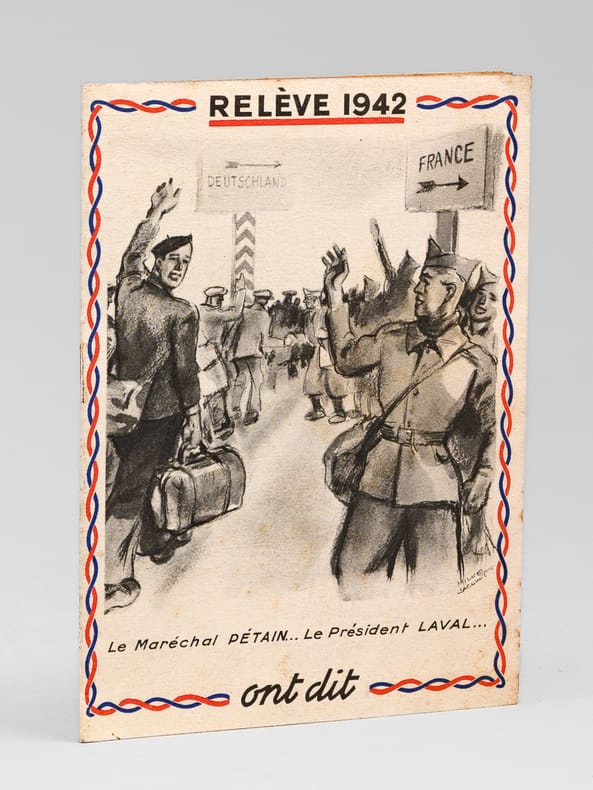
1942712401 brochure in-12, Editions R.B., Paris, s.d. [ 1942 ], 4 ff.
2874951439.Gpaperback. Good. Access codes and supplements are not guaranteed with used items. May be an ex-library book. paperback
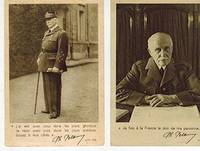
51-5826Secours National: Juin 1940. Two gravure postcards. 15 x 10cm.Le discours du maréchal Pétain le 17 juin 1940.Chef militaire illustre considéré comme “le vainqueur de Verdun†général en chef de l’armée française jusqu’en 1931 ministre de la guerre en 1934 ambassadeur de France en Espagne en mars 1939 Philippe Pétain devient le 17 mai 1940 à 84 ans vice-président du Conseil dans le gouvernement de Paul Reynaud.« J’ai été avec vous dans les jours glorieux. Chef du gouvernement je suis et je resterai avec vous dans les jours sombres. Soyez à mes côtés. Le combat reste le même. Il s’agit de la France de son sol de ses fils. »2757Philippe PÉTAIN 1856-1951 Conclusion de l’appel lancé à la radio 20 juin 1940. Pétain et les Allemands 1997 Jacques Le Groignec Secours National: Juin 1940 unknown
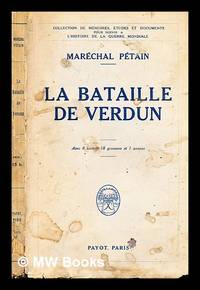
1929302558Paris : Payot 1929. Second Edition. Softcover. Very good copy in the original stiff-card wrappers; edges somewhat nicked and dust-dulled as with age. Some staining to covers. Bright and clean internally. Remains quite well-preserved overall. Series: Collection de mémoires études et documents pour servir à l'histoire de la guerre mondiale. Physical description: 3 preliminary leaves 9-156 1 pages illustrations maps plates 2 double portraits ; 23cm. Subjects: Verdun Battle of Verdun France 1916. Paris : Payot paperback
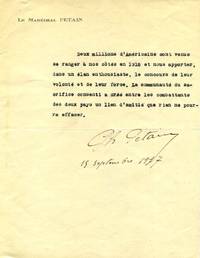
1927008277France: Not published 1927. Autograph. Very good condition. Unbound. Signed by Authors. First Edition. Octavo 8vo. One page note typed on Petain's personal stationery signed and dated "Ph. Petain 15 Septembre 1927." The note is a statement not addressed to anyone. It reads "Deux millions d'Americains sont venus se ranger a nos cotes en 1918 et nous apporter dans un elan enthousiaste le concours de leur volonte et de leur force. La communaute du sacrifice consenti a cree entre les combattants des deux pays un lien d'amitie que rien ne pourra effacer." Roughly translated it reads: Two million Americans came to settle the odds in 1918 and to bring to us in an enthusiastic surge the assistance of their will and their force. A community of consensual sacrifice was created between the veterans of the two countries and a bond of friendship that nothing will be able to erase. Not published Paperback
16-4387Paris: 1939. Original typescript. 2pp 4to. Provenance Estate of Paul Lombard. Né en 1889 Paul Lombard a été rédacteur en chef de la revue L’Homme libre journal de Clémenceau et critique littéraire sous le pseudonyme de Louis Méritan. Paul Lombard est de ces critiques qui comme l’a montré Thierry Laget Proust Prix Goncourt Gallimard 2019 reprochaient à l’Académie Goncourt d’avoir décerné leur prix à un écrivain trop vieux trop riche : "Au lieu de cela cette année le prix Goncourt … échoit à M. Proust qui n’est pas jeune : il a conquis en peu de jours une notoriété dont j’ignore le secret ; le prix Goncourt même s’il l’a mérité ne lui sera d’aucune utilité" déplore-t-il dans L’Homme libre du 11 décembre 1919 p. 2. Probablement aurait-il préféré que Les Croix de bois de Dorgelès remportât de prix d’autant que l'écrivain avait été un collaborateur régulier de L’Homme libre.Expertise by Ségolène Beauchamp 86bis rue de Bellébat 45000 Orléans and Pierre Prévost 75 rue Michel Ange 75016 Paris. Paris: 1939 unknown
194168258Introduction par G. L. Jaray, un des cent exemplaires sur vélin de Rives B.F.K. numérotés de 11 à 110 (n° 51, 1 vol. in-8 br. sous covuerture rempliée, H. Lardanchet, Paris, 1941, XXI-256 pp
194165790Introduction par G. L. Jaray, un des cent exemplaires sur vélin de Rives B.F.K. numérotés de 11 à 110 (n° 77), 1 vol. in-8 reliure demi-vélin blanc, couvertures conservées, H. Lardanchet, Paris, 1941, XXI-256 pp.
mon0003043139The Dial Press 1930-01-01. Hardcover. Good. 1.2000 8.6000 5.7000. The Dial Press hardcover
193085115London: Elkin Mathews & Marrot Ltd 1930. Presumed First U.K. Edition First printing. Hardcover. Good/No dust jacket present. 254 pages. Frontis illustration. Illustrations. Maps. Cocked. Henri Philippe Benoni Omer Pétain 24 April 1856 - 23 July 1951 commonly known as Philippe Pétain or Marshal Pétain was a French general who attained the position of Marshal of France at the end of World War I during which he became known as The Lion of Verdun. From 1940 to 1944 during World War II he served as head of the collaborationist regime of Vichy France. Pétain who was 84 years old in 1940 remains the oldest person to become the head of state of France. <br /> During World War I Pétain led the French Army to victory at the nine-month-long Battle of Verdun. After the failed Nivelle Offensive and subsequent mutinies he was appointed Commander-in-Chief and succeeded in repairing the army's confidence. Pétain remained in command for the rest of the war and emerged as a national hero. During the interwar period he was head of the peacetime French Army commanded joint Franco-Spanish operations during the Rif War and served twice as a government minister. During this time he was known as The Old Marshal. With the imminent Fall of France and the Cabinet wanting to ask for an armistice on 17 June 1940 Prime Minister Paul Reynaud resigned recommending to President Albert Lebrun that he appoint Pétain in his place which he did that day while the government was at Bordeaux. The Cabinet then resolved to sign armistice agreements with Germany and Italy. The government voted to transform the French Third Republic into the French State or Vichy France an authoritarian regime that collaborated with the Axis. After the war Pétain was tried and convicted for treason. He was originally sentenced to death but due to his age and World War I service his sentence was commuted to life in prison. His journey from military obscurity to hero of France during World War I to collaborationist ruler during World War II led his successor Charles de Gaulle to write that Pétain's life was "successively banal then glorious then deplorable but never mediocre". The Battle of Verdun was fought from 21 February to 18 December 1916 on the Western Front in France. The battle was the longest of the First World War and took place on the hills north of Verdun-sur-Meuse. The German 5th Army attacked the defences of the Fortified Region of Verdun and those of the French Second Army on the right east bank of the Meuse. Using the experience of the Second Battle of Champagne in 1915 the Germans planned to capture the Meuse Heights an excellent defensive position with good observation for artillery-fire on Verdun. The Germans hoped that the French would commit their strategic reserve to recapture the position and suffer catastrophic losses at little cost to the German infantry. Poor weather delayed the beginning of the attack until 21 February but the Germans captured Fort Douaumont in the first three days. The advance then slowed for several days despite inflicting many French casualties. By 6 March 201 2 French divisions were in the RFV and a more extensive defence in depth had been organized. Philippe Pétain ordered there to be no retreat and that German attacks were to be counter-attacked despite this exposing French infantry to the German artillery. By 29 March French guns on the west bank had begun a constant bombardment of Germans on the east bank causing many infantry casualties. The German offensive was extended to the west bank of the Meuse to gain observation and eliminate the French artillery firing over the river but the attacks failed to reach their objectives. In early May the Germans changed tactics again and made local attacks and counter-attacks; the French recaptured part of Fort Douaumont but then the Germans ejected them and took many prisoners. The Germans tried alternating their attacks on either side of the Meuse and in June captured Fort Vaux. The Germans advanced towards the last geographical objectives of the original plan at Fleury-devant-Douaumont and Fort Souville driving a salient into the French defences. Fleury was captured and the Germans came within 2 mi of the Verdun citadel but in July the offensive was cut back to provide troops artillery and ammunition for the Battle of the Somme leading to a similar transfer of the French Tenth Army to the Somme front. From 23 June to 17 August Fleury changed hands sixteen times and a German attack on Fort Souville failed. The offensive was reduced further but to keep French troops away from the Somme ruses were used to disguise the change. In September and December French counter-offensives recaptured much ground on the east bank and recovered Fort Douaumont and Fort Vaux. The battle lasted for 302 days the longest and one of the most costly in human history. In 2000 Hannes Heer and Klaus Naumann calculated that the French suffered 377231 casualties and the Germans 337000 a total of 714231 and an average of 70000 a month. In 2014 William Philpott wrote of 976000 casualties in 1916 and 1250000 in the vicinity of Verdun. In France the battle came to symbolize the determination of the French Army and the destructiveness of the war. Elkin Mathews & Marrot, Ltd hardcover
3094Payot, Paris 1929. Un volume broché (14,5 x 23cm) de 156 pages. Une légère déchirure au dos, manque au coin supérieur de la couverture, couverture salie, ouvrage coupé un peu brutalement...Deuxième édition postérieure de quelques jours à l'édition originale imprimée également en Février 1929. Envoi autographe daté du 1 Juin 1929 et signé de Philippe Pétain à madame Charley J. Drouilly (femme du Commodore du même nom).
3094Payot, Paris 1929. Un volume broché (14,5 x 23cm) de 156 pages. Une légère déchirure au dos, manque au coin supérieur de la couverture, couverture salie, ouvrage coupé un peu brutalement...Deuxième édition postérieure de quelques jours à l'édition originale imprimée également en Février 1929. Envoi autographe daté du 1 Juin 1929 et signé de Philippe Pétain à madame Charley J. Drouilly (femme du Commodore du même nom).
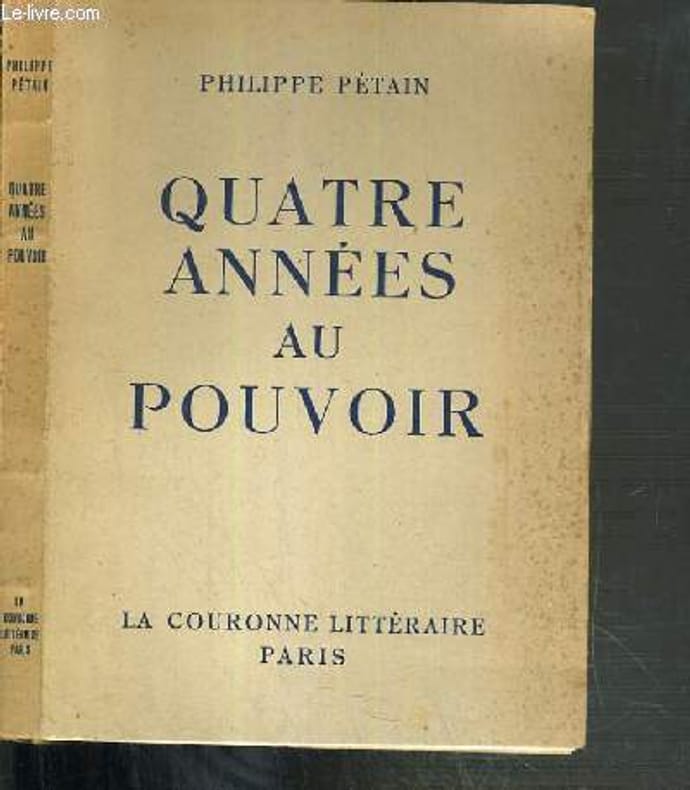
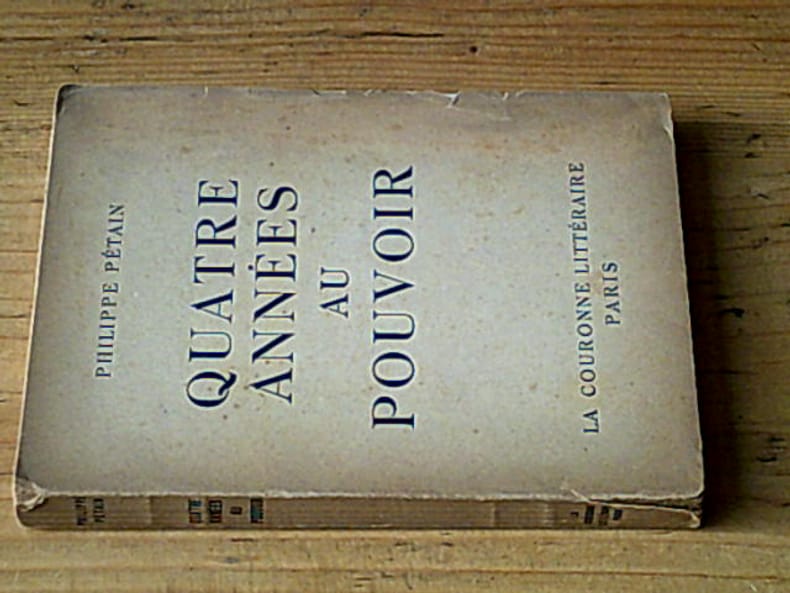
27263Paris, La Couronne Littéraire, 1949. In-8, broché, bande annonce conservé (Après ce livre le Maréchal ne publiera plus rien M° Isorni), 178 pp.
1949RO20164504LA COURONNE LITTERAIRE. 1949. In-12. Broché. Etat d'usage, Couv. convenable, Dos satisfaisant, Intérieur frais. 178 pages - quelques photos et fac-similés en noir et blanc hors texte - frontispice en noir et blanc du General PETAIN - 1 annotation sur la page de garde et de faux-titre.. . . . Classification Dewey : 940.533-Pétain
1949R160140531LA COURONNE LITTERAIRE. 1949. In-8. Broché. Bon état, Couv. légèrement passée, Dos plié, Intérieur acceptable. 175 pages. 7 gravures hors texte dont une en frontispice.. . . . Classification Dewey : 840-Littératures des langues romanes. Littérature française
5511LA COURONNE LITTERAIRE (1949) - Très bon état
194918243La couronne littéraire 1949 178 pages in-8. 1949. broché. 178 pages. Avec des illustrations en noir hors-texte