Ulysses S GrantBiblio.com
2 653 résultats
0483118842.Ghardcover. Good. Access codes and supplements are not guaranteed with used items. May be an ex-library book. hardcover
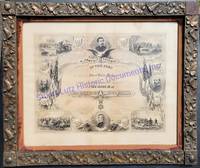
6831ULYSSES S. GRANT 1822-1885. Ulysses S. Grant was the Eighteenth President and led the Union Army to victory in the Civil War. DS. 1pg. c. 1884. Washington D.C. A document signed U.S. Grant as President of the Society of the Army of the Potomac and Horatio C. King as the organizations secretary. The partly-printed and illustrated document certifies membership of Captain Albert Victor Meeks to the Society of the Army of the Potomac. THE ARMY OF THE POTOMAC OF THIS ARMY ORGANIZED AUGUST 20 1861 DISBANDED JUNE 30TH 1865 Captain Albert Victor Meeks 62nd N.Y. Vols. was a Soldier and is now A MEMBER OF THE SOCIETY OF THE ARMY OF THE POTOMAC U. S. Grant President Horatio C. King Secretary. This certificate includes vignettes of famous Union commanders Major General George B. McClellan Major General Ambrose Burnside Major General George G. Meade and Major General Joseph Hooker. Albert Victor Meeks was a New York City lawyer and real estate businessman who served as a Captain in the Union Army during the Civil War. He served with the 62nd New York Volunteer Infantry. As a member of the Army of the Potomac his regiment fought in the Peninsula Campaign Antietam Fredericksburg Chancellorsville and Gettysburg. His unit was particularly noted for its bravery at the Bloody Angle during the Battle of Spotsylvania Court House. Along with being signed by Ulysses S. Grant this document is also signed by Horatio Collins King a celebrated Civil War hero who rode into the thick of battle at Dinwiddie Courthouse in 1865 and was awarded the Medal of Honor. He was also the Secretary for the Society of the Army of the Potomac for nearly three decades. The Society of the Army of the Potomac was a veteran organization founded in 1869 to preserve the history and fraternal bonds of the Unions eastern fighting force. In this society Grants role was defined by his status. His influence within the Society settled disputes helped the Society transition from a small group of elite officers into a more influential organization and his name was used to attract wealthy donors and political support for the Societys projects such as the establishment of military parks and the commissioning of statues. This document is held in a decorative antique frame and in fine condition. unknown
A9781258008635Hardback. New. hardcover
B9781258008635Hardback. New. hardcover
0332594122.Ghardcover. Good. Access codes and supplements are not guaranteed with used items. May be an ex-library book. hardcover
1330720954.Gpaperback. Good. Access codes and supplements are not guaranteed with used items. May be an ex-library book. paperback
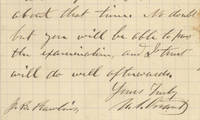
18752440305/06/1875. <blockquote><p>An uncommon handwritten letter as President showing Grant supporting Rawlins son after the General's death</p></blockquote><p>Ulysses S. Grant met John Rawlins in Galena Ill. where they both lived before the Civil War. Rawlins was a lawyer who did work for the Grant family business and the two men became close. When Grant was appointed brigadier general in August 1861 he immediately added Rawlins onto his staff as adjutant; Rawlins effectively acted as Grant’s chief of staff for the rest of the war. Rawlins rose to the rank of brevet major general by war’s end and during the conflict was Grant's chief defender. General James Harrison Wilson said of him ""John A. Rawlins all things considered was the most remarkable man I met during the Civil War…"" That is a remarkable statement from one who served under McClellan and Grant and was a cavalry leader in his own right. Some historians believe that without Rawlins Grant would not have soared to the heights he achieved in the war. He was appointed Secretary of War when Grant was elected President of the United States. He died in September 1869.</p><p>After Rawlins death Grant became guardian of his three children. Rawlins had a son James Rawlins who sought to follow his father's military footsteps deciding to go West Point where Grant himself had gone. Of the 39 West Point cadets who graduated in 1843 along with Grant four died in the Mexican-American War 15 became Union generals during the Civil War and 3 served as Confederate generals during the war. Ironically all three Confederate generals from the class of 1843 were from northern states. Young Rawlins entered the Military Academy.</p><p>On May 29 1875 Grant announced he would not run for a 3rd term a momentous announcement at the time.</p><p><strong>Autograph letter signed</strong> Long Branch NJ June 5 1875 to James Rawlins. <em>""Dear Jimmie Your letter of the 3rd instant was received yesterday. If I can go to West Point at all it will be about the 16th of this month. I do not know when your examination takes place but I think about that time. No doubt you will be able to pass the examination and I trust will do well afterwards.â€</em></p><p>Whether or not he passed the examination Rawlins decided on a different career path. Grant got him a job working for former New York governor Edwin Morgan.</p><p><img class=""alignnone wp-image-23729 size-post-window"" src=""https://cdn.raabcollection.com/wp-content/uploads/20231204152429/Folder-site-7-1600x1327.jpg"" alt="""" width=""1600"" height=""1327"" /></p> unknown
A9781163216002Hardback. New. hardcover
B9781163216002Hardback. New. hardcover
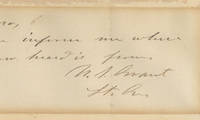
1864334181864. <blockquote><p>This letter has been for several generations in a private collection and is unpublished</p></blockquote><p>In January 1864 General Ambrose E. Burnside was asked to reorganize the IX Corps. He asked for and was granted permission by Secretary of War Edwin Stanton to form a division of “colored troops.†The 4th Division of the IX Corps infantry would be all black troops commanded by General Edward Ferrero.</p><p>The regiments were divided into two brigades; the first brigade was made up by the 27th 30th 39th and 43rd USCT. The second brigade was the 30th Connecticut Colored Infantry only 4 companies formed then consolidated into 31st USCT 19th 23rd 31st USCT. The 28th and 29th USCT regiments would be added to the second brigade. These regiments came from all across the North.</p><p>When the 4th Division of the IX Corps left Camp Stanton in Annapolis Maryland they were paraded in front of President Abraham Lincoln and General Burnside in Washington DC. The 23rd joined the division when the men marched across the bridge into Virginia.</p><p>In March 1864 Ulysses S. Grant was appointed by President Abraham Lincoln commander of the Union Armies. Grant developed a strategy to defeat the Confederacy by placing his army between the rebel capital of Richmond and Gen. Robert E. Lee’s Army of Northern Virginia. Grant moved southeast to try to create a wedge between Lee and Richmond but Lee's army successfully followed up the engagements by foiling that maneuver. Then Grant's assaults at Cold Harbor his most mistaken plan of the war and the one he most regretted resulted in a sharp defeat. Grant thus found that he was unable to take Richmond directly.</p><p>Next Grant focused on Petersburg due south of Richmond.</p><p>If Grant could take Petersburg then the Confederates would have to abandon Richmond. Grant's attempt to take it quickly failed so by mid-June 1864 Lee ended up in Petersburg with the Appomattox River protecting his back and surrounding the city below the river he built two lines of works that covered the entire area. Grant would besiege Petersburg and the IX corps played a part under General Ferrero.</p><p>The 23rd USCT became the first colored troops to fight in “directed combat†against Lee’s Army of Northern Virginia. The skirmish was fought at the intersection of Catharpin and Old Plank Roads originally Orange Plank Road on May 15 1864. The 23rd was at the Chancellorsville ruins when the Union 2nd Ohio Cavalry was chased by General Thomas Rosser’s Confederate Cavalry Brigade. The 2nd asked for assistance and the only soldiers nearby were General Edward Ferrero’s colored division. The 23rd USCT “double quicked†the two miles to the intersection and drove back Rosser’s cavalry as ordered by General Ferrero. The black soldiers were cheered by the 2nd Ohio who now gave chase to Rosser’s cavalry. This battle action proved to the white troops that black soldiers would fight against the Confederate army.</p><p>With the end of that campaign Grant ended up besieging the city and his Army of the Potomac built works from the river northeast of Petersburg down to south of the city as far as they could go. The Confederates controlled all the ground from Grant’s southern tip west up to the river. Grant’s main objective during the ten-month Siege of Petersburg was to extend his lines south and west to cut Lee’s railroad links and encircle him at the same time. Lee’s problem was that he was stuck in Petersburg and every Union successful extension west forced him to extend his lines. And every time he had to extend those lines became thinner.</p><p>In mid June as Grant prepared for his long assault on Petersburg Ferrero's black soldiers were now placed in the trenches with the other three divisions. The part of the line occupied by the IX Corps was very near the enemy's works and an incessant firing was kept up during the siege resulting in a daily loss of men killed or wounded. While there was a comparative quiet in front of the other corps positions the men of the IX Corps were subjected to the terrible strain of a constant watchfulness and deadly exposure. The enemy seemed to be excited to an undue activity by the presence of Ferrero's Colored Division.</p><p>In late July 1864 during the Battle of the Crater Ferrero's men had been trained for the attack on the Confederate line. However due to a last minute change by General George G. Meade the black soldiers were the last to enter the battle instead of the first. The three white divisions of the IX Corps did not follow General Burnside’s plan and delayed the attack. By the time the colored troops entered the battle the Confederates were ready to counterattack. Before being driven into the Crater the black troops advanced further than the white troops. The Confederate counterattack was a furious attack that won the day for the Confederate army. The black troops sustained the worst casualties. Ferrero initially accused of dereliction in this duty was cleared.</p><p><strong>Autograph letter signed</strong> no date but during the early siege perhaps mid to late June 1864 to General Ferrero. <em>""General Ferrero please inform me where the firing now heard is from.""</em></p><p>This letter has been for several generations in a private collection and is unpublished. We are not aware of another letter of Grant to Ferrero.</p><p><img class=""alignnone wp-image-25018 size-post-window"" src=""https://cdn.raabcollection.com/wp-content/uploads/20231204144051/Folder-site-11-1600x1327.jpg"" alt="""" width=""1600"" height=""1327"" /></p> unknown
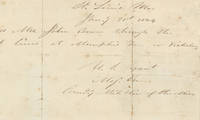
18643548131/01/1864. <blockquote><p>Written by Grant while on a visit to his family in St. Louis as he awaited his promotion to Lieutenant General</p></blockquote><p>His great victory at the Battle of Chattanooga in November 1863 made Major General Ulysses S. Grant the most prominent Union general. Soon legislation would be introduced in Congress to revive the rank of Lieutenant General—previously held only by George Washington and Winfield Scott—specifically to give Grant command of all Union armies. This Congress did on February 29 1864 and Grant would officially receive this promotion and the role of General-in-Chief on March 10.</p><p>In January 1864 Grant fresh from his victories in the West was still serving as the commander of the Military Division of the Mississippi overseeing Union operations in the Western Theater of the war. His activities that month focused on administrative and inspection tours of Kentucky and Tennessee and assessing supply lines. Finding the Cumberland Gap route for supplies unfeasible due to terrible road conditions he favored using the Nashville & Stevenson Railroad and the Tennessee River instead. More importantly he also concentrated on planning for the crucial 1864 spring campaign and the development of a grand strategy for the war. In a letter of January 19 to Gen. Henry Halleck demonstrating his proactive approach to ending the war Grant suggested a bold plan to invade North Carolina from New Bern to cut Confederate supply lines through Wilmington and capture Raleigh. Amidst all these activities Grant also took time to join his family in St. Louis for a short trip from January 27-February 3.</p><p><img class=""alignnone wp-image-35510 size-post-window"" src=""https://cdn.raabcollection.com/wp-content/uploads/20260125192231/Grant-Jan-31-1864-1-1600x664.jpg"" alt="""" width=""1600"" height=""664"" /></p><p>After his promotion Grant's subsequent strategy implemented from the field with the Army of the Potomac focused on simultaneous relentless pressure on Confederate forces leading to eventual victory.</p><p>Mrs. Bowen was the wife of Confederate general John Bowen a fine military commander who battled Grant and his armies in the final defense of Vicksburg. Bowen would die of disease just as the battle concluded in 1863. The Bowens were from St. Louis and when Gen. Bowen first left St. Louis to enter the war his wife Mary was by his side leaving their two young children at the family home to be cared for by Mary's mother. It is known that Mrs. Bowen passed through the lines after her husband’s demise and her passing back and forth to St. Louis and her access to Grant suggest this pass was almost certainly. for her.</p><p><strong>Autograph document signed</strong> St. Louis Mo. January 31 1864. <em>“Pass Mrs. John Bowen through the Federal lines at Memphis Tenn. or Vicksburg Miss.â€</em> It is signed <em>“U.S. Grant Maj. Gen. commanding Mil. Div. of the Miss.â€</em> Grant was known to be helpful to southern women so this would be consistent with his practice. This must be one of the few papers Grant signed while on the brief visit to his family.</p><p><img class=""alignnone wp-image-25018 size-post-window"" src=""https://cdn.raabcollection.com/wp-content/uploads/20231204144051/Folder-site-11-1600x1327.jpg"" alt="""" width=""1600"" height=""1327"" /></p> unknown
1998Q-1888952954Cumberland House Publishing 1998-08-01. Paperback. New. New. In shrink wrap. Looks like an interesting title! Cumberland House Publishing paperback
0267290071.Ghardcover. Good. Access codes and supplements are not guaranteed with used items. May be an ex-library book. hardcover
0260932418.Ghardcover. Good. Access codes and supplements are not guaranteed with used items. May be an ex-library book. hardcover
026663513X.Gpaperback. Good. Access codes and supplements are not guaranteed with used items. May be an ex-library book. paperback
0656980281.Ghardcover. Good. Access codes and supplements are not guaranteed with used items. May be an ex-library book. hardcover
1333398883.Gpaperback. Good. Access codes and supplements are not guaranteed with used items. May be an ex-library book. paperback
1981Q-0517352990Bonanza Books 1981-01-01. Hardcover. New. New. In shrink wrap. Looks like an interesting title! Bonanza Books hardcover
CA16C-00210Charles L. Webster & Company. Collectible - Acceptable. New York: Charles L. Webster & Company 1885. 1st edition. Volume 1. 584pp. Illustrations. Fair book. Ex-Library copy. Hinges and spine cracked. Title page detached. Large newspaper clipping tipped in on front endpapers. Ulysses S. Grant Generals Presidents Autobiography Inquire if you need further information. Charles L. Webster & Company unknown
18952307180032Century Co. New York 1895. Hardcover. Good. Volume 2 only. Bound in publisher's blue cloth. Gilt lettering on spine. Top edge gilt. Hardcover. Library stamps and markings. Shelf wear. Corner chipped. Century Co., New York hardcover
B9783387046595Hardback. New. hardcover
A9781240007806Paperback. New. paperback
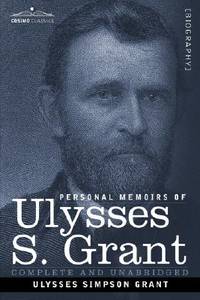
2006x-1596059990Cosimo Inc 2006. Hardcover. New. 544 pages. 9.25x6.00x1.50 inches. Cosimo Inc hardcover
2024Gyan-9788121268905Gyan Publishing House 2024. 1st. Hardcover. New. 14.34 x 22.59 x 5.96. English Gyan Publishing House hardcover
2024Gyan-9788121288903Gyan Publishing House 2024. 2 Vols. Set. Hardcover. New. 14.34 x 22.59 x 12.56. English Gyan Publishing House hardcover