GUINAND, UlysseBiblio.com
268 résultats
183361260Lausanne : Marc Ducloux 1833. 220x140mm. XV- brochÂŽ. IntÂŽrieurs propre. Couvertures ab”mÂŽes. Dos ab”mÂŽs fortement sur seconde livraison. Manque ÂŽgalement la quatriÂme de couverture de la seconde livraison. Cahier des pages 105-126 se dÂŽtache. Une nouvelle reliure serait souhaitable. 430 Marc Ducloux unknown
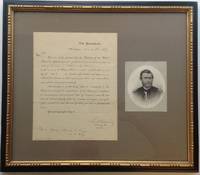
1867231088Washington 1867. unbound. 1 page on "War Department" letterhead 9.75 x 7.75 inches Washington November 6 1867 -- an uncommon partly printed document signed "U.S. Grant" as ad interim Secretary of War a post he held for only eight weeks informing Thomas J. Greggs: "You are hereby notified that the President of the United States has appointed you for gallant and meritorious services during the war a Captain by Brevet. Should the Senate at their next session advise and consent thereto you will be commissioned accordingly." Beautifully framed to 15.5 x 17.5 inches with a 4.5 x 3.75-inch copperplate portrait along with a tan matte and black-and-gold frame. The letter has horizontal folds and a small smudge in the left margin; overall a magnificent item in near fine condition.<br/><br/> At the time that this document was signed President Andrew Johnson was undergoing Impeachment proceedings. A week earlier he compounded his problems by firing Secretary of War Stanton and convincing Grant to fill the Cabinet position. Two months later both houses of Congress determined that it was illegal to fire Stanton and that he should be reinstated immediately. Grant rather than to get caught up with the political controversy walked away from President Johnson - both men refusing to speak to one another for the rest of their lives.<br/><br/> unknown books
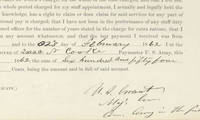
1862806901/03/1862. <blockquote><p>In it he also pays for his servants 3 of whom were black; An extreme rarity the first such document we can find having reached the market in a quarter century</p></blockquote><p>The battle of Fort Henry in Tennessee took place on February 6 1862 and an obscure and virtually unknown brigadier general named Ulysses S. Grant captured the fort and opened the Tennessee River to Union movements. This early in the war Union victories of any kind were scarce and this one was probably the most consequential of the war to date. Grant then moved directly on Fort Donelson entrapping the place both by land and sea from February 11-16. On the morning of February 15 the Confederate commander Simon B. Buckner sent a note to Grant requesting an armistice and asking terms of surrender. Buckner was expecting to give up the fort but get his soldiers paroled so they would not be prisoners of war. Grant refused to give terms but demanded unconditional surrender. The Confederates surrendered the next day the 16th. This victory opened the Cumberland River an important avenue for the invasion of the South to Union operations and Grant became instantly famous earning the nickname ""Unconditional Surrender"" Grant. President Lincoln took note of the fact that in Grant he had a general who could win. On February 20 1862 Lincoln promoted Grant to the rank of Major General a prerequisite to Grant's being able to command a large army.</p><p>However Grant’s very successes at Forts Henry and Donelson incurred the jealousy of his superior Gen. Henry Halleck who was in command of the whole Western Theater of war. Grant not yet realizing the peril Halleck's opposition placed him in knew Nashville was wide open with little in the way of defensive forces. Though Halleck had expressly forbade him to advance Grant ordered Union forces to enter Nashville. It fell on February 25 with Gen. Don Carlos Buell accepting the city's surrender. Nashville thus became the first Confederate state capital to fall into Union hands. Over the next week thousands of Union soldiers poured into the city and Grant took a boat upriver from Donelson to Nashville to confer with Buell. Halleck saw the taking of Nashville not as Grant recognizing and seizing an important opportunity but as willful disobedience of an order. And Grant's unauthorized trip to see Buell there only added to Halleck's anger.</p><p><img class=""alignnone wp-image-32063 size-post-window"" src=""https://cdn.raabcollection.com/wp-content/uploads/20240907140939/Grant-March-1-1862-1-1-1600x348.jpg"" alt="""" width=""1600"" height=""348"" /></p><p>So on March 1 1862 Halleck decided to tie Grant's hands by ordering him to return to Fort Henry and from there to launch an expedition up the Tennessee River to the state of Mississippi. The objective was the destruction of several key railroad bridges. Grant was to “avoid any general engagement with strong forces†and was told that it was “better to retreat than to risk a general battle.†Grant went to Fort Henry as ordered but did not communicate with Halleck directly. The next day Halleck complained to Gen. McClellan that he had heard no word from Grant for a week and that “his army seems to be as much demoralized by the victory of Fort Donelson as was that of the Potomac by the defeat of Bull Run.†On March 4 Halleck relieved Grant from his command writing him: “You will place Maj. Gen. C. F. Smith in command of expedition and remain yourself at Fort Henry.†Grant was shocked. “Thus"" say Grant's Memoirs ""in less than two weeks after the victory at Donelson the two leading generals Halleck and McClellan in the army were in correspondence as to what disposition should be made of me and in less than three weeks I was virtually in arrest and without a command.â€</p><p>Grant turned over command to Smith on March 5. Even as he did so he felt intensely frustrated and longed for action writing on the same day “I have not been well for the last ten days and don’t see that I will be much better until I can get to moving again.†Grant and Halleck exchanged letters after which Grant on March 11 demanded that Halleck relieve him from duty altogether in order to clear his name. ""There is such a disposition to find fault with me that I again ask to be relieved from further duty until I can be placed right in the estimation of those higher in authority.""</p><p>Perhaps this letter caused a change of mind or it may be that Halleck just could not risk loss of the popular Grant altogether. In any event surprisingly he refused and instead told Grant he would receive a new command writing him ""You cannot be relieved from your command. There is no good reason for it…Instead of relieving you I wish you as soon as your new army is in the field to assume the immediate command and lead it on to new victories."" Just four days later Grant was actually given a new command - he was placed in charge of Union forces in Tennessee. He proceeded to Pittsburg Landing Tennessee and arriving on the 17th established a wide camp with his forward units around Shiloh Church some 2.5 miles south of Pittsburg Landing. He wrote ""I at once put all the troops at Savannah in motion for Pittsburg Landing knowing that the enemy was fortifying at Corinth and collecting an army there under Johnston. It was my expectation to march against that army as soon as Buell who had been ordered to reinforce me with the Army of the Ohio should arrive; and the west bank of the river was the place to start from. Pittsburg is only about twenty miles from Corinth…When all reinforcements should have arrived I expected to take the initiative by marching on Corinth and had no expectation of needing fortifications though this subject was taken into consideration."" He reported to Halleck on his troop dispositions and imminently awaited reinforcements so he could move against Corinth. Halleck meanwhile continued to nitpick at Grant for supposed failure to discipline his troops properly.<br />The month of March was a significant one in Grant's career one that saw the tables turn twice on him. First in the flush of his great successes at Forts Henry and Donelson he was victimized by jealousy and relieved of command. Then when all seemed lost he was given an even greater command. And as he assumed that command and awaited reinforcements so he would move on Corinth he was unwittingly actually preparing for the Battle of Shiloh one of the most fateful of the war.</p><p><img class=""alignnone wp-image-32064 size-post-window"" src=""https://cdn.raabcollection.com/wp-content/uploads/20240907141021/Grant-March-1-1862-2-1600x657.jpg"" alt="""" width=""1600"" height=""657"" /></p><p><strong>Document signed</strong> Pittsburg Landing Tenn. April 2 1862 being a voucher for his own pay and expenses and those of his four private servants for the period from March 1 to March 31 1862. His pay was $220 per month and he received $52 per month for the pay of his servants. Forage for his seven horses came to $56 for the month. He received $10 per month as a clothing allowance and he was entitled to <em>""double rations for commanding army in the field""</em> which came to over 1000 rations for the month. The rations called ""<em>subsistence</em>"" cost $316.20. At the end the document recites that Grant has received a total of $654.20 from the paymaster and he has signed <em>""U.S. Grant Maj. Gen. Commanding Army in the field."" </em>Interestingly Grant's four servants are named and their skin color height and eye and hair color given. Frank was white; and Dan Jim and Sam were black. The voucher is docketed on the verso.</p><p>This is the first signed voucher for Grant's pay during the Civil War that we have seen. Research in public records going back 40 years discloses one previous monthly voucher having reach the market and that was a quarter century ago.</p><p>On April 6 1862 just four days after signing this document the Confederates commenced the Battle of Shiloh by bursting through Union lines and threatening to drive Grant's men back into the Tennessee River. Historians differ on whether Grant was at fault in being surprised but it is clear that Union forces only escaped being routed with the arrival of Buell's army. The next day the Union recaptured the initiative and drove the Confederates back in disorder. The battle was essentially a draw while also being the bloodiest battle yet to occur on the American continent. When the news reached the North where expectations had been high a storm of abuse broke out against Grant who was held responsible. He may well have not deserved the blame but he admitted reassessing the war after Shiloh. He wrote “Up to the battle of Shiloh I as well as thousands of other citizens believed that the rebellion against the Government would collapse suddenly and soon if a decisive victory could be gained over any of its armies. Donelson and Henry were such victories.But when Confederate armies were collected which not only attempted to hold a line farther south.but assumed the offensive and made such a gallant effort to regain what had been lost then indeed I gave up all idea of saving the Union except by complete conquest.â€</p><p><img class=""alignnone wp-image-25018 size-post-window"" src=""https://cdn.raabcollection.com/wp-content/uploads/20231204144051/Folder-site-11-1600x1327.jpg"" alt="""" width=""1600"" height=""1327"" /></p> hardcover
1887001282Boston Massachusetts: Cupples Upham & Co 1887. Light soil to covers and a touch of rubbing at the extremities. Pages show a thin strip of light damp stain at the bottom edge only less than 1/4 inch - text is not affected else Very Good condition. No owner's name or bookplate. No underlining. No highlighting. No margin notes. This 1887 first edition is not in Broadfoot. . First Edition. Hardcover. Original green cloth gilt/No dust jacket. 66pp. 37 page publisher's catalog. Cupples, Upham & Co Hardcover
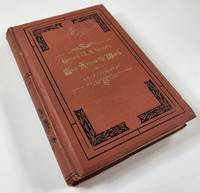
1879047975Hartford CT: James Betts & Co. 1879. First edition 1879. Attractive Victorian binding in brick red cloth over beveled boards gilt lettering decoration in black frontis portrait of Grant 350 pages. Modest wear to corners and spine ends smudge on front cover from what looks like removal of a price sticker good hinges firm text block a little foxing to the top of the frontis portrait and title page lightly age-toned but clean pages no names or other markings. First Edition. Hard Cover. Very Good. 8vo - over 7¾" - 9¾" tall. James Betts & Co. Hardcover
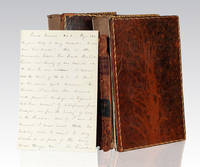
1885145720New York: Charles L. Webster & Company 1885-86. Exceedingly rare first edition of the autobiography of Ulysses S. Grant the 18th President of the United States which focusing mainly on his military career during the Mexican War and the Civil War entirely singular owned and annotated by Grant's close friend and most esteemed general: William Tecumseh Sherman. Octavo 2 volumes bound in the original full deluxe tree calf with gilt titles and elegant tooling to the spine gilt ruled borders to the front and rear panels gilt inner dentelles all edges gilt engraved portrait frontispieces illustrated with numerous facsimile letters 2 folding maps and wood engravings. William Tecumseh Sherman evidently read thes volumes in great detail making marginal notes on at least 18 pages in Vol. I several of them signed with his initials. On the last page of Vol. I Sherman wrote: "Read at St. Louis Mo. Dec 5 6 1885. This account of the Civil War is wonderfully accurate and him. W.T.S." Many of the notes are small corrections and additions by Sherman. On a passage regarding the Yazoo Pass Expedition on page 435 of Vol. I Sherman pointedly writes: "This conforms literally to my memoirs on the point most contested by Grant's pretended friends. W.T.S." He provides further thoughts regarding political interference on the next page: "If Grant had gone ahead living off the country we would have been inside of Vicksburg by Christmas 1862 the distance from Grenada to Vicksburg is little more than the circuit we afterward made from Bruinsberg via Jackson to Vicksburg --- This was my understanding when we parted at Oxford and the intervening country was better supplied with hay hominy. W.T.S." On p. 440-441 Grant wrote about the need to assign politically-connected John McClernand as Corps Commander: "I would have been glad to put Sherman in command to give him an opportunity to accomplish what he had failed in the December before; but there seemed no other way out of he difficulty for he was junior to McClernand. Sherman's failure needs no apology." In the margins Sherman's distinctive hand writes passionately: "because it was no failure at all." There is only one marginal annotation in Vol. II; however an autograph note is laid in at p. 123 supplying Sherman's recollection of Grant's first meeting with Lincoln which corroborates Grant's account. While Sherman was not present at the meeting between Grant and Lincoln he almost certainly heard about what transpired from Grant himself. The note reads in full: "Grants Memoirs Vol 2 Page 123 A good story is very correct. 'Si non vero ben trovalo.' Even if it is not true it is well conceived. This is the conversation between Genl. Grant President Lincoln and Secretary of War Stanton at the time he was addressed to command all the Armies of the U.S. Grant said in his usual quiet manner 'Mr. Lincoln I am told that several well planned campaigns in Virginia have been marred by interference from Washington viz from the Secretary of War or the President now if I am to command I must insist that no military order be issued to any detachment or part of the Army except through me' Mr. Lincoln in his inimitable way turning to Stanton said 'Stanton you and I have been running this machine for two years and have not made a brilliant success. I guess we had better trust this little man' Grant and then then and there the promise was made. And it is to the credit of Mr. Lincoln to say that he kept his word literally never interfering or making any order even when Washington was in real peril from Early's Army in 1865." Grant's insistence that there would be no political interference was likely particularly important to General Sherman who famously hated politicians. In good condition with detaching of the front boards and spines of each volume detaching of the rear board and separation of the folding facsimile letter at p. 312-313. Copies bound in highly polished gilt tree calf are extremely rare with only three other copies known. The first prospectus of Grant's Memoirs listed only 4 bindings: fine cloth full sheep fine half morocco and full Turkey morocco. The only other copy of Grant's Memoirs bound in tree calf was sold at auction - a copy presented to Mark Twain by Julia Grant and inscribed by both. Only two other known copies are located in private collections. To date no copies bound in the tree calf have been traced to institutional collections. As Grant died before publication was complete the only copy that he saw before his death was a prospectus bound in cloth; the extant tree calf copies suggest that the binding was perhaps reserved exclusively for presentations made by Julia Grant. Even the copies presented by publisher Mark Twain to his friends and colleagues were bound in one of the other available bindings. Though this copy bears no presentation inscription by Julia Grant Mark Twain or anyone else it is plausible that one of these figures would have sent the copy directly to General Sherman. After his second presidential term and world tour President Grant was stripped of nearly all of his life's earnings by conman Ferdinand Ward. Grant had forfeited his and his widow's military pension when he resigned as general to assume the presidency and his recent throat cancer diagnosis brought him deep concern about how his wife and family would manage financially after his death. In this moment of crisis Sherman rushed to Grant's aid and assisted him in restructuring his debt ensuring that Grant was able to keep his most prized possesions. Most importantly Sherman also encouraged Grant to do what he should have done years ago - write his memoirs. By June 1884 Grant had begun publishing articles on his major engagements of the Civil War for 'Century Magazine' which paid him $500 for each submission. The articles were received with great enthusiasm and Grant met with the magazine's representatives in early September to arrange for the publication of his memoirs. However when Samuel Clemens popularly Mark Twain learned of the potential arrangement with 'Century Magazine' he convinced Grant to sign with his own subscription publishing company which was able to offer Grant 70% of the net profit made from the sale of his memoirs. This rate was exorbitantly higher than what 'Century Magazine' had proposed. Grant began writing his memoirs in earnest racing against the illness to finish and ensure his family's financial stability. During this time Grant welcomed Sherman's repeated visits. On December 24 1884 Sherman wrote to his wife Ellen: "Grant says my visits have done him more good than all the doctors" Flood p.395. Grant with the moral support of Sherman lived to finish the memoir dying five days after its completion. Widely considered the finest military narrative ever published the memoirs were a national bestseller and Grant's widow Julia would eventually receive nearly $450000 about ~$14000000 today in royalties from their sale. Charles L. Webster & Company hardcover
18871162921887 Editions Hector Manceaux, Mons - 1887 - In-8, reliure toilé taupe, pièce de titre rouge au dos - 198 p.
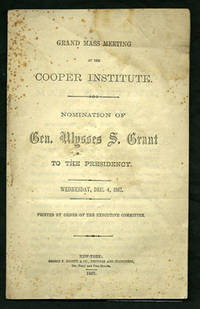
186727894New York: Printed by Order of the Executive Committee George F. Nesbitt & Co. Printers 1867. First edition. Stitched. Title paged foxed at the edges dampstain to upper front corner; a good copy. 40 pp. 8vo. They were all there Astor to Vanderbilt to give the Republican nomination to Grant. Printed by Order of the Executive Committee, George F. Nesbitt & Co., Printers unknown
186727894New York: Printed by Order of the Executive Committee George F. Nesbitt & Co. Printers 1867. First edition. Stitched. Title paged foxed at the edges dampstain to upper front corner; a good copy. 40 pp. 8vo. They were all there Astor to Vanderbilt to give the Republican nomination to Grant. Printed by Order of the Executive Committee, George F. Nesbitt & Co., Printers unknown books
18652285Petersburg VA: Eden & McCreery 1865. First edition. framed. EXTREMELY RARE FIRST ISSUE OF "GRANT'S PETERSBURG PROGRESS" PRINTED BY UNION SOLDIERS ON A CONFEDERATE PRESS THE DAY PETERSBURG AND RICHMOND WERE SEIZED SIX DAYS BEFORE LEE'S SURRENDER. "When on that famous Monday the third of April 1865 the advance line of attack on Petersburg found the city evacuated by the Confederate troops almost the first Federal soldiers to enter her doors took possession of the office of the Express and before the day was over from its presses there issued number one volume one of Grant's Petersburg Progress. It was a single sheet twelve by twenty inches in size printed on one side of the paper. Its cry was 'We are here!' Major Eden 37th Wisconsin Volunteers was editor assisted by Captain Charles H. McCreery 8th Michigan Veteran Volunteers and Chaplain D. Heagle. They proposed 'to publish a live paper as ling as circumstances will permit; that is as long as we can steal the paper and get men detailed to set the type.' Ten cents was the price. 'We are not particular as to the medium of exchange; and will take Hardtack Greenbacks Cigars postage stamps and in fact most any available currency Confederate Bonds and Contrabands always excepted.'" Nellie P. Dunn "General Lee in Grant's Petersburg Progress" South Atlantic Quarterly vol. 12. This first issue from the day of the fall of Petersburg was followed by only four other issues April 5 7 10. <br /> <br /> The paper is full of joy and wit providing a wonderful window into the mood of the soldiers now that the end of the war was near. <br /> <br /> Some highlights from the text:<br /> <br /> "For nearly six months the army of the United States has kept watch and ward over the City of Petersburg. Since last June the roar of shells and the whistle of bullets have disturbed the silence of the woods in the vicinity and today the old flag waves from the Court House. The United States armies and U.S. Grant have foreclosed and entered in possession and Petersburg is ours. And throughout the length and breadth of the land the joyful tidings will spread that another deadly blow has been struck at the fast dying Southern Confederacy. Slowly and miserably it yet drags on a lingering existence but its days are numbered and the end is at hand. The bright rays of the sun and the pleasant fresh breeze of this fair spring morning kiss the folds of the stars and stripes as it waves from the tower and hill the streets wear a lovely and animated appearance thronged with soldiers and citizens the cause of Liberty and truth is triumphant."<br /> <br /> Under the heading "LATEST NEWS":<br /> <br /> "RICHMOND TAKEN. -Just as we are about going to press we are reliably informed that the city of Richmond came into the possession of the Union forces at a quarter past eight o'clock this morning."<br /> <br /> Under "WE US AND CO":<br /> <br /> "We believe in the UNITED STATES one and indivisible; in Abraham Lincoln our adopted Father; in U.S. GRANT Captain of the Host; and ourselves as the principle sojourners in the Army of the Potomac and the Freedom of the Contraband the speedy extinction of the Rebellion and the perdition of Jeff. Davis here and here after."<br /> <br /> Under "FASHIONABLE ARRIVALS":<br /> <br /> "April 3d Gen. Grant and Staff and the Army of the Potomac generally."<br /> <br /> Under "AUCTION SALES":<br /> <br /> "To be sold very cheap if not badly sold already all the singularly ineligible and worthless property known as THE SOUTHERN CONFEDERACY. For particulars apply to Jefferson Davis Richmond Va. N.B. Liberal terms to agents of Maximillian Louis Napoleon or Victoria."<br /> <br /> Petersburg VA: Eden & McCreery April 3 1865. Broadside printed on recto only approx. 12x19.5 inches. Framed to an overall size of 17x24 inches. Some small holes at folds and edges; a few words of bleed-through from hand-written ink on verso. A wonderfully evocative piece of Civil War history. SCARCE. Eden & McCreery unknown books
183320260Lausanne, Marc Ducloux, 1833. In-8 broché, couverture imprimée. Petits manques de papier au dos, nombreuses rousseurs.
1847RO20052181DELAHAYS Adolphe. 1847. In-12. Broché. Etat d'usage, Couv. défraîchie, Coiffe en pied abîmée, Intérieur bon état. 709 pages.. . . . Classification Dewey : 944-Histoire de France varia
188932630Paris C.Charavay 1889 GRAND In-8 Fort Avec 28 reproductions de portraits d'après des documents authentiques
1844R260123185LIBRAIRIE DE CHARLES GOSSELIN. 1843-1844. In-12. Broché. Etat d'usage, Couv. légèrement passée, Dos fané, Quelques rousseurs. 456 + 710 + 576 + 486 pages. Dos du tome 3 légèrement détaché. Majeure partie des pages non coupées. Tampons de bibliothèque.. . . . Classification Dewey : 944.041-Histoire de France de 1789 à 1804
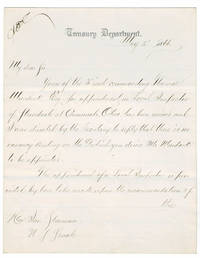
186698961<p>Washington D.C. May 5 1866. 1866. Very good. - Over 85 words penned in a secretarial hand on 2 pages of a 9-7/8 inch high by 7-3/4 inch wide "Treasury Department" stationery with an integral attached leaf. Hartley replies to Senator John Sherman of Ohio who has recommended Thomas Murdock Esq. for the position of Local Inspector of Steamboats at Cincinnati Ohio that "there is no vacancy in the District you desire Mr. Murdock to be appointed." Signed "John F. Hartley" as Assistant Secretary of the Treasury. Folded for mailing the document is docketed by Senator Sherman on the verso. There is a stain from a seal at the top inner corner of the integral leaf with a very small chip. Very good.</p><p>John F. Hartley 1809-1897 served as Assistant Secretary of the Treasury from 1865 to 1875 under Presidents Andrew Johnson and Ulysses S. Grant.</p> [Washington, D.C.], May 5, 1866.
189432951F. Tempsky / G. Freytag, Wien und Prag / Leipzig, 1894. LII, 222, 228 Seiten, 8° , ca. 19 x 13 cm, OHalbleder
1865138284Boston: Ticknor and Fields 1865. First edition of the second series of Hymns of the Ages from the library of Ulysses S. Grant. Octavo bound in full pebbled morocco with gilt titles and tooling to the spine in six compartments within raised bands gilt turn-ins and inner dentelles all edges gilt marbled endpapers tissue-guarded frontispiece. From the library of Ulysses S. Grant with a presentation bookplate to the pastedown which reads “Lieut. Gen. U. S. Grant from the Citizens of Boston January 1 1866.†In very good condition. Rare and desirable. Ulysses S. Grant was the 18th President of the United States 1869–77. As Commanding General of the United States Army 1864–69 Grant worked closely with President Abraham Lincoln to lead the Union Army to victory over the Confederacy in the Civil War. He implemented Congressional Reconstruction often at odds with Lincoln's successor Andrew Johnson. Twice elected president Grant led the Republicans in their effort to remove the vestiges of Confederate nationalism and slavery protect African-American citizenship and supported unbridled nationwide industrial expansionism during the Gilded Age. Ticknor and Fields hardcover
1895R200057280IMP. PAP. J. ROUMAZEILLE. 1895. In-4. Broché. Etat d'usage, Couv. convenable, Dos abîmé, Non coupé. 48 pages- agrafes légèrement rouillées. . . . Classification Dewey : 303.66-Guerre
1878_201800850Paris, Chez Alphonse Picard, Libraire, 1878 ; in-8 (183 x 232 mm), VIII-108-2-12-2, broché, couverture d'attente avec manque, dos muet (quelques rousseurs). Extrait du «Cabinet historique», Tome XXIII, Catalogue; p. 126 à 235. Tiré à 350 exemplaires.
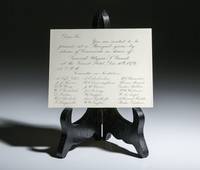
18791602Cincinnati Ohio 1879. Invitation Card. Fine. A private invitation to a dinner honoring General Ulysses S. Grant at the Grand Hotel of Cincinnati on December 11th 1879. Organizers of the event included Alphonso Taft Nicholas Longworth and Andrew Erkenbrecher. At the reception on December 11th 1879 Grant thanked the people of Cincinnati for their hospitality and was happy to be back in his "native State." An incredibly scarce piece of Cincinnati history and a relic of Ulysses Grant's World Tour. Upon returning from a two year post-presidential World Tour General Ulysses S. Grant was greeted as a returning hero to the United States. With stops at Yosemite Valley Galena Illinois and Chicago General Grant was greeted by thousands of well-wishers. Before this dinner in Cincinnati the Grant's visited Xenia Ohio to visit with Civil War orphans. unknown books
1887769111887 Valence, Céas, 1887, plaquette grand in 8° brochée, 19-29 pages ; couverture imprimée (effrangée).
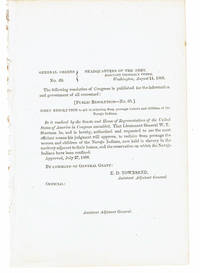
186895962Washington D.C. August 14 1868. 1868. Very good. - A 7-1/4 inches high by 4-5/8 inches wide broadsheet General Order issued as a "resolution of Congress" authorizing Lieutenant General W.T. Sherman "to use the most efficient means his judgment will approve to reclaim from peonage the women and children of the Navajo Indians now held in slavery in the territory adjacent to their homes and the reservation on which the Navajo Indians have been confined." The resolution adapted by Congress on July 27 1868 was distributed as a general order by "Command of General Grant" and signed in print by E.D. Townsend as Assistant Adjutant General. Removed from a bound collection in the distant past the broadsheet is lightly chipped with stab marks along the left edge. Very good. <p>Throughout the American Southwest and in this case New Mexico Spanish settlers and their ancestors pursued a flourishing slave trade from the 16th though the 19th centuries. Captive Native Americans who became known as "Genizaros" were sold as slaves to Hispanic families. This practice went on even after the United States came to govern New Mexico. Having abolished slavery through the 13th Amendment in 1865 Congress then passed the "Peonage Act" in 1867 when it became known that New Mexicans still owned hundreds maybe thousands of these "Genizaros" consisting mostly of Navajo women and children.<p>RARE. Washington, D.C., August 14, 1868. unknown
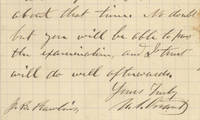
18752440305/06/1875. <blockquote><p>An uncommon handwritten letter as President showing Grant supporting Rawlins son after the General's death</p></blockquote><p>Ulysses S. Grant met John Rawlins in Galena Ill. where they both lived before the Civil War. Rawlins was a lawyer who did work for the Grant family business and the two men became close. When Grant was appointed brigadier general in August 1861 he immediately added Rawlins onto his staff as adjutant; Rawlins effectively acted as Grant’s chief of staff for the rest of the war. Rawlins rose to the rank of brevet major general by war’s end and during the conflict was Grant's chief defender. General James Harrison Wilson said of him ""John A. Rawlins all things considered was the most remarkable man I met during the Civil War…"" That is a remarkable statement from one who served under McClellan and Grant and was a cavalry leader in his own right. Some historians believe that without Rawlins Grant would not have soared to the heights he achieved in the war. He was appointed Secretary of War when Grant was elected President of the United States. He died in September 1869.</p><p>After Rawlins death Grant became guardian of his three children. Rawlins had a son James Rawlins who sought to follow his father's military footsteps deciding to go West Point where Grant himself had gone. Of the 39 West Point cadets who graduated in 1843 along with Grant four died in the Mexican-American War 15 became Union generals during the Civil War and 3 served as Confederate generals during the war. Ironically all three Confederate generals from the class of 1843 were from northern states. Young Rawlins entered the Military Academy.</p><p>On May 29 1875 Grant announced he would not run for a 3rd term a momentous announcement at the time.</p><p><strong>Autograph letter signed</strong> Long Branch NJ June 5 1875 to James Rawlins. <em>""Dear Jimmie Your letter of the 3rd instant was received yesterday. If I can go to West Point at all it will be about the 16th of this month. I do not know when your examination takes place but I think about that time. No doubt you will be able to pass the examination and I trust will do well afterwards.â€</em></p><p>Whether or not he passed the examination Rawlins decided on a different career path. Grant got him a job working for former New York governor Edwin Morgan.</p><p><img class=""alignnone wp-image-23729 size-post-window"" src=""https://cdn.raabcollection.com/wp-content/uploads/20231204152429/Folder-site-7-1600x1327.jpg"" alt="""" width=""1600"" height=""1327"" /></p> unknown
1900154675Leipzig, J. M. Gebhardt's Verlag, 1900. XIII, 704 S.; Mit 3 Illustrationen, Kl.-8° OLeinen, mit illustrierten Deckelbild, Frakturschrift,
1894RO40255864E. Vitte, Lyon - A. Picard, Paris. 1894. In-8. Broché. Etat d'usage, Tâchée, Dos satisfaisant, Intérieur acceptable. Plaquette de 47 pages. Papier encollé sur le dos, le consolidant. Etiquette de code sur la couverture. Quelques tampons et annotations de bibliothèque. Quelques annotations au crayon dans le texte.. . . . Classification Dewey : 264-Le culte