2 653 résultats
20072-0791467325State Univ of New York Pr 2007. Paperback. New. annotated edition. 124 pages. 9.00x6.00x0.50 inches. State Univ of New York Pr paperback
7210Five black & white illus. 18 pp. incl. inside of both wrappers. 8vo 210 x 150 mm. orig. semi-stiff pictorial wrappers staple-bound. From inside of lower wrapper: Amsterdam: Stichting de Appel 1984.<br /> The very rare program for Ulises Carrion's film festival celebrating the Mexican movie star Lilia Prado a famous actor from his childhood. Prado 1928-2006 starred in a number of Mexican films as well as several directed by Luis Buñuel in the 1950s. Carrión organized a festival screening four of her movies in four Dutch cities in 1984 which was attended by Prado herself. He conceived of this film festival as an "opportunity for viewers to examine their own cultural values and to reflect upon assumptions about the mythology created by the mass media in this case the film industry and its cultural-economic implications. In Carrión's eyes for example Prado could have been marketed as well as Marilyn had if post-World War II Mexico had been more economically dominant."-Ulises Carrión: ¿Mundos personales o estrategias culturales 2003 p. 76.<br /> This volume contains text in Dutch about Carrión by the curator Saskia Bos and the four movies to be shown and an interview between Prado and Carrión that took place earlier that year in Mexico City. Carrión's curriculum vitae is printed on the inside of the lower wrapper. This became one of the artist's most well-known projects. Pages 11-12 reproduce excerpts from the travel journal of "S.C. Macfarlane" who followed Carrión on his journey to Mexico in the spring of 1984.<br /> In fine condition. With a pictorial postcard listing the schedule and other events.<br /> ⧠U. Carrión Quant aux Livres 2008 p. 204. Ulises Carrión: ¿Mundos personales o estrategias culturales 2003 pp. 74-77. Ulises Carrión "We have won! Haven't we" ed. Guy Schraenen pp. 78-79 depicting the upper wrapper of the present work. unknown books
54 pages. Features: Nice color ad for Purina Poultry Chows inside front cover; Comment by E.T. Meredith; Our Vacation by the Gasoline Route - great photo-illustrated article about vacationing with car and tent; How I Built My Home in Spare Time - photo-illustrated article by Frank I. Hanson; How to Grow Asters Successfully; Perfect Privacy with Lattice Fences - photo-illustrated article; Have You Tried These Vegetables? - Cardoons, a variety of eggplant, a Japanese burdock, rocket salad, Chinese white cabbage, Shui-Tsai - with photos; Electricity in the Small Home; Radio is making the home the most interesting place to be; How We Finished Our Dream House - article with photos; Houses of Famous Americans - photo-illustrated article about "Hardscrabble" - the cabin home of Ulysses S. Grant; A Backyard Garden in June - with suggestiions for your city lot; The Society of Little Gardens - photo-illustrated article about an organization fostering the correct improvement of yards; Growing Sweet Corn Successfully; Nice one-page ad for Johnson's Polishing Wax; Tips to make your June work count; Nice one-page ad for Hupmobile cars; Great vintage one-page ad for Goodrich Silvertown Cord Tires; Successful Home Canning of Vegetables - article with photos; Half-page ad for The New Overland car; How to Adjust Your (Push) Lawn Mower - great illustrated article; How to build your own garage - illustrated article; Ads for oak flooring and the use of birch wood in homes; 2/3-page ad for The Davenport Bed; Has Music Led Us Astray?; The Novel of the Year - 'Trodden Gold'; Summer Care of Growing Stock (chickens); Nice half-page Coke ad; Two Compfortable Home Plans; Faust Coffee ad; Ad for the Iron Horse Cold Pack Canner; Illustrated embroidery article; Nice photo-illustrated one-page ad for Munsingwear underwear for ladies; Nice one-page illustrated ad for Dolly Gray of New York; Inside back cover is a fantastic two-color illustrated ad for Harris Brothers Co. of Chicago who sell many home building products; Nice back cover ad for the New Phaeton Reo car (partially covered by address label). Above-average wear. Coverfold mostly open. A worthy vintage copy. Magazine
2024x-3031609492Springer-Nature New York Inc 2024. Hardcover. New. 2nd edition. 400 pages. 9.25x6.10x10.00 inches. Springer-Nature New York Inc hardcover
3031609492.Ghardcover. Good. Access codes and supplements are not guaranteed with used items. May be an ex-library book. hardcover
47910323-nnew. unknown
47910323like new. unknown
3031609522.Gpaperback. Good. Access codes and supplements are not guaranteed with used items. May be an ex-library book. paperback
3030276554.Ghardcover. Good. Access codes and supplements are not guaranteed with used items. May be an ex-library book. hardcover
2009DADAX3030276554Springer 2020-09-11. 2020. hardcover. New. 7.00x1.00x10.00. Buy with confidence. Excellent Customer Service & Return policy. Springer hardcover
3030276589.Gpaperback. Good. Access codes and supplements are not guaranteed with used items. May be an ex-library book. paperback
A9783031609497Hardback. New. <p>This book is a concise but thorough introduction to the tools commonly used in pattern recognition and machine learning including classification dimensionality reduction regression and clustering as well as recent popular topics such as deep neural networks and Gaussian process regression.</p> hardcover
ria9783031609497_inpHardcover. New. New Book; Fast Shipping from UK; Not signed; Not First Edition; This book is a concise but thorough introduction to the tools commonly used in pattern recognition and machine learning including classification dimensionality reduction regression and clustering as well as recent popular topi hardcover
6390227473Springer pp. 357 . Papeback. New. Springer unknown
20082-8434487802Editorial Ariel 2008. Perfect Paperback. New. 56 pages. Spanish language. 9.29x7.09x1.34 inches. Editorial Ariel paperback
34228N.p.: N.p. n.y. Hardcover. Small 4to. Full green calf with gilt spine lettering. Pp. 681-696 rectos only. 12 steel engravings 1 map. Very good. Mildly edgeworn with spine and binding edges irregularlysunned to golden brown. Bibliographically cryptic but clearly relatively recent i.e. post-WW2 facsimile reprint of this 16-page extract from the May 1866 issue of "Harper's New Monthly Magazine" Vol. XXXII No. CXCII -- an article that follows up on U.S. Grant's postwar fame profiling the famed lead mining town in northwest Illinois that had become his home just prior to the Civil War. Front wrapper engraving depicts Galena's Main Street bulging with people assembled to hear the returning hero. A massive banner spans the street proclaiming "Hail to the Chief Who in Triumph Advances." Though an extract it is self-contained and sought after in its own right. This undated reprint circa 1970 is printed on an off-white stock artificially age toned to lend it a period feel. It's also slightly enlarged from the original. Scarce. N.p. hardcover
1020136006.Ghardcover. Good. Access codes and supplements are not guaranteed with used items. May be an ex-library book. hardcover
2003122289Doris Duke Charitable Foundation 2003-01-01. paperback. New. 11x9x0. Brand new gift quality softcover Please email for photos. Doris Duke Charitable Foundation paperback
0972558810.Gpaperback. Good. Access codes and supplements are not guaranteed with used items. May be an ex-library book. paperback
2003SONG0972558810Brand: Doris Duke Charitable Foundation 2003-01-01. paperback. Used: Good. 0.00x0.00x0.00. Buy with confidence. Excellent Customer Service & Return policy. Brand: Doris Duke Charitable Foundation paperback
2003DADAX0972558810Brand: Doris Duke Charitable Foundation 2003-01-01. paperback. New. 0.00x0.00x0.00. Buy with confidence. Excellent Customer Service & Return policy. Brand: Doris Duke Charitable Foundation paperback
0483879150.Ghardcover. Good. Access codes and supplements are not guaranteed with used items. May be an ex-library book. hardcover
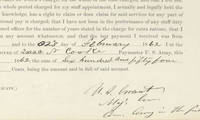
1862806901/03/1862. <blockquote><p>In it he also pays for his servants 3 of whom were black; An extreme rarity the first such document we can find having reached the market in a quarter century</p></blockquote><p>The battle of Fort Henry in Tennessee took place on February 6 1862 and an obscure and virtually unknown brigadier general named Ulysses S. Grant captured the fort and opened the Tennessee River to Union movements. This early in the war Union victories of any kind were scarce and this one was probably the most consequential of the war to date. Grant then moved directly on Fort Donelson entrapping the place both by land and sea from February 11-16. On the morning of February 15 the Confederate commander Simon B. Buckner sent a note to Grant requesting an armistice and asking terms of surrender. Buckner was expecting to give up the fort but get his soldiers paroled so they would not be prisoners of war. Grant refused to give terms but demanded unconditional surrender. The Confederates surrendered the next day the 16th. This victory opened the Cumberland River an important avenue for the invasion of the South to Union operations and Grant became instantly famous earning the nickname ""Unconditional Surrender"" Grant. President Lincoln took note of the fact that in Grant he had a general who could win. On February 20 1862 Lincoln promoted Grant to the rank of Major General a prerequisite to Grant's being able to command a large army.</p><p>However Grant’s very successes at Forts Henry and Donelson incurred the jealousy of his superior Gen. Henry Halleck who was in command of the whole Western Theater of war. Grant not yet realizing the peril Halleck's opposition placed him in knew Nashville was wide open with little in the way of defensive forces. Though Halleck had expressly forbade him to advance Grant ordered Union forces to enter Nashville. It fell on February 25 with Gen. Don Carlos Buell accepting the city's surrender. Nashville thus became the first Confederate state capital to fall into Union hands. Over the next week thousands of Union soldiers poured into the city and Grant took a boat upriver from Donelson to Nashville to confer with Buell. Halleck saw the taking of Nashville not as Grant recognizing and seizing an important opportunity but as willful disobedience of an order. And Grant's unauthorized trip to see Buell there only added to Halleck's anger.</p><p><img class=""alignnone wp-image-32063 size-post-window"" src=""https://cdn.raabcollection.com/wp-content/uploads/20240907140939/Grant-March-1-1862-1-1-1600x348.jpg"" alt="""" width=""1600"" height=""348"" /></p><p>So on March 1 1862 Halleck decided to tie Grant's hands by ordering him to return to Fort Henry and from there to launch an expedition up the Tennessee River to the state of Mississippi. The objective was the destruction of several key railroad bridges. Grant was to “avoid any general engagement with strong forces†and was told that it was “better to retreat than to risk a general battle.†Grant went to Fort Henry as ordered but did not communicate with Halleck directly. The next day Halleck complained to Gen. McClellan that he had heard no word from Grant for a week and that “his army seems to be as much demoralized by the victory of Fort Donelson as was that of the Potomac by the defeat of Bull Run.†On March 4 Halleck relieved Grant from his command writing him: “You will place Maj. Gen. C. F. Smith in command of expedition and remain yourself at Fort Henry.†Grant was shocked. “Thus"" say Grant's Memoirs ""in less than two weeks after the victory at Donelson the two leading generals Halleck and McClellan in the army were in correspondence as to what disposition should be made of me and in less than three weeks I was virtually in arrest and without a command.â€</p><p>Grant turned over command to Smith on March 5. Even as he did so he felt intensely frustrated and longed for action writing on the same day “I have not been well for the last ten days and don’t see that I will be much better until I can get to moving again.†Grant and Halleck exchanged letters after which Grant on March 11 demanded that Halleck relieve him from duty altogether in order to clear his name. ""There is such a disposition to find fault with me that I again ask to be relieved from further duty until I can be placed right in the estimation of those higher in authority.""</p><p>Perhaps this letter caused a change of mind or it may be that Halleck just could not risk loss of the popular Grant altogether. In any event surprisingly he refused and instead told Grant he would receive a new command writing him ""You cannot be relieved from your command. There is no good reason for it…Instead of relieving you I wish you as soon as your new army is in the field to assume the immediate command and lead it on to new victories."" Just four days later Grant was actually given a new command - he was placed in charge of Union forces in Tennessee. He proceeded to Pittsburg Landing Tennessee and arriving on the 17th established a wide camp with his forward units around Shiloh Church some 2.5 miles south of Pittsburg Landing. He wrote ""I at once put all the troops at Savannah in motion for Pittsburg Landing knowing that the enemy was fortifying at Corinth and collecting an army there under Johnston. It was my expectation to march against that army as soon as Buell who had been ordered to reinforce me with the Army of the Ohio should arrive; and the west bank of the river was the place to start from. Pittsburg is only about twenty miles from Corinth…When all reinforcements should have arrived I expected to take the initiative by marching on Corinth and had no expectation of needing fortifications though this subject was taken into consideration."" He reported to Halleck on his troop dispositions and imminently awaited reinforcements so he could move against Corinth. Halleck meanwhile continued to nitpick at Grant for supposed failure to discipline his troops properly.<br />The month of March was a significant one in Grant's career one that saw the tables turn twice on him. First in the flush of his great successes at Forts Henry and Donelson he was victimized by jealousy and relieved of command. Then when all seemed lost he was given an even greater command. And as he assumed that command and awaited reinforcements so he would move on Corinth he was unwittingly actually preparing for the Battle of Shiloh one of the most fateful of the war.</p><p><img class=""alignnone wp-image-32064 size-post-window"" src=""https://cdn.raabcollection.com/wp-content/uploads/20240907141021/Grant-March-1-1862-2-1600x657.jpg"" alt="""" width=""1600"" height=""657"" /></p><p><strong>Document signed</strong> Pittsburg Landing Tenn. April 2 1862 being a voucher for his own pay and expenses and those of his four private servants for the period from March 1 to March 31 1862. His pay was $220 per month and he received $52 per month for the pay of his servants. Forage for his seven horses came to $56 for the month. He received $10 per month as a clothing allowance and he was entitled to <em>""double rations for commanding army in the field""</em> which came to over 1000 rations for the month. The rations called ""<em>subsistence</em>"" cost $316.20. At the end the document recites that Grant has received a total of $654.20 from the paymaster and he has signed <em>""U.S. Grant Maj. Gen. Commanding Army in the field."" </em>Interestingly Grant's four servants are named and their skin color height and eye and hair color given. Frank was white; and Dan Jim and Sam were black. The voucher is docketed on the verso.</p><p>This is the first signed voucher for Grant's pay during the Civil War that we have seen. Research in public records going back 40 years discloses one previous monthly voucher having reach the market and that was a quarter century ago.</p><p>On April 6 1862 just four days after signing this document the Confederates commenced the Battle of Shiloh by bursting through Union lines and threatening to drive Grant's men back into the Tennessee River. Historians differ on whether Grant was at fault in being surprised but it is clear that Union forces only escaped being routed with the arrival of Buell's army. The next day the Union recaptured the initiative and drove the Confederates back in disorder. The battle was essentially a draw while also being the bloodiest battle yet to occur on the American continent. When the news reached the North where expectations had been high a storm of abuse broke out against Grant who was held responsible. He may well have not deserved the blame but he admitted reassessing the war after Shiloh. He wrote “Up to the battle of Shiloh I as well as thousands of other citizens believed that the rebellion against the Government would collapse suddenly and soon if a decisive victory could be gained over any of its armies. Donelson and Henry were such victories.But when Confederate armies were collected which not only attempted to hold a line farther south.but assumed the offensive and made such a gallant effort to regain what had been lost then indeed I gave up all idea of saving the Union except by complete conquest.â€</p><p><img class=""alignnone wp-image-25018 size-post-window"" src=""https://cdn.raabcollection.com/wp-content/uploads/20231204144051/Folder-site-11-1600x1327.jpg"" alt="""" width=""1600"" height=""1327"" /></p> hardcover
1887001282Boston Massachusetts: Cupples Upham & Co 1887. Light soil to covers and a touch of rubbing at the extremities. Pages show a thin strip of light damp stain at the bottom edge only less than 1/4 inch - text is not affected else Very Good condition. No owner's name or bookplate. No underlining. No highlighting. No margin notes. This 1887 first edition is not in Broadfoot. . First Edition. Hardcover. Original green cloth gilt/No dust jacket. 66pp. 37 page publisher's catalog. Cupples, Upham & Co Hardcover
1020755733.Ghardcover. Good. Access codes and supplements are not guaranteed with used items. May be an ex-library book. hardcover