145 résultats
196531609Paris Presses Universitaires De France 1965 In-12 "Erasme", collection de textes grecs commentés, publiée sous la direction de Robert Flacelière professeur à la Sorbonne - Edition, introduction et commentaire de Raymond Weil professeur à la Faculté des Lettres et Sciences Humaines de Dijon - textes grecs commentés en français - 105 pp 1 carte - 1 ff
In-8° (cm.22,4), pp. 13 (da p. 216 a p. 228). Brossura editoriale. Nome a penna e lievi ombre in cop. DURIDE di Samo, autore della Storia di Agatocle comprendeva almeno 4 libri, dedicati essenzialmente a mostrare la lotta di Agatocle, appunto, contro i Cartaginesi, le sue imprese in Magna Grecia e le congiure oligarchiche contro di lui. ORLANDI, prof. emerito della Sapienza Università di Roma (già Prof. ord. del settore scientifico disciplinare «Egittologia e Civiltà Copta»). Presidente dell'Unione Accademica Nazionale.
In 8, pp. 80. Danni rip. al d. Br. ed. con p. legg. polverosi. Monografia storico letteraria sulla Sicilia composta da tre saggi, il primo sulla presenza greca nell'isola, il secondo sul mito di Dafni secondo Diodoro siculo, il terzo sul dialetto siciliano.
Gutes Ex.; Einband stw. leicht lichtrandig. - Französisch; griechisch. - (Einzelband). - INHALT : NOTICE ----- INDEX SIGLORVM ----- LIVRE XVII ----- NOTES COMPLEMENTAIRES. - Diodor (Diodorus Siculus, "Diodor von Sizilien") war ein antiker griechischer Geschichtsschreiber des späten Hellenismus. Er lebte in der ersten Hälfte des 1. Jahrhunderts v. Chr. … Über Diodors Leben ist wenig bekannt. Er stammte aus der Polis Agyrion auf Sizilien und hat sich längere Zeit in Rom sowie in Ägypten (in der Zeit der 180. Olympiade, also im Zeitraum 60/59 bis 57/56 v. Chr.) aufgehalten. … (wiki) // Le principal merite du livre XVII de la Bibliotheque Historique est sans doute d'offrir une relation vivante et coloree du regne d'Alexandre. Mais l'historien trouvera davantage. Car la perte des Memoires et des Histoires composes par les contemporains d'Alexandre a donne une importance inattendue aux 118 chapitres compiles par Diodore. On comprend des lors l'acharnement avec lequel on s'est efforce d'identifier les sources auxquelles celui-ci a emprunte l'essentiel de son information. II n'est pas de probleme plus debattu par la " Quellenforschung " que celui des sources du livre XVII, et le mutisme observe sur ce point par Diodore a laisse champ libre aux hypotheses, souvent gratuites et parfois saugrenues. Ce serait pourtant faire preuve de paresse intellectuelle ou meme d'improbite que de se derober devant le probleme sous pretexte qu'i est obscur et de negliger, quand il existe, l'apport positif de la critique. Quelques solides conclusions peuvent en effet etre tirees de la longue polemique recemment resumee par J. Seibert . A dire vrai, la variete des reponses pro-posees temoigne moins de la complexite du probleme que de la sterilite de certaines methodes, soit que Ton ait pretendu elucider le mystere en fonction de criteres subjectifs, soit que l'on se soit refuse a comparer minutieusement le recit de Diodore a celui que nous offrent d'autres historiens plus Tardifs, grecs ou latins. … (X) // ... Diodors auf Griechisch verfasstes Geschichtswerk trägt den Namen Bibliotheke historike (lateinisch Diodori Siculi Bibliotheca historica) und ist eine Universalgeschichte in 40 Büchern, von denen uns die Bücher 1-5 sowie 11-16 und 18-20 erhalten sind. Das 17. Buch hat einige kleine Lücken. Die Bücher 6-10 und 21-40 sind nur fragmentarisch überliefert, vor allem durch Zitate byzantinischer Autoren und Exzerptsammlungen. Die Darstellung reicht von der sagenhaften Vorzeit (wobei er auch mythologische Erzählungen verarbeitete) bis in die Zeit Caesars (wohl bis in das Jahr 60/59 v. Chr., als Caesar das Consulat bekleidete). Es ist damit, soweit man weiß, das umfassendste Geschichtswerk, das von einem Griechen in der Antike verfasst wurde und uns zumindest in Teilen überliefert ist, und bildet zugleich den "Abschluss der hellenistischen Historiographie" (Klaus Meister). Diodor hat nach eigenen Angaben 30 Jahre lang Reisen und Nachforschungen unternommen. Er nahm in seiner Universalgeschichte allerdings ältere Darstellungen auf und schrieb sie um und kürzte sie (beispielsweise fehlen viele Reden, die ansonsten typisch für die antike Geschichtsschreibung sind), so dass sie besser lesbar und für das Publikum leichter zu verstehen waren. … (wiki)
19761201620Paris; Societe d'Edition "Les belles Lettres", 1976. LVIII; 277 Seiten; farb. Faltkarte; 20 cm; fadengeh. Orig.-Pappband.
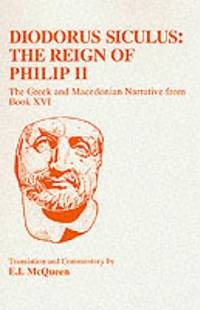
199534997Bristol Classical Press. New. 1995. 1853993859 . FREE UPGRADE to Courier/Priority Shipping Upon Request IN STOCK AND IMMEDIATELY AVAILABLE FOR SHIPMENT - FLAWLESS COPY BRAND NEW PRISTINE NEVER OPENED - 196 pages; 5 1/2 x 8 1/2 inches -- This edition one of the BCP Classics Companion Series provides a translation and detailed commentary of the Greek and Macedonian narrative of Diodorus Book XVI. An outstanding general statesman and diplomat Philip II inherited a kingdom near collapse and transformed it into the greatest power in the Mediterranean world. But for all its significance his reign is badly served by the surviving writers of Greek literature. The loss of the major contemporary historians has left us dependent for our knowledge on the speeches of the Attic orators especially the hostile Demosthenes and on the 16th Book of Diodorus Siculus who though he lived some 300 years later has bequeathed the only detailed account of Philip's reign in Macedonia and the Greek mainland. -- Preface Introduction 1 The Life and Works of Diodorus 2 Diodorus' Purpose of Writing 3 Diodorus' Chronological Scheme 4 The Sources of Diodorus in the Sixteenth Book 5 Diodorus' Portrait of Philip 6 Inaccuracies in Diodorus 16 Book Sixteen: Greek and Macedonian Narrative Commentary on the Text Appendix A: Philip II and the Transformation of Macedonia Appendix B: The Death of Philip Bibliography -- with a bonus offer-- . Bristol Classical Press unknown
17879253Hermann, Frankfurt 1782-1787. Hldr. der Zeit mit Rückenschild. Stärker beschabt, Ecken u. Kanten etw. bestoßen. Bd. 3 u. 4 am Kapital eingerissen. Rückenschildchen teils abgeplatzt. Durchgehend etw. gebräunt. Kleiner gelöschter Stempel a. d. Titelblättern. Wenige Bleistiftanstreich.
18342442DB6 (von 7) Bänden. Paris, L'imprimerie Royale, 1834-1837. 8°. Halblederbände der Zeit mit Rückenverg. (berieben).
95241Lipsiae, Libraria Weidmannia G. Reimer 1826, 170x110mm, reliure demi-chagrin. Plats papier marbré. Papier bruni, autrement bon état.
150711308Paris: pr. by Jean Marchant for Jean Petit ca. 1507. 4to 20 cm 8". 123 i.e. 124 6 ff. <br><br>bound with Justinus Marcus Junianus. Justini historia ex Trogo Pompeio quattor & triginta epithomatis collecta; acc. Lucius Florus et Sextus Rufus. Paris: De Marnef ca. 1507. 4to. A8B4C6ay8.4z6&4; 18 140 i.e. 141 ff. lacking last leaf.<br>Â Â Â Â Diodorus according to the Oxford Companion to Classical Literature "is one of the sources of our knowledge of the legends of mythology." His 40-book Bibliotheke Historike with its accounts of the mythic origins of Hellenes Greeks and Egyptians helps document the derivations of the Greek and Roman gods and also preserves fragments of the sources he consulted. Only 15 intact books of this history of the world were known at the beginning of the 16th century; the noted Renaissance scholar Poggio Bracciolini provided this translation of the first six from the original Greek for Nicholas V. Books 16 and 17 were to be discovered in 1517.<br>Â Â Â Â Diodorus's work is here accompanied by Justinus's abridged version of Trogus Pompeius's history. Both books feature striking capitals and title-page devices. The typography of the first book is Jean Marchant's done for Jean Petit whose lion-and-leopard device is prominently displayed. The second book's device shows initials of two of the three de Marnef brothers E and G beneath a pelican in her piety. This second book collates exactly like the Jean Petit edition of Justinus printed sometime after December of 1507 and appears to differ from it solely in its title-page probably reset only for insertion of the de Marnef device. => Via NUC WorldCat Moreau COPAC and the OPAC of the BNF we find no record of the apparently extremely scarce de Marnef variant.<br>Â Â Â Â Binding: 17th-century English calf spine with raised bands and blind ornament in each compartment; covers panelled with gilt fleurons and elaborate front and back gilt floral center motifs each worked with a minute "WE" and front device impressed upside-down; all edges red.<br>Â Â Â Â Provenance: Charles Spencer Third Earl of Sunderland lot 3934 in the Sunderland Library sale 1882. <br>Â Â Â Â <br>Â Â Â Â Diodorus: Moreau 1508:64; not in Schweiger; Copinger 1981; Pellechet 4265; assigned to the 16th century by the Gesamtkatalog der Wiegendrucke VII 431; Stillwell D-171. Justinus: not in Moreau not in Schweiger. On Diodorus see: Oxford Companion to Classical Literature 146. Binding as above overall worn and rebacked with original spine laid on; covers abraded and corners rubbed with careful refurbishment. Pages mostly clean with slight staining to inner margins from binding supports. => Gilt cover lozenges still bright and the whole safe to be worked or played with. {pr. by Jean Marchant for} Jean Petit hardcover books
1843RO40248314Ambrosio Firmin Didot, Paris. 1843. In-4. Relié demi-cuir. Etat d'usage, Plats abîmés, Coiffe en tête abîmée, Intérieur acceptable. 625 pages pour le tome I et 752 pages pour le tome II. Texte en grec ancien et en latin sur 2 colonnes. Titres, tomaisons et bandeaux dorés sur les dos. Etiquettes de code sur les couverture. Quelques tampons de bibliothèque. Fortes épidermures sur les dos. Quelques manques en surface des plats.. . . . Classification Dewey : 480-Langues helléniques. Grec
155929444Basel, (Heinrich Petri, 1559). Fol. Mit einigen Holzschn.-Vignetten u. Holzschn.-Druckermarke am Ende. 18 Bll., 715 (1) S., Etw. späterer Ldr.-Bd. m. reicher Rückenverg., goldgepr. Rückenschild, dreiseitigem Rotschnitt u. neuen Bindebändern.
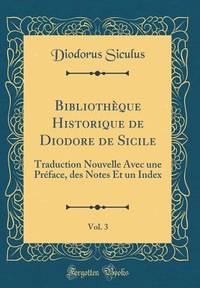
185137533Paris: Delahays 1851. hardcover. Traduction nouvelle avec preface. notes et index par M. Ferd. Hoefer. 4 vols. 12mo 1/2 calf rubbed marbled boards. Paris: Adolphe Delahays 1851. Very good.<br/><br/> French translation of the Greek historian.<br/><br/> Delahays unknown books
154761738Vinegia, Apresso Gabriel Giolito de Ferrari, 1547. 8°. Mit unterschiedlichen Holzschn.-Druckermarken am Titel u. auf der letzten Seite u. einigen figürl. Holzschn.-Initialen. 8 nn., 119 (recte 122) num. Bll., Späterer Pgmt.-Bd. m. durchzogenen Bünden, goldgepr. Rückenschild u. dreiseitigem Goldschnitt.
1782ALDR0701Frankfurt a. M., Johann Christian Hermann 1782-85. 8°. Jeweils Reihentit. u. Tit., XXXI(5), 448 S.; 480 S., 2 Bll.; 552 S., 2 Bll.; 546 S. Dekorative Halblederbände der Zeit auf 5 Bünden m. reicher goldgepr. Rückenverz., 2 mont. Rüschi. u. umseit. Rotschnitt. Einbände etwas fleckig, Kanten berieben, hint. Spiegel m. Exlibrisstempel. DBA 323, 388 u. 1242, 39 (Meusel). - KLL IV, 1510. - Vorliegend die ersten vier Bände der 'Bibliotheca historica' des Diodor von Sizilien, in Übersetzung des deutschen Philologen und Theologen Friedrich Andreas Stroth (1750-1785). Die Edition wurde nach dem Tod von Stroth von Johann Friedrich Salomon Kaltwasser fortgeführt und auf 6 Bände erweitert. - "Denn gerade die einfältige Arbeitsweise [Diodors], von Thema zu Thema und Epoche zu Epoche mit bescheidener Verbissenheit die frühere Sekundärliteratur abzuschreiben, ? ermöglicht es Philologen und Historikern, jene Vorlagen mit beachtlicher Sicherheit wieder herauszulösen" (KLL).
17467807Amstelodami Amsterdam Sumptibus Wetstenii. 1746. 2 vols. Folio. pp. xxxviii 731 v; iv 666 cviii index. With half title additional engraved title and portrait of Wesseling to volume one. Letterpress titles printed in red and black with engraved vignettes. Text in Greek and Latin. Occasional minor spotting. Contemporary Dutch blind-stamped vellum gilt a couple of chips to head and tail of spine of second volume lack free end-paper to vol I. Dibdin sums up the importance and beauty of this edition: the splendour and critical excellence of all former editions sayes Harles are eclipsed by this of Peter Wesseling which contains everything to be found in the preceding ones; and besides a learned preface useful notes and various illustrations of the author presents us with the readings of better MSS. and very full and perfect indexes. Dibdin I 497 Book hardcover
A9781167677571New. unknown
B9781167651915New. unknown
B9781167677571New. unknown
151011701Paris: Jehan Barbier venundantur in vico Sancti Iacobi sub signo Ensis 1510. Hardcover. Very good. Full leather sometime rebacked in calf with gilt decoration and black morocco title label marbled end papers and page edges 18 x 13 cm tp with ink institution stamp. The text has no page numbers rather a �Folio� at the top right corner of the recto of each leaf. This has 123 folios 246 pp. plus 11 pp. Index and 1 p. afterword. 258 pp. total including the title page. a-v8/4 x6 y4. a-v alternates 8s and 4s. Jean Barbier was a printer in Paris during the years 1502-1516 and used the address in the imprint from 1508. His printer�s emblem on the title page was used 1509-1514 and the dent visible in the top rule limits this printing to 1510. See A Typographical Catalogue of Books printed in France 1501-1520 in the British Library Renouard 33 Device of Jean Barbier.Translation from the Greek into Latin by Pogius Florentinus; edited by Egidius de Maseriis.Diodorus Siculus fl. 1st century BC Greek historian born at Agira Sicily. His monumental work once consisted of 40 parts; now only fifteen are known. The book we offer is the first third of the surviving parts which forms a distinct period that of the mythic history of the non-Greek and Greek tribes up to the destruction of Troy. It follows a geographical arrangement describing the history and culture of ancient Egypt book I of Mesopotamia India Scythia and Arabia book II of North Africa book III and of Greece and Europe books IV-VI. The text is in Latin. Jehan Barbier, venundantur in vico Sancti Iacobi sub signo Ensis hardcover
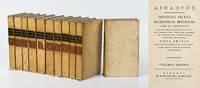
179332387AB1793. Editio Bipontina / Bilingual Edition in Greek and Latin. 11 Volumes complete set. Biponti Zweibrücken Ex typographia Societatis 1793. Octavo. Pagination: Volume I: CLXXXII 476 pages / Volume II: 565 pages / Volume III; 645 pages / Volume IV: LXXII 400 pages / Volume V: 638 pages / Volume VI: 680 pages / Volume VII: 680 pages / Volume VIII: 568 pages / Volume IX: 553 pages / Volume X: 493 pages plus 1 unnumbered page of Corrigenda / Volume XI: 456 pages. Hardcover / Original full vellum with gilt lettering and ornament on spine. Very good condition with only minor signs of wear. Very few Volumes with the pages a bit dusty and only some Volumes with a minor faded dampstain to the outer margins. From the library of Augustus Langdon Bayswater with his Exlibris to pastedown. Diodorus Siculus or Diodorus of Sicily Diódoros; fl. 1st century BC was an ancient Greek historian from Sicily. He is known for writing the monumental universal history Bibliotheca historica in forty books fifteen of which survive intact between 60 and 30 BC. The history is arranged in three parts. The first covers mythic history up to the destruction of Troy arranged geographically describing regions around the world from Egypt India and Arabia to Europe. The second covers the time from the Trojan War to the death of Alexander the Great. The third covers the period to about 60 BC. Bibliotheca meaning 'library' acknowledges that he was drawing on the work of many other authors. Diodorus' universal history which he named Bibliotheca historica "Historical Library" was immense and consisted of 40 books of which 15 and 1120 survive: fragments of the lost books are preserved in Photius and the Excerpts of Constantine Porphyrogenitus. It was divided into three sections. The first section books IVI deals with the mythic history of the non-Hellenic and Hellenic tribes up to the destruction of Troy and is geographical in theme describing the history and culture of Ancient Egypt book I of Mesopotamia India Scythia and Arabia II of North Africa III and of Greece and Europe IVVI. The next section books VIIXVII recounts the history of the world from the Trojan War down to the death of Alexander the Great. The last section books XVII to the end concerns the historical events from the successors of Alexander down to either 60 BC or the beginning of Julius Caesar's Gallic Wars. The end has been lost so it is unclear whether Diodorus reached the beginning of the Gallic War as he promises at the beginning of his work or as evidence suggests old and tired from his labours he stopped short at 60 BC. Diodorus selected the name "Bibliotheca" in acknowledgment that he was assembling a composite work from many sources. Identified authors on whose works he drew include Hecataeus of Abdera Ctesias of Cnidus Ephorus Theopompus Hieronymus of Cardia Duris of Samos Diyllus Philistus Timaeus Polybius and Posidonius. Wikipedia hardcover
185137533Paris: Delahays 1851. hardcover. Traduction nouvelle avec preface. notes et index par M. Ferd. Hoefer. 4 vols. 12mo 1/2 calf rubbed marbled boards. Paris: Adolphe Delahays 1851. Very good.<br/> <br/> French translation of the Greek historian.<br/> <br/> Delahays unknown
0365942537.Gpaperback. Good. Access codes and supplements are not guaranteed with used items. May be an ex-library book. paperback
139002816X.Gpaperback. Good. Access codes and supplements are not guaranteed with used items. May be an ex-library book. paperback
1390028356.Ghardcover. Good. Access codes and supplements are not guaranteed with used items. May be an ex-library book. hardcover