3 035 résultats
1930X100035Romae [Rome], Sumpt. Pontificii Instituti Biblici 1930-1932 Complete in 4 volumes: 43 + 42 + 47 + 40pp., 35cm., original softcovers, library label on front cover, spine of vol.4 repaired, in the series "Scripta Pontificii Instituti Biblici", [contains: volume I: cuneiform text, Vol.II: Latin transcription and translation into Latin, vol.III: Vocabulary, vol.IV: table of cuneiform signs], text clean and bright, overall in good condition, X100035
Complete in 4 volumes: 43 + 42 + 47 + 40pp., 35cm., original softcovers, library label on front cover, spine of vol.4 repaired, in the series "Scripta Pontificii Instituti Biblici", [contains: volume I: cuneiform text, Vol.II: Latin transcription and translation into Latin, vol.III: Vocabulary, vol.IV: table of cuneiform signs], text clean and bright, overall in good condition, X100035
Former scholar's name on ffep (P. Stork). Top corner has light bumping. Dustjacket has a few small tears and chipping. ; Oxford Monographs on Classical Archaeology; 286 pages; This study places the inscriptions found on Athenian vases in the context of the early development of writing in Athens. Focusing on the period from the invention of the alphabet in the 8th century B.C. to the early 4th century B.C., when the local alphabet had been supplanted by the common Ionic script, the book presents inscriptions on stone, both public and private, scratched inscriptions on pottery, including the political ostraca, and some inscriptions on lead tablets. Although the vase inscriptions are brief, they number in the thousands and give an accurate picture of the art of writing and the state of literacy in the Classical Period.
Scholar's bookplate to inner cover (G. P. Goold). Top textblock has a bit of foxing. Dustjacket has creasing along lower rear edge. ; Oxford Monographs on Classical Archaeology; 286 pages; This study places the inscriptions found on Athenian vases in the context of the early development of writing in Athens. Focusing on the period from the invention of the alphabet in the 8th century B.C. to the early 4th century B.C., when the local alphabet had been supplanted by the common Ionic script, the book presents inscriptions on stone, both public and private, scratched inscriptions on pottery, including the political ostraca, and some inscriptions on lead tablets. Although the vase inscriptions are brief, they number in the thousands and give an accurate picture of the art of writing and the state of literacy in the Classical Period.
Light bumping to 1 corner. Dustjacket has creasing along upper edge. ; Oxford Monographs on Classical Archaeology; 286 pages; This study places the inscriptions found on Athenian vases in the context of the early development of writing in Athens. Focusing on the period from the invention of the alphabet in the 8th century B.C. to the early 4th century B.C., when the local alphabet had been supplanted by the common Ionic script, the book presents inscriptions on stone, both public and private, scratched inscriptions on pottery, including the political ostraca, and some inscriptions on lead tablets. Although the vase inscriptions are brief, they number in the thousands and give an accurate picture of the art of writing and the state of literacy in the Classical Period.
Ex-library copy with usual stamps, call numbers and pocket. Mild Dampstaining to lower edge of textblock affecting some pages. ; With plates & table of letters; Oxford Monographs on Classical Archaeology; 4to 11" - 13" tall; 416 pages; Oversized.
590283Le Caire, IFAO, 1952. In-8, rel. de l'ép. demi basane bleu nuit à coins, dos à nerfs, titre doré, XV-328 pp., bibliographie, index.
Very light bumping to 1 corner. Scholars' bookplate to inner cover (Slater & Dunbabin). DJ has edgewear and creasing with 1 tiny tear. ; The volume presents unpublished papyri from Oxyrhynchus related to the theme of public games. Oxyrhynchites had a wide range of spectacles to watch: plays and mimes in the theatre, athletic and musical competitions at gymnasial and higher levels, chariot racing and other circus entertainment. ; Egypt Exploration Society. Graeco-Roman Memoirs 100; Vol. 79; 10.1 X 7.3 X 1.0 inches; 228 pages
72560aafGenève, Kündig, 1909 -1909, gr. in-4to, 148 p. + 3 ff. + 8 planches en couleurs brochure originale usée.
6096Vienne, Girard, 1875, 1876, 1 br., dos cassés sur 2 volumes, 1 dos renforcé et l'autre en partie manquant, petit manque sur une couverture. 4 forts volumes in-8 de (4)-XVI-544-30, (4)-600, (4)-478 et (4)-472 pp., carte dépliante en frontispice, tiré à 200 exemplaires ;
601338Cairo, Gen. Org. for Govern. Print. Offices, 1975. In-4, rel. demi-chagrin bordeaux, dos à nerfs, titre doré, XII-65 pp., 25 fig. in t, LI pl. h.t., dont dépl., index .
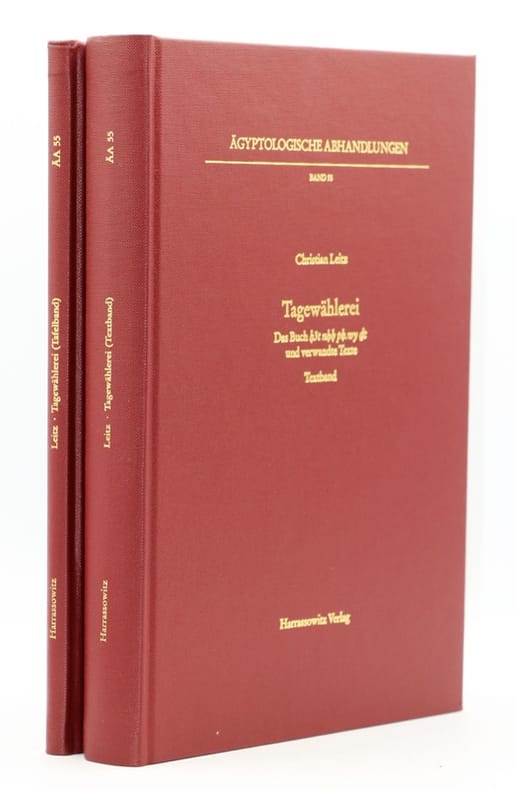
591278Wiesbaden, Harrassowitz Verlag, 1994. 2 vol. in-4, rel. pleine toile gommée bordeaux, titres doré aux dos et sur les premiers plats, XIV-525 pp., glossaire, index + VI pp., 79 pl. en noir sur papier glacé, certaines dépl.
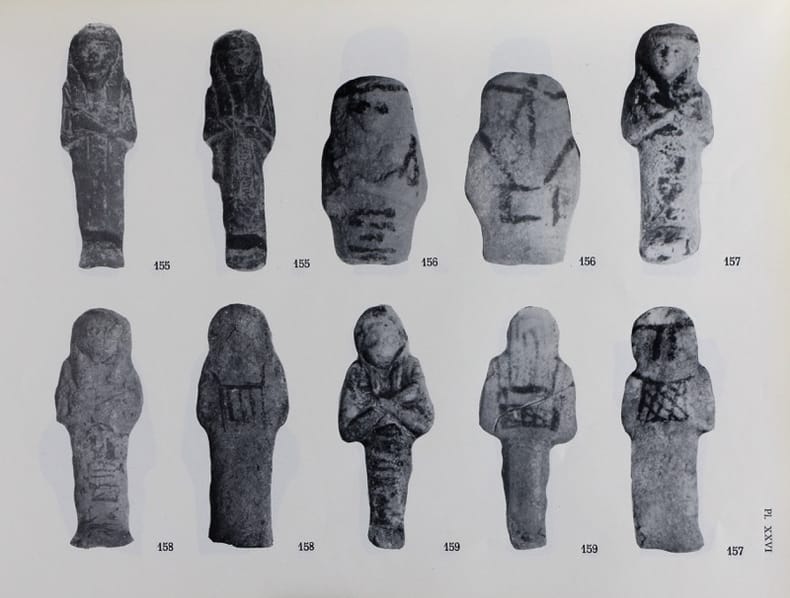
591797Le Caire, IFAO, 1972. In-4, rel. demi-chagrin marron à coins, dos à 5 nerfs, titre et filets dorés, VI-84 pp., XXXI pl. (l'une dépl.) de reprod. photogr. et fac similés en noir, index. Court envoi manuscrit de l'auteur à la page de faux-titre.
Light bump to top of spine. Former owner's name to ffep. Else minor shelfwear to book. DJ spine browned with a bit of sticker damage. Tears to head of spine. Some chipping to DJ. ; 191 pages; Flavius Abinnaeus is commander of the cavalry (praefectus alae) in the Fayum, stationed in a fortress in Dionysias, a village in the North-West of the province from AD 342 to 35. The book is a collection of petitions, letters, accounts and lists. Of the 42 letters, 37 are addressed to Abinnaeus and one is written by him. All together, he has 26 different correspondents. Fourteen petitions are addressed to Abinnaus in his official capacity as commanding officer at Dionysias. One petition in Latin is directed to the emperors by Abinnaeus himself. Most accounts and lists register tax contributions levied from farmers by the agents of Abinnaeus.
Book has minor rubbing to extremities. ; Aramaic Documents published here for the first time came from an unknown site in Egypt and consist of 13 or 14 more or less complete letters and the fragments of others from the Archives of Arsham, satrap of Egypt in the time of Darius II, and may be dated c. 410 B. C. They deal with the administrative problems confronting the satrap's subordinate officers, and with those arising from the relations of these officers with the native population, especially in the matter of their fiefs; one is concerned with the making of an equestrian statue for the writer, one is a letter of thanks for the safe transport of certain goods for personal use, and one is a safe-conduct for a Persian officer proceeding by way of Syria to Egypt.
Spine browned. Very light marginalia mostly in pencil with 1 word or two in pen. Edgewear with minor chipping. Spine ends have been reinforced with white binding tape. ; Zetemata: Monographien Zur Klassischen Altertumswissenschaft. Heft 24; 443 pages
Wraps browned with a bit of edgewear and creasing. Faint creasing through upper pages. ; Zetemata: Monographien Zur Klassischen Altertumswissenschaft. Heft 24; 443 pages
Minor edgewear. Signed by both authors to ffep of vol. 1. Name of scholar to ffeps of both volumes (E. Badian). ; Text is in French and Ancient Greek. XC pages of plates at end with 1 map. Vol. II is ; Meletemata 11; Centre De Recherches De L'Antiquite Grecque Et Romaine. Fondation Nationale De La Recherche Scientifique; Vol. 1/2/2022; 448 pages
Signed by author to Elaine Matthews (letter from author to Elaine Matthews tipped in). Light creasing to spine. Light edgewear to wraps (creasing). Minor discoloration to spine and part of front wrap. ; Revised version of the author's thesis (Ph. D. ) -- University of Thessaloniki, 1986.; Meletemata 8; 572 pages; Signed by Author
Former owner's name on inner cover. Mild browning to ffeps. Very light shelfwear to book. DJ is tattered with open tears & missing a few pieces but mostly complete. ; The Four Gospels of Karahissar is a thirteenth-century codex of the four Gospels in Greek, written in distinguished miniscule script, illustrated with 65 terse miniatures, and introduced by 7 elegant decorative arcades. Iconographically and stylistically its large cycle of text illustrations ranks in importance easily among the first half-dozen sequences miniatured in tetraevangelia. It stands at the very center of an extended, prominent, and singularly interesting family of medieval Greek manuscripts, very intimately related to each other and historically associated with the vicissitudes and policies of the imperial family of Byzantium. ; Volume 2 Only; Vol. 2
586911P., PUF, 1962-67. 4 vol. in-4 br., 120, 121, 176, 216 pp., nombr. planches dépliantes de fig. et ill. photogr. en noir. (Travaux de l'Institut de Papyrologie de Paris, fasc. 1, 2, 3 et 5).
11621RENNES, H. Caillière / PARIS, E. Thorin - 1892 - Tiré des Mémoires de la Société Archéologique d'Ille-et-Vilaine, année 1891 - In-8 - Débroché - Couverture illustrée - 14 planches en couleurs - 60 pages + table
RENNES, H. Caillière / PARIS, E. Thorin - 1892 - Tiré des Mémoires de la Société Archéologique d'Ille-et-Vilaine, année 1891 - In-8 - Débroché - Couverture illustrée - 14 planches en couleurs - 60 pages + table Trésor épigraphique découvert en 1890 dans la rue Rallier
In 8', br. ed. pp.562, ill. in n. n.t....preceduta da breve ma compiuta storia di esso edificio condotta fino a' nostri tempi abbellita di varie incisioni in legno e zincotipia; strappi e mancanze al dorso, interni in buono stato, bruniture e segni del tempo.Con aggiunta di un articolo del prof. archit. R.Lanciani sulle nuove scoperte.
1836115801Berlin In der Nicolaischen Berlin In der Nicolaischen Buchhandlung 1836. In-12 relié demi cartonnage d'époque à petit coins. Dos à faux nerfs, titre doré. Couverture conservée. 373 pages et 2 planches dépliantes en fin. Bon état. Peu courant.