M. De Bertrand-molevilleLivre Rare Book
14 résultats
182311828L. G. Michaud 1823 458 pages in8. 1823. reliure editeur plein veau dos orné. 458 pages.
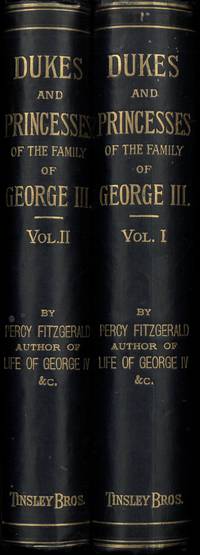
188264247London 1882. 8vo. Originalbind med gulldekor på rygg. xiv 384 s ; x 341 s. . Tinsley Brothers Engelsk. <br/><br/><em>Ex libris. </em> unknown
1812AQ24031London: s.n. 1812. 27pp 1. Docket title to verso of final leaf. Stitched as issued. A trifle browned and dusty. A Georgian act for the appropriation and privatisation of common land in the parish of Toft Cambridgeshire for agricultural purposes. . First edition. Folio. [s.n.] unknown
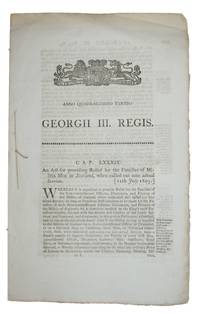
1803AQ18908London: Printed by George Eyre and Andrew Strahan 1803. 1 910-916pp. Stitched as issued. Lightly creased small hole to gutter of first leaf slight chipping to margins. A Georgian act for the provision of a weekly allowance for the families of non- commissioned officers drummers and private militiamen in Scotland; likely issued in response to the emergent conflict with Napoleonic forces on the Continent. . Folio. [Printed by George Eyre and Andrew Strahan] unknown
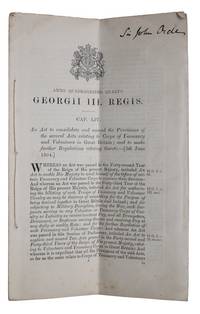
1848AQ21537Edinburgh: William Blackwood and Sons 1848. 32pp. Stitched as issued. Central horizontal fold lightly dust-soiled inked ownership inscription of Sir John Orde to head of title page. A Georgian Act issued to consolidate and amend several late eighteenth- early nineteenth-century acts relating to the establishment maintenance and regulation of yeomanry and volunteer corps and reissued in the early Victorian years. Many such civilian forces had been raised during the French Revolutionary Wars though they had been disbanded following the conclusion of the conflict. Under the provision of the Volunteer Act of 1804 fresh corps were raised for local particularly coastal defence in response to the beginning of the Napoleonic Wars. COPAC records a single copy of this reprint National Museums Scotland OCLC adds no further. The original 1804 printing is apparently unrecorded. . 8vo. [William Blackwood and Sons] unknown
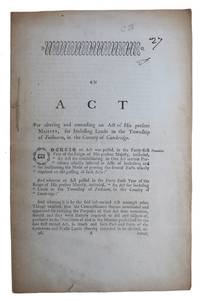
1808AQ24070London: s.n. 1808. 6pp 2. Docket title to verso of final leaf. Stitched as issued. A trifle browned and dusty. An apparently unrecorded Georgian act amending previous legislation regarding the appropriation and privatisation of common land in the town of Fulbourn Cambridgeshire for agricultural purposes. . First edition. Folio. [s.n.] unknown
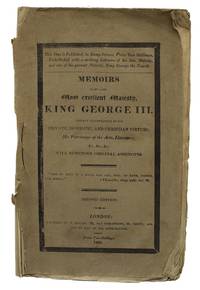
1820AQ26129London: Published by R. Miller 1820. 64pp. With an engraved portrait frontispiece and one further engraved plate a portrait of George IV. Uncut. Later stitched into original publisher’s printed buff wrappers with the edition of a 2pp publisher's advertisement announcing the publication of the present work. Extremities worn loss to spine. Plates foxed. The second edition printed in the same year as the first of a rather obsequious biography eulogising George III; to which is appended numerous official announcements of the monarch's death. Both editions are remarkably scarce OCLC records a single copy of the second Texas; COPAC adds no further. . Second edition. 8vo. Published by R. Miller unknown
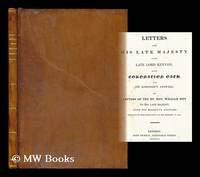
1827181920London : John Murray 1827. First Edition. Hardback. Very good copy in the original full aniline calf. Professionally and period sympathetically re-backed with the title blocked direct in gilt; very impressively finished. Remains particularly well-preserved overall; tight bright clean and strong.; 8vo 8"" - 9"" tall; 45 pages; Physical desc.: viii 2 45 1p.: 1 plate. ; 4o. Notes: Ed. by H. Phillpotts pref. With a half-title preceded by a facsimile. Other names: Phillpotts Henry 1778-1869. Kenyon Lloyd Kenyon Baron. Pitt William 1759-1806. Genre: Letters - 19th century. London : John Murray hardcover
1827619L14London: John Murray 1827. First edition. Leather. Good Only. 11" by 9". None. A selection of letters from George III to two political figures regarding the proposition of Catholic emancipation and his Coronation Oath. He writes to British politician and barrister Lord Kenyon and the then Prime Minister William Pitt. The first edition of this uncommon work. These letters are associated with the political process during the late eighteenth and early nineteenth century regarding the 'Catholic emancipation' or 'relief'. Following the Act of Union between Great Britain and Ireland there was a call to remove many of the restrictions on Roman Catholics introduced by the Act of Uniformity Test Acts and penal laws. During the Act of Union William Pitt the Younger the Prime Minister at the time promised emancipation to accompany the act. However no further steps were taken. This was due to King George III believing that any Catholic emancipation would violate his Coronation Oath. To this work there are correspondences between Pitt and George III regarding this matter. Pitt resigned from his position as Prime Minister when the King's opposition became known. To the main body of this work George writes to Kenyon regarding the standing of the Coronation Oath. He notes to the first letter that 'The following Queries on the present attempt to abolish all distinctions in Religion in Ireland with the intention of favouring the Roman Catholics in that Kingdom.' The King is enquiring to Kenyon as to whether emancipation would affect his Coronation Oath. With an introduction by Henry Phillpotts a well known opponent of Catholic emancipation. One of his well known works is 'A Letter to an English Layman on the Coronation Oath which was issued after this work. This copy is from the Bishop Phillpotts Library in Truro with a bookplate for the library to the front pastedown. The Philpotts library is still an important centre for theological studies. It was first opened in 1871 by Henry Phillpotts. Another prior owner's bookplate to front pastedown 'Henricus Exoniensis'. There are six letters between Kenyon and George III to this volume and five letters between Pitt and the King. With a facsimile letter by George III as the frontispiece. The first edition of this interesting contemporaneous account of British history. In a half calf binding with paper covered boards. Externally sound with slight rubbing to the boards spine and extremities. Loss to the calf at the spine due to a previous library removal. Bookplate to the front pastedown for Bishop Philpotts' Library Truro. Philpotts wrote the introduction to this work. Another bookplate to front pastedown Clero Cornubiensi Henricus Exoniensis. Front hinge is strained but firm. Internally firmly bound. Pages are generally bright with patches of scattered spotting mostly to the page edges. Good Only John Murray hardcover
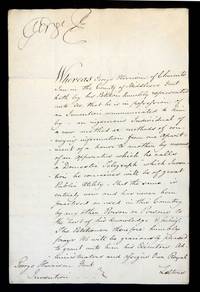
18092120802<i>Folio 4pp. with docket on fourth page "George Harrison Gent. Not stamped. Mr. Solicitor declines at present signing the Bill for this patent. S.G. Wyatt"; </i><i>folded and unbound as issued in very good state of preservation.</i><br /><br />A fascinating document which seems however not after all to have ended in a grant for a patent. George Harrison claims that "he is in possession of an invention communicated to him by an ingenious individual of a new method or methods of conveying information from one apartment of a house to another by means of an apparatus which he calls a "Domestic Telegraph" which invention he conceives will be of great public utility. That the same is entirely new and has never been practised or used in this country by any other person or persons to the best of his knowledge & belief". George Harrison not only does not disclose the name of the inventor he also petitions for the patent to be in his own name. No such patent in Harrison's name is included in Woodcroft's definitive Alphabetical Index. It is possibly that Harrison was trying to be a bit too clever as the award of a patent was conditional on Harrison producing "a particular description of the nature of the said invention and in what manner the same is to be performed".<br /><br />George III's signature here seems in some way to illustrate both his mental illness and his approaching blindness. Little more than a year after signing this document he became dangerously ill and finally accepted the need for the 1811 Regency Act. In 1809 Lord Liverpool was Home Secretary in the Duke of Portland's government.
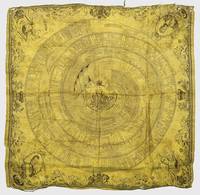
1812166835London: Rymer & Son 1812. Mapping the Age of Revolutions This visually arresting and minutely detailed chronology presents two concentric spirals radiating from a central portrait of George III offering a spectacular timeline of a half-century of conflict embellished with portraits of the king Pitt Fox Nelson and Wellington. The inner delineates the "various administrations formed during his reign" while the outer charts major events including the conclusion of the Seven Years War the American Revolution the Napoleonic Wars campaigns in South Asia and the opening salvoes of the War of 1812. The densely printed text also includes relevant statistical information particularly as relates to the major campaigns: numbers of troops under arms sailors at sea prisoners taken cost of supplies but also the funded national debt annual expenditure and ticking steadily throughout the price of a peck loaf. In each corner is a portrait of a hero of the period: "In an age abounding with so many Warriors & Senators whose equals the page of History can scarcely produce it is difficult to select the most suitable characters to adorn this design or those who have been most active in the great Events of our own times but none seem to have diffused the rays of glory with greater splendour round the nation than Nelson and Wellington. Fame will transmit to distant posterity the vigorous eloquence of Fox and Pitt & exhibit them as patterns worthy their imitation. The portraits are esteemed striking likenesses". Produced by the Edinburgh-born engraver and reform-leaning Whig Malcolm Rymer 1775-1835 the timing of the publication produced close on the removal of all restrictions on the powers of the Prince Regent and the catastrophist litany of disorder in 1812 - "Alarming Riots in Nottinghamshire Lancashire and Yorkshire" the assassination of Spencer Percival "The Old Administration continues with a few trivial changes" - suggests critical intent. Copper engraving printed on vivid yellow silk "handkerchief" 840 x 860 mm. Elaborate decorative frame comprised of a narrow chequered band enclosing a wide scrolled foliate border set with the Royal Arms centrally top and bottom and the Imperial State Crown with crossed rose and thistle with banderolle reading"dieu et mon droit" placed at the sides. Housed in grey archival box. Somewhat worn overall thinned and slightly faded and with some minor marginal loss top and bottom and a few splits but overall complete and remains striking good or better. Examples traced to the Victoria and Albert 1985/2028 Metropolitan Museum of Art 62/271 Art Institute of Chicago 2005.68 "cotton plan weave" and The Society of the Cincinnati M. 218.002 "ochre cotton plate-printed in dark red pigment". See Rebecca Nesvet "Science and Art a Farce in Two Acts" Scholarly Editing 38 2017. unknown
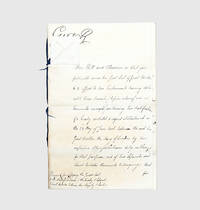
180718934215 July 1807. Diplomatic deals in the Napoleonic Wars A royal warrant signed by George III at the head ordering the application of the Great Seal to the Convention of Subsidy between Great Britain and Sweden signed at Stralsund on 23 June 1807. The document is countersigned on the second page by the Foreign Secretary George Canning later prime minister. The warrant orders the Great Seal be affixed to two instruments "containing our Ratifications of a Treaty concluded & signed at Stralsund on the 23d Day of June last between us and our good brother the King of Sweden by our respective plenipotentiaries". Annexed to the document are manuscript copies of the instruments. Sweden joined Britain in the war against Napoleon in 1805 in the Treaty of Bäckaskog. In early 1807 France launched an offensive against Swedish Pomerania and by June Swedish forces were weakening. Canning saw Pomerania as the only viable base for continental military operations against Napoleon and agreed in the treaty of 23 June to provide British subsidies to Swedish troops. The Swedes nevertheless capitulated in August. Britain reinforced Sweden in 1808 as France's allies entered the war against her but in 1809 King Gustav IV was deposed and in 1810 Sweden aligned with France and declared war on Britain. Folio 309 x 197 mm. 10 leaves: 2-page warrant followed by 16-page treaty blank page and final page with docket title all in manuscript; blind-impressed paper seal mounted over George III signature sewn with blue thread paper watermarked 1805. Minor fraying to ribbon else in fine condition. unknown
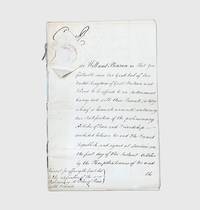
1801167096St James Palace 9 October 1801. Peace in Europe A royal warrant signed by George III at the beginning and end ordering that the Great Seal be applied to the Treaty of London the preliminary peace treaty to mark the cessation of hostilities between Britain and France while negotiations continued towards the Treaty of Amiens. The document is countersigned on the second page by the foreign secretary Charles Jenkinson Lord Hawkesbury. It orders the Great Seal to be affixed "to an Instrument. containing our Ratification of the preliminary Articles of Peace and Friendship concluded between us and the French Republick and signed at London". The Treaty of London was signed on 1 October 1801; this warrant applies the Great Seal on 9 October to ratify it. King George proclaimed the cessation of hostilities on 12 October. The Treaty of London paved the way for the Treaty of Amiens signed on 25 March 1802. Amiens created a year of peace the only such period between 1793 and 1814. The Treaty of Amiens is better known than the preliminary Treaty of London but most of the provisions of Amiens were established by London including the restoration to France of colonies occupied by the British the French evacuation of Egypt and the restoration of Malta to the order of St John of Jerusalem. Folio 309 x 197 mm. 12 leaves first 2 pages with manuscript warrant the subsequent 19 pages with manuscript copy of the treaty followed by 2 blank pages terminal page with docket title; seal impression beneath signature sewn with blue thread paper watermarked 1800. Light creases where folded at time else in excellent fresh condition. unknown
182010251820. Mezzotint frontis. port. of George III a little foxed arms on each title & two engraved views of the library serving as head- & tailpieces. Five vols. Large folio cont. red straight-grained morocco minor scuffing panelled & tooled in gilt with centerpiece stamped monogram "GR" surmounted by a crown on covers spines gilt dentelles gilt a.e.g. London: W. Bulmer & W. Nicol 1820-29.<br/> <br/> The catalogue "sumptuously printed" by Bulmer of the magnificent library of King George III 1738-1820 donated to the nation by his son George IV. This is a royal copy having belonged to Ernest Augustus Duke of Cumberland and the fifth son of George III who became King of Hanover in 1837. It is superbly bound in red straight-grained morocco and printed on paper superior to other sets. <br/> <br/> "The kings of England had from the end of the fifteenth century always shown a certain taste for fine books especially for the handsomer volumes of their own day.A new library was started in 1765 by King George III when he purchased for 10000 pounds the valuable collection of incunabula with a few manuscripts brought together by Joseph Smith 1682-1770 the British Consul at Venice. <br/> <br/> "George III continued adding to his library for nearly fifty years buying with considerable discrimination at all the notable sales of the period; he secured the best books at the West Ratcliffe and Askew auctions built up a magnificent collection of English plays and kept on right up to the Roxburghe sale 1812. His usual agents were Messrs Nicol the booksellers but he seems to have obtained from the Continent some extremely valuable incunabula by the assistance of one Horn of Ratisbon a great despoiler of the German convents. <br/> <br/> "There is a sumptuously printed but hastily compiled catalogue of which copies are seldom met with."-De Ricci pp. 55-56. <br/> <br/> "As a boy George III had received an excellent education. He learned Latin well enough to be able to read the classics; French and German; history geography and the British political system; mathematics and elementary science; art architecture and music. After he left the schoolroom he continued his education under the Earl of Bute an inspiring if somewhat pedantic tutor.Under his tuition the King developed wide cultural interests a reverence for scholarship and the instinct of a collector. <br/> <br/> "The King's aim was.to acquire a library which contained every book which an eighteenth-century scholar could desire. It was a library to be used not simply to be admired.It was as far as it could be in the eighteenth century a universal library.It is rich in library catalogues. In addition to the catalogues of British libraries there are catalogues from France Italy Spain Portugal Germany Belgium Switzerland Sweden Poland and Russia. There are over five hundred sale catalogues most British and most with the prices marked. <br/> <br/> "It was the King's wish that a catalogue should be published but he postponed this as long as possible. When it became clear after 1812 that the King would never recover Queen Charlotte and the Prince Regent urged the preparation of a catalogue. It was compiled by Barnard and published between 1820 and 1829 in five folio volumes.It was never offered for sale but copies were presented to heads of state and the great libraries in the United Kingdom and on the Continent. It is today an extremely rare book."John Brooke "The Library of King George III" in The Yale University Library Gazette Vol. 52 No. 1 July 1977 pp. 33-45. <br/> <br/> "Frederick Barnard had begun the catalogue of the books and manuscripts of the King's Library while it was at Buckingham House. The catalogue was completed.by Barnard and his staff for the Trustees of the British Museum and printed in five volumes between 1820 and 1829.Very few copies were printed none for sale and they are now very rare."-Paintin The King's Library p. 22. <br/> <br/> This copy lacks the engraved frontispiece portrait of Bernard. A sixth volume issued separately in 1829 and not present here describes the maps prints and drawings. <br/> <br/> A magnificent set. From the library of Prince Ernest Augustus Duke of Cumberland and the subsequent Kings of Hanover. <br/> <br/> Miller That Noble Cabinet p. 125"one of the finest libraries ever created by one man.By the time of the King's death the collection amounted to 65250 volumes besides 19000 unbound tracts. unknown