94 résultats
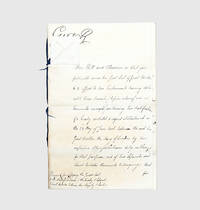
42584appointing "Our Trusty and Wellbeloved Major Thoam Inglis on half pay of our One Hundred and Twenty Sixth Regiment of Foot. to be Lieutenant Colonel." countersigned by Pelham at the foot 1 side oblong folio on vellum with papered seal and revenue stamp Court at St James's 29th April Pelham was Home Secretary from July 1801 to August 1803 under Addington who made him Chancellor of the Duchy of Lancaster in 1803. Pelham went out of office in 1804 and in the next year succeeded to the earldom. hardcover
40960saying that "on receiving the two Boxes yesterday morning I perceived that the one was not intended for my perusal and sent it to the Messenger which gave rise to the mistake of his going to London previous to my dispatching the other Box which I therefore sent by a safe hand at a later hour." 1 side 4to. Windsor 8th February It is unusual to find holograph letters from the monarch. unknown
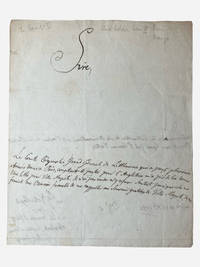
1785003743original letter. WILLIAM V PRINCE OF ORANGE 1748-1806 Stadtholder of the United Provinces. Autograph letter signed in French to GEORGE III King of Great Britain recommending Count Michal Kazimierz Oginski 1730-1800 Grand Hetman of Lithuania. 18 December 1785. Single bifolium written on the first and second pages with integral address panel endorsed "Prince d'Orange to the King" and contemporary docketing. Signed in the formal court style "De Votre Majesté le très humble et très obéissant serviteur G. Pr. d'Orange." Old folds light browning small repair at one fold; otherwise sound. Very good. English translation of the letter: "Sire Count Oginski Grand General of Lithuania who has spent several years in this country and who intends to depart for England in the month of June has had the honour of presenting himself to Your Majesty and most humbly to beg that Your Majesty will be pleased to grant him the continuation of your goodwill and assistance in the plans which he may have the honour to submit to you. I cannot refrain from expressing the profound respect with which I am Of Your Majesty The very humble and very obedient servant W. Prince of Orange. 18 December 1785." A formal letter of introduction from William V to George III on behalf of Count Michal Kazimierz Oginski Grand Hetman of Lithuania commending him to the King's continued favour and assistance as he prepared to travel to England. Oginski was one of the senior military and political figures of the Polish-Lithuanian Commonwealth. A former leader of the Bar Confederation and a persistent opponent of Russian dominance he had been defeated by Russian forces in the early 1770s forced into exile and thereafter remained a politically sensitive figure in eastern European affairs. . Very Good. Soft cover. 1st Edition. 1st Printing. 1785. original letter paperback
42237printed with manuscript details giving "Our Royal Licence authorizjng them to pay two Bills of Exchange for the respective sums of £290 & £473.19.10 the former drawn on themselves the other on Messrs Boyd Benfield & Co drawn at Leghorn." the printed side states that "by these Presents and by the Powers vested in us by the Act passed in the Thirty-fourth Year of Our Reign intitled 'An Act for preventing Money or Effects in the Hands of His Majesty's Subjects belonging to or disposable by Persons resident in France being applied to the Use of the Persons exercising the Powers of Government in France and for preserving the Property thereof'." countersigned by Portland 1 side folio with papered seal Court at St James's 1st April Thomas RAIKES the Elder 1741-1813 was a British merchant particularly trading from London with Russia a banker and newspaper proprietor. Notably he was Governor of the Bank of England during the 1797 currency crisis when the Bank was prohibited by the British Government from paying out in gold. Walter BOYD 1754-1837 was a financier. In March 1793 the firm of Boyd Benfield & Co. was established in London. Boyd as the principal partner contributed £60000 to the common stock. The Bank Restriction Act of 1797 was an Act of Parliament which removed the requirement for the Bank of England to convert banknotes into gold. The period lasted until 1821 when convertibility was restored. The period between these two dates is known as the Restriction period. unknown
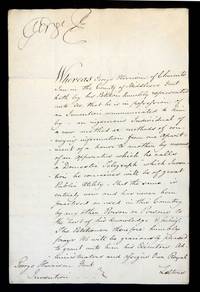
18092120802<i>Folio 4pp. with docket on fourth page "George Harrison Gent. Not stamped. Mr. Solicitor declines at present signing the Bill for this patent. S.G. Wyatt"; </i><i>folded and unbound as issued in very good state of preservation.</i><br /><br />A fascinating document which seems however not after all to have ended in a grant for a patent. George Harrison claims that "he is in possession of an invention communicated to him by an ingenious individual of a new method or methods of conveying information from one apartment of a house to another by means of an apparatus which he calls a "Domestic Telegraph" which invention he conceives will be of great public utility. That the same is entirely new and has never been practised or used in this country by any other person or persons to the best of his knowledge & belief". George Harrison not only does not disclose the name of the inventor he also petitions for the patent to be in his own name. No such patent in Harrison's name is included in Woodcroft's definitive Alphabetical Index. It is possibly that Harrison was trying to be a bit too clever as the award of a patent was conditional on Harrison producing "a particular description of the nature of the said invention and in what manner the same is to be performed".<br /><br />George III's signature here seems in some way to illustrate both his mental illness and his approaching blindness. Little more than a year after signing this document he became dangerously ill and finally accepted the need for the 1811 Regency Act. In 1809 Lord Liverpool was Home Secretary in the Duke of Portland's government.
19779St James 30 July 1796. 2 pages 9 x 7 inches plus integral address leaf gilt edges in fine fresh and attractive condition bearing two seals in red wax with ends of red silk ties SIGNED BY A RELUCTANT GEORGE III ON BEHALF OF HIS FORMER MINISTER TO THE UNITED STATES. The bearer of this letter George Hammond had returned to England after serving as the first British Minister to the United States of America in 1795. He was then promoted by George Grenville the Foreign Secretary to act as his senior Under-Secretary with George Canning serving as the second. Meanwhile faced with Napoleon's victories in Italy and the Rhineland Pitt's First Coalition was facing collapse. Grenville keen on an alliance with Prussia proposed that her support could be ensured by giving her a free hand in annexing either of the Belgic provinces or extensive domains in Germany; a plan that was turned down by George III with the cutting observation that 'Italian politics are too complicated for my understanding'. Nevertheless as Ward puts it the British Cabinet was in its desperation 'prepared to act on the degrading principle of gaining the help of a powerful State by conniving at its annexation of a week neighbour' Cambridge History of British Foreign Policy ii p. 267. Hammond as per our letter was therefore despatched to Berlin with George III's reluctant agreement. But he had no luck. For when he got to Berlin he discovered that the King was away and nothing could be done in his absence. So he let the matter drop. unknown
51577printed with manuscript details appointing Richard Ward to be "Captain of Dragoons in Our Army" countersigned by "Dunk HALIFAX" George Montague-Dunk 1716-1771 2nd Earl of Halifax uncle of Lord North as a Secretary of State and by the Hon. Robert WALPOLE d. 1810 Clerk of the Privy Council Ambassador to Portugal for the War office vellum 1 side oblong folio with papered seal and revenue stamp Court at St James's 17th November Dunk Halifax 'the Father of the Colonies' was 1st Lord of Trade 1748-1761 promoting Nova Scotia whose capital is named after him 1749 as are counties in Virginia and North Carolina. In 1741 he married the heiress of Sir Thomas Dunk. In 1763 he signed the famous 'Dunk Warrant' to search and apprehend the authors printers and publishers of Wilkes 'North Briton' No. 45. After the officers arrested 18 people and seized a vast quantity of papers the warrant was pronounced by the judges to be 'unreasonable search and seizure' and Halifax was mulcted in damages. It has been called 'the most important warrant in Anglo-American law' and the doctine overturning it is closely related to the Fourth Amendment. Robert Walpole's father was Horatio 1st Baron Walpole of Wolterton brother of the Prime Minister. hardcover
000162London 1798. Fine. 15x10 1/2 in. A military appointment framed. A lovely signature on an elagant item. London, 1798. unknown
43717George the Third's Hair Cut 22nd July 1819." 5½" x 3" no place 22nd July King George died of pneumonia at Windsor Castle on 29th January 1820 aged 81 six days after the death of his fourth son Prince Edward Duke of Kent and Strathearn. His favourite son Prince Frederick Duke of York and Albany was with him. He lay in state for two days and his funeral and interment took place on 16th February in St George's Chapel Windsor Castle Provenance: From a small collection of locks of Royal Hair. unknown
43718George the Third's Hair Cut 22nd July 1819." 5½" x 3½" no place 22nd July King George died of pneumonia at Windsor Castle on 29th January 1820 aged 81 six days after the death of his fourth son Prince Edward Duke of Kent and Strathearn. His favourite son Prince Frederick Duke of York and Albany was with him. He lay in state for two days and his funeral and interment took place on 16th February in St George's Chapel Windsor Castle Provenance: From a small collection of locks of Royal Hair. unknown
AQ30653s.i.: s.n. 1788 Manuscript on paper. Seven joined vellum membranes. A trifle creased and discoloured. Inscribed at foot: 'Examined by Thomas Lowley Deputy Clerk of the Pipe 10 July 1811'. An examined copy of a roll of foreign accounts dealing at a largely superficial level with the financing of troops stationed in Gibraltar Ireland North America the West and East Indies and associated plantations. Some specific sums are recorded such as the receipt of £300 18s 2d for the sale by public auction in Quebec of the brig Maria. Charges and receipts amounted to £3377122 0s 11 1/2d and payments and allowances to £1772059 19s 11d which after further allowances was reduced to a debt of £423277 2s 2 3/4d. Perhaps the most interesting inclusion is the list of deputy-paymasters and their stations and the numerous officials and the salaries which they received. The office of Paymaster of the Forces was established in 1661. By the eighteenth century it had become a political prize and potentially one of the most lucrative offices one could obtain during a parliamentary career offering a salary of £4000. At the time this roll was produced the office was jointly held by future Prime Minster William Wyndham Grenville Baron Grenville 1759-1834 and naval officer and politician Constantine John Phipps 1744-1792. . Dimensions 1425 x 29 cm. [s.n.], [1788] hardcover
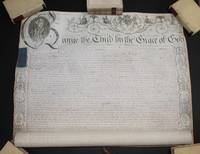
20855Manuscript on vellum three membranes with an initial portrait of the King and the Great Seal attached. The document overall 31 x 24 inches the Great Seal 6 inches in diam. All contained in the original shaped leather over wood case; the case now rather worn and lacking much of the original leather covering. The Great Seal is a rather poor lumpy impression and now lacking the original tin case skippet. The document inscribed to the reverse "The within Patent has been duly recorded in the College of Arms London pursuant to the tenor of His Majesty's Warrant under his Royal Signet and Sign Manual .Examined therewith the thirteenth day of December 1803" and signed George Harrison Clarenceux & Register. Watson has an interesting history. At the age of 14 and in the employ of his uncle on one of his merchant ships whilst swimming in Havana harbour was attacked by a shark and lost his right leg This incident prompted Watson in 1778 to commission John Singleton Copley to paint this dramatic scene known as "Watson and the Shark" for which see our illustration which when exhibited at the Royal Academy caused a sensation. It now hangs in the National Gallery of Art Washington D.C.Watson was a member of the original committee of the Corporation of Lloyd's of London; he was elected as an Alderman of the City of London and served as M.P. for the City of London. Lord Mayor of London in 1796 and a deputy Director of the Bank of England.Copley painted a portrait of Watson in c.1796. This now hangs in Indianapolis Museum of Art. He was also the subject of a caricature by Robert Dighton in 1803. His coat of arms had his severed leg on it and the shark as the crest. hardcover
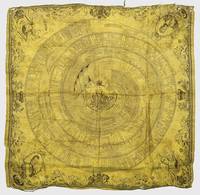
1812166835London: Rymer & Son 1812. Mapping the Age of Revolutions This visually arresting and minutely detailed chronology presents two concentric spirals radiating from a central portrait of George III offering a spectacular timeline of a half-century of conflict embellished with portraits of the king Pitt Fox Nelson and Wellington. The inner delineates the "various administrations formed during his reign" while the outer charts major events including the conclusion of the Seven Years War the American Revolution the Napoleonic Wars campaigns in South Asia and the opening salvoes of the War of 1812. The densely printed text also includes relevant statistical information particularly as relates to the major campaigns: numbers of troops under arms sailors at sea prisoners taken cost of supplies but also the funded national debt annual expenditure and ticking steadily throughout the price of a peck loaf. In each corner is a portrait of a hero of the period: "In an age abounding with so many Warriors & Senators whose equals the page of History can scarcely produce it is difficult to select the most suitable characters to adorn this design or those who have been most active in the great Events of our own times but none seem to have diffused the rays of glory with greater splendour round the nation than Nelson and Wellington. Fame will transmit to distant posterity the vigorous eloquence of Fox and Pitt & exhibit them as patterns worthy their imitation. The portraits are esteemed striking likenesses". Produced by the Edinburgh-born engraver and reform-leaning Whig Malcolm Rymer 1775-1835 the timing of the publication produced close on the removal of all restrictions on the powers of the Prince Regent and the catastrophist litany of disorder in 1812 - "Alarming Riots in Nottinghamshire Lancashire and Yorkshire" the assassination of Spencer Percival "The Old Administration continues with a few trivial changes" - suggests critical intent. Copper engraving printed on vivid yellow silk "handkerchief" 840 x 860 mm. Elaborate decorative frame comprised of a narrow chequered band enclosing a wide scrolled foliate border set with the Royal Arms centrally top and bottom and the Imperial State Crown with crossed rose and thistle with banderolle reading"dieu et mon droit" placed at the sides. Housed in grey archival box. Somewhat worn overall thinned and slightly faded and with some minor marginal loss top and bottom and a few splits but overall complete and remains striking good or better. Examples traced to the Victoria and Albert 1985/2028 Metropolitan Museum of Art 62/271 Art Institute of Chicago 2005.68 "cotton plan weave" and The Society of the Cincinnati M. 218.002 "ochre cotton plate-printed in dark red pigment". See Rebecca Nesvet "Science and Art a Farce in Two Acts" Scholarly Editing 38 2017. unknown
#[60986]British Empire d.d. 1 August 1817. Vellum charter good condition. 60x45 cm. Manuscript text and calligraphy with 4 coloured coats of arms three of the King and the officials and one of Hopton. Original 'signatures' written names and attached wax seals of both officials in decorated wooden spane casings. Encased in a made to fit oblong wooden case with metal closing mechanism and clothed with red linen decorated in gold with GR initials and crowns. This comes with an original letter from George W. Marshall Rouge Croix from the College of Arms dated 1900 and the Royal licence signed by Queen Victoria adressed to Lieutenant-Colonel Hopton for a change of name and arms from John Dutton Hunt to Hopton. This charter explains that William Hopton heretofore William Parsons only surviving son of John Parsons MP of Kemerton Court county Gloucester deceased by Deborah his wife who was the daughter of Richard Hopton of Canon Frome in Hereford and the aunt of Richard Cope Hopton also deceased took the name of Hopton by Royal decree of 11 March 1817 in order to inherit the Canon Frome estate. It also relates to the impressive family history dating several centuries back. The Hoptons had lived at Canon Frome for several generations the succession often being through the female line. The Canon Frome estate was one of the largest in the county and he was a typical squarson'. William Parsons Hopton married twice first to Mary Graves and second to Anna Poole and his eldest grandson by the second marriage Edward married his cousin Clare Ellen Trafford. A soldier who served in the Crimea Indian Mutiny and the Kaffir and Zulu Wars Edward became a General and was knighted in 1900. He and his son Edward after him were Trustees of the Michaelchurch Estate and Eliza Rawson bought them a house at Cagebrook in the parish of Eaton Bishop. It seems that Canon Frome Court is now inhabitated by a rural living community of adults and children. Kemerton Court apparently the ancestral home of the Parsons family still exists and in the village of Kemerton there is a two storey tower still known as "Parsons folly". Unusual is the grant of a crest "out of a Ducal Coronet" "under the peculiar circumstances and the antiquity of the family" but "may not be made a precedent." H96 hardcover
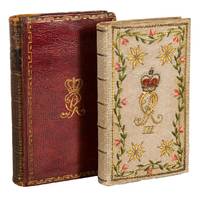
61172Lauenburg 1801. 8vo. 18 x 11 cm. pp.xxxii2643416. Contemporary needlework binding of white gold silk twill with borders of gold sequins and foliate border of green silks issuing in red flowers upper cover with crowned monogram of George III to the centre monogram in gold sequins the crown worked in coloured silks the lower cover with a central cornucopia worked in gold threads with flowers and leafy sprays in coloured silks corner pieces of flowers worked in sequins and gold threads gilt edges bright green endpapers slightly rubbed the binding preserved in its original red morocco slipcase with crowned gilt monogram of George III to upper cover and star emblem to lower cover gilt border to sides spine richly gilt. Slipcase a little rubbed at extremities the binding remarkable well preserved overall in excellent condition. Lauenburg, 1801. unknown
180718934215 July 1807. Diplomatic deals in the Napoleonic Wars A royal warrant signed by George III at the head ordering the application of the Great Seal to the Convention of Subsidy between Great Britain and Sweden signed at Stralsund on 23 June 1807. The document is countersigned on the second page by the Foreign Secretary George Canning later prime minister. The warrant orders the Great Seal be affixed to two instruments "containing our Ratifications of a Treaty concluded & signed at Stralsund on the 23d Day of June last between us and our good brother the King of Sweden by our respective plenipotentiaries". Annexed to the document are manuscript copies of the instruments. Sweden joined Britain in the war against Napoleon in 1805 in the Treaty of Bäckaskog. In early 1807 France launched an offensive against Swedish Pomerania and by June Swedish forces were weakening. Canning saw Pomerania as the only viable base for continental military operations against Napoleon and agreed in the treaty of 23 June to provide British subsidies to Swedish troops. The Swedes nevertheless capitulated in August. Britain reinforced Sweden in 1808 as France's allies entered the war against her but in 1809 King Gustav IV was deposed and in 1810 Sweden aligned with France and declared war on Britain. Folio 309 x 197 mm. 10 leaves: 2-page warrant followed by 16-page treaty blank page and final page with docket title all in manuscript; blind-impressed paper seal mounted over George III signature sewn with blue thread paper watermarked 1805. Minor fraying to ribbon else in fine condition. unknown
1761319882Great Britain 1761. 2pp. plus integral blank. Docketed on verso "King's Warrant / Province of Massachusetts / Bay £60634 in part / of £200000 Granted for / the North American / Provinces." Signed by George III at the head of the first page countersigned on the second page by William Wildman Barrington James Oswald and Gilbert Elliot. Folio 14 1/4 x 9 1/2 inches. Usual folds. 2pp. plus integral blank. Docketed on verso "King's Warrant / Province of Massachusetts / Bay £60634 in part / of £200000 Granted for / the North American / Provinces." Signed by George III at the head of the first page countersigned on the second page by William Wildman Barrington James Oswald and Gilbert Elliot. Folio 14 1/4 x 9 1/2 inches. Towards the end of the French and Indian War William Pitt started a specie grant program to reward colonies for raising troops thus putting the colonies in competition with each other for a share of an annual 200000 pounds. With specie scarce in the colonies the colonial assemblies were thus incentivized to raise troops to fight against the French. The present document authorizes Henry Fox to make payment to Massachusetts via their colonial agent William Bollan for their share of the annual grant. Although successful the policy was abandoned in favor of direct taxation after 1762 leading to the Sugar Act and most notably the Stamp Act. <br /> <br /> This undated document -- the space for the date being left blank suggesting it to possibly be a draft -- is countersigned by William Wildman Barrington Chancellor of the Exchequer 21 March 1761 to 8 May 1762; Sir Gilbert Elliot third Baron Minto Lord of the Treasury 1761-62 and James Oswald Commissioner of the Treasury 1759-63. The date would therefore appear to be 1761 or early in 1762.<br /> <br /> George III documents relating to North America from the early years of his reign are particularly scarce. unknown
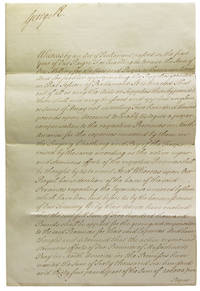
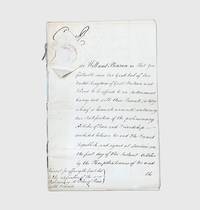
1801167096St James Palace 9 October 1801. Peace in Europe A royal warrant signed by George III at the beginning and end ordering that the Great Seal be applied to the Treaty of London the preliminary peace treaty to mark the cessation of hostilities between Britain and France while negotiations continued towards the Treaty of Amiens. The document is countersigned on the second page by the foreign secretary Charles Jenkinson Lord Hawkesbury. It orders the Great Seal to be affixed "to an Instrument. containing our Ratification of the preliminary Articles of Peace and Friendship concluded between us and the French Republick and signed at London". The Treaty of London was signed on 1 October 1801; this warrant applies the Great Seal on 9 October to ratify it. King George proclaimed the cessation of hostilities on 12 October. The Treaty of London paved the way for the Treaty of Amiens signed on 25 March 1802. Amiens created a year of peace the only such period between 1793 and 1814. The Treaty of Amiens is better known than the preliminary Treaty of London but most of the provisions of Amiens were established by London including the restoration to France of colonies occupied by the British the French evacuation of Egypt and the restoration of Malta to the order of St John of Jerusalem. Folio 309 x 197 mm. 12 leaves first 2 pages with manuscript warrant the subsequent 19 pages with manuscript copy of the treaty followed by 2 blank pages terminal page with docket title; seal impression beneath signature sewn with blue thread paper watermarked 1800. Light creases where folded at time else in excellent fresh condition. unknown
182010251820. Mezzotint frontis. port. of George III a little foxed arms on each title & two engraved views of the library serving as head- & tailpieces. Five vols. Large folio cont. red straight-grained morocco minor scuffing panelled & tooled in gilt with centerpiece stamped monogram "GR" surmounted by a crown on covers spines gilt dentelles gilt a.e.g. London: W. Bulmer & W. Nicol 1820-29.<br/> <br/> The catalogue "sumptuously printed" by Bulmer of the magnificent library of King George III 1738-1820 donated to the nation by his son George IV. This is a royal copy having belonged to Ernest Augustus Duke of Cumberland and the fifth son of George III who became King of Hanover in 1837. It is superbly bound in red straight-grained morocco and printed on paper superior to other sets. <br/> <br/> "The kings of England had from the end of the fifteenth century always shown a certain taste for fine books especially for the handsomer volumes of their own day.A new library was started in 1765 by King George III when he purchased for 10000 pounds the valuable collection of incunabula with a few manuscripts brought together by Joseph Smith 1682-1770 the British Consul at Venice. <br/> <br/> "George III continued adding to his library for nearly fifty years buying with considerable discrimination at all the notable sales of the period; he secured the best books at the West Ratcliffe and Askew auctions built up a magnificent collection of English plays and kept on right up to the Roxburghe sale 1812. His usual agents were Messrs Nicol the booksellers but he seems to have obtained from the Continent some extremely valuable incunabula by the assistance of one Horn of Ratisbon a great despoiler of the German convents. <br/> <br/> "There is a sumptuously printed but hastily compiled catalogue of which copies are seldom met with."-De Ricci pp. 55-56. <br/> <br/> "As a boy George III had received an excellent education. He learned Latin well enough to be able to read the classics; French and German; history geography and the British political system; mathematics and elementary science; art architecture and music. After he left the schoolroom he continued his education under the Earl of Bute an inspiring if somewhat pedantic tutor.Under his tuition the King developed wide cultural interests a reverence for scholarship and the instinct of a collector. <br/> <br/> "The King's aim was.to acquire a library which contained every book which an eighteenth-century scholar could desire. It was a library to be used not simply to be admired.It was as far as it could be in the eighteenth century a universal library.It is rich in library catalogues. In addition to the catalogues of British libraries there are catalogues from France Italy Spain Portugal Germany Belgium Switzerland Sweden Poland and Russia. There are over five hundred sale catalogues most British and most with the prices marked. <br/> <br/> "It was the King's wish that a catalogue should be published but he postponed this as long as possible. When it became clear after 1812 that the King would never recover Queen Charlotte and the Prince Regent urged the preparation of a catalogue. It was compiled by Barnard and published between 1820 and 1829 in five folio volumes.It was never offered for sale but copies were presented to heads of state and the great libraries in the United Kingdom and on the Continent. It is today an extremely rare book."John Brooke "The Library of King George III" in The Yale University Library Gazette Vol. 52 No. 1 July 1977 pp. 33-45. <br/> <br/> "Frederick Barnard had begun the catalogue of the books and manuscripts of the King's Library while it was at Buckingham House. The catalogue was completed.by Barnard and his staff for the Trustees of the British Museum and printed in five volumes between 1820 and 1829.Very few copies were printed none for sale and they are now very rare."-Paintin The King's Library p. 22. <br/> <br/> This copy lacks the engraved frontispiece portrait of Bernard. A sixth volume issued separately in 1829 and not present here describes the maps prints and drawings. <br/> <br/> A magnificent set. From the library of Prince Ernest Augustus Duke of Cumberland and the subsequent Kings of Hanover. <br/> <br/> Miller That Noble Cabinet p. 125"one of the finest libraries ever created by one man.By the time of the King's death the collection amounted to 65250 volumes besides 19000 unbound tracts. unknown