4 021 résultats
19582111902160305419Nagano Prefecture Police Headquarters 1958. Soft Cover. Fine. The book is in fine condition. Nagano Prefecture Police Headquarters paperback
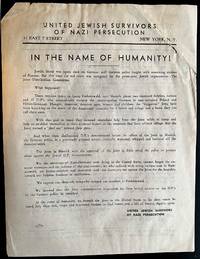
194743409New York The Organization No Date 1947. 1st edition. Double-sided English-Yiddish leaflet 2 pages. The Yiddish header translates roughly as "An Announcement To the Jewish Public"<br> Bilingual American Flyer condemning the Joint the American Joint Distribution Committee AJDC for not doing more to help the Jewish DPs and its "hiding" behind the German police when DP's demonstrated for more action on DP resettlement.<br> The issuing organization the United Jewish Survivors of Nazi Persecution/Farband fun Geveyzene Yidishe Katsetler un Partizaner was the first survivor network founded in the US. Their Yiddish name translates as "The Association of Former Jewish Concentration Camp Inmates and Partisans." The word "Katsetler" in their name is a contraction of "kontsentratsyonslager-er" using the letters K and Z "ka" and "tset" and thus short for "kontsetratsyonslager" a concentration camp inmate or survivor sometimes also noted as a "katsetnik." <br> <br> The flyer announces:<br> <br> "Jewish blood was again shed on German soil! German police fought with remaining victims of Nazism. But this time the sad event was instigated by the prominent Jewish organization-The Joint Distribution Committee.<br> <br> What happened<br> <br> There remains today in Camp Foehrenwald near Munich about two thousand helpless forlorn and ill D.P's who miraculously escaped the extermination furnaces in nazi-occupied Poland and Hitler-Germany. Hungry desperate destitute men women and children the 'forgotten' Jews have been knocking at the doors of the democratic countries for a haven and refuge and a home they can call their own.<br> <br> With this goal in mind they demand immediate help from the Joint while in camp and help to establish themselves in their eventual homes in the countries that have offered refuge. But the Joint turned a 'deaf ear' toward their pleas.<br> <br> And when these disillusioned D.P.'s demonstrated before the offices of the Joint in Munich the German police in a previously planned attack critically wounded whipped and battered off the demonstrators.<br> <br> The Joint in Munich with the approval of the Joint in Paris asked the police to protect them against the Jewish D.P. demonstrators.<br> <br> We the survivors of Nazi-Germany now living in the United States cannot forget the extreme torments and the inferno of the nazi-torture; we who suffered with many victims now in Foch- renwald are horror-stricken and dismayed and our hearts cry out against the Joint for the brutality toward our helpless brethern in misfortune.<br> <br> We express our deep-felt sympathy toward our brothers in Foehrenwald.<br> <br> demand that the Joint representatives responsible for these brutal attacks on the D.P.'s by the German police be punished.<br> <br> In the name of humanity we beseech the Jews in the United States to let their voices be heard help these sick tragic and frustrated victims to find homes and a life of human dignity again" From the English side of the flyer.<br> <br> <br> After World War II Munich served as a major center for Jewish Holocaust survivors the "Sh'erit ha-Pletah" who were living in DP camps. The "Joint" was the primary welfare organization providing aid clothing and food to these camps. While the Joint was a vital lifeline its Munich headquarters at Siebertstrasse 3 sometimes became the focal point for frustration regarding the pace of aid distribution or more frequently the slow pace of emigration to Palestine Aliyah and broader often frustrating postwar conditions.<br> Following the 1947 Exodus ship incident where Jewish refugees were returned to Germany by the British Jewish DPs felt trapped and staged intense demonstrations including protests at the offices of international organizations like the Joint to highlight their despair.<br> These demonstrations were part of a broader effort by survivors to assert their agency and demand rights during their time in Munich 1945-1951. For more on tensions between Munich's Jewish DPs and the Joint see www.juedisches-museum-muenchen.de/en/exhibitions/munich-displaced-online/moehlstrasse. <br> <br> Scholar David Slucki notes about the publishers of this leaflet that "Within months of arriving in the United States in 1946 Jewish Holocaust survivors began to organize themselves to help with the process of resettlement. The small band of socialists who established the Farband fun Geveyzene Yidishe Katsetler un Partizaner United Jewish Survivors of Nazi Persecution this group initiated a dual process of identity formation and memorialization of the Holocaust. <br> The first survivor network founded in the United States the Katsetler Farband this group developed a memorial culture that included commemorations and publications replete with its own rituals and calendar. Moreover the organization was part of a broader process of defining what experiences constituted the Holocaust and who was to be considered a survivor. Ultimately they were among a host of survivor networks in the United States to lay the foundation for Holocaust memorialization" Slucki D. 2017. A Community of Suffering: Jewish Holocaust Survivor Networks in Postwar America. Jewish Social Studies 222 116-145. https://muse.jhu.edu/article/649094<br> <br> We could locate no copies in OCLC-Worldcat Archive Grid nor using a google search. <br> <br> Touch of edgewear one diagonal fold paper generally bright and strong about Very Good- Condition. Holo2-163-28A. New York, The Organization, No Date unknown
19602080402107100261Not Available 1960. Soft Cover. Fine. The book is in fine condition. Not Available paperback
19592080402107100256Not Available 1959. Soft Cover. Fine. The book is in fine condition. Not Available paperback
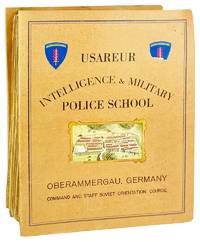
195431165Oberammergau Germany: Intelligence and Military Police School 1954. Very Good. Oberammergau Germany: Intelligence and Military Police School 1954. Quarto; stiff illustrated covers with hundreds of pages of reports bound in. Includes charts and graphs of Soviet governmental and military organization. Additional monographs laid in include Armed Forces Talk's four-part Communism Series and three issues of the U.S. Constabulary School's Department of Geopolitics series covering German History up to the rise of the Nazi Party the United Nations and International Relations. Staining to rear cover; pages toned but largely unmarked; a Very Good copy.<br /> <br /> Binder prepared by the United States Army for training Cold War-era officers and staff on USSR history ideology and military capabilities. The trove of documents here covers nearly everything an early Cold War American military or intelligence officer would need to know at the time: a history of Marxist ideology and its development in the 19th-century; details on the physical geography of the USSR; an ethnography of Central Asia detailing the Turkomen Kazakhs and Tatars; as well as extended analyses on who the power players in the Communist Party were and what the capabilities of their rifle and artillery division might be. <br /> <br /> Logistics psychological warfare and the role of Communism in the Middle East are also covered with detailed but succinct chapters on each. An impressive array of information highlighting the early Cold War Western perspective. No copies in retail and three holdings found in OCLC at the US Army War College Georgetown University and the University of Iowa. Intelligence and Military Police School unknown
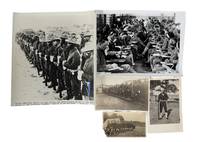
1910210211910. Archive of five photographs documenting African American military service from the Spanish-American War through World War II preserving visual evidence of Black participation in the United States armed forces across multiple generations of conflict and segregation. The material documents military systems of training deployment labor organization and wartime service through images of Black quartermasters sailors signal corps trainees and infantrymen revealing the varied roles occupied by African American servicemen within the segregated military structure of the United States. The photographs provide primary-source evidence for the study of Black military history racial integration and segregation within armed forces wartime labor divisions and the evolving visibility of African American soldiers from the late nineteenth century through the twentieth century.<br /> Archive consists of five silver gelatin photographs ranging in size from approximately 3.75 x 5.5 inches to 8 x 9 inches dating from the 1910s through the 1980s including original photographs real photo postcards and later documentary reprints. One World War I photograph depicts an integrated line of Black and white soldiers standing with cups and mess pans during food service documenting interracial proximity within military camp operations despite broader segregation policies. Another World War I image shows a large group of African American quartermasters posed before a tented encampment while wearing uniforms with insignia caps and holding swagger sticks emphasizing military discipline and organizational identity within support units. A World War II real photo postcard portrays a Black sailor in dress uniform with white cap and necktie posed formally before a training ground where additional servicemen appear in the background. Another mid-century reprint reproduces an image of African American World War I soldiers attending signal corps radio instruction while seated at desks wearing large headsets and making technical notations documenting specialized communications training available to Black troops during the war. The final image reprinted in 1983 for the PBS American Masters documentary The Different Drummer: Blacks in the Military reproduces an 1898 photograph of Black soldiers stationed in Havana Cuba during the Spanish-American War. The troops stand in formation wearing campaign hats and holding rifles upright with several soldiers gazing directly toward the camera.<br /> Together the photographs trace the changing but still restricted position of African Americans within the United States military from the era of overseas imperial expansion through the world wars of the twentieth century. Black soldiers served in segregated units for much of this period while simultaneously contributing to military logistics communications naval service and combat operations despite systemic discrimination within the armed forces. The inclusion of later documentary reproductions connected to public television programming further reflects growing efforts during the late twentieth century to recover and interpret African American military history for broader audiences. Some editor's markings on versos. Minor edge wear throughout with one photograph lacking lower left corner. Overall very good condition. Compact but historically substantial visual archive documenting African American military service across multiple major conflicts. unknown
19592080402107100363Not Available 1959. Soft Cover. Fine. The book is in fine condition. Not Available paperback
236932Paris, Moutardier, 1829 4 vol. in-8, demi-basane brune, dos lisse, filets dorés (reliure postérieure). Rousseurs et brunissures.
235705Paris, Debure l'aîné, 1759 in-12, xiv pp., 596 pp., [2] ff. n. ch. de privilège, veau fauve marbré, dos à nerfs cloisonné et fleuronné, simple filet doré sur les coupes, tranches rouges (reliure de l'époque). Bon exemplaire.
236991Paris, Rouff, 1881-1883 10 vol. in-12, fac-similé replié aux tomes 1, 7 et 8, portrait-frontispice au tome 10, demi-chagrin brun, dos à nerfs orné de caissons dorés (rel. de l'époque). Petites usures à certaines coiffes, ressauts de quelques cahiers, qqs rousseurs
22633Laboratoires Carnine Lefrancq, Romainville, 1910, 1911, 1912, 1914, 1920.
244272Paris, Marchant, 1840 4 vol. in-8, demi-veau blond, dos à faux nerfs, filets dorés et à froid (reliure de l'époque). Petit accroc en tête des tomes 2 et 3, dos un peu frotté.
214819Paris, Perrin et Clavreuil, 1908-1964 5 vol. gr. in-8, index, broché. Couv. muette au tome 1 (une partie de la couverture a été contrecollée sur le premier plat). Qss soulignures crayon.
13577Spécial Police n° 40 / Fleuve Noir (1953) - Edition originale - In-12 broché de 224 pages - Très belle couverture en couleurs de Michel Gourdon - Très bon état
20082091502135703916Nobuyama-sha 2008. Soft Cover. Fine. The book is in fine condition. Nobuyama-sha paperback
19252111902160603793Not Available 1925. Soft Cover. Fine. The book is in fine condition. Not Available paperback
2080202105000122Oita Police N.A. Soft Cover. Fine. Number of pages: 1130p Size: 22cm Number of books: 2 Oita Police paperback
304 pages. Black and white illustrations. "Few of us have known until the release of this book that NAFTA may be an elaborate camouflage for a totalitarian police state stretching from the Canadian Arctic to the southernmost reaches of Mexico. Yet this is the thrust of a Secret Report by a North American Counter Intelligence Military Team and certain ancillary documents. The Report cites far-reaching legislation which shifted the responsibility for law enforcement in the U.S. to the U.N. The creation of MJTF and FINCEN seem preliminary to a massive round-up of North American citizens opposed to the New World Order." - back cover. Clean and unmarked with moderate wear. Tight and square. A sound copy of this conspiracy classic. Book
Abundant black and white illustrations and reproductions of photos. Features: Satan - story of a pet monkey in the Ivory Coast; Exploring in Brazil - photo-illustrated account of a sixteen-hundred mile trip up rapid-strewn rivers in a tiny launch through territory almost unknown to Europeans; The "King of the Clearwater" - a man claimed an area in Clearwater country, about sixty miles west of the North Thompson River, as his own and would go to any length to keep out intruders; The Ivory Raiders - Part II - a vivid picture of the dangers and difficulties of suppressing the Swahili ivory-raiders and Turkana warriors of Turkanaland, a wild district of Central Africa bordering on the western shores of Lake Rudolf; An Isle of Unrest - a chatty account of a little tramping holiday in Crete, with nice photos; Aquarium Adventures - remarkable stories of aquarium predicaments related by curators of various institutions; The Cat - Photo-illustrated tale from near Boise, Idaho; In Quest of the Unknown - Part IV - Photo-illustrated account of "Our adventures among the Chucunaque Indians (conclusion); The Second Touch - one of the queerest things that ever happened in Alaska; After a Native Murderer in Rhodesia - A B.S.A. Police trooper's story; On the "Devil's Staircase" - a New Zealand trapper's dangerous experience in a mountain blizzard; The Burmese Buddha - A stolen image of Buddha, stolen from the Shwe Dagon Pagoday, Rangoon, is returned after forty years; My Jungle Jaunts - Part II - An Englishwoman's experiences in Burma, with nice photos (conclusion); A Wild Goose Chase - A sportsman's account of his first experience with a wily Canada goose; and more. 88 pages plus 16 pages of nostalgic ads. Clean and unmarked with moderate wear. A quality copy of this excellent vintage issue. Book
Abundant black and white illustrations and reproductions of photos. Features: The Hunting of Gonzales - An adventure of Senor Ramon Torres, a Captain of Rurales - the famous mounted police of Mexico; Adrift on an Ice-Floe - Lieut. Commander Fitzhugh Green provides a photo-illustrated account of the amazing fashion in which a primitive Eskimo extricated himself from a predicament which would assuredly spelt death for a white man; An Englishwoman in Upper Egypt - Part II - Winifred S. Blackman's photo-illustrated account of the three winters she spent with the local people of Upper Egypt; Fraser's Price - The tale of an angered railroad engineer; The Three Angleteers - Part V (conclusion) of the trouble and adventures of three English wanderers in Constantinople and Athens; "Remember the Mortons" - A stirring story of an episode in the Matabele rebellion of 1895; Salvage Extraordinary - An Indian planter's account of an odd affair on the Brahmaputra River in Assam, including photo of five elephants pushing a stranded steamer; The Head-Hunters of Sepik - Part III - Beatrice Grimshaw explored the Sepik River of New Guinea and dealt with the local cannibals - article with photos; Where Everyone is Wealthy - The Osage Indians of Oklahoma come up with the strangest ways to divest themselves of their wealth earned from local oil - article with photos; "Grip" and I - Part III - Count Nils Cronstedt spares a condemned bull-terrier which rewards him by saving him multiple times while he served in West Africa as Commander of H.M.S. Heron and Assistant Marine Superintendant in Northern Nigeria; "Old White Face" - Allen Borders of Montana relates a terrifying cougar experience; To Afghanistan in Disguise - Part III - The story of a British officer's remarkable journey - disguised as an Oriental - across a large part of India and finally into forbidden Afghanistan and beyond, living among the natives; "Captain Jed" - a tale of the whalers of New Bedford, MA, involving the "Cap'n Jed" and the "Wanderer" - very few men have ever fought a 'right' whale single-handed and lived to tell the tale; Python and Lion in Nyassaland - after visiting a witch-doctor for poisoning the author is attacked first by a great python, then a lion!; Photo of a Manchurian man 7 feet and 3 inches tall; Photo of a veritable forest of masts at Lowestoft, the Suffolk fishing port, during the height of herring season; and more. 88 pages plus 24 pages of nice vintage ads. Clean and unmarked with light wear. A quality copy of this excellent vintage issue. Book
86, 16 [ads] pages. Features: My Fall into Germany from an Aeroplane (Airplane) - how I dropped 8,000 feet getting in - and crawled 400 miles getting out, by Lieut. Pat O'Brien, R.F.C.; The "Debil, Debil' of George's Gap - a snake story; Through Ireland with a "Fit-Up", by Nan Gray; Photo and short article on the Indian-built Hagwilget suspension bridge across the Bulkley River, British Columbia; Behind the Scenes in Russia - Part III - Robert Wilton reports on the war in Russia - article includes several good photos; The Greater Duty - A Corporal in the Royal North-West Mounted Police finds himself in a predicament; In Unknown British Guiana - part 3, with wonderful photos; Tales of the Service - VII - The Saccharine Smugglers (off the Irish coast); Trench Journals - documenting the irrepressible gaeity of French and English soldiers engaged in trench warfare; A Slow Revenge - a snake story from Zululand; The Romance of Fossil-Hunting - with great photos including horse-powered bone hauling out of Red Deer Canyon, Alberta; St. Patrick's Purgatory - with great photos; Photo and brief article on Robert W. Patten of Seattle; Leaping from trees in the New Hebrides - with photo. Unmarked with moderate wear. Binding intact. A sound vintage copy of this most interesting issue. Book
3200068London: T Duggan Book. Very Good. Booklet. 12mo - over 6¾" - 7¾" tall. pp 16 Undated but evidently mid 19th century. Recent marbled cover with endpapers unclear whether there had originally been a wrapper. Testblock reasonably fresh with slight browning. Very scarce - no copies on COPAC and as far as we are aware no others on offer. T Duggan unknown
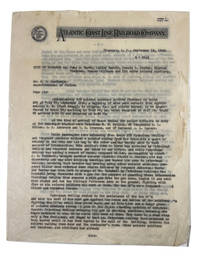
1944929931944. Good. Letter dated September 13 1946. 28 cm. Carbon copy on thin Atlantic Coast Line Railroad Company letterhead stationery. Substantial chipping around edges no loss of text on first leaf. Our unnamed Captain of Police reports on an incident which began when around 200 African American soldiers were changing trains. Local police arrested two of the soldiers for intoxication and took them to the local Police Station. When police returned to the railroad station they found six of the soldiers assaulting two military policemen and intervened to help the MPs using the butt end of a riot gun to break up the fight. When a large number of other soldiers came to join the fight they were stopped at gunpoint by the local policemen with assistance from the MPs and military officers. The African American soldiers marched in formation to local Police Headquarters where 133 soldiers were charged with disorderly conduct and five others differently charged. Almost all pleaded not guilty but all were found guilty the next day and remained in jail another night until their fines were paid -- $17 each for the 133 soldiers and up to $100 for the five who were differently charged. All 138 soldiers were then marched back the the train station and departed. One wonders how accurately the incident was described to our unnamed Captain by those he interviewed. There is nothing in his letter to suggest that he interviewed any of the African American soldiers. unknown
188015922ELos Angeles: 1 page 8†x 4 7/8†March 23 1880. Original document single sheet with engraved letterhead of the Los Angeles Police Department Office of the Chief of Police dated March 23 1880. This piece appears to be a handwritten receipt and reads in Spanish: “$6.00 Don Pedro. Hotel de Paris. deve a A. Aguilar por compostura de dos Cuartos. seis pesos.†Below this at the bottom of the page is written in pencil in a different hand: “Recevido Pago. A. Aguilar.†With staple holes at the upper left corner light horizontal crease from folding evenly cropped at the bottom edge else fine. A very early and scarce L.A.P.D. item. Law enforcement in Los Angeles during the 1880s was often a brutal affair with mob and vigilante violence commonplace. Between 1876 and 1889 the department had seen fifteen Chiefs come and go often under great duress and suspicious circumstances as the city’s population continued to grow at ever increasing rates with seemingly little concern or funding for public welfare. 1 page, 8†x 4 7/8†unknown books
116782sd A Louvain, Imprimerie Pierre Mafrans - Sans date (circa 1930) - In-8, broché - 17 p. - 7 figures hors texte en N&B en fin d'ouvrage - Envoi (dédicace) de l'auteur en 1ère page à l'attention de l'ancien propriétaire, Monsieur Antonin Thiers