Livre Rare Book
Livre Rare Book
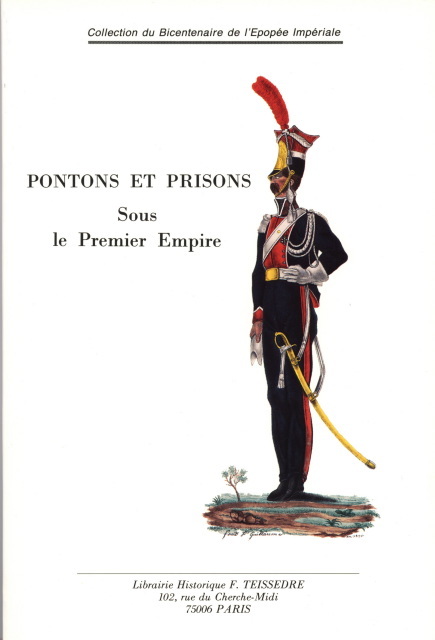
Pontons et prisons sous le Premier Empire.
8995Paris, Librairie Historique F. Teissèdre, 1998 16 x 24 cm, 142 pp., broché.
Librairie Historique Fabrice Teissèdre · Sauve, France27,00 €
1 123 résultats
1776GITh281A Grenoble chez la Veuve Faure et Fils 1776. In-12 24pp. Dérelié, brochage solide, tache brune en tête sans gêne pour la lecture, complet, bon état malgré le défaut signalé.
1776GITh282A Grenoble chez la Veuve Faure et Fils 1776. In-12 15pp dont le titre. Dérelié, brochage solide, petite tache brune en tête sans gêne pour la lecture, complet, bon état malgré le défaut signalé.
2005116380Geste éditions 2005 In-8 oblong relié 22,7 cm sur 19,8. 135 pages. Bon état d’occasion.
8995Paris, Librairie Historique F. Teissèdre, 1998 16 x 24 cm, 142 pp., broché.
1951GITh338Ensemble de 251 numéros de cette célèbre revue de faits divers, format in folio (30cm sur 41cm). *1951 numéros 264 à 287, du 23 juillet au 31 décembre, 20 numéros (sans les numéros 265, 270, 284 et 285). *1952 numéros 288 à 326, du 7 janvier au 29 septembre, 32 numéros (sans les numéros 294, 299, 308, 309, 310 et 312). *1953 numéros 353 à 374, du 6 avril au 28 décembre, 30 numéros (sans les numéros 355, 366, 367, 368, 376, 386, 387 et 390). *1954 numéros 392 à 443, du 4 janvier au 27 décembre, 43 numéros (sans les numéros 397, 399, 409, 413, 418, 435, 437, 438, et 439). *1955 numéros 445 à 495 du 10 janvier au 26 décembre, 40 numéros (sans les numéros 452, 453, 455, 457, 465, 469, 478, 481, 482 483 et 487). *1956 numéros 496 à 548 du 2 janvier au 31 décembre, 32 numéros (sans les numéros 499, 500, 502, 503, 505, 507, 508, 510, 511, 516, 517, 521, 522, 523, 525, 529, 532, 536, 537, 545 et 547). * 1957 numéros 552 à 600 du 28 janvier au 30 décembre, 32 numéros (sans les numéros 558, 560, 563, 564, 571, 573, 574, 577, 580, 584, 586, 587, 590, 594, 595, 596 et 599). * 1958-1959 numéros 601 à 657 du 6 janvier 1958 au 30 janvier 1959, 23 numéros (sans les numéros 602, 605, 607, 608 à 612, 614 à 629, 631, 632, 634, 643, 644, 646, 647, 652 à 656. Abondante illustration d'après des photographies. Quelques numéros présentent une usure des dos, des coupures ou des petits manques sans gravité, le plus grand nombre est frais et en bon état. Ensemble de 9 années incomplètes mais chaque numéro est bien complet et représente un aperçu intéressant des fais divers de cette époque, servi par une bonne iconographie, dans la tradition de cette revue créée en 1928 par Gaston Gallimard et qui continue à paraître de nos jours.
189725330Paris Librairie Marchal et Billiard 1897 In-8 ( 8 Fascicules ) 1476 pp, la criminalité en Italie - le Reformatory de Concord, le sauvetage de l"enfance catholique aux Etats-Unis - l'éducation correctionnelle en Angleterre - enquête sur les aliénés criminels - la population des prisons Italiennes - la criminalité juvénile en France et en Angleterre Le patronage des libérés en Angleterre Année Complète pagination continue
2332Paris, Libr. Marchal et Billard, 1900/1901 - 2 t. in-4: 1572/1660 pp. - en 2 vol. demis-bas. rouge, dos à faux-nerfs, plats pap. marbré (menus défauts; couv. cons.)
1990118005Créaphis 1990 In-8 broché. 327 pages. Bon état d’occasion.
2210Revue trimestrielle, Strasbourg 1989, 18x22 cm, 127 pages, illustrations en noir et blanc et couleurs.
1886275Paris, Imprimerie Gauthier-Villars, 1886. In-8 de 71 pp., couverture imprimée.
207723Paris, Michel, s. d. (1794-1795) 2 vol. in-16, 198 pp.. et 179 pp., frontispice à chaque volume bradel demi-maroquin poli bordeaux (reliure fin XIXe). Petites usures des coiffes. Ex-libris.
3714Genève beroud et susanne guers, paris librairie protgestante 1850 - In 8 demi reliure dos lisse titre dans un fleuron central romantique, 637 pages - édition originale française
7141Paris, Emile Dentu éditeur, sans date ( 1864 ). In-8 relié de 151 pages au format 15 x 19,5 cm. A noter que la dernière page est chiffrée par erreur 153. Magnifique reliure plein chagrin bordeaux. Dos rond à 5 nerfs avec titre doré. Pages de gardes en papier marbré, entourées d'une superbe frise doré. Tête dorée. Couvertures non conservées. Tirage sur couché, avec infimes et rares rousseurs. L' " Hôtel Darricaud ", populairement rebaptisé " Hôtel des Haricots ", était la prison où l'on envoyait les militaires insoumis, désobéissants, intempérants ou déficients dans leur service. L'auteur s'est intéressé aux traces laissées sur les murs de cette prison par ses pensionnaires, notemment ceux des cellules n° 7, 8 et 14, dites " Cellules des Artistes ", rédigeant ainsi un des premiers ouvrages abordant d'un point de vue artistique les productions graphiques carcérales. Albert de Lassale avec l'aide de 70 dessins d'Edmond Morin, s'est appliqué à reproduire croquis, vers et notes avec toute la fidélité possible. Chaque dessin a été augmenté d'un commentaire. Les légendes authentiques, celles données par les auteurs mêmes, ont été reproduites entre guillemets. Les signatures reproduites sont celles trouvées et déchiffrées sur les murs, les autres sont anonymes. Mention de quatrième édition. Rare tirage en superbe état général.
194395821943 Melun, Imprimerie administrative, 1943 ; brochure in-8°, couverture cartonnée rose pale imprimée en noir, dos de toile bleu foncé muette; 36pp.
188232544Richmond VA: W. A. Mountcastle 1882. Lithograph. Ca. 9" X 8". Very good. Well-known lithograph of the notorious Confederate prison in Richmond second in infamy only to Georgia's Andersonville Prison. A clean and handsome example of this famous image of this prison with six large tents in the middle ground. One soldier stands sentry in the foreground another stands with arm in a sling and a handful of others military and civilian mill about near the tents and along the large brick structure; interestingly three male civilians stand as a group in the foreground one of them clutching the hand of a young girl clearly posing for the photograph upon which this lithograph has been based. A front corner of the building still retains its original large "Libby & Son / Ship Chandlers & Grocers" sign. An attractive and highly detailed image. Housed in a modern ca. 1970s single cream matte and a simple ½" wooden frame with non-glare glass overall dimensions 12" X 11½". A simple but suitable presentation. W. A. Mountcastle unknown
1951LFA-126728494Une plaquette de 20 pages, format 135 x 210 mm, illustrée, brochée, publiée en 1951, Impr. Nouvelle de Marseille, bon état
1782110421782 A Hambourg, 1782; 2 parties en 1 volume in-8°, pleine basane époque, dos à nerfs orné de petits fers dorés, titre doré sur étiquette de maroquin vieux - rouge, tranches mouchetées de rouge; (XIV - (II) - 366pp. -(1)f.; 237pp. Edition originale.
193176467Moundsville: Work & Hope 1931. First edition for this year OCLC records no holding for this year but does for 1927 4 1930 3 1932 3 1935 2 1937 1. Octavo. 48 pp. Extensively illustrated from photographs. Publisher's teal wrappers with red lettering and a large decorated border. Some finger soiling to rear wrapper else a very good copy.The publishers Work & Hope and printers and writers were all inmates of the Moundsville Penitentiary in West Virginia. Likely they worked in the hope of getting released as for a time the Moundsville Penitentiary ranked on the United States Department of Justice's Top Ten Most Violent Correctional Facilities list. The photographs herein present a different story of course. We see a beautiful chapel clean and tidy cells and prisoners at work in the shirt shop the broom shop and the whip shop. There are also photographs of the gothic prison itself. When it was built it was outside the town but by the time of closing it was right in the middle of a residential zone One of the countries most famous pre-historic mounds lent its name to the town.'The West Virginia Penitentiary in Moundsville was built in 1876 and closed in 1995. During its working history it was deemed as one of the most violent prisons in the U.S.A. seeing its fair share of riots murders and executions. Conditions were less than adequate and humane with the cells and rooms crawling with vermin and cockroaches.During its operation there were 36 reported murders and 94 executions. This does not take into account the suicides and accidents which take the total number of deaths to nearly 1000" A. Oborn 2019 Work & Hope unknown
183339519Paris: Au Dépôt de Lois Chez Gustave Pissin Imprimerie de P. Dupont et Laguionie 1833. Pp. 1-32 49-128 lacking part of "Nouvelle lois actes rendues en Angleterre" and much of Victor Foucher's "Code pénal de la république de Bolivia". 1 vols. 8vo. Disbound accompanied by upper cover some light spotting inked underlining of a few pages else very good. Pp. 1-32 49-128 lacking part of "Nouvelle lois actes rendues en Angleterre" and much of Victor Foucher's "Code pénal de la république de Bolivia". 1 vols. 8vo. Intended to provide the readers with recent changes or papers in the international legal and economic fields. Includes Mittermaier's paper on the British Penal System "Renseignemens nouveaux et récens sur l'efficacité du systeme pénal des Anglais et spécialement de la transportation" pp. 7-24 a section on "Nouvelle Publications" the "Chronique" M. Pinnheiro-Ferreira former minister of Portugal's "Observations sur la loi belge du 1er Octobre 1833 concernant l'extridition des réfugiés" pp. 65-80 an extract of the article by M. Wagener on "De l'Administration de la Justice criminelle en Autriche" pp. 113-122. Au Dépôt de Lois, Chez Gustave Pissin [Imprimerie de P. Dupont et Laguionie unknown
a26244Dec 29 1939. 4to. 87pp. charts blue stapled wraps. Mimeographed typescript. Good backstrip reinforced tips of a few pages chipped off no loss of text at all. . paperback
a26243May 14 1937. 4to. 69 leaves mimeo on rectos charts blue stapled wraps. Good several corners bumped. . paperback
191273780Jeffersonville IN: Reformatory Press 1912. First edition. Octavo. 8 ll. printed on rectos only and bound at the top. Publisher's string-tied brown wrappers with printed paper title label on front. Excellent.This pamphlet lauds the fact that one of the very first psychological laboratories in the country was opening at the Reformatory at Jeffersonville preceded by New York and Boston. This was a huge step forward in penal reform and reflects the growing importance of psychology in preparing inmates for the outside world. "The new laboratory was endorsed by academics and reformers across the country including sociologist Hasting Hart of the Russell Sage Foundation Charles Henderson from the University of Chicago Zebulon Brockway and Maude Ballington Booth. Warden Peyton explained how the lab would disseminate knowledge and significantly advance prison reform. He also emphasized that both heredity and environment played a role in crime. Interestingly Governor Thomas Marshall rejected this view because he said it would be necessary to reject the religious doctrine of original sin" P. R. Clark; Barred Progress 2008. Earlier it was commonly believed that the best course of action for the health of society was to sterilize the insane and "feeble-minded" inmates. But Dr. Petyton was of the new school of though and pushed for psychological reform rather than physical. "Fortunately for inmates the big push for sterilization fizzled and was replaced by a more sophisticated and nuanced approach to crime and the treatment of criminals. In the summer of 1912 prison officials and the scientific community collaborated to create a department of research at the Indiana Reformatory. The psychology laboratory paralleled the commencement of the research department but other sub-departments soon followed including those dedicated to medical and sociological research. The research department took individual testing classification and treatment to a new level. Using relatively new techniques such as the Binet-Simon IQ test researchers tested inmates for perception association memory reason orientation fatigue mental activity motor control moral appreciation the ability to profit by experience attention the ability to carry on a conversation and the ability to plan. Researchers further classified the inmates by the kinds of criminal activity in which they participated. These categories included habitual criminal born criminal criminal through passion criminal by chance accidental" Ibid. The Laboratory seemed to have functioned as both a guidance counselor and a low-skill trade school. David Peyton was a doctor prison warden and a champion of prison reform and published Psychology and Crime 1915; Principles of Prison Reform 1915; The Differential Diagnosis of Crime 1912; Crime as an Expression of Feeble-Mindedness 1913 and many others. He once risked his entire career when he decided to allow the inmates at the Reformatory to fight a local fire.OCLC only locates 2 copies and incorrectly gives the page count as 12. {Reformatory Press] unknown
18474980Troy: Published and Sold by L. Willard 1847. First Edition. 1 - 44 pp. 1 vols. 8vo. Original printed wrappers uncut and unopened; some chipping at margins sporadic foxing. First Edition. 1 - 44 pp. 1 vols. 8vo. Contains: The Condemned: A Chapter from Our City Prison: A Tale of Truth and Horror. Wright I 2444 Published and Sold by L. Willard unknown
5428Aix, David, 1745. Placard de 40 x 53 cm sur vergé.
47453Sans lieu l'An III de la République Française 1795 in 8 (21,5x13,5) 1 fascicule broché, sous couverture ancienne, étiquette de titre manuscrite au dos, XXIV et 186 pages, non rogné, petites taches marginales et et petite trace de moillure angulaire claire sur les 8 premiers feuillets. Honoré Riouffe, 1764-1813. Maximilien de Robespierre, Arras 1758 - paris 1794, avocat et homme politique français. Seconde édition, revue et augmentée. Bon exemplaire