80 résultats
189635124London: Ward & Downey Limited 1896. First edition. 1 vols. 8vo. Original black pictorial cloth stamped in red and gilt. Fine. First edition. 1 vols. 8vo. Presents accounts of thirty famous crimes and criminals in 19th-century Britain including the Tichborne claimant Charles Peace John Bellingham James Cook Henry Blackburn John Holloway and others. Ward & Downey Limited unknown
18421319981Paris, Pourrat frères, 1842. Gr.-8vo. Zus. über 1300 S. Mit 16 Tafeln in Stahlstich u. 4 Titelvignetten in Holzstich. Hldrbde d. Zeit mit Rückenvergoldung (berieben, Innengelenke gelockert, Vorsätze fleckig, Bd 1/2 durchgehend mit Nässerand, etwas braunfleckig, Stempel auf Titel).
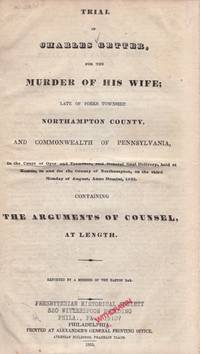
183335550Philadelphia: Printed at Alexander's General Printing Office 1833. First Edition. Hardcover. Good. Octavo. Hardcover. Ex-institutional copy. 72 pages. Original wraps without the outer covers bound in black cloth covered boards with copy of the title pasted down on the front cover. Gilt lettered title on the spine. New tan end sheets front and back. Page 1 is the title page and has two stamps at the bottom: Presbyterian Historical Society Philadelphia and a red withdrawn stamp. Print is small and contents are clean. <br /> <br /> McDade 335 - "Getter convicted of fornication and bastardy was given the option of marrying the girl he had wronged; six weeks later saddled with a wife he did not want he choked her to death.â€. From wikipedia:<br /> <br /> Getter's Island previously known as Abel's Island is a small island in the Delaware River in Easton Pennsylvania in the United States. It is best known as the location of the execution of Charles Getter the last person to be publicly executed in Pennsylvania. History edit Execution of Charles Getter edit The island is named after Charles Getter a farm hand who was hanged on the island in 1833 for the murder of Margaret Lawall a woman he married to avoid prosecution for impregnating her outside of wedlock. Getter's execution was initially scheduled to take place at Center Square in Easton but it was moved to the island - then known as Abel's Island - to accommodate the crowds.<br /> An estimated 15000 to 20000 people some of whom traveled hundreds of miles gathered in the town to view the execution. 12 An initial attempt to hang him failed forcing a second attempt which resulted in his death. A reporter who witnessed the scene was horrified at how little the crowd was affected by the execution and called on lawmakers to take action. 2 Governor George Wolf agreed with the reporter and signed a law banning public execution on April 10 1834. As a result Getter was the last person in Pennsylvania to be publicly executed. 2. Printed at Alexander's General Printing Office hardcover
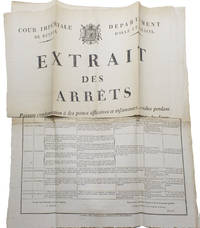
181330782Rennes: Chez Cousin-Danelle Imprimeur de la Cour Impériale 1813. l sheet consisting of three leaves. 1 vols. FOLIO 20 x 46 inches. Broadside. Some marginal discoloration and creasing else very good. l sheet consisting of three leaves. 1 vols. FOLIO 20 x 46 inches. Lists the date of arrest the court identifies the criminal with age profession address a physical description crime and punishment citing the applicable laws next to them. Chez Cousin-Danelle, Imprimeur de la Cour Impériale unknown
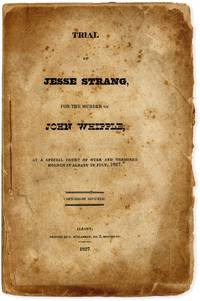
182787802Albany: D. M'Glashan 1827. First and Only Edition. Octavo in 4's. 24cm. Stab bound pages with the title page serving as the front cover and no trace that the pamphlet was ever bound. 35pp. Some mild chipping to edges and extremities most notably the upper right corner toning and soiling to wraps; internally clean but uniformly toned with offsetting from the type throughout edges untrimmed luxuriously wide margins some traces of careless opening in places. Very good by dint of survival and solidity rather than beauty the paper is cheap and the pamphlet was printed to leverage opportunity rather than posterity.<br /> <br /> A notable and at the time highly controversial trial dealing with what was later referred to as "The Murder at Cherry Hill." The prominent New York Van Rensselaer family owned and lived at Cherry Hill Farm in Albany the daughter Elsie was married somewhat unhappily to John Whipple and fell for a younger man she met in a bar by the name of Jesse Strang. The couple fell in love Elsie expressed her deep unhappiness with Whipple; Strang masquerading under the name of Jesse Orton took on a job at the farm and began an affair with Elsie which was maintained by the house staff many of whom were enslaved people of color whose testimonies were heard at the trial passing notes between the two. Elsie chafing somewhat at having to endure her legal husband resolved that he must die to make way for Strang and they would run away together to Canada. <br /> <br /> The first plan was arsenic poisoning which failed. What Elsie lacked in poisoning ability she made up for with murderous intent and she purchased a rifle removed the ammunition from her now somewhat suspicious husband's gun and induced Strang who does not come across as the sharpest tool in the shed to shoot Whipple dead. Strang then attempted to fabricate an alibi which did not hold up and he was arrested. What followed was a widely publicised trial in which both defendants turned on each other Elsie's status as the daughter of prominent landowners was leveraged as protection from any serious punishment and Strang bore the brunt of the law. He had of course further doomed himself by attempting to plant evidence lying under several oaths and generally being one of the less gifted murderers of the early 19th century; he was hanged Elsie went home to Cherry Hill the Van Rensselaer's invested heavily in local collective amnesia and the rest of the US stared somewhat incredulously and gossiped over their breakfast grits. <br /> It was a carnival of awfulness that posed many questions about the societal rights and freedoms of women the privileges of wealth and the integrity of the judicial system. Fairly represented in institutions with 20 examples in US libraries but scarce in commerce and usually in later binding. D. M'Glashan unknown
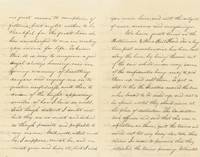
1857List2022Washington 1857. Autograph letter measuring 8 x 5 inches bifolium with free franked stampless cover. Fine condition. Fine. An interesting letter written by James W. Denver written while he was serving as Commissioner of Indian Affairs describing crime on the Baltimore and Ohio Railroad in 1857. He writes:<br /> “We have great times on the Baltimore & Ohio Railroad. For a long time past merchandise has been lost along the line by being thrown out of the cars while under way some of the confederates being ready to pitch them up and sell them. To put a stop to this the Directors ordered the cars when loaded to be sealed up and not to be opened until they should arrive at the place of destination. The conductors took offense and said that this was a reflection on them quit the trains and would not let anybody else take their places. In order to prevent this they attacked the trains passing Ellicott’s Mills and succeeded in turning back all but one. Today it was rumored that the Plug Uglies had possession of the track between Baltimore and the Relay House but this is hardly so as a train has I am told arrived here this evening. This is a very extraordinary affair as it is in fact an effort to give greater license to stealing and from the way they have acted there is not much doubt but the conductors were engaged in the plundering.â€<br /> The Plug Uglies first operated in Baltimore beginning in 1854. Several iterations of the Nativist gang eventually formed all of which were referred to by the same name. They would be involved a month later in the Know Nothing Riot in Washington D.C. in June of 1857 the same month that Denver would gain his appointment as Secretary of Kansas Territory. <br /> <br /> <br /> Full text follows:<br /> <br /> My Dear Wife<br /> The cheerful tone of your letter of the 28th ult. pleases me very much. I hope and trust that will be ever thus. A light heart and cheerful disposition makes life a perennial springtime. There is nothing like it. Keep up your sprits ever thus and besides being the pride of my life you will be my light also—the polar star of my existence.<br /> <br /> O Lou! how lonely I feel here at times without you! Were we only together how much more pleasantly would the time pass away. Still I have no great reason to complain of fortune but ought rather to be thankful for the great boon she has vouchsafed to me in making you mine for life. To know this it is easy to imagine a good angel always hovering near me giving warning of besetting dangers and urging me on to greater usefulness and then to dream of the bright approving smiles of her I love so well. And though distant I doubt not but they are as sweet and as kind as though present and palpable to my vision. Well well what must be I suppose must be and we must grin and bear it; but I wish you were here and not the subject of mere dreams and imaginings.<br /> <br /> We have great times on the Baltimore & Ohio Railroad. For a long time past merchandise has been lost along the line by being thrown out of the cars while under way some of the confederates being ready to pitch them up and sell them. To put a stop to this the Directors ordered the cars when loaded to be sealed up and not to be opened until they should arrive at the place of destination. The conductors took offense and said that this was a reflection on them quit the trains and would not let anybody else take their places. In order to prevent this they attacked the trains passing Ellicott’s Mills and succeeded in turning back all but one. Today it was rumored that the Plug Uglies had possession of the track between Baltimore and the Relay House but this is hardly so as a train has I am told arrived here this evening. This is a very extraordinary affair as it is in fact an effort to give greater license to stealing and from the way they have acted there is not much doubt but the conductors were engaged in the plundering.<br /> <br /> Judge Stephen A. Douglass intends leaving <br /> here with his family tomorrow. Nat Cartmell was here on Friday. He said they were all well in Virginia except cousin John Lupton who was convalescing. Tell your father I will keep him posted and tell your mother to keep you at work—if she can. My love to all. Goodnight. God bless you my own dear Lou. Adieu. — Will. unknown
18161192942Heidelberg, J. Engelmann, 1816. Lithograph. Porträt-Tafel, 2 Bl., 254 S. Interims-Broschur d. Zeit (unbeschnitten, mit kl. Randeinrissen, gelegentlich etwas braunfl.).
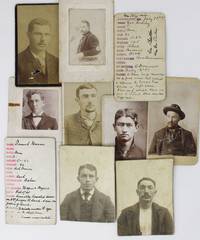
18995150Kansas City Mo 1899. Very good. Ten carte-de-visite photographs 4 x 2.5 inches or slightly smaller on thick cardboard mounts four with partially-printed "rap sheets" on verso completed in manuscript. Occasional edge and surface wear as well as generally light dust-soiling. A nice group. A group of ten fabulous mugshot photographs or studio portraits featuring criminals in the last few years of the 1800s in Kansas City Missouri. Four of the photographs are particularly interesting for the personal and criminal history information recorded on their versos. These photographs are pre-printed with a list of fields to be filled out by the criminal or perhaps the jailer. The combination of fields varies slightly on three of the four cards but generally they all ask for similar information including name; aliases nationality age height weight eye color hair color complexion occupation or "Criminal Occupation" the pertinent crime place of arrest arresting officer date date of arrest and distinguishing marks or "Peculiarities of Build Features Scars Marks etc.". <br /> <br /> One of the mugshots is that of James Carrington Francis 1869-1892. At the bottom of his card is written: "Killed at Pleasanton KS for Pacific Ex Robbery Jan. 23 '92." Francis had indeed taken part in the robbery of the Frisco Express out of St. Louis on the night of November 30 1891. During the robbery two masked men boarded that train as it was leaving St. Louis. They remained in seclusion until they had traveled a few miles and then presented pistols to the heads of the engineer and fireman. They ordered them to stop at the point where two accomplices of the highwaymen were stationed. The engineer and fireman were then ordered from the cab and kept covered while the party proceeded to the express car where the robbers demanded admission but were refused by the messenger. The robbers then set off a stick of dynamite and blew in the side of the car seriously injuring the messenger. They then entered blew open the safe and after taking $10000 made their escape. The Pinkerton Detective Agency and Chief of Detectives Desmond of St. Louis investigated the case and gathered evidence which convinced them that the robbers were Marion Hedgepeth Dink Wilson Adelbert Slye and James Francis.<br /> <br /> The other three men whose photographs are supplemented with personal information include Frank Norris Patrick Raine and George Conley. Oddly enough the crimes of all four men are not stipulated on the present photographs. Norris was a baker by trade with a scar on the palm of his hand and a "knuckle knocked down" who was arrested on October 5 1895. Patrick Raine was a waiter with a forearm tattoo and "2 vax scars on left arm" arrested on January 24 1899. George Conley alias George Baker or George King was a brakeman arrested on July 12 1897. The remaining photographs do not include identifying information save for two with penciled names on the verso and one with a studio stamp from J.V. Dabbs in Fort Scott Kansas but were found with the previous four photographs and would likely reward further research into the Wild West criminal world of late-19th century Kansas. unknown
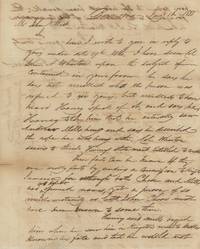
1838List2426Republic of Texas 1838. Stampless letter folded with red two-line handstamp of Steam Packet Columbia on January 16 1838 from Brazoria Tex. to New Orleans. Fine condition. Fine. An intriguing letter written by Edmund Andrews a judge in Brazoria Texas who had arrived in Stephen Austin’s colony eight years before he penned this in 1830. The letter is written to John K. West the New Orleans attorney who was an original member of the notorious “New Orleans Associates.†Andrews discusses a conversation he had on behalf of West with John Austin Wharton who would die later in 1838 relating that Andrews had a conversation with Wharton on West’s behalf. The conversation with Wharton revolved around a man with the last name Chase and Andrew Mills who had both left Texas presumably and traveled to Kingston Jamaica where Mills was hanged for an undisclosed crime. Andrews writes that Wharton related that that Mills told him he “would not have done it if he had not been drunk†presumably talking about the crime for which he was hanged. Overall a very intriguing letter relating to crime exile and misdeeds in the Republic of Texas which should be of interest to scholars of the Republic. <br /> <br /> Full text follows:<br /> <br /> Brazoria Jan'y 16 1838<br /> <br /> Mr. John K. West<br /> Sir <br /> <br /> Since I wrote to you in reply to yours under date 19th ulto. I have seen Col. John A. Wharton upon the subject contained in your favor. He says he does not recollect who the person was referred to in yours but recollects to have heard Haney speak of it and says he Haney told him that he actually saw Andrew Mills hung and says he described the rope he was hung with. Col. Wharton seems to think Haney's statement entitled to credit. <br /> <br /> These facts can be known if they are really facts by sending a commission to Kingston Jamaica for although both Chase and Mills had no doubt assumed names yet a person of so much notoriety as Capt. John Chase must have been known to some there.<br /> <br /> Haney said Mills begged him when he saw him in Kingston never to make known his fate and that he would not have done it if he had not been drunk. The foregoing is the substance of the conversation held with Col. J. A. Wharton. <br /> <br /> I am yours truly <br /> Edmund Andrews. unknown