CRIMEBiblio.com
152 résultats
1886140042London: Irwin Langley & Co. 1886. Advice to Strangers" - avoiding the criminal pitfalls of 1880s London First and only edition of this extraordinary little volume offering practical advice against the thieves and tricksters plaguing the streets of London. The first half of the text is a spotter's guide on pickpockets "Who they are and what they are like" with explanations of their methods the distraction of the "stall" the techniques of the "wire" given in sufficient detail and with such specifics as to suggest that the author genuinely was of the profession claimed. The second section offers "Advice for Strangers" to the metropolis illuminating the operations of the "Mysterious Dental Rooms" "swell assignations houses" that thrive on the "carnal weaknesses of casual visitors to the city"; forwards an explanation for "the mysterious disappearances which are almost daily reported" the lure of "a pretty face snapping black eyesand red lips" drinks in a café ending with a "bloated disfigured swollen corpse" pulled from the river; and looks into the "women and young girls who have a great mania for disappearing". A respectable and highly cultivated young girl in Liverpool taking "short cut through a disreputable part of town" reappears in London the story never made public but understood to be "horrible in the extreme". The final sections comprise a short piece on "the Dark Ways of Street-sharpers" and a lengthier description of a rather complicated American scam to illustrate "High Class and Ingenious Roguery on a Grand Style" followed by a brief explanation of cipher writing and reading which concludes with a "Prize Competition £1000 in Prizes" requiring the solution of three ciphered messages. Noting well what has gone before this has more than a hint of "roguery" to it but where the catch might have been is beyond our wit to discover. We have been unable to trace any other publications or enterprises put out over the name of Irwin Langley & Co. Scarce just two locations world-wide BL and Harvard Medical School. Octavo 180 x 120 mm. Portrait frontispiece 6 stock portraits in text one full-page illustrations in text printed in menacing sanguine throughout. Wire-stitched in original green cloth-backed sanguine printed boards. A little rubbed and soiled head and tail of spine chipped hinges with some give to them but sound staples rusted but intact text block lightly browned overall very good. hardcover
1840WRCAM53792Sydney: W.A. Duncan Australasian Chronicle Office 1840. 52pp. Dbd. Minor toning some loose leaves. Good. A rare trial account of a peculiar though perhaps an oddly-justified assault in Australia in 1840. "James Mudie had in his book THE FELONRY OF NEW SOUTH WALES reflected upon the capacity of Kinchela's father in his office as judge. The younger Kinchela waited for Mudie who had recently returned to the colony and administered many lashes one witness said 50 with a horsewhip. The defence was that Mudie well deserved what he got as a common libeller and that Judge Kinchela was now aged and unable to take his own part. The jury returned a verdict for the plaintiff in the sum of £50 - one pound for each stroke" - Ferguson. Some might call the horsewhipping a simple case of frontier justice. <br> <br> Together Ferguson and OCLC locate only five copies all in Australia. FERGUSON 3104. OCLC 220294602. W.A. Duncan, Australasian Chronicle Office unknown books
1896STLL0129Hamburg, Verlagsanst. u. Druckerei A.-G. 1890-1896. Gr.-8°, XXXI(1) S. (Tit., Einführ. u. Vorw. d. Verf.), 545(1) S., IV (Tit. u. Vorw. d. Übers.), 412 S. mit 1 Tafelbild u. Tit. II S. (Vorw. d. Verf.), 29(1) S., 64 meist gefaltete Tafeln mit z. Tl. photogr. Abb. Mit etlichen Tabellen u. einigen wenigen Fig. im Text. HLdrBde. d. Zt. auf vier falschen Bünden m. Tit. u. reichen Verz. in Goldpräg. auf Rü., marmor. Buchschnitt u. gemusterten Vorsätzen. Kanten u. Kapitale berieben. Stempel auf Tit. unschön m. Exlibris überklebt. Im Text etwas gebräunt u. stellenw. stockfleckig. Mischauflage der ersten und zweiten Auflage dieser ersten deutschen Ausgabe, übersetzt nach der 1876 veröffentlichten Originalausgabe ("L'uomo delinquente in rapporto all'Anthropologia, alla Giurisprudenza ed alle discipline carcerarie"). Der italienische Mediziner und Anthropologe Cesare Lombroso (1836-1909) war Militärarzt in Pavia, leitete fünf Jahre die Nervenanstalt von Pesaro, lehrte später in Turin gerichtliche Medizin, Hygiene sowie Psychiatrie und gilt als Begründer der Kriminologie. Er vertrat die These, es gebe geborene Verbrecher, die durch körperliche und psychische Merkmale zu erkennen seien. Abstehende Ohren, zusammengewachsene Augenbrauen, schmale Lippen und hervorstehende Eckzähne waren für ihn u. a. Erkennungszeichen krimineller Neigungen. Europaweit lieferten Lombrosos umstrittene Theorien den Anstoß für wissenschaftliche Debatten über die Ursachen des Verbrechens. (vlg. dazu Brockhaus, 19. Aufl. XIII, 509).
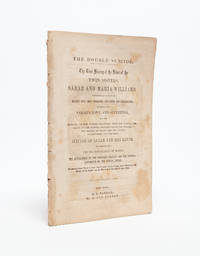
18555437New York: H.H. Randall 1855. First edition. Printed self wraps stitched at spine. Measuring 220 x 140mm and complete in 64 pages. Some rubbing along spine and scattered foxing to preliminary and terminal leaves; toned throughout else clean. A scarce piece sensationalizing the tragic affairs and subsequent suicides of Sarah and Maria Williams OCLC reports fewer than twenty copies with libraries with this being the only example on the market.<br /> <br /> We've been unable to determine whether the tragic story of the Williams twins is in fact historically true. What is clear whether the narrative is fiction or non-fiction is that the damage caused to women and their lives as a result of their social positions and sex had a wide audience and attracted a variety of readers -- some who hoped to judge the parties involved some who sought the experience of empathy and catharsis some with prurient fantasies and some who simply wanted a thrill. According to this story Sarah and Maria Williams were firstborn daughters to a loving and prosperous middle-class New York family and that like any "perfect victims" they combined "sincerity kindness and judgement" with "the bloom of loveliness grace and innocence." Chaste and well behaved in their boarding-school days their lives took a turn at twenty. During their father's extended absence on business Maria began receiving visits from Mr. Knight an insidious but well-recommended brother of an old schoolmate. Seduced by him into a fraudulent marriage Maria is ultimately separated from her family and forced into sex work for his profit.<br /> <br /> Rising eventually to "a high position among those of her kind.as a prostitute of superior grade" Maria operated on her own and refused to return to the Williams household despite Sarah's urgining; being degraded by her old neighbors and parents when she could be respected by her own was too much to bear. Sarah's insistence on maintaining a relationship with her twin and visiting her disreputable home led to her own reputation being cast into doubt. And when Sarah's intended eventually fell for engaged in keeping and ultimately got pregnant Maria all participants in the affair ended their own lives. <br /> <br /> In many ways the sensationalized stories of these twins reveal how no woman is safe and how no woman can rely on her chastity to protect her socially. Though Maria and Sarah were identical and took opposite paths their violent ends wind up being identical and equally scandalous. H.H. Randall unknown
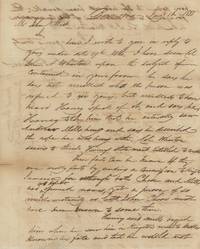
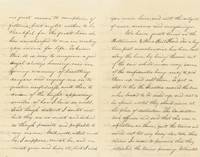
1838List2426Republic of Texas 1838. Stampless letter folded with red two-line handstamp of Steam Packet Columbia on January 16 1838 from Brazoria Tex. to New Orleans. Fine condition. Fine. An intriguing letter written by Edmund Andrews a judge in Brazoria Texas who had arrived in Stephen Austin’s colony eight years before he penned this in 1830. The letter is written to John K. West the New Orleans attorney who was an original member of the notorious “New Orleans Associates.†Andrews discusses a conversation he had on behalf of West with John Austin Wharton who would die later in 1838 relating that Andrews had a conversation with Wharton on West’s behalf. The conversation with Wharton revolved around a man with the last name Chase and Andrew Mills who had both left Texas presumably and traveled to Kingston Jamaica where Mills was hanged for an undisclosed crime. Andrews writes that Wharton related that that Mills told him he “would not have done it if he had not been drunk†presumably talking about the crime for which he was hanged. Overall a very intriguing letter relating to crime exile and misdeeds in the Republic of Texas which should be of interest to scholars of the Republic. <br /> <br /> Full text follows:<br /> <br /> Brazoria Jan'y 16 1838<br /> <br /> Mr. John K. West<br /> Sir <br /> <br /> Since I wrote to you in reply to yours under date 19th ulto. I have seen Col. John A. Wharton upon the subject contained in your favor. He says he does not recollect who the person was referred to in yours but recollects to have heard Haney speak of it and says he Haney told him that he actually saw Andrew Mills hung and says he described the rope he was hung with. Col. Wharton seems to think Haney's statement entitled to credit. <br /> <br /> These facts can be known if they are really facts by sending a commission to Kingston Jamaica for although both Chase and Mills had no doubt assumed names yet a person of so much notoriety as Capt. John Chase must have been known to some there.<br /> <br /> Haney said Mills begged him when he saw him in Kingston never to make known his fate and that he would not have done it if he had not been drunk. The foregoing is the substance of the conversation held with Col. J. A. Wharton. <br /> <br /> I am yours truly <br /> Edmund Andrews. unknown
1808WRCAM53841New York 1808. 56pp. Dbd. Faint institutional ink stamp and embossed blindstamp to titlepage minor toning light foxing. Overall very good. A curious and rare account of the trial of Alexander Whistelo a black man accused of leaving Lucy Williams a mulatto with child. A controversy ensued as sundry doctors stated that the child was the offspring of white parents. In addition a witness attested to a white man visiting Ms. Williams: "The witness.confessed that such a person had been in bed with her: that he had turned the black man out with a pistol and taken his place - that they had a connexion; but she said she was sure they had made no one young one." In the end Whistelo was acquitted. SABIN 103312. SHAW & SHOEMAKER 14750. unknown books
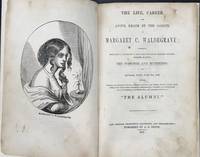
185257744New Orleans Charleston Baltimore and Philadelphia: A.R. Orton 1852. the original wrapper was dated 1853 apparently accounting for that date being used in each of the three OCLC listings. First edition of this rather primitively printed pamphlet. 8vo. 2 11-36 pp. Portrait frontispiece three wood-engraved plates. OCLC: "Sensational and presumably fictitious account of the criminal career of Margaret C. Waldegrave probably written by the publishers" the author of several similar lurid tales in the early 1850s. Contemporary pencil inscription on verso of frontispiece "Allow one vol. / plain binding / leather back." Not in Wright "American Fiction" McDade "Annals of Murder" or Jumonville "New Orleans Imprints." OCLC locates four copies American Antiquarian Soc. New York Historical Soc. Juniata British Library; AAS also holds a prospectus broadside for the work. Some interior foxing and soiling corner of one leaf renewed not affecting text. Recent plain gray wrappers. #4698. <br/><br/> A.R. Orton hardcover books
185946765New-York: George W. Matsell & Co 1859. First Edition. Small 12mo 12.5cm.; publisher's blue pebble-grained blind-embossed cloth gilt-lettered spine dark brown glazed endpapers; vi7-1301adpp. Boards gently scuffed corners bumped else a Very Good quite brilliant copy. Early American slang dictionary by a commissioner of the New York City police force about two-thirds of the work plagiarized from English sources though the author here claims that "Occupying the position of a Special Justice and Chief of the Police of the great Metropolis of New-York where thieves and others of a like character from all parts of the world congregate and realizing the necessity of possessing a positive knowledge of every thing connected with the class of individuals with whom it was my duty to deal I was naturally led to study their peculiar language" p. iv. The work appears to be aimed at readers of Matsell's newspaper the "National Police Gazette" advertized on the last leaf of text. A random dip into the early leaves reveals such unknown slang words as "Ard" hot though the OED only defines this as an obsolete form of "Hard." More recognizable listings appear under "Cow" a dilapidated prostitute while her "grease" is butter her "juice" is milk and "Cows and Kisses" applies to the ladies. George W. Matsell & Co unknown books
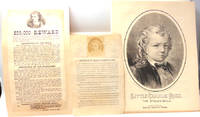
1874313368Philadelphia 1874. Together 4 items. Together 4 items. The Kidnapping of Little Charley Ross. Four items relating to the abduction of Charley Brewster Ross the first instance of kidnapping for ransom in the United States. On July 1 1874 four-year-old Charley was abducted from the sidewalk in front of his father's house in Germantown Pennsylvania by two men in a buggy offering the promise of candy and fireworks. Soon after Charlie's father received a note demanding $20000 for the safe return of his son. Mr. Ross went to the police the case caught the attention of the press and soon it became a national sensation. A group of prominent Philadelphians raised money to hire the Pinkerton Agency who produced and widely disseminated reward posters and handbills. <br/>Of the two examples offered here the first is a three page leaflet with a mounted photographic portrait of the boy at the top in which a $20000 reward is offered for the safe return of the child detailed circumstances of the kidnapping are provided as are descriptions of the child and kidnappers along with a section of "Questions for Identification." <br/>The second example is a broadside with an engraved image of the child at the top offering the reward and providing a description of Ross and the kidnappers. <br/><br/>Though several attempts to deliver the ransom were made the kidnappers never appeared; shortly after two men were killed during a burglary in Brooklyn and one of them confessed with his dying words that they were the kidnappers. His claims were ultimately determined to be credible however the boy was never found. Charley's father published his own account of the affair a copy of which is present here to raise money to continue the search which he and his wife kept up for the rest of their lives. The case left an indelible mark on the American psyche and as late as the 1930s people were still coming forward claiming to be the missing boy<br/><br/><br/>1. "Abduction of Charley Brewster Ross." Printed handbill 3 pp with applied photographic print on front page. 8vo. Philadelphia: printed by Wm. F. Murphy's Sons for the Pinkerton National Detective Agency August 1874. $850<br/>2. "$20000 Reward has been offered for the recovery of Charlie Brewster Ross and for the arrest and conviction of his abductors." Printed broadside 275 x 144 mm signed in print at bottom "Allan Pinkerton" and "Pinkerton's National Detective Agency" with woodcut portrait of Charley Ross at top laid down imprint lacking.<br/>3. "Little Charlie Ross the Stolen Child." Boston: Dexter Smith 1874. Printed cover page only for sheet music with oval lithograph portrait of Charley Ross 209 x 160 mm. Browning chipping at bottom edge. <br/>4. Ross Christian K. The Father's Story of Charley Ross the Kidnapped Child. Illustrated. Thick 8vo. Philadelphia: John E. Potter and Company 1876. First edition. Original cloth good only. unknown books
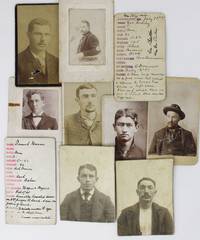
18995150Kansas City Mo 1899. Very good. Ten carte-de-visite photographs 4 x 2.5 inches or slightly smaller on thick cardboard mounts four with partially-printed "rap sheets" on verso completed in manuscript. Occasional edge and surface wear as well as generally light dust-soiling. A nice group. A group of ten fabulous mugshot photographs or studio portraits featuring criminals in the last few years of the 1800s in Kansas City Missouri. Four of the photographs are particularly interesting for the personal and criminal history information recorded on their versos. These photographs are pre-printed with a list of fields to be filled out by the criminal or perhaps the jailer. The combination of fields varies slightly on three of the four cards but generally they all ask for similar information including name; aliases nationality age height weight eye color hair color complexion occupation or "Criminal Occupation" the pertinent crime place of arrest arresting officer date date of arrest and distinguishing marks or "Peculiarities of Build Features Scars Marks etc.". <br /> <br /> One of the mugshots is that of James Carrington Francis 1869-1892. At the bottom of his card is written: "Killed at Pleasanton KS for Pacific Ex Robbery Jan. 23 '92." Francis had indeed taken part in the robbery of the Frisco Express out of St. Louis on the night of November 30 1891. During the robbery two masked men boarded that train as it was leaving St. Louis. They remained in seclusion until they had traveled a few miles and then presented pistols to the heads of the engineer and fireman. They ordered them to stop at the point where two accomplices of the highwaymen were stationed. The engineer and fireman were then ordered from the cab and kept covered while the party proceeded to the express car where the robbers demanded admission but were refused by the messenger. The robbers then set off a stick of dynamite and blew in the side of the car seriously injuring the messenger. They then entered blew open the safe and after taking $10000 made their escape. The Pinkerton Detective Agency and Chief of Detectives Desmond of St. Louis investigated the case and gathered evidence which convinced them that the robbers were Marion Hedgepeth Dink Wilson Adelbert Slye and James Francis.<br /> <br /> The other three men whose photographs are supplemented with personal information include Frank Norris Patrick Raine and George Conley. Oddly enough the crimes of all four men are not stipulated on the present photographs. Norris was a baker by trade with a scar on the palm of his hand and a "knuckle knocked down" who was arrested on October 5 1895. Patrick Raine was a waiter with a forearm tattoo and "2 vax scars on left arm" arrested on January 24 1899. George Conley alias George Baker or George King was a brakeman arrested on July 12 1897. The remaining photographs do not include identifying information save for two with penciled names on the verso and one with a studio stamp from J.V. Dabbs in Fort Scott Kansas but were found with the previous four photographs and would likely reward further research into the Wild West criminal world of late-19th century Kansas. unknown
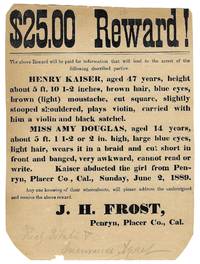
18891461Penryn Ca 1889. About very good. Broadside 9 x 6.75 inches. Trimmed unevenly corners clipped lightly tanned. Contemporary pencil notation at bottom of sheet. Broadside advertising a reward for the arrest of Henry Kaiser for the abduction of Miss Amy Douglas taken from the little town of Penryn in Placer County on Sunday June 2 1889. Kaiser is described as "aged 47 years height about 5 ft. 10 1-2 inches brown hair blue eyes brown light moustache cut square slightly stooped shouldered plays violin carried with him a violin and black satchel." Miss Douglas is described as well: "aged 14 years about 5 ft. 1 1-2 or 2 in. high large blue eyes light hair wears it in a braid and cut short in front and banged very awkward cannot read or write." The reward is offered by a J.H. Frost and a pencil note seems to indicate that he was a real estate and insurance agent. A newspaper article from the San Francisco Chronicle of June 24 1889 relates that the two eloped. Kaiser was a divorcé and the son of a well-known winemaker in the area. The two were located in Portland Oregon having unsuccessfully tried to gain a marriage license due to Amy's young age. Another article indicates that Amy fled cruelty at home her father having consented to her marrying Kaiser when she turned sixteen. In any case Kaiser was discharged from criminal prosecution having been found to have acted honorable with regards to the girl. An interesting story and the broadside is unrecorded. unknown books
18672143Cincinnati: s.n. 1867. FIRST EDITION. Softcover. Good. Original publisher's printed pale green wrappers chipped. 128 pp. 8vo. 8-1/4" x 5-1/2". Some general wear & soiling. A touch of foxing. Unsightly abrasion to rear wrapper resulting in some loss. "A Book for the Family" in which are described in the most graphic detail over 100 murders in Cincinnati and environs. This highly curious volume represents a genuinely early American work in the literary genre now known as "True Crime" about which see especially Mark Steltzer "True Crime: Observations on Violence and Modernism" 2007 passim. True Crime as a form of entertainment created important American pop culture icons namely the sociopaths the psychopath the mass murderer and the serial killer all of whom are represented herein. The full title adds useful information about the crimes including: "Trials and Executions of John May ; Philip Lewis colored ; John Cowan the Murderer of his Family ; Washburn and his Associates Davis and Hoover the Butchers of over 30 Persons ; Byron Cooley who killed John Rambo ; Henry Lecount ; Patrick McHugh the Murderer of his own Wife ; and a Careful History of the Hughes Murderers with a Precise Account of the Murder of John Brasher the Watchman ; the Summons Massacre ; Arrison and the Infernal Machine ; Mrs. Howard who Avenged her Own Wrongs ; Nancy Farrer the Child Poisoner ; with a Correct Detail of Over a Hundred Other Murders which have Taken Place in this City and County." Scarce. ¶ Sabin 19107. s.n. unknown books
18161192942Heidelberg, J. Engelmann, 1816. Lithograph. Porträt-Tafel, 2 Bl., 254 S. Interims-Broschur d. Zeit (unbeschnitten, mit kl. Randeinrissen, gelegentlich etwas braunfl.).
1857List2022Washington 1857. Autograph letter measuring 8 x 5 inches bifolium with free franked stampless cover. Fine condition. Fine. An interesting letter written by James W. Denver written while he was serving as Commissioner of Indian Affairs describing crime on the Baltimore and Ohio Railroad in 1857. He writes:<br /> “We have great times on the Baltimore & Ohio Railroad. For a long time past merchandise has been lost along the line by being thrown out of the cars while under way some of the confederates being ready to pitch them up and sell them. To put a stop to this the Directors ordered the cars when loaded to be sealed up and not to be opened until they should arrive at the place of destination. The conductors took offense and said that this was a reflection on them quit the trains and would not let anybody else take their places. In order to prevent this they attacked the trains passing Ellicott’s Mills and succeeded in turning back all but one. Today it was rumored that the Plug Uglies had possession of the track between Baltimore and the Relay House but this is hardly so as a train has I am told arrived here this evening. This is a very extraordinary affair as it is in fact an effort to give greater license to stealing and from the way they have acted there is not much doubt but the conductors were engaged in the plundering.â€<br /> The Plug Uglies first operated in Baltimore beginning in 1854. Several iterations of the Nativist gang eventually formed all of which were referred to by the same name. They would be involved a month later in the Know Nothing Riot in Washington D.C. in June of 1857 the same month that Denver would gain his appointment as Secretary of Kansas Territory. <br /> <br /> <br /> Full text follows:<br /> <br /> My Dear Wife<br /> The cheerful tone of your letter of the 28th ult. pleases me very much. I hope and trust that will be ever thus. A light heart and cheerful disposition makes life a perennial springtime. There is nothing like it. Keep up your sprits ever thus and besides being the pride of my life you will be my light also—the polar star of my existence.<br /> <br /> O Lou! how lonely I feel here at times without you! Were we only together how much more pleasantly would the time pass away. Still I have no great reason to complain of fortune but ought rather to be thankful for the great boon she has vouchsafed to me in making you mine for life. To know this it is easy to imagine a good angel always hovering near me giving warning of besetting dangers and urging me on to greater usefulness and then to dream of the bright approving smiles of her I love so well. And though distant I doubt not but they are as sweet and as kind as though present and palpable to my vision. Well well what must be I suppose must be and we must grin and bear it; but I wish you were here and not the subject of mere dreams and imaginings.<br /> <br /> We have great times on the Baltimore & Ohio Railroad. For a long time past merchandise has been lost along the line by being thrown out of the cars while under way some of the confederates being ready to pitch them up and sell them. To put a stop to this the Directors ordered the cars when loaded to be sealed up and not to be opened until they should arrive at the place of destination. The conductors took offense and said that this was a reflection on them quit the trains and would not let anybody else take their places. In order to prevent this they attacked the trains passing Ellicott’s Mills and succeeded in turning back all but one. Today it was rumored that the Plug Uglies had possession of the track between Baltimore and the Relay House but this is hardly so as a train has I am told arrived here this evening. This is a very extraordinary affair as it is in fact an effort to give greater license to stealing and from the way they have acted there is not much doubt but the conductors were engaged in the plundering.<br /> <br /> Judge Stephen A. Douglass intends leaving <br /> here with his family tomorrow. Nat Cartmell was here on Friday. He said they were all well in Virginia except cousin John Lupton who was convalescing. Tell your father I will keep him posted and tell your mother to keep you at work—if she can. My love to all. Goodnight. God bless you my own dear Lou. Adieu. — Will. unknown
184119189Boston: Published by S. G. Simpkins 1841. First edition. Some trifling wear and soiling; a fine copy. 16mo original blind-stamped diaper grain blue cloth gilt lettering 48 pages. No man of ordinary observation can pass through the streets of New York or Philadelphia without meeting numerous living witnesses of the misery which exists in both of those cities and especially in the former. Enough can be seen in Boston to make any benevolent heart ache daily for suffering humanity. But still the amount is less in proportion to population than in either of the other two cities. Through the influence of better laws for education intellectual culture the best preservative from vice and crime is more generally diffused in Boston than in Philadelphia; and from its geographical position Boston is not like New York the common resort of the squalid poverty that seeks refuge on our shores from Europe." A fairly nuanced sociological criminal and economic argument for temperance among the laboring classes pointing to the savings in cost of drinks and to the economic advantages of sober fathers; additional aspersions are cast as well on adulteration of wines and liquors. Originally published as a series in Boston Daily Times here collected and published with a prefatory Advertisement dated May 1841 and signed by a committee of Boston advocates of temperance. Includes an appendix of collected statistics on inmates at the jails and house of correction juvenile crime insane asylum numbers etc. OCLC 6/2019 notes two locations. Published by S. G. Simpkins, unknown books
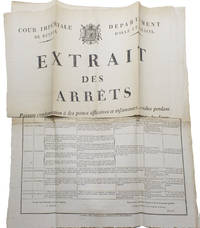
181330782Rennes: Chez Cousin-Danelle Imprimeur de la Cour Impériale 1813. l sheet consisting of three leaves. 1 vols. FOLIO 20 x 46 inches. Broadside. Some marginal discoloration and creasing else very good. l sheet consisting of three leaves. 1 vols. FOLIO 20 x 46 inches. Lists the date of arrest the court identifies the criminal with age profession address a physical description crime and punishment citing the applicable laws next to them. Chez Cousin-Danelle, Imprimeur de la Cour Impériale unknown
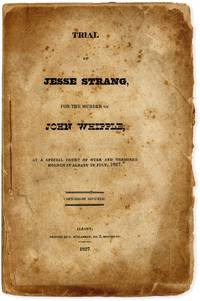
182787802Albany: D. M'Glashan 1827. First and Only Edition. Octavo in 4's. 24cm. Stab bound pages with the title page serving as the front cover and no trace that the pamphlet was ever bound. 35pp. Some mild chipping to edges and extremities most notably the upper right corner toning and soiling to wraps; internally clean but uniformly toned with offsetting from the type throughout edges untrimmed luxuriously wide margins some traces of careless opening in places. Very good by dint of survival and solidity rather than beauty the paper is cheap and the pamphlet was printed to leverage opportunity rather than posterity.<br /> <br /> A notable and at the time highly controversial trial dealing with what was later referred to as "The Murder at Cherry Hill." The prominent New York Van Rensselaer family owned and lived at Cherry Hill Farm in Albany the daughter Elsie was married somewhat unhappily to John Whipple and fell for a younger man she met in a bar by the name of Jesse Strang. The couple fell in love Elsie expressed her deep unhappiness with Whipple; Strang masquerading under the name of Jesse Orton took on a job at the farm and began an affair with Elsie which was maintained by the house staff many of whom were enslaved people of color whose testimonies were heard at the trial passing notes between the two. Elsie chafing somewhat at having to endure her legal husband resolved that he must die to make way for Strang and they would run away together to Canada. <br /> <br /> The first plan was arsenic poisoning which failed. What Elsie lacked in poisoning ability she made up for with murderous intent and she purchased a rifle removed the ammunition from her now somewhat suspicious husband's gun and induced Strang who does not come across as the sharpest tool in the shed to shoot Whipple dead. Strang then attempted to fabricate an alibi which did not hold up and he was arrested. What followed was a widely publicised trial in which both defendants turned on each other Elsie's status as the daughter of prominent landowners was leveraged as protection from any serious punishment and Strang bore the brunt of the law. He had of course further doomed himself by attempting to plant evidence lying under several oaths and generally being one of the less gifted murderers of the early 19th century; he was hanged Elsie went home to Cherry Hill the Van Rensselaer's invested heavily in local collective amnesia and the rest of the US stared somewhat incredulously and gossiped over their breakfast grits. <br /> It was a carnival of awfulness that posed many questions about the societal rights and freedoms of women the privileges of wealth and the integrity of the judicial system. Fairly represented in institutions with 20 examples in US libraries but scarce in commerce and usually in later binding. D. M'Glashan unknown
181330782Rennes: Chez Cousin-Danelle Imprimeur de la Cour Impériale 1813. l sheet consisting of three leaves. 1 vols. FOLIO 20 x 46 inches. Broadside. Some marginal discoloration and creasing else very good. l sheet consisting of three leaves. 1 vols. FOLIO 20 x 46 inches. Broadside of Criminals in Napoleonic France. Lists the date of arrest the court identifies the criminal with age profession address a physical description crime and punishment citing the applicable laws next to them. Chez Cousin-Danelle, Imprimeur de la Cour Impériale unknown books
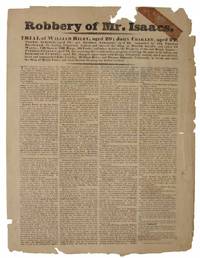
183444354Liverpool: W. Bethell Printer 1834. 1st printing presumed. Age-toned. Edge-chipping with largish chunk ~1" square from top edge just touching headline title. Old tape repair to the right of missing chunk. A Good copy. Broadside printed four column after a 9 line drophead title with two horizontal typographical ornament seperators. 19-1/2" x 15" <br/><br/>"Trial of William Riley aged 29; John Coakley aged 27; Thomas Simcock aged 18; and George Atkinson aged 28; by Sir Thomas Brancker for having feloniously borken and entered the Shop of Ralph Isaacs and stolen 80 Watches 130 Spoons 100 Rings 30 Forks and other Articles the Property of the said Ralph Isaacs -- Patrick Coakley aged 73 for receiving divers and sundry property knowing the same was stolen; and Elizabeth Cumpsty aged 35 charged upon oath with having feloniously incited aided and abetted hired and commanded John Coakley William Riley and Thomas Simcock feloniously to break and enter the Shop of Ralph Isaacs and steal therin the property before recited." So proclaims the headline of this crime broadside followed by 4 columns of text describing the trial of the accused individuals with the result that the jury "after being absent for about half-an-hour returned and found all the prisoners GUILTY." No copies found on OCLC. Rare. W. Bethell, Printer unknown books
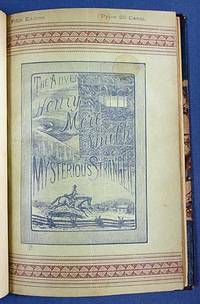
188741538Saint John N. B.: Printed by Geo. W. Day Corner Prince Wm. and Princess Sts 1887. "Fifth Edition" stated. The First Edition published in 1816 cf. Sabin 3947; Watters p. 462. Late 19th C. 3/4 blue sheep binding with marbled paper boards. Marbled eps. Original pale green printed wrappers retained. Rear wrapper an advert for Geo. Day. Binding shows some extremity wear. Original wrappers & text paper show age-toning with rear wrapper having a chip from the fore-edge. A VG copy. 82 pp. Wood engraved vignette to front wrapper. 8vo. 8" x 5-1/4" <br/><br/>"Henry More Smith also known as Henry Frederick Moon Henry J. Moon Henry Hopkins Henry Frederick More Smith and William Newman was a confidence man master puppeteer hypnotist seer liar and above all else a superlative escape artist who lived for a while in New Brunswick Canada. Chains handcuffs shackles even made-to-fit iron collars could not hold him." Wiki. The author Bates was the sheriff of Kings' County New Brunswick. Uncommon in the trade. Printed by Geo. W. Day, Corner Prince Wm. and Princess Sts hardcover books
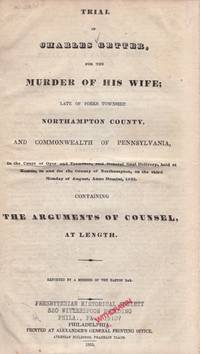
183335550Philadelphia: Printed at Alexander's General Printing Office 1833. First Edition. Hardcover. Good. Octavo. Hardcover. Ex-institutional copy. 72 pages. Original wraps without the outer covers bound in black cloth covered boards with copy of the title pasted down on the front cover. Gilt lettered title on the spine. New tan end sheets front and back. Page 1 is the title page and has two stamps at the bottom: Presbyterian Historical Society Philadelphia and a red withdrawn stamp. Print is small and contents are clean. <br /> <br /> McDade 335 - "Getter convicted of fornication and bastardy was given the option of marrying the girl he had wronged; six weeks later saddled with a wife he did not want he choked her to death.â€. From wikipedia:<br /> <br /> Getter's Island previously known as Abel's Island is a small island in the Delaware River in Easton Pennsylvania in the United States. It is best known as the location of the execution of Charles Getter the last person to be publicly executed in Pennsylvania. History edit Execution of Charles Getter edit The island is named after Charles Getter a farm hand who was hanged on the island in 1833 for the murder of Margaret Lawall a woman he married to avoid prosecution for impregnating her outside of wedlock. Getter's execution was initially scheduled to take place at Center Square in Easton but it was moved to the island - then known as Abel's Island - to accommodate the crowds.<br /> An estimated 15000 to 20000 people some of whom traveled hundreds of miles gathered in the town to view the execution. 12 An initial attempt to hang him failed forcing a second attempt which resulted in his death. A reporter who witnessed the scene was horrified at how little the crowd was affected by the execution and called on lawmakers to take action. 2 Governor George Wolf agreed with the reporter and signed a law banning public execution on April 10 1834. As a result Getter was the last person in Pennsylvania to be publicly executed. 2. Printed at Alexander's General Printing Office hardcover
189920704Lyon, Paris, Storck, Masson, 1899 ; in-8, demi-basane réglisse, dos à nerfs, titre doré (reliure de l'époque) ; XXIX, [3], 379 pp., [1] f. de table, 6 planches hors-texte en couleurs.
186743987.1Cincinnati 1867. 1st Edition Sabin 19107. Original publisher's printed pale green wrappers. Some general wear soiling & light edge chipping to wrappers. A touch of foxing. Some paper loss at spine ends. Withal an About VG copy. 128 pp. 8vo. 8-1/4" x 5-1/2" <br/><br/>De Beck describes over 100 people who committed murders in and around Cincinnati. Curiously enough the front wrapper describes this volume as "A Book for the Family". Reissued later in the year with the author's name with the title amended to "The Horrors of Queen City. Being an Account.". unknown books
18498522Paris, Michel Lévy Frères, 1849 ; 2 tomes reliés en un volume in-8, demi-chagrin vert-lierre, dos à nerfs soulignés de filets à froid, fleurons décoratifs et titre dorés (reliure de l'époque) ; (4), 300 ; (4), 282 pp., (1) f. blanc.
182611366Boston: Various Publishers 1826-1829. Various Editions. Octavo 22cm.; cloth-backed boards with original paper spine label; 330pp paginated continuously but each report with a separate title page; six inserted leaves of woodcut plates. A solid well-preserved copy with scattered foxing to text; Very Good. First four reports of Timothy Dwight's pioneering Prison Discipline Society dedicated to the amelioration of the harsh conditions prevailing in American prisons during the early republic. With six woodcut plates mostly plans of prison buildlings and grounds. Various Publishers unknown books