RUE DE JOINVILLEMareMagnum
Rucka GregLivre Rare Book
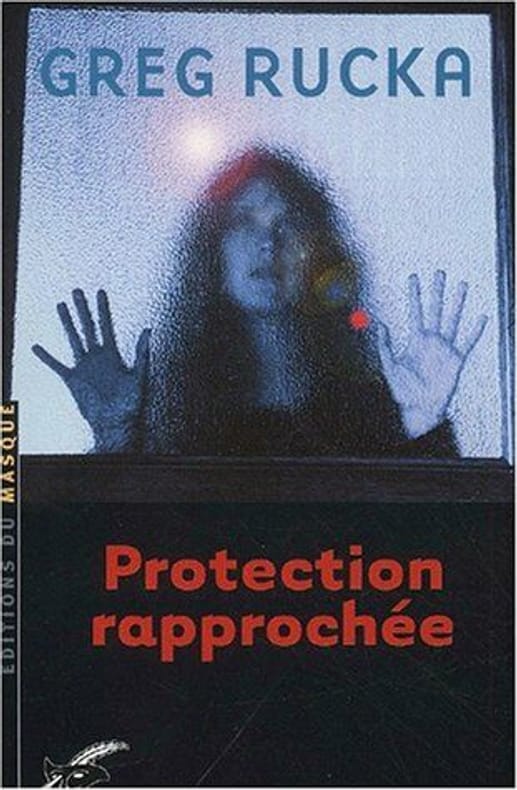
Protection rapprochée
2002500037267ED DU MASQUE 2002 360 pages 23x2 4x15cm. 2002. Broché. 360 pages.
Démons et Merveilles · Joinville, France8,00 €
5 445 résultats
Num?ro complet.
H&S yellow jacket paperback (9D serie), 128 pages, original illustrated paper wrappers - Good Copy. GOOD, No Marks [CA-00]
2002500037267ED DU MASQUE 2002 360 pages 23x2 4x15cm. 2002. Broché. 360 pages.
246 p. Hardcover Very good condition good
2014500254866SONATINE 2014 544 pages 14x3 4x22cm. 2014. Broché. 2 volume(s). 544 pages.
Rodez, Carrère, 1970. In-8 broché, 95 pages. Très bon état.
2015100124234Aaarg 2015 360 pages 13 8x2 8x20 2cm. 2015. Broché. 360 pages.
196056691960 Editions Opta, Club du Livre Policier, N° 13 - 1960 - In-8, reliure pleine toile décorée de l'éditeur sous jaquette rhodoïd - 718 pages - Exemplaire numéroté 4600 / 5000
No publication date or edition statement, 254 pages, spine slightly nicked at edges, pages browned, no. 676 in series. eng
8vo., Second Edition, with a portrait frontispiece, title in red and black, 4 plates and a map, some moderate foxing throughout; original red cloth, backstrip lettered in black, a very good, clean copy. Published in the series Notable British Trials. The first edition appeared in 1914.
Broch?. 367 pages. Couverture d?fra?chie.
in-8°, 364 pages, ill. hors texte N&B, broche, couverture illustree plastifiee. Bel exemplaire. [SC-2]
A clean, unmarked book with a tight binding. Previous owner's name inside. A collection of criminal cases presented by William Roughead, an early practitioner of the "true crime" literary genre.
in 16°, bross. edit. ill.
2008500112844Timée-éditions 2008 14x2 4x20 2cm. 2008. Broché.
19971704Flammarion, 1997 in-8°, 298 pp, documents en annexes, broché, bon état
136775aafEditions à la Carte, 2004, in-8vo, 119 p. + 1 p. (Bibliogr.) + 1 f. blanche, brochure originale illustrée.
20 pages. Features: The Sally Ann in Suburbia - Lieutenant Ken Chapman wages the Salvation Army's battle in North Vancouver - with great colour photo of Ken and Brenda Chapman of London, Ontario; K-Tel's Greatest Hits - fantastic kitschy article - with great colour photos - about the firm's hit products, and it's leader Philip Kives, a former Saskatchewan farm boy - products include the Miracle Brush, Hair Magician, Multi-Sharpener, Feather-Touch Knife, Record Selector, Frypans, Veg-o-matic, Patty Stacker, Multi-Exerciser, Super-Bond glue - a cool article!; Comparing the lot of a department store sales lady in 1907 with the modern version - a fascinating study plus archival photos; How to win at the most popular board games - Othello, Scrabble, Monopoly, Mastermind, Risk, Organized Crime; A fascinating short history of Christmas carols; and more. Moderate wear. Unmarked. A quality vintage copy. Book
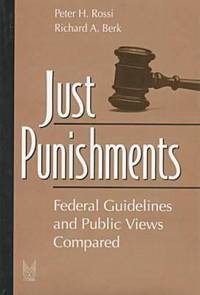
1997028439Hawthorne New York: Aldine de Gruyter 1997. Very Good condition in a bright and shiny Near Fine dust jacket. NO chips tears or creases. Sharp corners. NO owner's name or bookplate. NOT a library discard. NOT a remainder. Only a few pages with margin notes. Occasional yellow highlighting. Publisher's mailer describing the book is laid in. A volume from the publisher's Social Institutions and Social Change series. Tables. 3 appendices. Bibliography. Index. Bound in the original brown cloth stamped in bright gold on the spine. Complete with dust jacket. From the publisher: "The sentencing guidelines written by the U.S. Sentencing Commission for the federal crime courts were designed to lead to uniform the just punishments for convicted criminals. How well did the Commission's judgments about what were just punishments compare to the view of the American public Using data from a 1994 national household survey the authors compare the punishments described by the Commission to those desired by the public. Contrary to the frequency claims of excessive leniency on the part of judges that are often asserted by journalists and shapers of opinions Rossi and Berk find strong correspondence between the median sentences deemed appropriate by the public and the sentences prescribed by the guidelines. Although the authors conclude that the Commission was able to match prescribed punishments closely to the American consensus for most crimes in one category -- drug trafficking offenses -- the guidelines were much harsher in dealing with offenders. The national survey used a factorial survey as its design strategy allowing for analysis of a large variety of federal crimes and variations in the social characteristics of convicted felons. A wealth of detail along with ample graphic and tabular illustrations extends the book's application to issues of consensus and variations in punitiveness by region and socioeconomic characteristics of respondents.". First Printing of the First Edition. Hardcover. Very Good condition/Near Fine dust jacket. Illus. by NOT a library discard. 8vo. xi 244pp. Great Packaging Fast Shipping. Aldine de Gruyter Hardcover
8vo, 253 pages, not illustrated. eng
in-8°, 297 pages, broché, couverture illustrée. Bel exemplaire. [AB-2SF]
431 p. Illustrations. 8vo. Very worn publisher's cloth binding. On July 1, 1874 two little boys were abducted in front of their family's mansion. It was the first kidnapping for ransom in the history of th e United States. And it would be the major event of its kind until the Lindbergh baby kidnapping. The boys were named Charley and Walter Ross; they were 4 and 6 years old. The two men who kidnapped th em had given the boys candy on previous occasions. That day, however, the men told the boys to climb into their buggy and promised to buy them firecrackers. The boys boarded and they drove off into th e city. Charley would never be seen again. As they drove farther away, Charley wanted to go home and began to cry. The men stopped in front of a store and gave Walter 25 cents. He entered the store and started choosing firecrackers, while the men drove away with Charley. The boys' father, Christian K. Ross, thought the boys were playing in a neighbor's yard. But soon a neighbor told him that she saw the boys traveling in a buggy. The father began the search for his son that he would continue until his death. He didn't tell his wife at first, who was recovering from an illness in Atlantic City. Two days later, however, she found out when he began advertising in the newspapers for his sons' return. A stranger found Walter and returned him to his father. Walter related the tale. Two days after that, the father received a crude note, saying that Charley would be released for a sum of money. On July 7, came another note demanding $20,000 and instructing the boy's father how to go about paying the kidnappers. The father tried to follow the instructions as best he could but never contacted the kidnappers. Later that year, police were investigating the kidnapping of a Vanderbilt child and found a ransom note in that case that matched closely the one for Charley Ross. They identified the handwriting as fugitive convict William Mosher's. Mosher was killed during a burglary in Brooklyn, but his partner Joseph Douglas identified Mosher as the kidnapper of Charley Ross. Douglas died insisting that only Mosher had known where Charley was being held. Douglas also said that Charley would be returned safely in a few days. He never was, and the father spent $60,000 in his futile search. Imposters came forward in the years afterward claiming to be the missing boy. Each was disproved. Charley's father died in 1897, his mother in 1912. Walter Ross died in 1943. The Ross mansion was torn down in 1926. The Cliveden Presbyterian Church now stands on the site of the kidnapping. **PRICE JUST REDUCED! PA 28
197413772Bobbs Merrill Indianapolis & New York, 1974. 199 S., Halbleinen (Hardcover), 8°. Zustand: gut.
1904265505Berlin, Barsdorf, 1904. (Reprint Leipzig 1971). VII, 435 S. OLwd.
Size: 8vo - over 7¾" - 9¾" tall eng