26 résultats
1864DLIT4067Brünn, Karafiat o.J. [1862 - 1864]. 290; 224 S., HLnbde. d. Zeit, priv. Eignerstempel auf Vorsatzblättern, papierbedingt leicht gebräunt.
1986EEZZ5931fFlorenz, Istituto Francese di Firenze 1986. 4°. 181 S. m. zahlreichen s/w Abb., OKart., sehr guter Zustand. Austellungskatalog: Istituto Francese di Firenze, 22 novembre - 20 dicembre 1986.
Memoiren der Frau Roland über die französische Revolution. 322pp., 16 b / w plates, hardback in d / j ** Mme Roland's memoirs of the French revolution
in-12, 223 pp., broche, couverture illustree Bel exemplaire, en partie non coupe. [NV-14]
La décapitation est-elle un supplice barbare, la souffrance et la conscience survivent-elles à la section du cou? ou bien la tête, séparée du corps, a-t-elle pendant un temps si court qu'on le suppose, conscience des impressions internes et ou extérieures? Telles sont les questions que Monsieur Paul Loye a voulu élucider.
in-8°, 287 pages, suite iconographique, biblio, index, relie cartonnage ed., jaquette rhod..— Exemplaire numerote. Bel exemplaire. [CA33-2]
1996107925Berlin, Kadmos-Verlag 1996. 214 Seiten. Hardcover/Pappeinband
8vo., First Edition thus, with portrait frontispiece; red cloth, gilt back, top lightly spotted, backstrip sunned (but all gilt wholly legible), a very good, bright, clean copy. With a personal bookplate on front paste-down. VERY SCARCE.
198428972Berlin, Edition Mariannenpresse, 1984. 40 Seiten mit teils ganzseitigen Abb. 4°, OBroschur mit ill. Schutzumschlag.
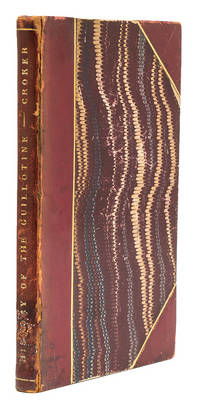
1853257180London: John Murray 1853. Murray's Railway Reading. Illustrated with woodcuts in text. viii 88 pp. 1 vols. 12mo. Contemporary half red calf and marbled boards red printed wrappers preserved. Owner signature of E. Forbes at head of title; ink number on verso of title W.H. Smith blindstamp on back wrapper. Bookplate. Traces of old label or shelfmark at foot of spine some toning of text. Very good. Murray's Railway Reading. Illustrated with woodcuts in text. viii 88 pp. 1 vols. 12mo. Pocket History of the Guillotine and Its Victims. John Murray unknown books
19452London: Printed at the Minerva Office for Wiliam Lane 1793. Overall 19 x 14 inches in very good clean condition one closed tear at foot folds. There are two states of this dramatic depiction of Louis XVI beheaded by the Guillotine. The other has a similar text but the Guillotine is shown at some distance guarded by soldiers. The text describes the sentencing and the last moments of the King. The broadside was priced at Three Pence or sold Wholesale at One Guinea per Hundred. unknown
pp. 468 + Plus frontis and full page plates. Decorated title page printed in red and black. XLib. 12mo. Original full gold decorated green cloth binding. Rev. Washington Frothingham (1822-1914) Journalist, Author, Philanthropist. Known as "The Hermit of New York", **PRICE JUST REDUCED! FRENG 2
1912301941München, Georg Müller, 1912. 351 Seiten. 22cm. Originalhalbpergament-Band mit Rückentitel.
in-8°, 251 pp., illustrations, broché. Bon état [SO-6]
With Index. Rubbing to surface of dust jacket. Dust jacket unclipped
grand in-8°, 247 pages, broche, couverture illustree plast. Bel exemplaire. [HI-4]
8vo., First English Edition, with an engraved plate (moderately spotted), 2 engraved plans on one plate, and two engraved facsimiles on one plate, rear free endpaper and one rear blank preliminary lightly spotted; attractively bound in nineteenth century half calf, marbled boards, back gilt extra with five raised bands, second compartment with red leather label lettered in gilt, all other compartments ruled and elaborately tooled in gilt to a floral design, all edges marbled, marbled endpapers, corners lightly bruised else a remarkably bright, crisp, clean copy in elegant binding. With the 16pp list of subscribers, which includes virtually every member of the Royal family extended to Prince William of Gloucester. This is the early issue with 'Bookselllers' in the publisher's imprint (see ESTCT110766). The plates depict the Temple tower, plans of the second and third floors and two facsimiles of Marie Antoinette's handwriting. Clery's family had been in the service of the French Royal Family since the time of Louis XIV. Together with his brother, he began his career with the Princesse de Guenenee, governess to the royal children, and became valet-de-chambre to the Duke of Normandy (later the Dauphin) in 1785. From 1789, he acted as valet to King Louis XVI and was permitted by Petion to continue to wait on the Royal Family during their imprisonment in the Temple. After the King's execution, Clery accompanied the Madame Royale (Marie-Therese de Bourbon) on her exile to Vienna where he continued to serve until his death. LOVELY COPY OF A KEY DOCUMENTARY RECORD IN THE HISTORY OF FRANCE, THE REVOLUTION AND THE TERROR, AND THE SINGLE MOST IMPORTANT CONTEMPORARY ACCOUNT OF THE IMPRISONMENT OF LOUIS XVI.
1819901891AGCarlsruhe:, Mylius, 1819. Federlithographie 12 x 33,5 cm, Blattgröße 17 x 36 cm.
grand in-8°, 320 pp., cartonnage de l"editeur, jaquette illustree en couleurs. Bon etat (accrocs a la jaquette). [CA29-30][TX-20]
1649696175.Gpaperback. Good. Access codes and supplements are not guaranteed with used items. May be an ex-library book. paperback
1988134708Reinbek bei Hamburg : Rowohlt-Taschenbuch-Verl. 1988. 220, [16] S. : 18 Ill. 19*12 cm. OBroschur.
198884641Reinbek, Rowohlt Taschenbuch Verlag, 1988. 221 S. 8° Oktav, Softcover/Paperback
Sm. 8vo., First Edition thus, small age-mark on half-title verso; contemporary half calf, marbled boards, back ruled in gilt, second compartment with red leather label lettered in gilt, all other compartments tooled in gilt with a floral motif, joints cracked (but hinges and binding entirely sound), a most attractive and remarkably crisp, clean copy. Complete with half-title, and 6pp publisher's catalogue (dated February 1817) bound in at end. RARE. We have seen this edition confused with a very similar but shorter (and apparently less elusive) version of Angouleme's memoirs published by Constable in Edinburgh later the same year. NICE COPY OF A KEY DOCUMENTARY RECORD IN THE HISTORY OF FRANCE, THE REVOLUTION AND THE TERROR, AND AFTER CLERY ONE OF THE MOST IMPORTANT CONTEMPORARY ACCOUNTS OF THE IMPRISONMENT OF LOUIS XVI.

G/G (intact dj chipped and worn edges and white back cover lightly soiled, clean red cloth with gilt lettering on spine, good sound clean copy with tiny ownership initials front free endpaper and one dog-eared corner) octavo 224pp. First British edition. Biography of the man who gave his name to the guillotine and who only narrowly escaped execution himself in the French Revolution, and whose sole motive in suggesting the use of the guillotine was the prevention of further suffering to the victims. Illustrated with b/w plates.
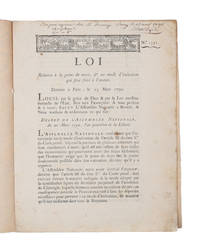
179263223Paris L'Imprimerie Royale 1792. 4to. Stitched in later marbled wrappers with printed book label "Collection Quarré-Reyboyrbon Lille" to inside of front wrapper. Contemporary handwritten inscription above head-piece "Bon pour imprimeur chez M. Descamps Douay le 12 avril 1792." presumably in the hand of Quarré-Reybourbon. A bit of brownspotting and soiling but overall very nice. 4pp. <br/><br/><em>Scarce first printing of the legal document that led to the guillotine becoming France's standard method of judicial execution. This groundbreaking decree of the National Assembly given 20 March 1792 suspended all pendig death punishments and authorized the use of necessary expenses to achieve a more humane method of execution throughout the kingdom. The methods for achieving this humane form of execution is explained in the the annexed text signed by Antoine Louis see below the permanent secretary of the Academy of Surgery. The decree is as follows: “The National Assembly considering that the uncertainty regarding the method of execution of Article III of Title 1 of the Penal Code suspends the punishment of several criminals who are sentenced to death; that it is urgent to put an end to inconveniences which could have unfortunate consequences; that humanity requires that the death penalty be as painless as possible in its execution decrees that there is an emergency.†The Penal Code of 1791 title 1 article 3 Tout condamné aura la tête tranchée “Every condemned person will have their head cut off†should be executed “according to the manner indicated and the method adopted by the consultation signed by the Permanent Secretary of the Academy of Surgery which remains annexed to this decree†and the National Assembly “consequently authorizes the Executive Power to incur the necessary expenses to achieve this method of execution so that it may be uniform throughout the Kingdom.†p. 1 Prior to 1791 under the Ancien Régime there existed a variety of means of capital punishment in France depending on the crime and the status of the condemned person. In 1791 there was a campaign towards the abolition of the death penalty but later that year The National Assembly refused to pass such a law. However torture was abolished and a single method of execution was declared that of beheading which had previously only been applied to nobles. In 1791-92 the development of a mechanical beheading device was set in force by a committee in order to make the death penalty "as painless as possible in its execution" and "uniform throughout the kingdomâ€. Note that before the use of a mechanical beheading device manual beheading and a variety of other methods of execution had been in force in France. Ironically what is now known as the guillotine was developed with the help from Louis XVI – who was a skilled amateur locksmith – with regards to the shape of the blade. This change towards a more painless method was ignited by physician Joseph-Ignace Guillotin in October 1789 at the National Assembly. Later a committee was formed under Antoine Louis the inventor of the guillotine and physician to the King and Secretary to the Academy of Surgery. This committee included Guillotin and although he did not invent the guillotine and opposed the death penalty his name became an eponym for it. After its adoption the device remained France's standard method of judicial execution until the abolition of capital punishment in 1981. The last execution with a guillotine in France took place in 1977. </em> unknown