Morgenthau, Hans JBiblio.com

257 résultats
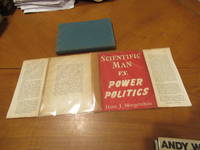
1946054900Chicago: University Of Chicago Press 1946. 1st Edition 1st Printing. Hardcover. Very Good/Good. Ix 245 Pp. Green Cloth Gilt. First Printing 1946. Unusually Direct And Somewhat Acidic Commentary On The Title Subject By A Leading Professor Of Political Science At The University Of Chicago. Book With Slight Wear Spine Gilt Bright. Dust Jacket Priced $3.00 Wear Losses At Corners 2" Tear At Bottom Of Rear Panel Spine ;Panel Completely Browned With No Trace Of Lettering Remaining. Per Wikipedia Morgenthau's Scientific Man Versus Power Politics 1946 Argued Against An Over Reliance On Science And Technology As Solutions To Political And Social Problems. The Book Presented A "Pessimistic View Of Human Nature" Centered On A Universal Lust For Power And The Inevitability Of Selfishness. Hans Joachim Morgenthau 1904 - 1980 Was A German-American Jurist And Political Scientist Who Was One Of The Major 20Th-Century Figures In The Study Of International Relations. Morgenthau's Works Belong To The Tradition Of Realism In International Relations Theory; He Is Usually Considered Among The Most Influential Realists Of The Post-World War Ii Period. Morgenthau Made Landmark Contributions To International Relations Theory And The Study Of International Law. In 1933 Morgenthau Published A Second Book In French La Notion Du "Politique" Which Was Translated Into English And Published In 2012 As The Concept Of The Political. In This Book Morgenthau Seeks To Articulate The Difference Between Legal Disputes Between Nations And Political Disputes Between Nations Or Other Litigants. The Questions Driving The Inquiry Are: I Who Holds Legal Power Over The Objects Or Concerns Being Disputed Ii In What Manner Can The Holder Of This Legal Power Be Changed Or Held Accountable Iii How Can A Dispute The Object Of Which Concerns A Legal Power Be Resolved And Iv In What Manner Will The Holder Of The Legal Power Be Protected In The Course Of Exercising That Power For Morgenthau The End Goal Of Any Legal System In This Context Is To "Ensure Justice And Peace". In His Work In The 1920S And 1930S Morgenthau Sought A "Functional Jurisprudence" An Alternative To Mainstream International Law. He Borrowed Ideas From Sigmund Freud Max Weber Roscoe Pound And Others. In 1940 Morgenthau Set Out A Research Program For Legal Functionalism In The Article "Positivism Functionalism And International Law". Francis Boyle Has Written That Morgenthau's Post-War Writings Perhaps Contributed To A "Break Between International Political Science And International Legal Studies."30 However Politics Among Nations Contains A Chapter On International Law And Morgenthau Remained An Active Contributor To The Subject Of The Relationship Between International Politics And International Law Until The End Of His Career.His Politics Among Nations First Published In 1948 Went Through Five Editions During His Lifetime And Was Widely Adopted As A Textbook In U.S. Universities. While Morgenthau Emphasized The Centrality Of Power And "The National Interest" The Subtitle Of Politics Among Nations-"The Struggle For Power And Peace"-Indicates His Concern Not Only With The Struggle For Power But Also With The Ways In Which It Is Limited By Ethical And Legal Norms. In Addition To His Books Morgenthau Wrote Widely About International Politics And U.S. Foreign Policy For General-Circulation Publications Such As The New Leader Commentary Worldview The New York Review Of Books And The New Republic. He Knew And Corresponded With Many Of The Leading Intellectuals And Writers Of His Era Such As Reinhold Niebuhr George F. Kennan Carl Schmitt And Hannah Arendt.At One Point Morgenthau Was A Consultant To The U.S. Department Of State When Kennan Headed Its Policy Planning Staff As Well As A Second Time During The Kennedy And Johnson Administrations Until He Was Dismissed By Johnson When He Began To Publicly Criticize American Policy In Vietnam. For Most Of His Career However Morgenthau Was Esteemed As An Academic Interpreter Of U.S. Foreign Policy. <br/> <br/> University Of Chicago Press hardcover
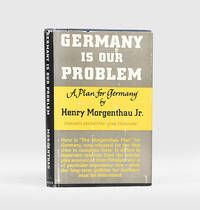
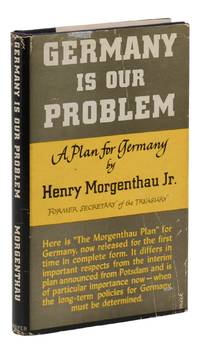
1945187482New York and London: Harper & Brothers Publishers 1945. The Morgenthau Plan First edition of the Morgenthau Plan the proposed de-industrialization and partition of Germany turning it into a pastoral divided nation forever unable to wage war. Morgenthau the US Treasury Secretary submitted the plan in 1944 as an internal memorandum. It proposed demilitarizing Germany dismantling its industrial base and dividing its territory among France Poland an international zone and two German states. Roosevelt and Churchill provisionally accepted elements of the plan at the Quebec Conference in September 1944 which prompted international controversy. Goebbels used it as propaganda to claim Germany faced national destruction and George Marshall argued it was stiffening German resistance. Roosevelt disowned the plan but allowed Morgenthau to publish it. Issued in October 1945 the book comprises a facsimile of the original document followed by Morgenthau's extended commentary and rationale. Morgenthau still hoped it would still serve as the framework for governing post-war Germany and Eisenhower arranged for 1000 copies to be distributed to military officials but it was not implemented. The US instead pursued rebuilding Germany through the Marshall Plan as a counter to Soviet power. Octavo. Folding map diagrams in text. Original blue cloth spine lettered in gilt. With dust jacket. Neat contemporary ownership signature to front free endpaper and their irate inked annotations to the text fervently disagreeing with Morgenthau. Endpapers toned; unclipped jacket slightly sunned and rubbed with minor nicking: a very good copy in very good jacket. hardcover
1945140947693New York and London: Harper & Brothers 1945. First Edition. Near Fine/Near Fine. First edition first printing. viii 4 ix - xiii iii 239 pp. foldout map. Bound in publisher's navy cloth with gilt lettering to spine. Near Fine with light toning to contents and bookplate to front pastedown. In a Near Fine unclipped dust jacket with moderate toning and light edgewear and soiling. Several scratches to front panel 3 archival tape repairs to chipping at upper edge and small hole at lower right of front panel. <p>Henry Morgenthau's controversial plan for postwar Germany. The U.S. Secretary of the Treasury called for the defeated enemy's total deindustrialization decentralization and transformation into a pastoral society. President Franklin Delano Roosevelt regretted his initial support for Morgenthau's plan after it was vigorously decried at home and abroad and his successor favored the less vengeful and more pragmatic Marshall Plan. Harper & Brothers unknown
1945140949192Cambridge MA: Harvard University Press 1945. First edition. First edition first printing. Association copy from the library of Hans Morgenthau his card laid in. xxxiii 1 516 pp. Bound in publisher's red cloth lettered in gilt on spine. Near Fine with light wear to extremities and dulling to spine gilt light soiling to upper textblock edge. In a Good unclipped dust jacket with light soiling and appreciable wear including two small holes to rear flap fold and 1.75" split and evidence of label removal to spine panel.<br /> <br /> <p>A treatise on jurisprudence by the eminent Austrian-American legal theorist Hans Kelsen who wrote the text in German while teaching at the University of California Berkeley. It was translated by the Swedish philosopher Anders Wedberg who had studied at Harvard. Kelsen was a good friend of his fellow jurist and political refugee Hans Morgenthau. He had promoted the younger man's career before the two arrived in the United States and Morgenthau dedicated his 1970 book Truth and Power to Kelsen. Harvard University Press unknown
1946059794Chicago: University Of Chicago Press 1946. 1st Edition 1st Printing. Hardcover. Very Good/Good. Ix 245 Pp. Green Cloth Gilt. First Printing. Book With Wear Spine Gilt Bright. Inscribed By Morgenthau "With Kindest Regards" To Yves René Marie Simon 1903 - 1961. Simon Studied Under Jacques Maritain At The Institut Catholique De Paris. He Taught At The Institut Catholique De Lille From 1930 To 1938. In 1938 He Went To The University Of Notre Dame Where He Remained Until 1958. He Is Best Known For His Work In Moral And Political Philosophy.Dust Jacket Priced $3.00 Wear Short Edge Tears And Small Losses Somewhat Crushed Spine Panel Completely Pinked . Per Wikipedia Morgenthau's Scientific Man Versus Power Politics 1946 Argued Against An Over Reliance On Science And Technology As Solutions To Political And Social Problems. The Book Presented A "Pessimistic View Of Human Nature" Centered On A Universal Lust For Power And The Inevitability Of Selfishness. Hans Joachim Morgenthau 1904 - 1980 Was A German-American Jurist And Political Scientist Who Was One Of The Major 20Th-Century Figures In The Study Of International Relations. Morgenthau Is Usually Considered Among The Most Influential Realists Of The Post-World War Ii Period. Morgenthau Made Landmark Contributions To International Relations Theory And The Study Of International Law. In 1933 Morgenthau Published A Second Book In French La Notion Du "Politique" Which Was Translated Into English And Published In 2012 As The Concept Of The Political. In This Book Morgenthau Seeks To Articulate The Difference Between Legal Disputes Between Nations And Political Disputes Between Nations Or Other Litigants. The Questions Driving The Inquiry Are: I Who Holds Legal Power Over The Objects Or Concerns Being Disputed Ii In What Manner Can The Holder Of This Legal Power Be Changed Or Held Accountable Iii How Can A Dispute The Object Of Which Concerns A Legal Power Be Resolved And Iv In What Manner Will The Holder Of The Legal Power Be Protected In The Course Of Exercising That Power For Morgenthau The End Goal Of Any Legal System In This Context Is To "Ensure Justice And Peace". In His Work In The 1920S And 1930S Morgenthau Sought A "Functional Jurisprudence" An Alternative To Mainstream International Law. He Borrowed Ideas From Sigmund Freud Max Weber Roscoe Pound And Others. In 1940 Morgenthau Set Out A Research Program For Legal Functionalism In The Article "Positivism Functionalism And International Law". Francis Boyle Has Written That Morgenthau's Post-War Writings Perhaps Contributed To A "Break Between International Political Science And International Legal Studies." However Politics Among Nations Contains A Chapter On International Law And Morgenthau Remained An Active Contributor To The Subject Of The Relationship Between International Politics And International Law Until The End Of His Career. His Politics Among Nations First Published In 1948 Went Through Five Editions During His Lifetime And Was Widely Adopted As A Textbook In U.S. Universities. While Morgenthau Emphasized The Centrality Of Power And "The National Interest" The Subtitle Of Politics Among Nations-"The Struggle For Power And Peace"-Indicates His Concern Not Only With The Struggle For Power But Also With The Ways In Which It Is Limited By Ethical And Legal Norms. In Addition To His Books Morgenthau Wrote Widely About International Politics And U.S. Foreign Policy For General-Circulation Publications Such As The New Leader Commentary Worldview The New York Review Of Books And The New Republic. He Knew And Corresponded With Many Of The Leading Intellectuals And Writers Of His Era Such As Reinhold Niebuhr George F. Kennan Carl Schmitt And Hannah Arendt. Morgenthau Was A Consultant To The U.S. Department Of State When Kennan Headed Its Policy Planning Staff And During The Kennedy And Johnson Administrations Until He Was Dismissed By Johnson After He Began To Publicly Criticize American Policy In Vietnam. <br/> <br/> University Of Chicago Press hardcover
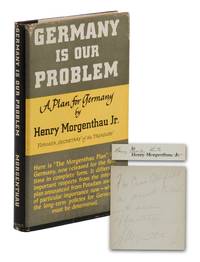
1945140948892New York and London: Harper & Brothers 1945. First Edition. Near Fine/Near Fine. First edition first printing. A remarkable association copy not only signed by author Henry Morgenthau on the front free endpaper and inscribed to the then-President of the book's publisher known for picking Pulitzer Prize winners: "For Cass Canfield a swell Publisher with sincere affection." Additionally it is signed in pencil on the book's title page by one its primary ghostwriters government official Harry Dexter White with Morgenthau's name suggestively crossed-out. As White's biographer David Rees put it "White was now to supervise the writing of a book by Treasury staff explaining the Morgenthau Plan eventually published a year later under Morgenthau's name as Germany is Our Problem." Morgenthau himself acknowledged White's role in the signed copy he gave White in 1945 cited in James Boughton's Harry White and the American Creed. <p>In 1948 a handwritten note by White to Whittaker Chambers would embroil him in a covert hunt for Soviet moles within the U.S. government. He died that year but five years later his face would grace newspapers all over the world as he was accused of being a spy for the Soviet Union connected to the network of Nathan Silvermaster. His degree of culpability remains debated to this day although release of the Venona decrypts provided damning evidence. The posthumous nature of White's notoriety has meant that his signature is extremely rare especially on books rather than documents.<br /> <p>viii 4 ix - xiii iii 239 pp. foldout map printed on speckled wartime paper. Bound in publisher's navy cloth with gilt lettering to spine. Near Fine light rubbing to extremities dulled gilt and dust jacket clipping tipped to front pastedown. In a Near Fine unclipped dust jacket with lightly worn with a few small tape repairs to verso. Uncommon especially in such nice shape.<br /> <br /> <p>The book outlines what would become known as The Morgenthau Plan for postwar Germany. The U.S. Secretary of the Treasury called for the defeated enemy's radical total deindustrialization decentralization and transformation into a pastoral society. President Franklin Delano Roosevelt regretted his initial support for Morgenthau's plan after it was vigorously decried at home and abroad and his successor favored the less vengeful and more pragmatic Marshall Plan. White's role in formulating the plan that would bear his superior at the Treasury Department's name remains little-known as it itself has fallen into obscurity since the early Cold War. Less controversial was White's role in co-founding both the International Monetary Fund and World Bank. Harper & Brothers unknown
1945134H4082New York: Harper & Brothers Publishers. Good in Fair dust jacket. 1945. First Edition. Hardcover. Signed and inscribed by author FDR's Secretary of the Treasury Henry Morgenthau Jr. 1891-1967 to his first cousin once removed James Frank Jr. The infamous Morgenthau Plan charted a course for Germany post WWII intended to revert it to a pastoral state. Senator Henrick Shipstead denounced it as "America's eternal monument of shame for the destruction of the German people." - Congressional Record Senate May 15 1946 p.5039. "The punishment policy deeply betrayed the will of the American people against indiscriminate vengeance which had been demonstrated in the nationwide condemnation of the Morgenthau Plan." - James Bacque Other Losses p.158. "The Morgenthau Plan would wipe out everything in Germany except land and the Germans would have to live on the land. Thus only 60 percent of the population could support themselves and the other 40 percent would die." - The Memoirs of Cordell Hull p.1617. When word of the plan leaked to Goebbels he exploited it to stiffen German resistance thus extending the war - and bringing considerable criticism upon Morgenthau. Unmarked with moderate wear to navy blue cloth. Binding sound. Above-average wear to dust jacket now preserved in archival-grade Brodart. An important and controversial piece of WWII political history.; Germany is Our Problem - A Plan for Germany Suggested Post-Surrender Program for Germany WWII history Politics Harry Dexter White Harsh Peace Morgenthau Plan Starvation Germany Must Perish Theodore Kaufman; Signed by Authors . Harper & Brothers Publishers hardcover