MORGENTHAU HANS JBiblio.com
273 résultats
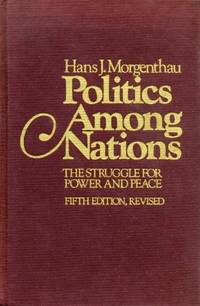
1978G0394500857I4N00ALFRED A. KNOPF 1978. Hardcover. Very Good. May have limited writing in cover pages. Pages are unmarked. ~ ThriftBooks: Read More Spend Less.Dust jacket quality is not guaranteed. ALFRED A. KNOPF hardcover
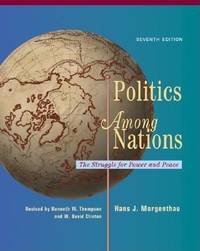
2005UJan2018--1712McGraw-Hill Education 2005-04-19. Paperback. Good. US Edition Textbook May Have Highlights Notes and/or Underlining BOOK ONLY-NO ACCESS CODE NO CD Ships with Emailed Tracking from USA McGraw-Hill Education paperback
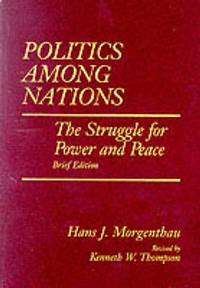
1992Q-0070433062McGraw-Hill Humanities/Social Sciences/Languages 1992-07-01. Paperback. New. In shrink wrap. Looks like an interesting title! McGraw-Hill Humanities/Social Sciences/Languages paperback
0394500857.Ghardcover. Good. Access codes and supplements are not guaranteed with used items. May be an ex-library book. hardcover
0070433062.Gpaperback. Good. Access codes and supplements are not guaranteed with used items. May be an ex-library book. paperback
0394321936.Ghardcover. Good. Access codes and supplements are not guaranteed with used items. May be an ex-library book. hardcover
007289539X.Gpaperback. Good. Access codes and supplements are not guaranteed with used items. May be an ex-library book. paperback
1992SKU0481096McGraw-Hill Humanities/Social Sciences/Languages 1992-07-01. Paperback. Good. 6x0x9. Textbook May Have Highlights Notes and/or Underlining BOOK ONLYNO ACCESS CODE NO CD Ships with Emailed Tracking McGraw-Hill Humanities/Social Sciences/Languages paperback
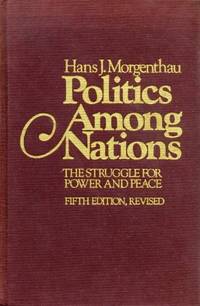
196755993New York: Alfred A. Knopf 1967. Fourth Edition Revised and Reset stated. Third printing Stated. Hardcover. Very good/Good. xxxiv 4 615 1 xiii 3 pages. Maps. Charts. Footnotes. Illustrations. Tabular Data. Appendix. Bibliography. Historical Glossary. Index. DJ has some wear tears chips and soiling and is price clipped. Faint marker notation on rep. A comprehensive theory of international relations revolving around the central principle of power. This revised edition issued during the Vietnam War stresses charismatic power and elaborates on the discussion of political ideologies. There is a discussion of the balance of power. Hans Joachim Morgenthau February 17 1904 – July 19 1980 was a German-American political scientist. He was one of the major twentieth-century figures in the study of international relations. Morgenthau is considered among the most influential realists of the post-World War II period. Morgenthau made landmark contributions to international relations theory and the study of international law. Politics Among Nations was widely adopted as a textbook in U.S. universities. Morgenthau emphasized the centrality of power and "the national interest" -- "the struggle for power and peace" -- his concern was with the struggle for power and the ways in which it is limited by ethics norms and law. Derived from a New York Times article by Barry Gewen: At the start of the Cold War America found itself in a position of leadership for which it was intellectually unprepared. The approach that became the guiding principle of foreign policy over the next four decades was as devised by George F. Kennan known as containment. But the man who provided the intellectual scaffolding for it was Hans J. Morgenthau. Morgenthau set out his ideas most fully in his 1948 masterwork “Politics Among Nations†a book that bears returning to today for the lessons it offers a contemporary America struggling once again to clarify its stance toward a volatile world. Virtually as soon as it was published “Politics Among Nations†became one of the most influential books of the 20th century. Nearly 100 colleges and universities including Harvard Yale and Princeton adopted it for classes and within five years it apparently was being assigned on the nation’s campuses more often than all of the other textbooks on foreign policy combined. It wasn’t only college undergraduates who were reading it. The book’s admirers constituted a Who’s Who of the period’s leading thinkers on foreign policy: Kennan Walter Lippmann Reinhold Niebuhr Raymond Aron and Arthur Schlesinger Jr. Probably no one took more from “Politics Among Nations†than Henry Kissinger. “We shared almost identical premises†Kissinger said at the time of Morgenthau’s death in 1980. “I never ceased admiring him or remembering the profound intellectual debt I owed him.†Morgenthau’s book so revolutionized thinking that its author has been called the founding father of the entire modern study of international affairs. Some have compared his status to that of Freud in psychology. At the dawn of the Cold War “Politics Among Nations†tried to steer a path between isolationists who were suspicious of any foreign entanglements and idealists who believed that America had a mission to convert the world to democracy. Locating that middle ground was the key to its success in 1948. It’s an outlook that still has relevance today. Alfred A. Knopf hardcover
1992DADAX0070433062McGraw-Hill Education 1992-07-01. 1. paperback. New. 6.50x0.75x9.25. Buy with confidence. Excellent Customer Service & Return policy. McGraw-Hill Education paperback
2005SONG007289539XMcGraw-Hill Education 2005-04-19. 7. paperback. Used: Good. 7.50x1.20x9.10. Buy with confidence. Excellent Customer Service & Return policy. McGraw-Hill Education paperback
0226538257.Gpaperback. Good. Access codes and supplements are not guaranteed with used items. May be an ex-library book. paperback
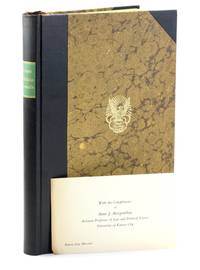
1925510267Duncker & Humboldt 1925. Hardcover with Dust Jacket. VERY GOOD. Personal copy of political theorist Hans Morgenthau with his neat marginal pencilling and newsprint placemarkers. 8vo half black cloth over green marbled boards gilt stamped spine lettering and printer's device to front cover. With publisher's original plain brown dust jacket quite brittle and tattered; original plain slipcase present in a tattered state as well. Provenance: From Hans Morgenthau's daughter Susanna Morgenthau. The penciling matches that of the dozens of other books we have cataloged from his library. The Catholic jurist and political philosopher Carl Schmitt was one of the most influential political thinkers of the 20th Century in no small part for his role in establishing the ideological underpinnings of the Third Reich. He was unavoidably a key interlocutor for all German political scholars of the Weimar Era including Hans Morgenthau who would go on to become one of the most influential political thinkers of the 20th century in his own right from a much different but related vantage point.William Scheuerman writes 'the young Hans Morgenthau was involved in an intense 'hidden dialogue' with Carl Schmitt twentieth-century Germany’s most significant right-wing authoritarian political thinker.' 'Although committed to a sociologically minded analysis of international law shaped by left-wing Weimar legal thought the young Morgenthau turned early on to the work of the right-wing authoritarian thinker Carl Schmitt in order to develop his realistic or sociological approach. Morgenthau's precocious fascination with Schmitt though at first glance surprising is by no means difficult to fathom. Other members of the Sinzheimer School - including Ernst Frankel and Franz Neumann - similarly pursued a close and at times surprisingly sympathetic examination of Schmitt's work during the 1930s. Like Morgenthau they vociferously criticized his extreme right-wing political preferences while acknowledging that Schmitt offered the outlines of a realistic i.e. power-oriented vision of politics too often missing from mainstream jurisprudence and legal positivism. Morgenthau's early writings highlighted deep flaws in Schmitt's thinking not only denouncing his political choices but ultimately describing his theory as fundamentally unsound. Yet he credited Schmitt with acknowledging the need for precisely that realistic account of power relations in the international arena which legal orthodoxy had failed to deliver. Like Morgenthau Schmitt had long been skeptical of mainstream international law which he analogously interpreted as veiling the brutal realities of inequality at the international level. Morgenthau initially appears to have identified Schmitt's theory despite its weaknesses and troublesome political orientation as a potentially useful source of insights for his own alternative theory of international law. Morgenthau's first mention of Schmitt in 1929 . offered a critical response to a widely read 1927 essay by Schmitt in which the right-wing theorist had defined the political as constituting a fundamentally distinct and independent sphere of activity existing alongside alternative modes of human activity. In Schmitt's initial formulation morality concerned the problem of good and bad aesthetics was occupied with the distinction between beautiful and ugly economics was preoccupied with profitability and unprofitability whereas only politics concerned the contrast between what Schmitt famously described as friend and foe. The young Morgenthau astutely diagnosed the Achilles' heel of this position: Schmitt's exposition misleadingly implied that political activity was limited to a pre-given set of objects or concerns thereby obscuring the possibility that any conceivable sphere of activity could take on political qualities. In its stead Morgenthau proposed that politics be described as 'a characteristic quality or coloration which any substance can take on' IRWG 67. The distinctive attribute of political activity was captured best by focusing on the degree of intensity of the conflict at hand. Although drawing their substantive concerns from any of a host of moral aesthetic and economic arenas of human activity identifiably political concerns were those in which a high degree of intensity of conflict had surfaced IRWG 69. Even though he admitted the difficulty of determining at what specific juncture a particular conflict had become intense and thus authentically political Morgenthau insisted that his alternative model of intensity offered a superior way of capturing the distinctive traits of political life. In his view politics was never an either/or state of affairs but always a matter of degree necessarily depending on how intense - and potentially violent - a conflict had become. Schmitt apparently agreed. As Morgenthau noted in his 1978 autobiographical reflections Schmitt subsequently 'changed the second 1932 edition of the Concept of the Political in the light of the new propositions of my thesis without lifting the veil of anonymity from their author.'47 In fact Schmitt's 1932 study dropped the misleading imagery of politics as a distinct or separate sphere instead following Morgenthau's conceptualization of politics as concerning conflicts characterized by intense enmity. Yet Schmitt never bothered to acknowledge his debts to the young left-leaning Jewish Morgenthau. For a politically upwardly mobile right-wing thinker busy cultivating influence with Germany's rising authoritarian political groupings such an admission would have been incon-venient. In his 1978 comments Morgenthau went so far as to accuse Schmitt of having engaged in mean-spirited plagiarism. He recounted a humiliating 1929 meeting with Schmitt in which Morgenthau hoped to discuss their shared interest in the political only to encounter a calculating mean-spirited careerist: 'when I walked down the stairs from Schmitt's apartment I stopped on the landing between his and the next floor and said to myself: 'Now I have met the most evil man alive.' Schmitt's subsequent kowtowing to the Nazis apparently did not take Morgenthau by surprise.' Morgenthau: Key Contemporary Thinkers 32-34. Duncker & Humboldt hardcover
1985Q-0313244987Praeger 1985-01-22. Hardcover. New. In shrink wrap. Looks like an interesting title! Praeger hardcover
0260003131.Ghardcover. Good. Access codes and supplements are not guaranteed with used items. May be an ex-library book. hardcover
0428710425.Ghardcover. Good. Access codes and supplements are not guaranteed with used items. May be an ex-library book. hardcover
0265888085.Ghardcover. Good. Access codes and supplements are not guaranteed with used items. May be an ex-library book. hardcover
0366808729.Ghardcover. Good. Access codes and supplements are not guaranteed with used items. May be an ex-library book. hardcover
0366834266.Ghardcover. Good. Access codes and supplements are not guaranteed with used items. May be an ex-library book. hardcover
0366808680.Gpaperback. Good. Access codes and supplements are not guaranteed with used items. May be an ex-library book. paperback
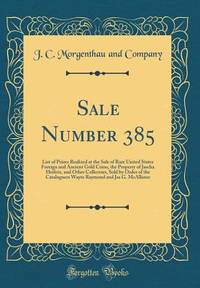
193241082New York: J.C. Morgenthau 1932. First edition. Paper wrappers. A very good clean copy. 26 pp. Illus. with b/w photos. 8vo. 82 items described. Lancour 5893. J.C. Morgenthau unknown books
0265903521.Ghardcover. Good. Access codes and supplements are not guaranteed with used items. May be an ex-library book. hardcover
0265902738.Ghardcover. Good. Access codes and supplements are not guaranteed with used items. May be an ex-library book. hardcover
0266918611.Ghardcover. Good. Access codes and supplements are not guaranteed with used items. May be an ex-library book. hardcover
0266901875.Ghardcover. Good. Access codes and supplements are not guaranteed with used items. May be an ex-library book. hardcover