257 résultats
1925510267Duncker & Humboldt 1925. Hardcover with Dust Jacket. VERY GOOD. Personal copy of political theorist Hans Morgenthau with his neat marginal pencilling and newsprint placemarkers. 8vo half black cloth over green marbled boards gilt stamped spine lettering and printer's device to front cover. With publisher's original plain brown dust jacket quite brittle and tattered; original plain slipcase present in a tattered state as well. Provenance: From Hans Morgenthau's daughter Susanna Morgenthau. The penciling matches that of the dozens of other books we have cataloged from his library. The Catholic jurist and political philosopher Carl Schmitt was one of the most influential political thinkers of the 20th Century in no small part for his role in establishing the ideological underpinnings of the Third Reich. He was unavoidably a key interlocutor for all German political scholars of the Weimar Era including Hans Morgenthau who would go on to become one of the most influential political thinkers of the 20th century in his own right from a much different but related vantage point.William Scheuerman writes 'the young Hans Morgenthau was involved in an intense 'hidden dialogue' with Carl Schmitt twentieth-century Germany’s most significant right-wing authoritarian political thinker.' 'Although committed to a sociologically minded analysis of international law shaped by left-wing Weimar legal thought the young Morgenthau turned early on to the work of the right-wing authoritarian thinker Carl Schmitt in order to develop his realistic or sociological approach. Morgenthau's precocious fascination with Schmitt though at first glance surprising is by no means difficult to fathom. Other members of the Sinzheimer School - including Ernst Frankel and Franz Neumann - similarly pursued a close and at times surprisingly sympathetic examination of Schmitt's work during the 1930s. Like Morgenthau they vociferously criticized his extreme right-wing political preferences while acknowledging that Schmitt offered the outlines of a realistic i.e. power-oriented vision of politics too often missing from mainstream jurisprudence and legal positivism. Morgenthau's early writings highlighted deep flaws in Schmitt's thinking not only denouncing his political choices but ultimately describing his theory as fundamentally unsound. Yet he credited Schmitt with acknowledging the need for precisely that realistic account of power relations in the international arena which legal orthodoxy had failed to deliver. Like Morgenthau Schmitt had long been skeptical of mainstream international law which he analogously interpreted as veiling the brutal realities of inequality at the international level. Morgenthau initially appears to have identified Schmitt's theory despite its weaknesses and troublesome political orientation as a potentially useful source of insights for his own alternative theory of international law. Morgenthau's first mention of Schmitt in 1929 . offered a critical response to a widely read 1927 essay by Schmitt in which the right-wing theorist had defined the political as constituting a fundamentally distinct and independent sphere of activity existing alongside alternative modes of human activity. In Schmitt's initial formulation morality concerned the problem of good and bad aesthetics was occupied with the distinction between beautiful and ugly economics was preoccupied with profitability and unprofitability whereas only politics concerned the contrast between what Schmitt famously described as friend and foe. The young Morgenthau astutely diagnosed the Achilles' heel of this position: Schmitt's exposition misleadingly implied that political activity was limited to a pre-given set of objects or concerns thereby obscuring the possibility that any conceivable sphere of activity could take on political qualities. In its stead Morgenthau proposed that politics be described as 'a characteristic quality or coloration which any substance can take on' IRWG 67. The distinctive attribute of political activity was captured best by focusing on the degree of intensity of the conflict at hand. Although drawing their substantive concerns from any of a host of moral aesthetic and economic arenas of human activity identifiably political concerns were those in which a high degree of intensity of conflict had surfaced IRWG 69. Even though he admitted the difficulty of determining at what specific juncture a particular conflict had become intense and thus authentically political Morgenthau insisted that his alternative model of intensity offered a superior way of capturing the distinctive traits of political life. In his view politics was never an either/or state of affairs but always a matter of degree necessarily depending on how intense - and potentially violent - a conflict had become. Schmitt apparently agreed. As Morgenthau noted in his 1978 autobiographical reflections Schmitt subsequently 'changed the second 1932 edition of the Concept of the Political in the light of the new propositions of my thesis without lifting the veil of anonymity from their author.'47 In fact Schmitt's 1932 study dropped the misleading imagery of politics as a distinct or separate sphere instead following Morgenthau's conceptualization of politics as concerning conflicts characterized by intense enmity. Yet Schmitt never bothered to acknowledge his debts to the young left-leaning Jewish Morgenthau. For a politically upwardly mobile right-wing thinker busy cultivating influence with Germany's rising authoritarian political groupings such an admission would have been incon-venient. In his 1978 comments Morgenthau went so far as to accuse Schmitt of having engaged in mean-spirited plagiarism. He recounted a humiliating 1929 meeting with Schmitt in which Morgenthau hoped to discuss their shared interest in the political only to encounter a calculating mean-spirited careerist: 'when I walked down the stairs from Schmitt's apartment I stopped on the landing between his and the next floor and said to myself: 'Now I have met the most evil man alive.' Schmitt's subsequent kowtowing to the Nazis apparently did not take Morgenthau by surprise.' Morgenthau: Key Contemporary Thinkers 32-34. Duncker & Humboldt hardcover
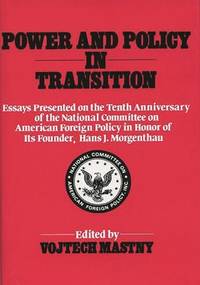
1985Q-0313244987Praeger 1985-01-22. Hardcover. New. In shrink wrap. Looks like an interesting title! Praeger hardcover
0260003131.Ghardcover. Good. Access codes and supplements are not guaranteed with used items. May be an ex-library book. hardcover
0428710425.Ghardcover. Good. Access codes and supplements are not guaranteed with used items. May be an ex-library book. hardcover
0265888085.Ghardcover. Good. Access codes and supplements are not guaranteed with used items. May be an ex-library book. hardcover
0366808729.Ghardcover. Good. Access codes and supplements are not guaranteed with used items. May be an ex-library book. hardcover
0366834266.Ghardcover. Good. Access codes and supplements are not guaranteed with used items. May be an ex-library book. hardcover
0366808680.Gpaperback. Good. Access codes and supplements are not guaranteed with used items. May be an ex-library book. paperback
0265903521.Ghardcover. Good. Access codes and supplements are not guaranteed with used items. May be an ex-library book. hardcover
0265902738.Ghardcover. Good. Access codes and supplements are not guaranteed with used items. May be an ex-library book. hardcover
0266918611.Ghardcover. Good. Access codes and supplements are not guaranteed with used items. May be an ex-library book. hardcover
0266901875.Ghardcover. Good. Access codes and supplements are not guaranteed with used items. May be an ex-library book. hardcover
0366806920.Ghardcover. Good. Access codes and supplements are not guaranteed with used items. May be an ex-library book. hardcover
036503472X.Ghardcover. Good. Access codes and supplements are not guaranteed with used items. May be an ex-library book. hardcover
0365050423.Ghardcover. Good. Access codes and supplements are not guaranteed with used items. May be an ex-library book. hardcover
0364059621.Gpaperback. Good. Access codes and supplements are not guaranteed with used items. May be an ex-library book. paperback
0366834754.Ghardcover. Good. Access codes and supplements are not guaranteed with used items. May be an ex-library book. hardcover
0366878999.Ghardcover. Good. Access codes and supplements are not guaranteed with used items. May be an ex-library book. hardcover
0366835467.Ghardcover. Good. Access codes and supplements are not guaranteed with used items. May be an ex-library book. hardcover
0366834746.Gpaperback. Good. Access codes and supplements are not guaranteed with used items. May be an ex-library book. paperback
0366834622.Ghardcover. Good. Access codes and supplements are not guaranteed with used items. May be an ex-library book. hardcover
0366830074.Gpaperback. Good. Access codes and supplements are not guaranteed with used items. May be an ex-library book. paperback
0366830082.Ghardcover. Good. Access codes and supplements are not guaranteed with used items. May be an ex-library book. hardcover
0428711243.Ghardcover. Good. Access codes and supplements are not guaranteed with used items. May be an ex-library book. hardcover
042843679X.Gpaperback. Good. Access codes and supplements are not guaranteed with used items. May be an ex-library book. paperback