634 résultats
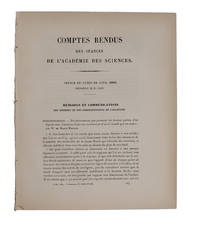
190547065Paris Gauthier-Villars 1905. 4to. No wrappers. In: "Comptes Rendus Hebdomadaires des Séances de L'Academie des Sciences" Tome 140 No 23. Titlepage to vol. 140. Pp. 1497- 1572. Entire issue offered. Poincaré's paper: pp. 1504-1508. Titlepage with a stamp on verso. A bit of upper right corner gone. Leaves a bit fragile caused by the poor paperquality. Clean. <br/><br/><em>First printing of this famous paper delivered to the Academy of Paris on its session of June 1905 as the first Poincaré relativistic text "On the dynamic of electron" where Poincaré set forth the essential element of relativity and the "Lorentz Transformation". Poincaré concludes "It seems that this impossibility of demonstrating absolute motion is a general law of nature" !! and that Newton's law need modification and that there should exist gravitational waves which propagate with the velocity of light !! - This famous paper gave rice to the controversy about priority around the discovery of special relativity as Poincaré's paper is from June 5 and Einstein's first paper on relativity was received by the "Annalen" on June 30 both 1905."The official history tells us that Einstein without having read the works of Lorentz and Poincaré past 1895 and without any prior publication on the subject had written alone in Bern the "founder paper" of the Relativity in the last days of June 1905. For that reason and a few other of less importance the biographers of Einstein have called that year 1905 "Annus mirabilis" and its centenial is celebrated in 2005. However on June 5 1905 after many other papers on this subject Poincaré had presenteda note at the French Academy of Science a text that contains the essential elements of Einstein paper: the relativity principle and the "Lorentz transformation". This coincidence involves the suspicion of a possible plagiarism of Poincaré by Einstein." C. Marchal "Poincaré Einstein and the Relativity: the Surprising Secret." </em> unknown
190546288Berlin Uppsala & Stockholm Paris 1905. 4to. Bound in contemporary half cloth. In "Acta Mathematica Hrsg. von G. Mittag-Leffler." Bd. 29. Entires issue offered. Fine and clean. Pp. 235-272. Entire volume: 4 433 pp. <br/><br/><em>Second of this paper in which Poincaré comments on the Swedish astronomer work.The offered issue contain many other papers by contemporary mathematicians. </em> hardcover
190549615Berlin G. Reimer 1905 4to. Bound in contemporary half cloth with gilt lettering to spine. In "Acta Mathematica" Vol 29 1905. Entire volume offered. Stamps to title page otherwise a fine and clean copy. Pp. 235-72. Entire volume: 4 433 pp. <br/><br/><em>First printing of Poincaré's final and most extensive paper on Gyldén's horistic methods. </em> hardcover
189239133Berlin Uppsala & Stockholm Paris 1892 a. 1897. 4to. Without wrappers as extracted from "Acta Mathematica Hrsg. von G. Mittag-Leffler." Bd. 16 and 20 pp. 297-339 and pp. 313-355. <br/><br/><em>First edition of these importent papers on the polarization of light. The geometrical representation of different states of polarization by points on a sphere are due to Poincare. The method shown to visualize the different states of polarization is given in these two papers and the method is called Poincare's Sphere. </em> unknown
189245849Berlin Uppsala & Stockholm Paris 1892 a. 1897. 4to. Without wrappers as extracted from "Acta Mathematica Hrsg. von G. Mittag-Leffler." Bd. 16 and 20. Fine and clean. Pp. 297-339 pp. 313-355. <br/><br/><em>First edition of these important papers on the polarization of light. The geometrical representation of different states of polarization by points on a sphere is due to Poincare. The method shown to visualize the different states of polarization is given in these two papers and the method is called Poincare's Sphere. </em> unknown
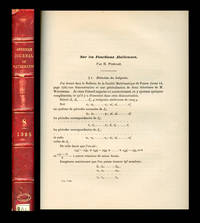
18861389Baltimore: John Hopkins University 1886. 1st Edition. FIRST EDITION OF POINCARE'S PROOF & A GENERALIZATION OF TWO THEOREMS OF KARL WEIERSTRASS a German mathematician frequently cited as the ‘father of modern analysis.' "Henri Poincaré 1854-1912 was a mathematician theoretical physicist and a philosopher of science famous for discoveries in several fields and referred to as the last polymath one who could make significant contributions in multiple areas of mathematics and the physical sciences" Stanford Encyclopedia of Philosophy. <br /> <br /> While the proof Poincare published here had appeared in a French journal Poincare wanted it placed in American Journal of Mathematic the journal offered here so that he could both reproduce and expand upon it. As with many of Poincare's work this one exists or involves the interaction between various branches of mathematics. <br /> <br /> A translation of the first paragraph of Poincare's paper reads: ""I have given in the Bulletin de la Societe mathematique de France t. 12 page 124 a proof and a generalization of two theorems of M. Weierstrass. I wish to reproduce them here succinctly by making some additions which are essential to the proof" Poincare 289. The paper proceeds under six headings respectively: Reduction of Integrals; Singular Case of Reduction; Generalization of the Theorem of Abel; Intermediary Functions; Transformation; Sum of Zeros" Poincare 289. <br /> <br /> Poincare's proof and generalization relates to Weierstrass's work on Abelian functions and algebraic geometry. In fact "as soon as he came into contact with the work of Riemann and Weierstrass on Abelian functions and algebraic geometry Poincare was very much attracted by those fields. His papers on these subjects occupy in his complete works as much space as those on automorphic functions their dated ranging from 1881 to 1911. One of the main ideas in these papers is that of "reduction" of Abelian functions. Generalizing particular cases studied by Jacobi Weierstrass and Picard Poincare proved the general "complete reducibility" theorem. Abelian varieties can be decomposed in sums of "simple" abelian varieties having finite intersection. Poincare noted further that Abelian functions corresponding to reducible varieties and even to products of elliptic curves that is Abelian varieties of dimension 1 are "dense" among all Abelian functions - a result that enabled him to extend and generalize many of Riemann's results on theta functions and to investigate the special properties of the theta functions corresponding to the Jacobian varieties of algebraic curves. Dictionary of Scientific Biography Vol. 11 p. 54. CONDITION & DETAILS: Full volume handsomely bound in half red leather and marbled boards scuffed and rubbed at the edges and spine; raised bands at the spine as well as gilt-lettering. Ex-libris bookplate front paste-down library "Due Date" label tipped-in rfep small library number sticker spine. No other library markings. 4to. Clean and bright throughout. Very good. John Hopkins University hardcover
188244432Leipzig B.G. Teubner 1882. 8vo. Original printed wrappers no backstrip. In "Mathematische Annalen. Begründet 1882 durch Rudolf Friedrich Alfred Clebsch. XIX. 19 Band. 4. Heft." Entire issue offered. Poincaré: Pp. 553-64. Entire issue: Pp. 435-594. <br/><br/><em>First printing of Poincaré's paper on his comprehensive theory of complex-valued functions which remain invariant under the infinite discontinuous group of linear transformations. In 1881 Poincaré had published a few short papers with some initial work on the topic and in the 1881 Klein invited Poincaré to write a longer exposition of his results to Mathematische Annalen which became the present paper. This however turned out to be an invitation to at mathematical dispute:"Before the article went to press Klein forewarned Poincaré that he had appended a note to it in which he registered his objections to the terminology employed therein. In particular Klein disputed Poincaré's decision to name the important class of functions possessing a natural boundary circle after Fuch's a leading exponent of the Berlin school. The importance he attached to this matter however went far beyond the bounds of conventional priority dispute. True Klein was concerned that his own work received sufficient acclaim but the overriding issue hinged on whether the mathematical community would regard the burgeoning research in this field as an outgrowth of Weierstrassian analysis or the Riemannian tradition." Parshall. The Emergence of the American Mathematical Research Community. Pp. 184-5.The issue contains the following important contributions by seminal mathematicians:1. Klein Felix. Ueber eindeutige Functionen mit linearen Transformationen in sich. Pp. 565-68.2. Picard Emile. Sur un théorème relatif aux surfaces pour lesquelles les coordnnées d´un point quelconque s´experiment par des fonctions abéliennes de deux paramètres. Pp. 578-87.3. Cantor Georg. Ueber ein neues und allgemeines Condensationsprincip der Singularitäten von Functionen. Pp. 588-94. </em> unknown
188249173Paris: Gauthier-Villars 1882. 4to. No wrappers. In: "Comptes Rendus Hebdomadaires des Seances de l'Academie des Sciences" Vol 94 No 4 15 17. Pp. 149- 184 pp. 997-- 1068 a. pp. 1139- 1214. 3 entire issues offered. Poincare's papers: pp. 163-168 1038-1042 a. 1166-67. <br/><br/><em>First appearance in print of the discovery of the automorphic forms which Poincaré named Fuchsian functions."One of Poincaré's first discoveries in mathematics dating to the 1880s was automorphic forms. He named them Fuchsian functions after the mathematician Lazarus Fuchs because Fuchs was known for being a good teacher and had researched on differential equations and the theory of functions. Poincaré actually developed the concept of these functions as part of his doctoral thesis. Under Poincaré's definition an automorphic function is one which is analytic in its domain and is invariant under a discrete infinite group of linear fractional transformations. Automorphic functions then generalize both trigonometric and elliptic functions." Wikipedia. </em> unknown
188247185Leipzig B.G. Teubner 1882. 8vo. Bound in recent full black cloth with gilt lettering to spine. In "Mathematische Annalen" Volume 37 1890. Entire volume offered. Library label pasted on to pasted down front free end-paper. Small library stamp to lower part of title title page and verso of title page. Fine and clean. Pp. 182-228. Entire volume: IV 604 pp. <br/><br/><em>First printing of Poincaré's paper on his comprehensive theory of complex-valued functions which remain invariant under the infinite discontinuous group of linear transformations. In 1881 Poincaré had published a few short papers with some initial work on the topic and in the 1881 Klein invited Poincaré to write a longer exposition of his results to Mathematische Annalen which became the present paper. This however turned out to be an invitation to at mathematical dispute:"Before the article went to press Klein forewarned Poincaré that he had appended a note to it in which he registered his objections to the terminology employed therein. In particular Klein disputed Poincaré's decision to name the important class of functions possessing a natural boundary circle after Fuch's a leading exponent of the Berlin school. The importance he attached to this matter however went far beyond the bounds of conventional priority dispute. True Klein was concerned that his own work received sufficient acclaim but the overriding issue hinged on whether the mathematical community would regard the burgeoning research in this field as an outgrowth of Weierstrassian analysis or the Riemannian tradition." Parshall. The Emergence of the American Mathematical Research Community. Pp. 184-5.The issue contains the following important contributions by seminal mathematicians:1. Klein Felix. Ueber eindeutige Functionen mit linearen Transformationen in sich. Pp. 565-68.2. Picard Emile. Sur un théorème relatif aux surfaces pour lesquelles les coordnnées d´un point quelconque s´experiment par des fonctions abéliennes de deux paramètres. Pp. 578-87. </em> hardcover
188541900Stockholm F.& G. Beier 1885. 4to. Orig. printed wrappers to Acta Mathematica 4:3. Extracted from "Acta Mathematica" Vol. 4. Pp. 201-312. Clean and fine. <br/><br/><em>First appearance of a major paper on differential equations of the first order".the whole theory of automorphic functions was from the start guided by the idea of integrating linear differential equations with algebraic coefficients. Poincaré simultaneously investigated the local problem of linear differential equation in the neighborhood of an "irregular" singular point showing for the first time how asymptotic developments could be obtained for the integrals. A little later 1884 the paper offered he took up the question also started by I.L. Fuchs of the determination of all differential equations of the first order in the complex domain algebraic in y and y' and having fixed singular points; his rechearches was to be extended by Picard for equations of the second order and to lead to the spectacular results of Painlevé and his school at the beginning of the tweentieth century."DSB. </em> unknown
188639132Berlin Uppsala & Stockholm Paris 1886. 4to. Without wrappers as extracted from "Acta Mathematica. Hrsg. von G. Mittag-Leffler." Bd. 8 pp. 295-344. <br/><br/><em>First edition. "The full recognition of the nature of those divergent series that are useful in the representation and calculation of functions and a formal definition of those series wer achieved by Poincaré and Stieltjes independently in 1886. Poincaré called these series asymptotic while Stieltjes continued to use the term semiconvergent. Poincaré took up the subject in order to further the solution of linear differential equations. Impressed by the usefulness of divergent series in astronomy he sought to determine which were useful and why. he succededed in islolating and formulating the essential property.Poincaré applied his theory of asymptotic series to diffrential equations and theree are many such uses in his treatise on celestical mechanics 'Les Methodes nouvelles de la mechanique céleste". Morris Kline. </em> unknown
1016628781.Ghardcover. Good. Access codes and supplements are not guaranteed with used items. May be an ex-library book. hardcover
189839135Berlin Uppsala & Stockholm Paris Almqvist & Wiksell 1898. 4to. Without wrappers as extracted from "Acta Mathematica. Hrsg. von G. Mittag-Leffler." Bd. 22 pp. 89-178. <br/><br/><em>First edition. "As soon as he came into contact with the work of Riemann and Weierstrass on Abelian Functions and algebraic geometry Poincaré was very much attracted by those fields. His papers on these subjects occupy in his complete works as much space as those on automorphic functions their dates ranging from 1881 to 1911. One of his main ideas in these papers is that of "reduction" of Abelian functions. Generalizing particular cases studied b Jacobi Weierstrass and Picard Poincaré proved the general "complete reducibility" theorem."DSB. </em> unknown
189746182Berlin Stockholm Paris F. & G. Beijer 1897. 4to. Without wrappers as extracted from "Acta Mathematica. Hrdg. von G. Mittag-Leffler." Bd. 21. No backstrip. Fine and clean. Pp. 331-341. <br/><br/><em>First printing of Poincaré's principal address at the first International Congress of Mathematicians held in Zürich in 1897. </em> unknown
188745902Stockholm Beijer 1887. 4to. With the original wrappers in "Acta Mathematica 9:4. Band. No backstrip. Fine and clean. Pp. 321-380. Entire issue: Pp. 321-400 <br/><br/><em>First printing of Poincaré important - but partly unrecognized - paper which coined the term 'Poincaré lemma'. Even though it is named after Poincaré the discovery has by attributed to the Italian mathematician Vito Volterra who published a series of papers in 1889 on this subject. </em> unknown
a103423dParis 1882 first edition. Gauthier Villars. Hardcover. Thick 4to. Marbled boards with half blue leather. Marbled end papers. 1431p. in volume. Poincare articles at p. 23-26 626-28 766-68. Many other important articles on other topics in same volume by Louis Pasteur Etienne Marey others. Text is Near Fine binding is very secure; hinges are not cracked. Cover leather is rubbed and somewhat worn. Overall Good plus. no owner marks. Pictures available on request. . hardcover
188545788Stockholm Beijer 1885. 4to. As extracted from "Acta Mathematica 21. Band. No backstrip. Fine and clean. Pp. 83-97. <br/><br/><em>First printing of Poincaré's paper in which he developed the idea published by Fuchs in 1884. Fuchs established that the equation with fixed branch points can be made into a Riccati equation if its genus - the genus of the corresponding Riemann surface - with respect to u and du/dz is zero and can be integrated using elliptic functions if the genus is 1. </em> unknown
189739134Berlin Uppsala & Stockholm Paris Almqvist & Wiksell 1897. 4to. No wrappers as extracted from "Acta Mathematica. Hrsg. von G. Mittag-Leffler." Bd. 21 pp. 83-97. <br/><br/><em>First edition. In this paper Poincaré arrives at a new theorem about canonical transformation and in his later "Methodes Nouvelles" he proved this theorem using a variiational principle of mechanics known today as the Hamilton principle. </em> unknown
189749621Berlin Uppsala & Stockholm Paris Almqvist & Wiksell 1897. 4to. Bound in contemporary half cloth with gilt lettering to spine. In "Acta Mathematica" Vol 21 1897. Entire volume offered. Stamps to title page otherwise a fine and clean copy. pp. 83-97; Pp. 331-341.Entire volume: 6 376 pp 4 plates. <br/><br/><em>First printing of this paper in which Poincaré arrives at a new theorem about canonical transformation and in his later "Methodes Nouvelles" he proved this theorem using a variiational principle of mechanics known today as the Hamilton principle.Also included is the first printing of Poincaré's principal address at the first International Congress of Mathematicians held in Zürich in 1897. </em> hardcover
a112510Issues for July 1922 Vol. IX no 3 and Vol XX no. 1. January 1933. Octavo original printed wraps. pp. 111-183; pp. 1-130. Two complete issues. G and VG. 1922 issue has a few tiny mss ink lines at end of table of contents otherwise no owner marks. 1922 issue has reinforced backstrip; both volumes are clean and bright and securely bound. Pair: . paperback
45126293-nnew. unknown
45126293like new. unknown
1112361758.Gpaperback. Good. Access codes and supplements are not guaranteed with used items. May be an ex-library book. paperback
1023382474.Ghardcover. Good. Access codes and supplements are not guaranteed with used items. May be an ex-library book. hardcover
1023382415.Gpaperback. Good. Access codes and supplements are not guaranteed with used items. May be an ex-library book. paperback