1 180 résultats
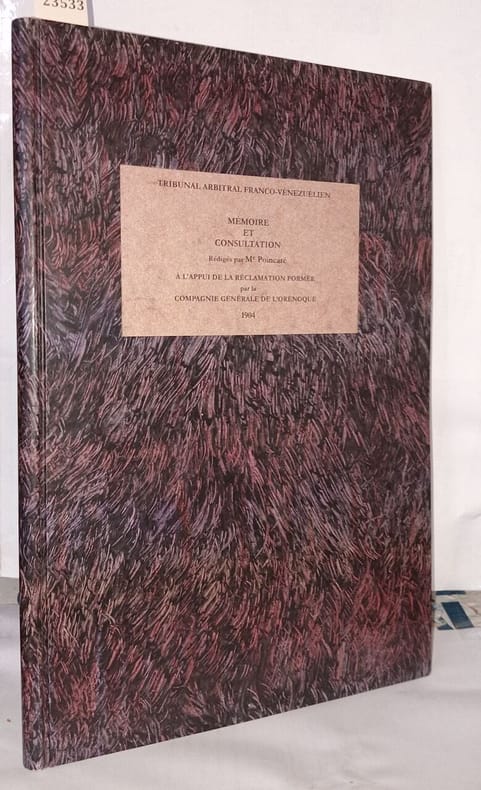
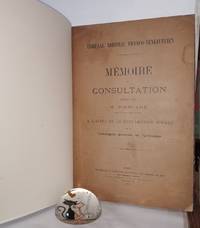
2026523406Imp. et lib. centrale des chemins de fer 2026. Etat correct Reliure en bon état . Brochure d'origine insolée marges brunies . Nombreux passages soulignés et notes en marge. quelques petites tâches en marge également. in-4. 2026. Relié. 127 pages. Imp. et lib. centrale des chemins de fer unknown
1904523406Imp. et lib. centrale des chemins de fer 1904 127 pages in-4. 1904. Relié. 127 pages.
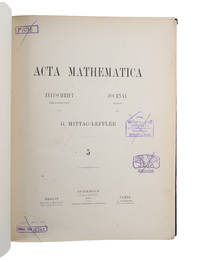
188462251Berlin Stockholm Paris F. & G. Beijer 1884. 4to. In contemporary half cloth. Stamps to title-page and last leaf. In "Acta Mathematica" no 5 1884/1885. Entire issue offered. Pp. 209-278. Entire issue: 4 408 pp. <br/><br/><em>First publication of this groundbreaking paper which together with his three other papers on the pubject not offered here constitute the discovery of Automorphic Functions. "Before he was thirty years of age Poincaré became world famous with his epoch-making discovery of the "automorphic functions" of one complex variable or as he called them the "fuchsian" and "kleinean" functions." DSB.These manuscripts written between 28 June and 20 December 1880 show in detail how Poincaré exploited a series of insights to arrive at his first major contribution to mathematics: the discovery of the automorphic functions. In particular the manuscripts corroborate Poincaré's introspective account of this discovery 1908 in which the real key to his discovery is given to be the recognition that the transformations he had used to define Fuchsian functions are identical with those of non-Euclidean geometry. See Walter Poincaré Jules Henri French mathematician and scientist.The idea was to come in an indirect way from the work of his doctoral thesis on differential equations. His results applied only to restricted classes of functions and Poincaré wanted to generalize these results but as a route towards this he looked for a class functions where solutions did not exist. This led him to functions he named Fuchsian functions after Lazarus Fuchs but were later named automorphic functions. First editions and first publications of these epochmaking papers representing the discovery of "automorphic functions" or as Poincaré himself called them the "Fuchsian" and "Kleinian" functions."By 1884 Poincaré published five major papers on automorphic functions in the first five volumes of the new Acta Mathematica. When the first of these was published in the first volume of the new Acta Mathematica Kronecker warned the editor Mittag-Leffler that this immature and obscure article would kill the journal. Guided by the theory of elliptic functions Poincarë invented a new class of automorphic functions. This class was obtained by considering the inverse function of the ratio of two linear independent solutions of an equation. Thus this entire class of linear diffrential equations is solved by the use of these new transcendental functions of Poincaré." Morris Kline.Poincaré explains how he discovered the Automorphic Functions: "For fifteen days I strove to prove that there could not be any functions like those I have since called Fuchsian functions I was then very ignorant; every day I seated myself at my work table stayed an hour or two tried a great number of combinations and reached no results. One evening contrary to my custom I drank black coffee and could not sleep. Ideas rose in crowds; I felt them collide until pairs interlocked so to speak making a stable combination. By the next morning I had established the existence of a Class of Fuchsian functions those which come from hypergeometric series; i had only to write out the results which took but a few hours.the transformations that I had used to define the Fuchsian functions were identical with those of Non-Euclidean geometry." </em> hardcover
188245910Berlin Stockholm Paris F. & G. Beijer 1882. Large4to. As extracted from "Acta Mathematica" In "Acta Mathematica" volume 1. Clean and fine. Pp. 193-294. <br/><br/><em>First printing of Poincaré's famous paper which conjectured the uniformization theorem for the Riemann surfaces of algebraic curves. It also constitute the second paper in Poincaré's exceedingly important series of six paper's which together represent the discovery of Automorphic Functions. "Before he was thirty years of age Poincaré became world famous with his epoch-making discovery of the "automorphic functions" of one complex variable or as he called them the "fuchsian" and "kleinean" functions." DSB.These manuscripts written between 28 June and 20 December 1880 show in detail how Poincaré exploited a series of insights to arrive at his first major contribution to mathematics: the discovery of the automorphic functions. In particular the manuscripts corroborate Poincaré's introspective account of this discovery 1908 in which the real key to his discovery is given to be the recognition that the transformations he had used to define Fuchsian functions are identical with those of non-Euclidean geometry.The idea was to come in an indirect way from the work of his doctoral thesis on differential equations. His results applied only to restricted classes of functions and Poincaré wanted to generalize these results but as a route towards this he looked for a class functions where solutions did not exist. This led him to functions he named Fuchsian functions after Lazarus Fuchs but were later named automorphic functions. First editions and first publications of these epochmaking papers representing the discovery of "automorphic functions" or as Poincaré himself called them the "Fuchsian" and "Kleinian" functions."By 1884 Poincaré published five major papers on automorphic functions in the first five volumes of the new Acta Mathematica. When the first of these was published in the first volume of the new Acta Mathematica Kronecker warned the editor Mittag-Leffler that this immature and obscure article would kill the journal. Guided by the theory of elliptic functions Poincarë invented a new class of automorphic functions. This class was obtained by considering the inverse function of the ratio of two linear independent solutions of an equation. Thus this entire class of linear diffrential equations is solved by the use of these new transcendental functions of Poincaré." Morris Kline.Poincaré explains how he discovered the Automorphic Functions: "For fifteen days I strove to prove that there could not be any functions like those I have since called Fuchsian functions I was then very ignorant; every day I seated myself at my work table stayed an hour or two tried a great number of combinations and reached no results. One evening contrary to my custom I drank black coffee and could not sleep. Ideas rose in crowds; I felt them collide until pairs interlocked so to speak making a stable combination. By the next morning I had established the existence of a Class of Fuchsian functions those which come from hypergeometric series; i had only to write out the results which took but a few hours.the transformations that I had used to define the Fuchsian functions were identical with those of Non-Euclidean geometry." </em> unknown
188245910[Berlin, Stockholm, Paris, F. & G. Beijer, 1882]. Large4to. As extracted from ""Acta Mathematica"", In ""Acta Mathematica"", volume 1. Clean and fine. Pp. 193-294.
188462251Berlin, Stockholm, Paris, F. & G. Beijer, 1884. 4to. In contemporary half cloth. Stamps to title-page and last leaf. In ""Acta Mathematica"", no 5, 1884/1885. Entire issue offered. Pp. 209-278. [Entire issue: (4) 408 pp.].
310715/08/1922 & Je ferai le possible pour venir quelques instants au Conseil de luniversit demain matin, comme vous voulez bien men exprimer le dsir. Mais je crains de ntre pas libre avant 11 heures moins ou 11 heures&
310807/02/1930 & Je nai aucune observation prsenter sur le programme de Confrences que vous avez bien voulu me communiquer et que je vous retourne ci-joint&
124816/01/1897 & Je vais immdiatement me renseigner sur le sort fait la proposition dont M. Perchot avait t lobjet et, sil en est temps encore, lappuyer de mon mieux&
124531/07 & Nous avons t trs touchs, chre Madame, de votre tmoignage de sympathie et nous vous en remercions vivement&
124614/02/1897 & Voici lavis attendu de la nomination de M. Perchot. Je mempresse de vous le transmettre&
125125/02/1897 & Voici une lettre de M. Liard qui explique le retard de la nomination de M. Perchot, mais qui est, en mme temps, trs rassurante. Je suis heureux davoir vous la transmettre& Au verso, rponse signe Marie Waldeck-Rousseau : & Renvoyez moi de suite la lettre de L. afin quen remerciant S. je puisse la lui rendre& Louis Liard (1846-1917), philosophe et administrateur franais. Il travaille en collaboration avec des savants et de hauts-fonctionnaires de la Troisime Rpublique tels que Raymond Poincar ou Jules Ferry. Il est galement un minent personnage de la Franc-Maonnerie.Justin Perchot (1867-1946), homme politique franais.
4113Poincar adresse ses flicitations George Souli de Morant, diplomate, sinologue et promoteur de lacupuncture en France :& Remerciements et flicitations pour ltude sur les droits conventionnels des trangers en Chine & Les Droits conventionnels des trangers en Chine (1916), George Souli de Morant (1878-1955), Paris, chez L. Tenin , 1916.
301110/03/1930 Poincar avise son correspondant de son accord pour la date quon lui propose : & Jaccepte volontiers la date de jeudi 3 avril 4h Comit, 5h Assemble pour la socit des amis de luniversit. Jespre que je serais en mesure dassister aux deux sances&
124719/06/1898 Poincar ne peut accompagner son ami cause dun entretien demand par M. Sarrier la dernire minute. & Je me proposais et me rjouissais daller vous accompagner et vous entendre aujourdhui St Mand. Mais Sarrier ma manifest le dsir davoir un entretien avec moi cet aprs-midi et je ne puis naturellement lui refuser&
125007/02/1923 Poincar sollicite une faveur : & Sil tait possible Mr Martin Archer dattendre quelques jours, je le recevrai volontiers entre le 16 et le 21, aprs la sparation des chambres, dont les deux sances quotidiennes ne me laissent en ce moment, aucune libert !...Sir Martin Archer-Shee (1873-1935) est un officier britannique et homme politique du parti Conservateur. Aprs sa carrire militaire, il se lance en politique. En cette anne 1923, il est fait Chevalier mais aussi battu par son adversaire du parti Travailliste George Masterman Gillett.
265516/12/1925 Raymond Poincar regrette de navoir pas t chez lui ...lorsque vous tes venu pour me voir. Jaurai, je pense, le plaisir de vous rencontrer, de nouveau, au Palais avant la runion de notre Colonne, qui ne sera convoque que pour le courant de janvier...Germaine-Jean-Hippolyte Hugounet (1892-1965) est officier de la Lgion dHonneur, avocat de la Cour dappel de Paris. Il obtient le prix Horace Helbronner en 1926.
4112Ce mot trs court informe Monsieur George Souli de lentretien quil doit avoir avec Monsieur Raymond Poincar le samedi matin suivant : & Raymond Poincar Recevra Monsieur George Souli Samedi 9 h & George Souli est un haut-fonctionnaire franais, qui occupe plusieurs postes ladministration centrale des Affaires Etrangres avant dtre nomm Diplomate en Chine. Il a galement une carrire de mdecin puisquil introduit lacupuncture en France aprs lavoir tudi en Chine. partir de 1935, il devient un praticien acupuncteur rput et reoit dans son cabinet Neuilly-sur-Seine toute une clientle de clbrit. On imagine que Raymond Poincar devait faire partie de ses patients.
4114Sans doute en rponse des condolances, Raymond Poincar adresse George Souli ses ...Remerciements pour vos sympathies... En mai 1885, Poincar dbute sa carrire en tant que secrtaire dun clbre avocat daffaires, Monsieur Henry du Built.
4115Carte de remerciement : & avec remerciements et vSux&
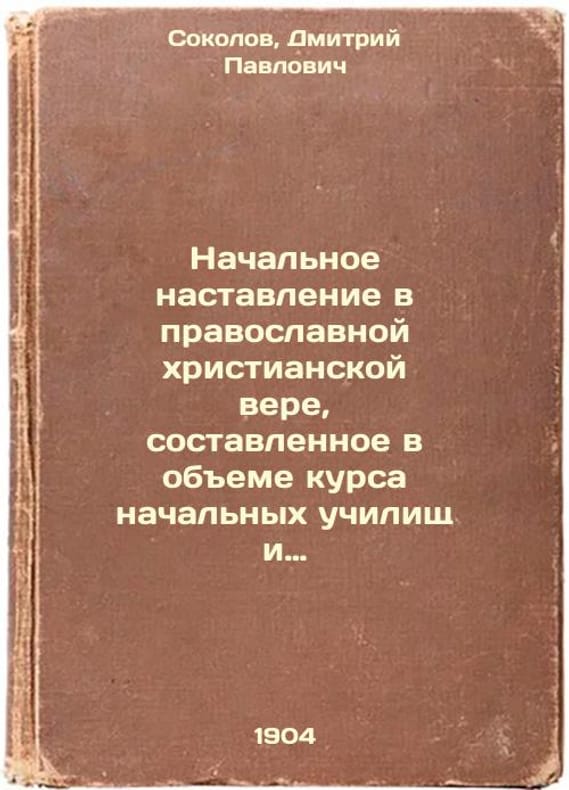
10348574Short description: In Russian. Sokolov, Dmitry Pavlovich. An initial instruction in the Orthodox Christian faith, compiled in the course of elementary schools and the preparatory class of secondary schools by the court archpriest Dimitri Sokolov. You are welcome to reach out to us for a detailed description of the copies currently available. Delivery of this book may take longer than usual including extended processing and pre-shipping time, no expedited shipping is available. Please advise us if you have a set date or a deadline to receive your order.SKU10348574
10351647Short description: In Russian. Poincare Henri. Science and Hypothesis. The journal Popular Science Library. The image is provided for reference only. It may reflect condition of one of the available copies or only help in identifying the edition. Please feel free to contact us for a detailed description of the copies available. SKU10351647 unknown
843Henriette Poincar adresse la photo & En souvenir de votre bonne visite& Quelques lignes au crayon de M. Girod de lAin prcisent : & cette carte ma t donne par Madame Poincar la dernire fois que nous sommes alls lui rendre visite, J et moi. Cest une des dernires photographies du Prsident&
844Remerciements pour des & nonettes exquises& dont elle demande ladresse du marchand.
1563961172New. Brand new and still unused unknown