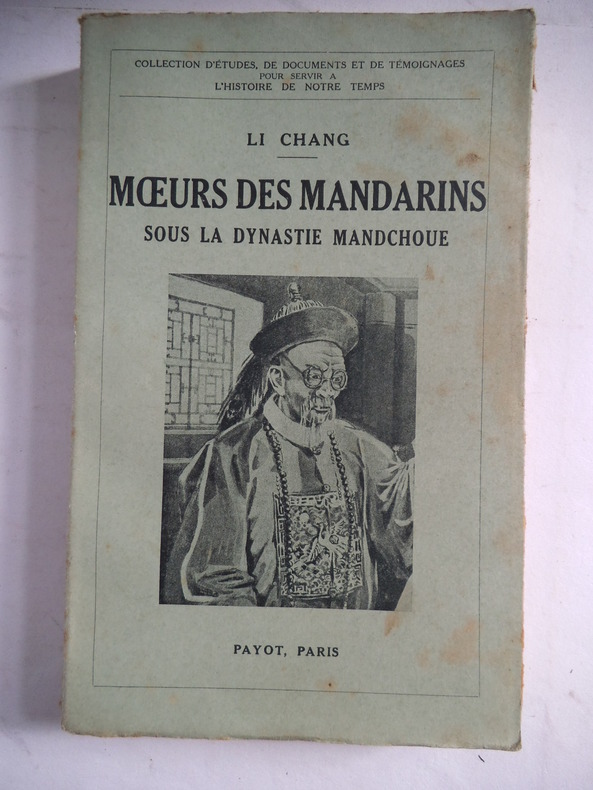
LI CHANGLivre Rare Book
Mœurs des mandarins sous la Dynastie MANDCHOUE
9008In 8 broché, couverture illustrée, faux-titre, titre, 230 pages, 7 pages de catalogue Payot Paris 1935. Traduction par Eva MEYEROVITCH
Charbonnel · Bar le Duc, France28,00 €
1 436 résultats
xxx + 456pp. + qqs. planches hors-texte, 25cm., brochure originale, bon état, B102645
Complet en 2 tomes: xxx,456 + xxx,429pp. + qqs. planches hors-texte, brochures originales, 25cm., pages toujours non coupées, étiquette au dos, bon état, [contient I: Fondation de l'état du Congo, défense de la Meuse, II: Revision de la constitution], B56210
48483Editions du Centaure, s.d. (ca 1945). 13 x 20, 24 pp., broché, bon état.
2004B64026Bruxelles, Racine 2004 517pp.avec ills., toile, jaq., 24cm., bel état
517pp.avec ills., toile, jaq., 24cm., bel état
2001B64016Bruxelles, Racine 2001 239pp.avec ills., cart., jaq., 24cm., bel état
239pp.avec ills., cart., jaq., 24cm., bel état
Hardcover in-8°, 239 pp., cartonnage ed., jaquette illustree.- 9782873862510 Tres bel exemplaire. [TX-15][NAN]
in-4° oblong, 120 pp., nombreuses illustrations en noir et en couleurs, broché. Très bel exemplaire. [P-8] Publié dans le cadre du Festival Europalia.brasil.
in-8°, 165 pages, broché, couv. Bel exemplaire. [BAT-2]
in-8°, 204 pp., illustrations en noir, broche, couverture illustree Tres bel exemplaire. [MI-13]
Very Good Turkish, Ottoman (1500-1928) Original cloth bdg. with marbled boards and brown cloth spine. Fading on spine and foxing on boards and pages. Overall a good copy. Roy. 8vo. (24 x 17 cm). In Ottoman script (Old Turkish with Arabic letters). 118 p. Lithographed. Early edition of this rare poem collection by Leyla Hanim (?-1847), who was a few female poets in the Ottoman literature, known for her lyrical love poems. Divan literature is described as "a certain tradition literature with its rules and boundaries" in the most general form. These rules and boundaries have enabled the formation of common expressions in religion and in Sufi intellection in particular and in poetry by the influence of Persian literature, and they have made it traditional in time. In this context, in classical Turkish poetry, whose male poets are predominant in quality and quantity, patriarchal rhetoric presents an outlook that its frame has been established by common tropes, metaphors, poetic themes, and in short by similar imaginations and ideas. The divans of Lady Mihri (died after 1512), Lady Leyla (died in 1848), and Lady Seref (1809-1861) have different aesthetic understandings in that context. Leylâ Hanim was one of the few Turkish female poets who made a collection of her poems. Lived in Istanbul and died in 1848. Her family was close to the Ottoman Sultanate and Leylâ Hanim, witnessing the reign of Sultan Mahmud II (1808-1839) and Sultan Abdülmecid I (1839-1861). She is the daughter of Moralizâde Hâmid Efendi. Her mother Hadîce Hanim is the sister of Keçecizâde Izzet Molla, a notable bureaucrat, and poet of the times. She has three brothers, Atâullah Mehmed Efendi, Nurullah Mehmed Efendi and Hâlid Efendi, who died at a young age. She had financial problems after her father's death and she expressed those in her poems. Some of her poems in the divan mention that her father and brother Hâlid Efendi have lived in Bursa for a while. She is educated by Keçecizâde Izzet Molla, she is quick-witted. She experienced a short marriage, which lasted about a week; after the divorce, she devoted herself to poetry. Her grave is in Galata Mevlevîhanesi. Several books include information of her life, characteristics, and poetry such as Fatin Tezkiresi (363), Ahmet Rif'at's Lugat-i Târîhiyye ve Cogrâfiyye (154), Tuhfe-i Nâ'ilî (895), Sicill-i Osmânî (93), Bursali Mehmet Tahir's Osmanli Müellifleri (406), et alli. These resources indicate that Leylâ Hanim is from a noble family and the links of the family to the high cadres of Ottoman bureaucracy and their intellectual property have left traces in her poetry. AH 1299 = AD 1882. (Source: All poetry). OCLC 949496080.; Özege 4177 / 4. First two editions were printed in Cairo.
Very Good Turkish, Ottoman (1500-1928) In contemporary cloth bdg. Roy. 8vo. (24 x 17 cm). In Ottoman script. 43, 59 p. Divan literature is described as "a certain tradition literature with its rules and boundaries" in the most general form. These rules and boundaries have enabled the formation of common expressions in religion and in Sufi intellection in particular and in poetry by the influence of Persian literature, and they have made it traditional in time. In this context, in classical Turkish poetry, whose male poets are predominant in quality and quantity, patriarchal rhetoric presents an outlook that its frame has been established by common tropes, metaphors, poetic themes and in short by similar imaginations and ideas. The divans of Lady Mihri (died after 1512), Lady Leyla (died in 1848) and Lady Seref (1809-1861) have different aesthetic understandings in that context. Laylâ Hanim was one of the few Turkish women poets who made a collection of her poems. Lived in Istanbul and died in 1848. Her family was close to the Ottoman Sultanate and Leylâ Hanim, witnessed the reign of Mahmud II (1808-1839) and Abdülmecid I (1839-1861). She is the daughter of Moralizâde Hâmid Efendi. Her mother Hadîce Hanim is the sister of Keçecizâde Izzet Molla, a notable bureucrat and poet of the times. She has three brothers, Atâullah Mehmed Efendi, Nurullah Mehmed Efendi and Hâlid Efendi, who died at a young age. She had financial problems after her father's death and she expressed those in her poems. Some of her poems in the divan mention that her father and brother Hâlid Efendi have lived in Bursa for a while. She is educated by Keçecizâde Izzet Molla, she is quick-witted. She experienced a short marriage, which lasted about a week; after the divorce she devoted herself to poetry. Her grave is in Galata Mevlevîhanesi. Following books include information of her life, characteristics and poetry: Fatin Tezkiresi (363), Ahmet Rif'at's Lugat-i Târîhiyye ve Cogrâfiyye (154), Tuhfe-i Nâ'ilî (895), Sicill-i Osmânî (93), Bursali Mehmet Tahir's Osmanli Müellifleri (406), Haci Begzâde Ahmet Muhtar's Sâir Hanimlarimiz (51-2), Mehmed Zihnî Efendi's Mesâhir'ün-Nisâ (195), and Semseddin Sâmî's Kâmusü'l-A'lâm (4060). These resources indicate that Leylâ Hanim is from a noble family and the links of the family to the high cadres of Ottoman bureaucracy and their intellectual property have left traces in her poetry. AH 1299 = AD 1882. Fourth Edition. (Source: All poetry). OCLC 163633996.; Özege 4177 / 2. First Bulaq Edition. Litho. Rare.
2007B64245Antwerpen, Houtekiet 2007 254pp.geïll., 24cm., gesigneerd door Barend Leyts en Brigitte Balfoort, mooie staat
254pp.geïll., 24cm., gesigneerd door Barend Leyts en Brigitte Balfoort, mooie staat
9008In 8 broché, couverture illustrée, faux-titre, titre, 230 pages, 7 pages de catalogue Payot Paris 1935. Traduction par Eva MEYEROVITCH
19582407100217xbvkKyoto, Jimbunkagaku Kenkyusho Kyoto University, 1958. 48, 180 (1) pages. - Publisher's gilt titled orange-colour cloth-binding in the publ. slipcase; 4to.(ca. 26 x 19 x 2,5 cm).
1997B63915Braine-l' Alleud, Collet 1997 179pp. + [viii] pp. ills.hors-texte, 22cm., bel état, [texte en français]
179pp. + [viii] pp. ills.hors-texte, 22cm., bel état, [texte en français]
in-8°, 453 pages, portrait en noir, broche, couv. Bel exemplaire. [109B-6]
in-8°, 427 pages, portrait en noir, reliure plein maroquin, dos et plat armorié, frise intérieure dorée, gardes de papier marbré, couverture et dos conservés. Le coup d'oeil du genie. Le partage de l'Afrique; la part du lion. La politique royale en Afrique. La revision de la Constitution. Malentendus et conflits. Les dernieres annees,etc. Bel exemplaire. [CA32-4] Bel exemplaire.
in-8°, 415 pages, ill. in-t., index, broche, couverture illustree pell. Tres bel exemplaire DEDICACE par l'auteur. [CA-8]
Fort volume grand in-8°, 360 pp, photos n&b, broche, couv. Dos abime avec manques, plats salis, interieur en bon etat. [P-16]
19133042226Paderborn, Ferdinand Schöningh 1913. X, 514 Seiten, Gr. 8° (23 x 15,5 cm), Softcover (Paperback), Orig-Pappeinband.
Milano, De Agostini,1986.In 8°pp.274n.+6nn.legat.editoriale tt.tela e sovraccoperta illustrata.
