Talakovics, ElinaAntiquariat.de

1 436 résultats
2002JA9-1106Wien, 2002. original Werkstoffeinband, Hardcover, 4?, 119 Blatt, Zustand: gut
19602407100218xbvkKyoto, Jimbunkagaku Kenkyusho Kyoto University, 1960. 887 (2) pages. - Publisher's gilt titled orange-colour cloth-binding in the publ. slipcase; 4to.(ca. 26 x 19 x 5 cm; ca. 2 kg.).
19652407100219xbvkKyoto, Jimbunkagaku Kenkyusho Kyoto University, 1964/1965. 20, 1.825 (2) pages. - Publisher's gilt titled orange-colour cloth-bindings in the publ. slipcases; 4to.(ca. 26 x 19 x 10 cm; ca. 3,5 kg.).
19642407100220xbvkKyoto, Jimbunkagaku Kenkyusho Kyoto University, 1964. 889 (1) pages. - Publisher's gilt titled orange-colour cloth-binding in the publ. slipcase; 4to.(ca. 26 x 19 x 5 cm; ca. 2 kg.).
19652407100221xbvkKyoto, Jimbunkagaku Kenkyusho Kyoto University, 1965. 20 p., pages 883-1.825 (1) pages. - Publisher's gilt titled orange-colour cloth-binding in the publ. slipcase; 4to.(ca. 26 x 19 x 5 cm; ca. 2 kg.).
19602407100214xbvkKyoto, Jimbunkagaku Kenkyusho Kyoto University, 1954/1960. 120 (1) / 178 (1) pages. - Publisher's gilt titled orange-colour cloth-bindings in the publ. slipcases; 4to.(ca. 26 x 19 x 4 cm; ca. 2 kg.).
1878B120966Paris, Hachette 1878 Complet en 2 tomes, 438 + 422pp., 23cm., reliures uniformes en plein-cuir brun, titre doré au dos, feuilles de garde marbrées, brochures originales conservées et reliées, peu de rousseurs (surtout aux tranches), bon état, poids: 2kg., B120966
2090502113716667Not Available N.A. Soft Cover. Fine. The book is in fine condition. Not Available paperback
19832090502113718183Not Available 1983. Soft Cover. Fine. The book is in fine condition. Not Available paperback
1947141614Édition de la Baconnière. Boudry, Neuchatel (Suisse) 1947. 236, (1) pages and 10 plates. Illustrated Original softcover binding (A little used). 21x18 cm
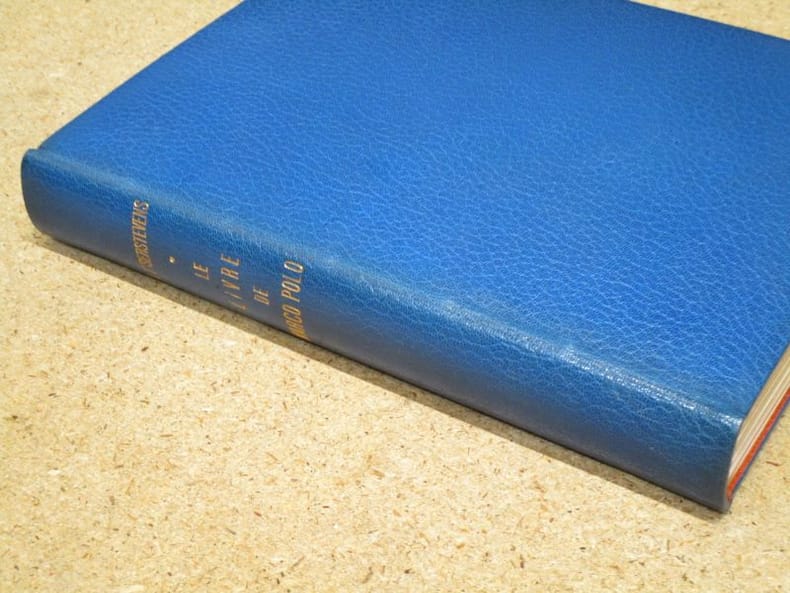
95502Les Editions J. Susse, 1944, 1 volume in-folio de 305x230 mm environ, xxx-227 pages, luxueuse reliure signée Lesage, plein maroquin bleu roi avec titres dorés sur dos lisse, gardes plein maroquin rouille, tranches dorées, sous emboîtage comprenant une chemise-étui rigide à demi reliure à bandes à recouvrement en maroquin bleu avec intérieur en basane havane portant titres dorés sur le dos, ensemble sous étui marbré avec ouverture en maroquin assorti et intérieur en basane havane, couverture et dos conservés. Exemplaire N° 584, un des 964 exemplaires sur Vélin de Rives, accompagné de 20 miniatures reproduites d'après le manuscrit 2810 de notre Nationale, exhumé tout exprès des profondeurs d'une cave ou l'avait enseveli la crainte des bombardements, tirées par les frères Draeger, Imprimeurs insignes, et une carte dépliante établie par A. T'SERSTEVENS, dessinée et coloriée par Sadi Dermndjieff, et réalisée par le maître-lithographe Pichon. Dos de la chemise-étui insolé, infimes frottements sur les angles de l'étui, petite déchirure dans la marge p. 151 sans manque de papier. Bon état pour le reste.
Very Good Turkish, Ottoman (1500-1928) Original autograph letter signed (ALS) by Ottoman princess 'Sükriye Serafeddin'. 17,5x14,5 cm. In Ottoman script (Turkish with Arabic letters). 1 p. [in four]. Bifolium. The letter starts with 'Huve' and it has 12 lines. She mentions a letter that was sent by this unnamed recipient to 'Serafeddin' who is probably from the Ottoman dynasty. Sükriye Sultan was an Ottoman princess, the daughter of the heir to the throne Sehzade Yusuf Izzeddin, son of Sultan Abdulaziz, and Leman Hanim. Sükriye Sultan was born on 24 February 1906 in Çamlica Palace. Her mother was Leman Hanim. She was the second child, and eldest daughter born to her father and the eldest child of her mother. She had two younger siblings, a brother, Sehzade Mehmed Nizameddin, two years younger than her, and a sister, Mihrisah Sultan, ten years younger than her. She was the granddaughter of Abdulaziz and Dürrünev Kadin.
New English Paperback. Pbo. Roy. 8vo. (24 x 17 cm). In English. 300 p. Introduction 1. "The Ottoman Empire in world history: What the Archives Can tell us" unpublished Legitimizing the sultan and his empire 2. "Presenting the sultans' power, glory and piety: a comparative perspective," in Prof. Dr. Mübahat Kütükoglu'na Armagan, ed. by Zeynep Tarim Ertug (Istanbul: Istanbul Üniversitesi Edebiyat Fakültesi Tarih Bölümü, 2006): 169-206. 3. "Exotic animals at the sultans' court," unpublished Relating to the outside world 4. "Ottoman views on corsairs and piracy in the Adriatic," in The Kapudan Pasha. His Office and his Domain, ed. by Elizabeth Zachariadou (Rethymnon: University of Crete Press, 2002): 357-371. 5. "Ottoman attitudes towards merchants from Latin Christendom before 1600," Turcica, 35 (2002): 69-104. 6. "Ibrahim Pasa and the marquis de Bonnac," in Essays in honour of Ekmeleddin Ihsanoglu, Volume 1: Societies, cultures, sciences: a collection of articles, compiled by Mustafa Kaçar and Zeynep Durukal (Istanbul: IRCICA, 2006): 279-294. 7. "An Ottoman ambassador in Iran: Dürri Ahmed Efendi and the collapse of the Safavid Empire in 1720-21," in Wahrnehmung des Fremden, Differenzerfahrungen von Diplomaten in Europa (1500-1648) ed. by Michael Rohrschneider and Arno Strohmeyer (Münster/Germany: Aschendorff, 2007): 375-398. Revised and translated for this volume by the author Outsiders on Ottoman territory and Ottomans abroad: prisoners, slaves and merchants 8. "A prisoner of war reports: The camp and household of Grand Vizier Kara Mustafa Pasa in an eyewitness account," in Unfreie Arbeits-und Lebensverhältnisse von der Antike bis in die Gegenwart, ed. Elisabeth Herrmann-Otto (Hildesheim, Zurich, New York: Georg Olms Verlag, 2005): 206-234. Translated for this volume by the author 9. "Trying to avoid enslavement: the adventures of an Iranian subject in eighteenth-century Anatolia," in Unfreie Arbeit, Ökonomische und kulturgeschichtliche Perspektiven ed. by M. Erdem Kabadayi and Tobias Reichardt (Hildesheim, Zurich, New York: Georg Olms Verlag, 2007): 133-146. Translated for this volume by the author 10. "Bosnian merchants in the Adriatic," in Ottoman Bosnia. A History in Peril - has also appeared as The International Journal of Turkish Studies, 10, 1-2, ed. by Markus Koller and Kemal Karpat (Madison/Wisc.: Center of Turkish Studies, 2004): 225-239. 11. "The Ottomans and the trade routes of the Adriatic," in a collective volume edited by Oliver Jens Schmidt (to be published in 2009) Translated for this volume by the author. Bibliography. Index.
19832090602128804794Heibonsha 1983. Soft Cover. Fine. Number of books: 1 book Heibonsha paperback
111676The Commercial Press. Peking. 1957. The Commercial Press. Peking. 1957. First edition. Large folio. Bound in coloured patterned brocade silk boards with fine silk cord. Housed in a folding clam shell box of cream water silk with ribbon and ivory closures. Silver sparkly endpapers. 15 mounted colour reproductions very gorgeous. text in Chinese and English. A very clean and fresh copy in original labelled cardboard box torn at corners. hardcover
19812080202105200050Chubun Publishing Company Kyoto 1981. Soft Cover. Fine. Number of pages: 344 18 Chubun Publishing Company (Kyoto) paperback
New New Persian Original bdg. Dust wrapper. Roy. 8vo. (24 x 17 cm). In Persian and a short abstract in English. 2 volumes in 1 (488 p.), ills. Rouzname-ye Safar-e Sultan Murad IV be Iravan va Tabriz: The journal of Sultan Murad IV's campaignsof Yerevan and Tabri, 1044-45 AH / 1635 AD. & Manzelname-ye Baghdad: The gazetteer of the Baghdad invasion, 1048-49 AH/ 1638-39 AD. Edited and introductions by Yunus Zeyrek, Halil Sahillioglu. Introduced, annotated, attachments and translated from original Ottoman TUrkish texts in Persian by Dr. Nasrollah Salehi.= Rûznâmah-'i safar-i Sultân Murâd-i chahârum bih Iravân va Tabrîz (1044-1045 H.Q.). & Manzil'nâmah-'i Sultân Murâd-i chahârum bih Baghdâd (1048-1049 H.Q.). (Iran & Ottoman History Series 3).
Very Good Turkish, Ottoman (1500-1928) Paperback. Chipped on margins. Some owner notes. Otherwise a good copy. Roy. 8vo. (24 x 18 cm). In Ottoman script. 32 p. This rare book includes the royal travel of Sultan Abdülmecid in 1262 AH [1846 AD] to Roumelia. From Edirne, Abdülmecid proceeded to Eski Zagra (Stara Zagora), Kizanlik (Kazanluk), Gabrova (Gabrovo), Tirnova (Turnovo), Rusçuk (Ruse), Silistre (Silistra), and Varna. The route of the 1846 tour followed closely, except in reverse order, Mahmud II's tour of 1837. According to witness accounts, along the way, the sultan was greeted everywhere with poetic recitations and songs of praise and prayer, both in Ottoman and Bulgarian. The pride of place among welcoming parties invariably fell on students, of all creeds, most clad in white uniforms, some in solemn church-going attire, with flowers and green branches in their hands. At every stop, ceremonial cannon salvos were fired during the day and elaborate firework illuminations were performed at night. In the town of Kizanlik, known then as now for the most fragrant roses and the best rose oil, the sultan's visit coincided, possibly by design, with the rose harvesting season. So the locals sprinkled rose water and poured rose oil before the sultan's cavalcade. According to Hristo Stambolski, in the three days of the sultan's stay in town, no rose harvesting was done so that the whole area would be exquisitely scented in his honor. For his part, the sultan had doctors vaccinate all children against smallpox in public before sending each one off with a small gift of money. Even people with rare diseases were, on occasion, summoned to the sultan's presence so his doctors could cure them. The sublime visit caused the locals, who were unaccustomed to direct contact with the center of power, quite a stir. The most detailed account, albeit from a hostile source, relates the sultan's visit to Rusçuk, which, at four days, may have also been the longest. According to Nayden Gerov, the greeting ceremonies proceeded on a communal basis, with the Jews being placed closest to the town walls, next to them the Armenians, then the Bulgarians, and finally, the Muslims, situated the farthest from town, yet being the first to see and welcome the sultan. As the sultan approached, each group of youngsters would in turn sing for him, everyone else bowing profusely. Based on Gerov's description, it seems that Abdülmecid was dressed in a slightly more luxurious fashion than during state ceremonies in Istanbul. ((Source: Sultan Abdülmecid's Tour of Rumelia and the Trope of Love by Stephanov). The sultan began to travel by the way of the gate of Yedikule in Istanbul in May 6, 1846. He followed the way of Ayastefanos, Silivri, Çorlu, Burgaz, Edirne, Zagra-i Atik, Kizanli, Trnova, Rusçuk, Silistre, Rusçuk, Shumnu, and Varna and came back to Istanbul by way of the sea on June 14, 1846. During this travel, the Sultan listened to people's problems and ordered the authorities to be solved with those problems. He received successful military and administrative authorities in settlements on the way of travel and rewarded them. He also received the governors of Serbia, Eflak and Bogdan, and the representatives of foreign states. With this travel, the Sultan aimed to strengthen the connection to the center of people and administrators in provinces. Özege 17910. First Edition.
xi + 115pp., 22cm., cart.cover, dustwrapper, VG, [text in Italian, translation of the original French work: Le Roi Baudoin. Une vie qui nous parle], B69580
1995B69580Torino, Società editrice internazionale 1995 xi + 115pp., 22cm., cart.cover, dustwrapper, VG, [text in Italian, translation of the original French work: Le Roi Baudoin. Une vie qui nous parle], B69580
New Persian Paperback. 4to. (29 x 21 cm). In Persian with bilingual title in English an persian on cover. It's a Persian translation. 128 p., color ills. Persian painting: Five royal Safavid manuscripts of the sixteenth century.= Naqâshî-i Irânî: Nuskhah nigârah'hâ-yi 'ahd-i saravî. Prep. by Ahmed Reza Taqâ.
199964449Stuttgart : Steiner 1999. 89 S. ; 24 cm Top Zustand, kart., Softcover/Paperback, Exemplar in sehr gutem Erhaltungszustand
1118197Hachenburg : Geschichtswerkstatt Hachenburg e. V., 2018. Mit zahlr. farb. Abb. Originalbroschur.
2011310994Darmstadt : Wissenschaftliche Buchgesellschaft (WBG), 2011. VIII,152 Seiten. Originalbroschur. 23cm
11460Editions Philippe Picquier, 2003. Fort volume broché au format 14x23, couverture souple glacée illustrée rempliée (encre), 407 pages, bel exemplaire sous tous rapports. Epuisé.