301 résultats
19862092902137701293Kyukoshoin 1986. Soft Cover. Fine. The book is in fine condition. Kyukoshoin paperback
ria9781543461596_inpPaperback. New. New Book; Fast Shipping from UK; Not signed; Not First Edition; Living Poetry with Dynasty Hill is a phenomenal collection of poetry at random by the author as she lives day by day. The author gives the reader more than a collective piece in organized fashion but she writes by inspiration day to day paperback

B9781543461596Paperback / softback. New. paperback
154346159X.Gpaperback. Good. Access codes and supplements are not guaranteed with used items. May be an ex-library book. paperback
20212081502111902723Chinese book office 2021. Soft Cover. Fine. The book is in fine condition. Chinese book office paperback
19-5242Taiwan PRC: Freedom Press in Taiwan circa 1968. 8vo. Red Cloth 398 pages. Very Good. Text in Chinese. Taiwan, PRC: Freedom Press in Taiwan, [circa 1968]. hardcover
19-5241Taiwan PRC: Freedom Press in Taiwan circa 1968. 8vo. Red Cloth 422 pages. Very Good. Former owner’s notes in Chinese & English penciled inside cover. Text in Chinese. Taiwan, PRC: Freedom Press in Taiwan, [circa 1968]. hardcover
19-5589Taiwan Republic Of China: Freedom Press in Taiwan circa 1968. 8vo. Red Cloth. 532 pages. Very Good. Text in Chinese. Taiwan, Republic Of China: Freedom Press in Taiwan, [circa 1968]. hardcover
20022092902141203520old books in shanghai 2002. Soft Cover. Fine. Volume: 1 old books in shanghai paperback
20022081502111904630Shanghai Ancient Book Publishing House 2002. Soft Cover. Fine. Size: A5 Soft Cover Number of books: 1 Shanghai Ancient Book Publishing House paperback
20142081502111904478shanghai people 2014. Soft Cover. Fine. Number of pages: 924p Size: A5 hardcover book shanghai people paperback
19722090502130200001Kogyo Book Bureau 1972. Soft Cover. Fine. Number of pages: 1222p 1 sheet Size: 27cm Number of books: 1 Kogyo Book Bureau paperback
2003L3 nbsLao Can You Ji - The Travels of Lao Can Text in Chinese. By Liu E Qing Dynasty China. Published by Anhui Literature and Art Press in 2003. Paperback 195 pages. Anhui Literature and Art Press paperback
18032091202133201466Not Available 1803. Soft Cover. Fine. Number of books: 4 Not Available paperback
19712081502111903247National Defense Research Institute 1971. Soft Cover. Fine. Size: B5 Hardcover Number of books: Hardcover 8 National Defense Research Institute paperback
20212081502111906654Chinese book office 2021. Soft Cover. Fine. Size: A5 Chinese book office paperback
20172081502111906289Chinese book office 2017. Soft Cover. Fine. The book is in fine condition. Chinese book office paperback
20172092902141204343Chinese book office 2017. Soft Cover. Fine. Volume: 1 Chinese book office paperback
20172092902141204841Chinese book office 2017. Soft Cover. Fine. Volume: 1 Chinese book office paperback
20012081502111904695Shanghai Ancient Book Publishing House 2001. Soft Cover. Fine. Number of pages: 566p Size: A5 Soft Cover Number of books: 1 Shanghai Ancient Book Publishing House paperback
2092902143700875Kasama shoin N.A. Soft Cover. Fine. Number of pages: 196p Size: 22cm Kasama shoin paperback
20152081502111902430Shanghai Ancient Book Publishing House 2015. Soft Cover. Fine. Number of pages: 215 Shanghai Ancient Book Publishing House paperback
20152081502111902351Shanghai Ancient Book Publishing House 2015. Soft Cover. Fine. Number of pages: 215 Shanghai Ancient Book Publishing House paperback
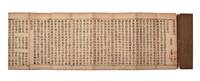
8663Trans. by Xuanzang 玄奘 in 650 CE. 70 pages six columns per page 30 columns per sheet 17 characters per column. 14 sheets average sheet length: 570 mm. five pages per sheet. Accordion format 305 x 7980 mm. print surface from top border to bottom border: 245–250 mm. Single woodcut borders at top & bottom of text. Orig. sutra binding of semi-stiff paper wrappers. Woodblocks carved by Ge Fang & Ma Qing & others in Sixi present day Huzhou printed between 1110s/40s–1276.<br /> <BR> <BR> This fascicle in its original sutra binding was printed in the 12th or 13th century in northern Zhejiang China as part of an extremely rare edition of the Buddhist canon variously known as the Yuanjue Canon Zifu Canon or Sixi Canon. Examples very rarely appear on the market. This edition of the Buddhist canon was for a long time largely unknown in China until the famous Chinese book collector and scholar Yang Shoujing 1839-1915 brought a set back from Japan in the late 19th century. Now in a Chinese library this is the only near-complete set as far as we know the rest being single sutras.<br /> <BR> <BR> Yuanjue Zifu or Sixi Canon: The three names refer to some or all of the imprints of the Chinese Tripitaka made from a set of blocks that were carved in a place called Sixi present-day Huzhou in what was then Songting township Guian county Hu prefecture part of the Circuit of the eastern and western Zhe of the Southern Song.<br /> <BR> <BR> Sixi one of the names retrospectively used for this edition was the location of Yuanjue Meditation Hall founded in 1119-25 where the printing blocks were housed and perhaps carved. Sometime after 1239 the hall’s name may have changed to Fabao Zifu lit. “Dharma jewel supplying happiness†Meditation Temple whence Zifu Canon.<br /> <BR> <BR> Bibliographic scholarship has dated certain imprints of this canon to either the period of Yuanjue Meditation Hall or that of Fabao Zifu Meditation Temple calling imprints dating from the earlier period Yuanjue Canon or “first Sixi canon†qian Sixi jing and imprints from the later period Zifu Canon or “second Sixi canon†hou Sixi jing. On the basis of a comparison of two catalogues of the canon — one claiming to be of the Yuanjue Canon and one of the Zifu Canon — it was believed that a substantial amount of re-carving had taken place between the Yuanjue and Zifu canons. However the catalogue purportedly of the Zifu Canon has been shown in fact to have been based not on an inventory of a set of the Zifu Canon but on another unrelated catalogue. Thus there is no reason to assume that a substantial amount of re-carving of the blocks took place after the temple changed its name and ipso facto there is no reason to posit the existence of two Sixi canons. Printings ascribed to the Yuanjue and Zifu canons belong to the same edition of the Chinese Tripitaka printed at various times during a period that stretched over a century. Blocks were repaired and replaced during this period but not to the extent that would justify calling them two editions.<br /> <BR> <BR> The Timing of Carving and Printing: The sources are ambiguous as to when carving of the blocks began. Li Fuhua and He Mei state that the carving began in 1126 whereas Wang Chonglong says it began before 1110 and thus not at the Yuanjue Hall which had not yet been founded and agrees with others that it likely had finished in 1132. It has also been proposed however that carving only began in 1132. Finally 1140 has been proposed as another completion date. Therefore we can say with confidence that the initial set of blocks was carved sometime between the 1110s and 1140s.<br /> <BR> <BR> Once the blocks were carved they were used for printing for a long time. Some printings can be dated because they contain colophons. <br /> <BR> <BR> Liu Yuantang has documented three instances of blocks being mended buban: in 1238 1248 and 1250. The blocks were burned by the invading Mongols in 1276 which is thus the terminus ante quem for prints from the Yuanjue Canon.<br /> <BR> <BR> Our Copy and the Yuanjue / Zifu Canon: Benshi jing is marked with the ordinal character shen 甚 in five editions of the Chinese Tripitaka. Of these five only the Yuanjue Canon also known as the Zifu or Sixi Canon is a possible candidate. More precisely our copy appears to be from a late printing of the Zifu Canon dating from sometime in the latter portion of the period 1110s/1140s-1276. The vast majority of extant sutras from this edition of the canon are late printings. They have the following characteristics:<br /> <BR> <BR> 1. Sheets folded into five pages with six columns per page 30 per sheet and 17 characters per column.<br /> <BR> <BR> 2. Glosses appended to the end of the volume.<br /> <BR> <BR> 3. Single woodcut borders at top and bottom of text. For earlier printings of this edition one source specifies that the borders go around on all four sides but for the later printings the same source simply says “single-lined margin frame†danxian biankuang 單線邊框. This would appear to suggest borders also at the beginning and the end of each sheet.<br /> <BR> <BR> 4. No empty column before the beginning of the text on the first page.<br /> <BR> <BR> 5. Small-script numerals marking the number of the sheet are printed at the beginning of every sheet as opposed to in the crease between pages for example except for the first sheet.<br /> <BR> <BR> 6. Printed area of roughly 570 mm. long and 250 mm. wide.<br /> <BR> <BR> The sutra has a total of seven fascicles juan of which we have fascicle six. The upper cover and the first line of the first page both have the character shen in manuscript on the cover which is here used as an ordinal drawn from Qianzi wen åƒå—æ–‡ The Thousand Character Essay to arrange the sutras of the Chinese Tripitaka.<br /> <BR> <BR> Layout and Appearance of Our Copy: Unsurprisingly for a very large printing project that took many years not all the sutras of the Yuanjue Canon have the same appearance. Yet the dimensions of our copy agree with other known copies: five pages per woodblock six columns per page 17 characters per column. Other non-official Song editions of the Buddhist canon Chongning and Pilu have six pages per block but the same number of columns per page and characters per column.<br /> <BR> <BR> The measurements of our copy accord with copies of other sutras from the same edition of the canon held by the Gansu Provincial Library in Lanzhou the National Palace Museum in Taipei and the Gotoh Museum outside of Tokyo. The layout of our copy accords with that of a different sutra from the same canon that has been reprinted in facsimile in unknown
20202081502111901649Chinese book office 2020. Soft Cover. Fine. Size: A5 Soft Cover Chinese book office paperback