LUCIEN JERPHAGNONLivre Rare Book
1 436 résultats
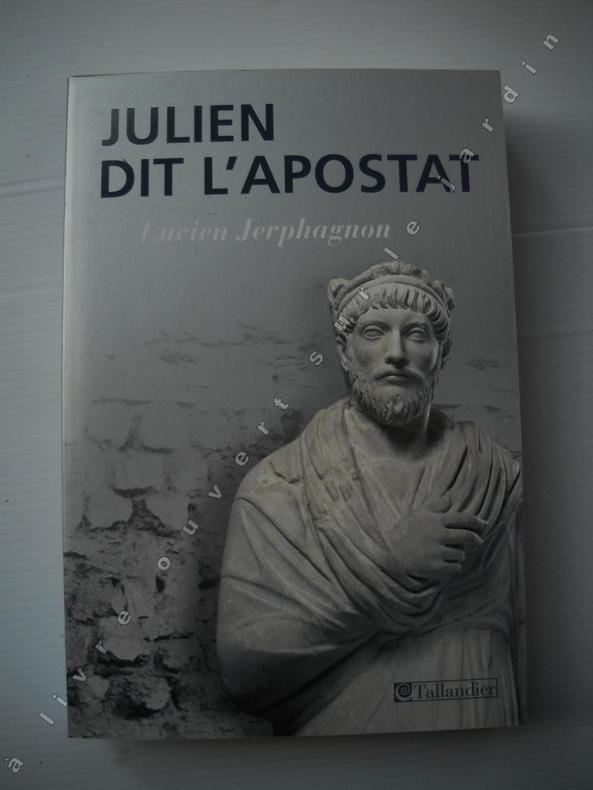
17011Broché - 14,5 x 21,5 - 357 pp - année 2008 - Editions Tallandier -
496pp.met ills.in en buiten tekst in kleur en z/w, 22cm., gecart.band met stofwikkel, gesigneerd met opdracht door auteur, mooie staat
194032483München : Callwey 1940. 442 S. : mehr. Bl. Abb. ; 8°, Schrift: Antiqua gebundene Ausgabe, Leinen, Einband etwas fleckig, sonst Exemplar in gutem Erhaltungszustand
in-8°, 87 pp., broche, couverture illustree. Bon etat. [TX-7]
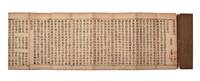
8663Trans. by Xuanzang 玄奘 in 650 CE. 70 pages six columns per page 30 columns per sheet 17 characters per column. 14 sheets average sheet length: 570 mm. five pages per sheet. Accordion format 305 x 7980 mm. print surface from top border to bottom border: 245–250 mm. Single woodcut borders at top & bottom of text. Orig. sutra binding of semi-stiff paper wrappers. Woodblocks carved by Ge Fang & Ma Qing & others in Sixi present day Huzhou printed between 1110s/40s–1276.<br /> <BR> <BR> This fascicle in its original sutra binding was printed in the 12th or 13th century in northern Zhejiang China as part of an extremely rare edition of the Buddhist canon variously known as the Yuanjue Canon Zifu Canon or Sixi Canon. Examples very rarely appear on the market. This edition of the Buddhist canon was for a long time largely unknown in China until the famous Chinese book collector and scholar Yang Shoujing 1839-1915 brought a set back from Japan in the late 19th century. Now in a Chinese library this is the only near-complete set as far as we know the rest being single sutras.<br /> <BR> <BR> Yuanjue Zifu or Sixi Canon: The three names refer to some or all of the imprints of the Chinese Tripitaka made from a set of blocks that were carved in a place called Sixi present-day Huzhou in what was then Songting township Guian county Hu prefecture part of the Circuit of the eastern and western Zhe of the Southern Song.<br /> <BR> <BR> Sixi one of the names retrospectively used for this edition was the location of Yuanjue Meditation Hall founded in 1119-25 where the printing blocks were housed and perhaps carved. Sometime after 1239 the hall’s name may have changed to Fabao Zifu lit. “Dharma jewel supplying happiness†Meditation Temple whence Zifu Canon.<br /> <BR> <BR> Bibliographic scholarship has dated certain imprints of this canon to either the period of Yuanjue Meditation Hall or that of Fabao Zifu Meditation Temple calling imprints dating from the earlier period Yuanjue Canon or “first Sixi canon†qian Sixi jing and imprints from the later period Zifu Canon or “second Sixi canon†hou Sixi jing. On the basis of a comparison of two catalogues of the canon — one claiming to be of the Yuanjue Canon and one of the Zifu Canon — it was believed that a substantial amount of re-carving had taken place between the Yuanjue and Zifu canons. However the catalogue purportedly of the Zifu Canon has been shown in fact to have been based not on an inventory of a set of the Zifu Canon but on another unrelated catalogue. Thus there is no reason to assume that a substantial amount of re-carving of the blocks took place after the temple changed its name and ipso facto there is no reason to posit the existence of two Sixi canons. Printings ascribed to the Yuanjue and Zifu canons belong to the same edition of the Chinese Tripitaka printed at various times during a period that stretched over a century. Blocks were repaired and replaced during this period but not to the extent that would justify calling them two editions.<br /> <BR> <BR> The Timing of Carving and Printing: The sources are ambiguous as to when carving of the blocks began. Li Fuhua and He Mei state that the carving began in 1126 whereas Wang Chonglong says it began before 1110 and thus not at the Yuanjue Hall which had not yet been founded and agrees with others that it likely had finished in 1132. It has also been proposed however that carving only began in 1132. Finally 1140 has been proposed as another completion date. Therefore we can say with confidence that the initial set of blocks was carved sometime between the 1110s and 1140s.<br /> <BR> <BR> Once the blocks were carved they were used for printing for a long time. Some printings can be dated because they contain colophons. <br /> <BR> <BR> Liu Yuantang has documented three instances of blocks being mended buban: in 1238 1248 and 1250. The blocks were burned by the invading Mongols in 1276 which is thus the terminus ante quem for prints from the Yuanjue Canon.<br /> <BR> <BR> Our Copy and the Yuanjue / Zifu Canon: Benshi jing is marked with the ordinal character shen 甚 in five editions of the Chinese Tripitaka. Of these five only the Yuanjue Canon also known as the Zifu or Sixi Canon is a possible candidate. More precisely our copy appears to be from a late printing of the Zifu Canon dating from sometime in the latter portion of the period 1110s/1140s-1276. The vast majority of extant sutras from this edition of the canon are late printings. They have the following characteristics:<br /> <BR> <BR> 1. Sheets folded into five pages with six columns per page 30 per sheet and 17 characters per column.<br /> <BR> <BR> 2. Glosses appended to the end of the volume.<br /> <BR> <BR> 3. Single woodcut borders at top and bottom of text. For earlier printings of this edition one source specifies that the borders go around on all four sides but for the later printings the same source simply says “single-lined margin frame†danxian biankuang 單線邊框. This would appear to suggest borders also at the beginning and the end of each sheet.<br /> <BR> <BR> 4. No empty column before the beginning of the text on the first page.<br /> <BR> <BR> 5. Small-script numerals marking the number of the sheet are printed at the beginning of every sheet as opposed to in the crease between pages for example except for the first sheet.<br /> <BR> <BR> 6. Printed area of roughly 570 mm. long and 250 mm. wide.<br /> <BR> <BR> The sutra has a total of seven fascicles juan of which we have fascicle six. The upper cover and the first line of the first page both have the character shen in manuscript on the cover which is here used as an ordinal drawn from Qianzi wen åƒå—æ–‡ The Thousand Character Essay to arrange the sutras of the Chinese Tripitaka.<br /> <BR> <BR> Layout and Appearance of Our Copy: Unsurprisingly for a very large printing project that took many years not all the sutras of the Yuanjue Canon have the same appearance. Yet the dimensions of our copy agree with other known copies: five pages per woodblock six columns per page 17 characters per column. Other non-official Song editions of the Buddhist canon Chongning and Pilu have six pages per block but the same number of columns per page and characters per column.<br /> <BR> <BR> The measurements of our copy accord with copies of other sutras from the same edition of the canon held by the Gansu Provincial Library in Lanzhou the National Palace Museum in Taipei and the Gotoh Museum outside of Tokyo. The layout of our copy accords with that of a different sutra from the same canon that has been reprinted in facsimile in unknown
20202081502111901649Chinese book office 2020. Soft Cover. Fine. Size: A5 Soft Cover Chinese book office paperback
19832080502106503533Seibundang Chinese medicine book distribution society 1983. Soft Cover. Fine. Volume: 1 Seibundang Chinese medicine book distribution society paperback
20192081502111906085Chinese book office 2019. Soft Cover. Fine. The book is in fine condition. Chinese book office paperback
Book is in excellent condition. Binding is solid and square, covers have sharp corners, exterior shows no blemishes, text/interior is clean and free of marking of any kind. Dust jacket shows the slightest signs of shelf wear only, no tears. Brown paper over boards with silver and black lettering. 166 pages. Jikji is the world's oldest metal-printed material available today, developed in a small temple named Heungdeoksa Temple 80 years earlier than the printing of the 42-line Gutenberg Bible. This book includes the book Jikji, seeeking truth from the pioneer of Buddhism
19992081502111904571Chinese book office 1999. Soft Cover. Fine. The book is in fine condition. Chinese book office paperback
19992092902141205872Huaxia Publishing Company 1999. Soft Cover. Fine. Number of books: 2 Huaxia Publishing Company paperback
2000AIB283_0702449_283Liaoning Education Press 2000-01-01. hardcover. New. Ship out in 2 business day And Fast shipping Free Tracking number will be provided after the shipment.HardCover. Number of Pages: 695 Pages. Language: Chinese-English. Satisfaction guaranteedor money back. <br/><br/> Liaoning Education Press hardcover
Mm 90x160 Opera facente parte della "Collezione completa di Storia Toscana", tomi VI-XII - Opera pubblicata tra il 1820 e il 1821 in 7 tomi rilegati a mezza pelle con titoli e numeri in oro ai dorsi, pp. LXXXIV, 348; 408; 424; 414; 452; 460; 428 con una grande tavola più volte ripiegata dell'albero genealogico dei Medici. Fioriture e inevitabili segni del tempo agli angoli delle legature, nel complesso esemplari molto ben conservati nelle loro legature salde. SPEDIZIONE IN 24 ORE DALLA CONFERMA DELL'ORDINE.
(Filosofie islamiche esoteriche - Islam sciita - Ismailismo - Nizariti - Dinastia dei Fatimidi - Il Vecchio della Montagna - Storia delle religioni - Orientalismo) In 8°, brossura editoriale verde oliva con titoli in nero al dorso ed al piatto anteriore, pp. (10),352,(4), con due cartine nel testo. Volume stampato nella Tipografia Poggi di Milano. Prima edizione. Ottimo stato di conservazione.
Fine Turkish Paperback. Cr. 8vo. (20 x 14 cm). In Turkish. 252 p. Islam'da otorite. Peygamber'in gelisinden Emevî idaresine kadar. Authority and state idea in Islam from Mohammad to the Umayyad.
2091202133209320Macao New Book Office N.A. Soft Cover. Fine. Number of books: 4 books in total Macao New Book Office paperback
New Persian Paperback. Roy. 8vo. (24 x 17 cm). Text in Persian with bilingual title in English and Persian on cover. [5], 318 p. Iran's political and economic relations in Safavid period.
New English Original bdg. HC. In publisher's special slip-case. 4to. (29 x 24 cm). In English and Persian. 184 p., b/w and color photos. Iran during the Qajar dynasty: From the perspective of Montabone, the Italian photographer.= Îrân-i 'asr-i Qâjâr az dîd-i Mûntâbûnah 'akkâs-i Itâlîyâyî. Edited and text by Muzhgan Tariqi; C. Adle; Muhammad Sattari. Photographs taken by Montabone during the 1862 diplomatic mission sent by Victor Emmanuel II of Italy to Iran. In the 1860s, two Italian photographers Luigi Montabone (died 1877) and Luigi Pesce (1818-1891) were also active in Iran in the 1860s. Montabone accompanied an Italian mission of sixteen political, scientific, and military officers to Iran in 1862. Originally from Naples, Italy, Colonel Pesce went to Iran in 1852 to train military officers.
New Persian Paperback. Demy 8vo. (21 x 14 cm). In Persian with bilingual in Persian and English on cover. 231 p., b/w ills. Iran caravanserais.= Kâravânsarâ'hâ-yi Irân'zamîn.
New Persian Paperback. Roy. 8vo. (24 x 17 cm). In Persian, with a bilingual title in English and Persian on cover. [8], 500 p. Iran between two coups d'etat: A history of the political, social, economic, and cultural evolutions in Iran from Qajars fall to the 28 Mordad Coup).= Îrân bayn-i dû kûditâ: Târîkh-i tahavvulât-i siyâsî, ijtimâ'î, iqtisâdî va farhangî-i Îrân az inqirâz-i Qâjârîyah tâ kûditâ-yi 28 Murdâd.
20062090202120404604Geijutsu shinbun-sha 2006. Soft Cover. Fine. Number of books: 1 Geijutsu shinbun-sha paperback
Fine Turkish, Ottoman (1500-1928) Paperback. Pbo. Cr. 8vo. (20 x 14 cm). In Ottoman script. 31 p. Hegira 1334 = Gregorian 1918. Özege 9199. First and Only Edition. Said Halim Pasa was a statesman who served as the Grand Vizier of the Ottoman Empire from 1913 to 1917. Born in Cairo, Egypt, he was the grandson of Muhammad Ali of Egypt, often considered the founder of modern Egypt. He was one of the signers in Ottoman - German Alliance. Yet, he resigned after the incident of the pursuit of Goeben and Breslau, an event which served to cement the Ottoman-German alliance during World War I. It is claimed that Mehmed V wanted a person in whom he trusted as Grand Vizier, and that he asked Said Halim to stay in his post as long as possible. Said Halim's term lasted until 1917, cut short because of continuous clashes between him and the Committee of Union and Progress, which by then controlled the Imperial Government of the Ottoman Empire. During the court martial trials after World War I in the Ottoman Empire, he was accused of treason as he had his signature under Ottoman - German Alliance. He was exiled on 29 May 1919 to a prison on Malta. He was acquitted from the accusations and set free in 1921, and he moved to Sicily. He wanted to return to the Istanbul, the capital of the Ottoman Empire, but this request was rejected. He was assassinated soon after in Rome by Arshavir Shiradjian, an agent of the Armenian Revolutionary Federation, for his alleged role in the Armenian Genocide. Other sources, however, stated that he was unrelated to the Genocide. This intellectual study of him on self-experiences of decline and fall of Islamic world, view and thought. Extremely rare.
9729, Paris, Calmann - Levy, 1968., Broche, couverture d' editeur illustre n/b., 14x21cm, 319pp, illustre n/b.
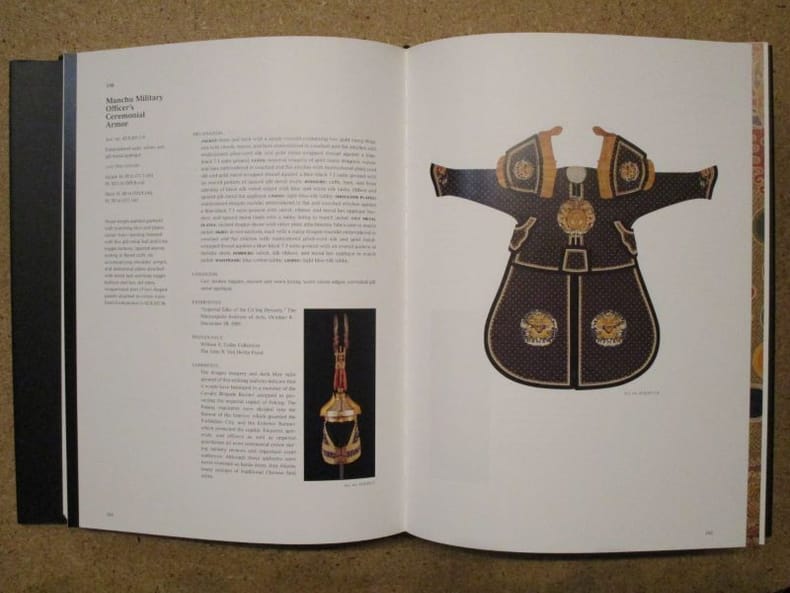
2000116865The Minneapolis Institute of Arts 2000 The Minneapolis Institute of Arts, 2 volumes, 2000, 1182 p., cartonnages éditeur sous jaquette, sous étui assorti, environ 35x26cm. Des frottements d'usage sur l'étui, quelques rares et discrets frottements sur les bords des jaquettes. Bon état pour le reste et intérieurs très propres.
20192081502111901097Chinese book office 2019. Soft Cover. Fine. Size: A5 Soft Cover Chinese book office paperback