5 057 résultats
1700ABC_50128Spain 1700. Contemporary elaborately gold-tooled red morocco sewn on six supports with the corresponding raised bands on the spine the gold-tooling is built up from numerous impressions of small pointillé tools creating a large intricate centrepiece within two detailed frames gold-tooled board edges and turn-ins marbled pastedowns and gilt edges. Folio. With an elaborately decorated letterpress title page the letters of the title are highlighted in blue red gold and silver and are surrounded by a contemporary hand-drawn hand-coloured and highlighted in gold and silver floral frame in the same style as the other floral borders in this work including equally decorated arms of the Echeniques y Aguirres family. All text is set within woodcut borders incorporating the familys coat of arms the borders show two different floral designs which are repeated throughout the work. All borders are vividly coloured by a contemporary hand and highlighted in gold and silver. Rare ejecutorias de hidalguía of the Echeniques y Aguirres family. The work is beautifully bound in contemporary richly gold-tooled morocco and it is handsomely decorated throughout with contemporary hand-coloured borders which are highlighted in gold and silver. Among the most impressive legal artefacts produced in early modern Spain are the ejecutorias de hidalguía royal documents issued when a family had successfully proven its noble status before the highest courts of the kingdom. These richly ornamented works are far more than dry legal records: they preserve genealogies heraldic descriptions testimonies of limpieza de sangre purity of blood and the voices of neighbours and officials who vouched for a familys lineage. They were the final seal that converted a favourable verdict into a binding hereditary right. The present work is dated 24 July 1664 and comprising 233 pages. It opens with a hand-painted title page bearing the family arms and every leaf is bordered with coloured decoration. The Echenique y Aguirre family originated in Erratzu a village in the Baztan Valley of Navarre. Martín de Echenique and María de Aguirre both natives of the valley were the parents of five sons Lorenzo Juan the elder Juan Pedro and another Juan whose activities spread across the Iberian Peninsula. From their home region the brothers established themselves in Madrid Pamplona Seville and elsewhere forming part of the thriving network of Basque and Navarrese merchants.In 1659 the brothers petitioned for their heraldic rights to be formally confirmed. The Rey de Armas Bernardo de Fonseca y Pinto issued an official grant later certified by herald Rodrigo Méndez Silva combining elements from the Errazuriz Echenique and Aguirre lineages. The resulting arms featured the iconic black-and-white chequered pattern of the Baztan Valley enhanced with chevrons gold fields and coloured bands. Although later heraldists noted that this composition was more elaborate than the traditional local arms such embellishment was typical of mid-17th-century grants where royal heralds often produced grander shields at the clients request. By royal order the five brothers were authorised to use these arms freely on seals rings chapels tombs and household objects in this work the arms are displayed on every leaf.It records the full proceedings of the lengthy trial brought before the kingdoms senior judiciary. It opens with the royal heading of King Philip IV followed by the legal narrative of the case heard first by the mayors of the High Court then by the Regents and the Royal Council.The opposing party was none other than the municipal authorities of the Tierra y Valle de Baztán who challenged the brothers claim. The result preserved in this volume was a firm royal recognition of the Echenique y Aguirre lineage as noble in perpetuity.The present work is bound in sumptuous contemporary red morocco its boards covered with intricate gold tooling arranged in the refined pointillé and a petit fers French-inspired style of the second half of the 17th-century. The tooling is reminiscent of the work of celebrated French and Dutch binders like le Gascon only known by this nickname Florimond Badier and Albert Magnus.With a later pencil annotation on the first flyleaf providing a brief bibliographical or descriptive note about the content and significance of the work and stating the year 1657. Pages 232-233 bear the date 24 July 1664 along with the signatures of the royal authorities and members of the Echeniques y Aguirres family page 233 includes a large royal blind stampits verso is covered by a separate piece of paper with a manuscript note presumably by the official issuing the stamp signed by a certain Juan. The front hinge is slightly damaged at the foot of the spine some browning and staining throughout. Otherwise in good condition.l Google Arts & Culture Las ejecutorías de hidalguía; Il congreso de estudios vascos 324; Máximo Diago Hernando "Los hombres de negocios navarros en el Madrid de mediados del siglo xvii: los Echenique del valle de Baztan" Principe de Viana 274 May-August 2019 pp. 925-950. hardcover
185935S.l., (XVIIIe siècle) 6 vol. in-folio, environ 2200 pages, veau brun marbré glacé, dos lisses cloisonnés et fleuronnés avec pièces de titre grenat, armoiries dorées au centre des plats, coupes filetées, tranches mouchetées (rel. de l'époque). Qqs petits défauts d'usage sans gravité.
175078168s. l. 1750 | 23 x 38 cm | 2 manuscrits reliés en un volume
184286807[Paris] 12 mars 1842 | 13.50 x 26 cm | 4 pages sur un feuillet
LCS-18309Somptueux manuscrit sur peau de vélin, soigneusement calligraphié à l'encre brune, ligné en rouge, et orné de 21 superbes lettrines enluminées et peintes, dorées ou argentées. Grenade, août 1602. Manuscrit enluminé sur peau de vélin. Petit in-folio de 56 ff.n.ch., le dernier blanc, complet. 34 lignes écrites à l’encre noire sur des lignes rouges horizontales. Justification : 260 x 160 mm. 4 peintures à pleine page, 4 grandes initiales historiées et enluminées en tête de chapitres, 17 initiales ornées et enluminées, 1 portrait du roi. Chaque page est encadrée d’un large filet doré. Relié en velours rouge sur ais de bois, dos à nerfs muet, gardes de peau de vélin. Reliure du XVIIIe siècle. 310 x 208 mm.
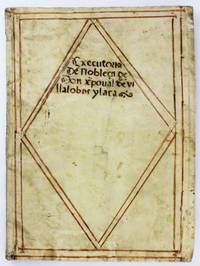
16265681Lima 1626. Still very good. 62 i.e. 61 leaves. Folio. Limp vellum ruled and lettered in ink; edges sprinkled red and black. Some creasing and staining to vellum. Small tissue repair to first leaf of text. Occasional dampstaining and foxing. Accomplished in a highly legible hand. An outstanding and minutely-detailed colonial Spanish patent of nobility accomplished in Lima in the early part of the 17th century and illustrated with two full-page coats of arms. This patent was commissioned by one Cristóbal de Villalobos y Lara corregidor or mayor of the Province of Yampares a province in Bolivia in the Department of Chuquisaca. The office of corregidor was a municipal position although the office holder was also required to assist the army in times of war. Among the many duties of this position were to promote and to carry out all manner of public works maintain health standards and the police force verify weights and measures avoid contraband and prohibited merchandise and in general observe and impose commercial standards. The patent of nobility was a highly formal official document which not only confirmed the noble rank of the recipient but also could grant certain privileges commensurate with rank. As a result the form was highly stylized structured and often quite lengthy -- the text of the present example runs to nearly 120 pages and traces the lineage of Villalobos y Lara for generations generously assessing his claims to nobility. The outstanding features of the document are the two full-page illustrations of the new nobles' coats of arms on the initial two leaves accomplished in gouache and gilt. Each shield features differing emblems in four quarters lies on a folial background and is headed by a knight's helmet. The second illustration also features a depiction of St. Sebastian and a knight on horseback who is trampling what appear to be smiling peasants. Patents of nobility from colonial Spanish America from this early date are very rare on the market and the present example has survived in fine condition. unknown
15400031701540 Portefeuille grand in-quarto (230 X 337 mm) vélin ivoire recouvert de satin bleu (en partie décousu avec petits manques en marge) et bordé d’un fin galon doré, cordons de fermeture brodés de fils couleurs et or (en partie manquants) ; 28 feuillets (dont deux réglés sans inscription et deux autres vierges) sur peau de vélin reliés au portefeuille par un cordon de soie à brins jaune, vert et rouge (Reliure de l'époque).
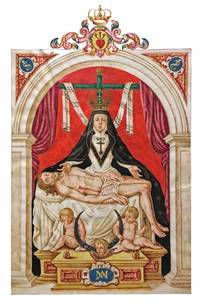
1726LL 878<p><em>"Ejecutoria de Hidalguía ganada por los Caballeros hijosdalgo de los Señores Don Nicolás Antonio de Arjona y Don Zoilo Alfonso de Arjona".</em></p><p>4to. 33 x 23 cm. Contemporary silk binding. Three manuscript pages vellum folio containing a beautifully rendered depiction of the spiritual state of Solitude with a figure of a recumbent Christ with two cherubim at his feet and angels with a Virgin Mary illuminated vellum folio with coat of arms of nobility of the Arjona Family with colored helmet two vellum pages with a genealogical tree cover five blank folios 211 folios.</p><p><strong>RICHLY ILLUMINATED SPANISH "CARTA DE HIDALGUIA</strong>. According to seventeenth century writer Bernabé Moreno de Vargas a patent of nobility hidalguía consists of a transcription of a favorable outcome of a lawsuit filed before the Chancellories of Ciudad Real Granada and Valladolid. on behalf of individuals families and often of entire lineages recognizing the plaintiff's or plaintiffs' noble status.</p><p>After January 20 1703 the competencies for determining noble status would fall exclusively on the Chancellories of Valladolid and Granada in order to protect the impoverished Royal treasury from tax evasion. </p><p>This patent of nobility or hidalguía concerns the families of Don Nicolás Antonio de Arjona and Don Zoilo Alfonso de Arjona in 1726.</p><p><em>Artfully decorated the depiction of the family's noble coat of arms is especially worthy of mention. The document examines the two genealogical trees and stands as a good example of the heraldic literature of the time</em></p>
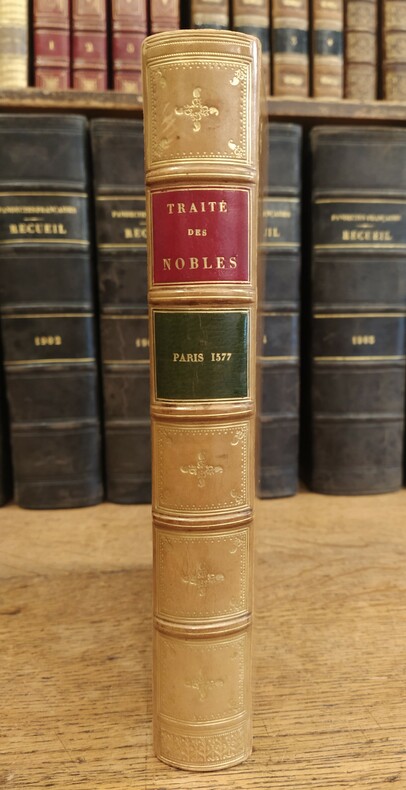
15773409Paris, chez Guillaume de la Nouë, 1577. In-4 (23 x 17 cm), veau blond glacé, dos à nerfs orné, filet encadrant les plats et sur les coupes, dentelle intérieure, tranches dorées (reliure signée Simier relieur du roi). Edition originale, contenant un Tableau dépliant (p. 80). Erreurs de pagination. Bel exemplaire.
005670Le 16 d'aoust 1717 à 9 heures du soir. In-quarto (275 X 210 mm) veau havane glacé de l'époque, dos à nerfs, caissons dorés ornés aux petits fers, pièce de titre maroquin grenat, coupes et coiffes filetées, chasses ornées d'une roulette dorée, tranches rouges (Reliure de l'époque) ; (1) f. de titre, 732 pages, (1) f. blanc, 68 feuillets, (1) f. blanc. Petit manque et petites restaurations à la coiffe supérieure, quelques taches sur les plats.
220955S.l., s.d. (vers 1695) 2 parties en un vol. in-folio, [71] ff. n. ch., généralement anopisthographes, dont le titre dans un beau cartouche aquarellé et dans un encadrement de filet rouge, nombreuses armes finement aquarellées, veau fauve granité, dos à nerfs cloisonné et fleuronné, pièce de titre cerise, tranches mouchetées de rouge (reliure de l'époque). Petites restaurations aux coiffes et aux coins.
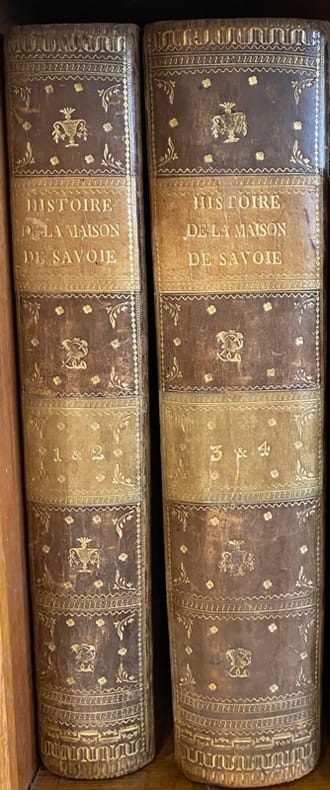
225363A Turin, Chez Briolo, 1778-1780 4 tomes en 2 vol. in-folio, basane fauve, dos lisse orné de filets et de fleurons dorés, tranches rouges (rel. de l'époque). Qqs épid. sur les plats, qqs rousseurs.
1992LFA-1267105386 volumes de 456, 462, 499, 498, 731 et 175 pages, format 240 x 340 mm, reliés bleu avec blason de Savoie, réimpression (1992) des éditions de Grenoble (1863-1966), tirage limité à 350 exemplaires numérotés, bon état
1847B119828Bruxelles, Auguste Decq, e.a. 1847-1950 Série complète de 1847 à 1950 reliée en 77 volumes physiques, ensemble 34.823 pp., illustré de quelques frontispices ainsi de quelques illustrations dans et hors-texte, 20cm. (sauf année 1910: 24cm. sur papier de luxe), reliures modernes solides (titre doré au dos, la plupart des dos sont en toile et quelquesuns en cuir, plats marbrés), la brochure originale est conservée et reliée dans une grande partie des volumes, avec ex-libris héraldique dans chacun des tomes, texte et intérieur sont frais, très bon état, poids total: 55 kg., [Importante source pour l'histoire de la (jeune) Belgique et de la noblesse belge. Les 'deuxièmes parties' des années 1889 à 1899 contiennent la première liste alphabétique des "Membres de la noblesse officiellement reconnus" (en Belgique) // On y joint: DE SCHAETZEN Marcel, Historique et table générale de lannuaire de la noblesse de Belgique depuis sa foundation 1847-1930, Bruxelles, 1932, 142pp. // Détails des VOLUMES: 1847: xvi,364pp., 1848-1849 reliées ensemble: xvi,326 + xxvi,328pp., 1850-1851 reliées: xvi,352 + xx,339pp., 1852-1853 reliées: xxiii,372 + xix,337pp., 1854-1855 reliées: xxiii,340 + xx,334pp., 1856-1857 reliées: xx,352 + xvi,344pp., 1858: xvi + 363pp., 1859: xvi + 375pp., 1860: xvi + 383pp., 1861: xii + 384pp., 1862: xii + 395pp., 1863: xii + 396pp., 1864: xii + 400pp., 1865: xii + 434pp., 1866: xiii + 422pp., 1867: xii + 416pp., 1868: viii + 432pp., 1869: viii + 399pp., 1870: viii + 410pp., 1871: 402pp., 1872: 406pp., 1873: 400pp., 1874: 410pp., 1875: 396pp., 1876: 410pp., 1877: 424pp., 1878: 406pp., 1879: 416pp., 1880: 402pp., 1881: 410pp., 1882: 414pp., 1883: 416pp., 1884: 420pp., 1885: 406pp.,; 1886: 412pp., 1887: 430pp., 1888: 421pp., 1889-I: 283pp., 1890-I: 292pp., 1889-II & 1890-II reliées: 257pp. & pp.217-503, 1891-I: 264pp., 1892-I: 261pp., 1891-II & 1892-II reliées: pp.501-750 & 751-1000, 1893-I: 255pp., 1894-I: 250pp., 1893-II & 1894-II reliées: pp.1001-1250 & 1251-1500, 1895-I: 243pp., 1896-I: 239pp., 1895-II & 1896-II reliées: pp.1501-1754 & 1755-2000, 1897-I: 259pp., 1898-I: 256pp., 1897-II & 1898-II reliées: pp.2001-2250 & 2251-2500, 1900-I: 247pp., 1899-I & 1899-II reliées: 265pp. & pp.2501-2719 + tables générales, [Lannuaire na pas paru de 1901 à 1909], 1910-I: 363pp., 1910-II: 463pp., 1911-I: 389pp., 1911-II: 463pp., 1912-I: 435pp., 1912-II: 474pp., 1913-I: 395pp., 1913-II: 541pp., [non pas paru de 1914 à 1920], 1921-I & 1921-II reliées: 229 + 402pp., 1922-I & 1922-II reliées: 231 + 396pp., 1923-I & 1923-II reliées: 241 + 315pp., 1924-I & 1924-II reliées: 201 + 442pp., 1925-I & 1925-II: 205 + 423pp., 1926-I & 1926-II reliées: 225 + 375pp., 1927-1928-I & 1927-1928-II reliées: 174 + 377pp., 1929-1930-I & 1929-1930-II reliées: 217 + 272pp., 1931-1932-I & 1931-1932-II reliées: 216 + 315pp., 1933-I & 1933-II reliées: 249 + 301pp., 1934-I & 1934-II reliées: 288 + 283pp., 1935-1939-I & 1935-1939-II reliées: 184 + 379pp., 1940-1941-I: 267pp., 1940-1941-II: 274pp., 1942-1945-I & 1942-1945-II reléies: 208 + 312pp., 1946-1950-I & 1946-1950-II reliées: 162 + 277pp.], B119828
B113987s.l., s.d. [19th cy.] [6bl] + [740] + [14bl] pp., containing 242 biographies of the Great Councils members (each starting on top of the page with their coat of arms (pre-printed, 220 of them handcoloured), followed by 1 to 3 pages of text in French) and followed by a chronological and alphabetical list of the members, included is also a text of 9 pages: Translation du Grand Conseil à Namur à cause des troubles des Pays-Bas le 7 juin 1580, 40x27 cm., 19th cy. hardcover binding (spine in vellum, marbled boards, edges bit rubbed, small defect at lower end of spine), very neat and uniform handwriting, text and interior is clean and bright, no date mentioned but most probably dating from the first half of or mid 19th cy., well preserved and in good condition, [The Great Council of the Netherlands at Malines was the highest court in the Burgundian Netherlands. It was founded by Charles the Bold in 1473 and disbound after his death. It was re-erected in 1503 by Philip the Handsome in 1503 and its influence and importance grew till the Eighty Years War, after which its power declined and it was finally abolished during the French Revolution. The composition of the Great Council was quite stable throughout the period of its existence, and consisted of a chairman, 15 to 16 councillors, one procureur-general, one fiscal advocate, some secretaries and clercs, advocates and a Huissier de justice], weight: 4.3kg., B113987
Seven books in two volumes, complete. AN OUTSTANDING SET, IN FIRST STATE AND ABSOLUTELY COMPLETE, OF THE FIRST AND ONLY EDITION OF ONE OF THE RAREST, MOST IMPORTANT, AND BEST-PRODUCED GENEALOGICAL WORKS OF THE 18th CENTURY. 1 leaf; xxxvii pp.; 1 leaf; 30, 457 pp.; 4 leaves; 533 pp. plus 16 genealogical tables on 10 inserted leaves; 8 double-page genealogical tables; one larger folding double-page genealogical table; 10 etched and engraved plates (mainly views of estates); and 19 fine portraits (COMPLETE, incuding 18 mezzotints engraved by John Faber, and an engraving by William Henry Toms after Van Dyck and Lempriere. The five Rawdon portraits, intended for a different work but sometimes inserted into this one, are not present). The introduction is in the first state, before the cancelation of p. xxxvii (later copies have xli pages in the introduction). Moreover, pp. [453-460] of volume II, printed in 1765 and rarely found, are present. This set is extra-illustrated with an engraved portrait (1807) of John Perceval in volume I and with an engraved view (1783) of Enmore Castle in volume II. Lowndes, who examined only second-state copies of this work, asserts that pp. 446-447 of volume II are missing. IN THE SET I OFFER THESE PAGES ARE PRESENT. (The reason for this discrepancy is that quire Lll of volume II was re-set to eliminate a lengthy--two page--screed on the privileges of the nobility. That screed is present in the copy I offer, but in few others.) Lowndes also mistakenly calls for a map of part of the estate of John Perceval, which was in fact printed long after this work and does not form part of it, although it is sometimes found bound in. The fact that almost all of the portraits are executed in mezzotint indicates how small the press run was: only 25 to 50 impressions of a mezzotint could be taken before the plate would have shown signs of wear (and the impressions in this set are uniformly rich and brilliant). A few of the known sets of this work, indeed, are missing the portraits (which is even more understandable since the mezzotint portraits were engraved after the book was printed, some of them as late as 1747). The dozens of in-text coats of arms (and the vignettes on the fly-titles of all of the individual books) are engraved on copper, not wood, demonstrating that no expense was spared in the production of this lavish publication. The attractive engraved Northwick armorial bookplate (motto: "Par ternis suppar") in each volume. Beautifully printed on fine handmade Dutch laid paper, with the title-pages printed in red and black. Royal 8vo. ELEGANTLY BOUND BY SAMUEL CHARLES SMITH (signed) c. 1810 in full forest green morocco, covers gilt, spines elaborately gilt in six compartments. All edges gilt. Only tiny traces of wear, else A BRIGHT AND FINE SET. Lowndes I, 40 (giving an extensive collation); Lewine, p. 28; Graesse I, 116; Brunet I, 262; Moule DXLII (giving an astronomical price of 15 to 30 guineas in 1822.) Very rare. An important source for Norman and English history, and an impressive example of 18th-century English book production at its finest.
201291763S. n. | s. l. 2012 | 20 x 13.50 cm | autre
176989843Jean-François Robert Dessaint, Saillant & Nyon | Toulouse Paris 1769 | 9.8 x 17 cm | 2 volumes reliés
206929Altenburg, Druck der Hofbuchdruckerei, 1852 8 pièces en un portefeuille in-4, velours cramoisi, dos lisse orné de guirlandes dorées en long en tête et en queue, encadrement de guirlande dorée sur les plats, armes réalisées à l'aide de perles sur le premier plat, M couronné sur le second, gardes à soufflets doublées de tabis ivoire (reliure de l'époque). Dos un peu usé, couleur du velours un peu passée.
216693À Paris, Par la Compagnie des Libraires, 1726-1733 9 vol. in-folio, env. 930 pp. par vol., index dans chaque vol., très copieux index (350 pp.) dans le T. IX, veau fauve, dos ornés à nerfs, tranches rouges (reliure de l'époque). Petit manque à certaines coiffes, usures aux coins, tache sur le premier plat du tome III et sur le second plat du tome VIII. Bon exemplaire malgré les défauts signalés.
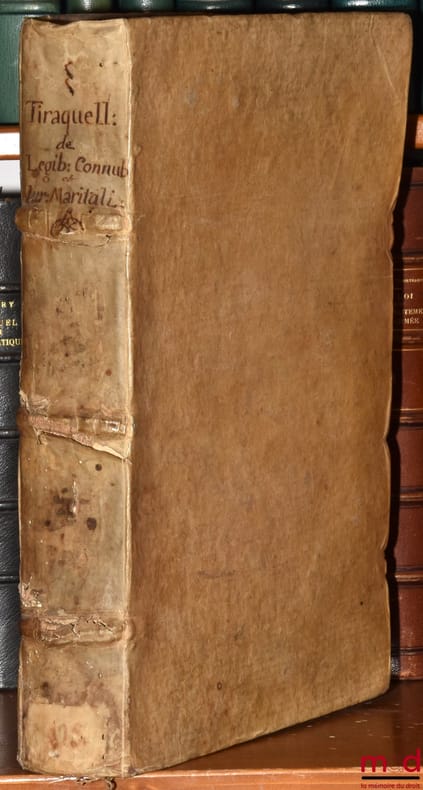
51410, Lugduni [Lyon], Gulielmum Rouillium 1554, in-folio, pl. vélin ivoire, tit. manuscrit sur dos à 3 nerfs, inscription sur la tr. inf., tit. gravé pl. p. en frontispice, portrait hors-texte en noir & blanc de l’auteur, (rel. fragile partielt détachée, qq. mq. et trous de vers non traversants au dos, coins émoussés, coin inf. droit de la page de tit. déchiré sur 6x4cm), int. très bien conservé, XXI-360- [Tab. mat]p.
211666Paris, P. L'Huillier, 1568 fort vol. in-folio, [5] ff. n. ch. (titre - restauré et renforcé -, dédicace à Charles IX, préface), 684 pp., [19] ff. n. ch. de table et de privilège, veau fauve marbré, dos à nerfs cloisonné et fleuronné, tranches mouchetées de rouge (rel. du XVIIe s.).
In-12°, (24cc), 560pp, (4cc), occhietto, fregi e iniziali xilografiche, bellissima legatura in marocchino rosso alle armi dell’Arcivescovo di Tarso Francesco Maria Febei su entrambi i piatti, titolo in oro al dorso, fregi, nervature, tagli in oro. Esemplare di dedica allo stesso Arcivescovo Febei. Si tratta dell’opera più famosa del giurista umbro Antonstefano Cartari. In-12°, (24cc), 560pp, (4cc), half-title, wooden engraved ornaments and tail ornaments, splendid red morocco binding, gilt coat of arms of Archbishop of Tarsus Francesco Maria Febei on both sides, gilt title at the spine, ornaments, bands, gilt edges. It is the most known work of Umbrian jurist Antonstefano Cartari. Dedication copy to the same Archbishop Febei.
226396Paris, Au Bureau de l'Annuaire de la Noblesse et Champion, 1894 (1909) 12 vol. in-4 et 1 album in-4, demi-percaline rouge à coins à la Bradel, dos orné, premier plat de couv. cons. (reliure légt post.). Dos légt passé. Ex-libris J. de Lazerme. Bon exemplaire.
224017Paris, Lib. Bachelin-Deflorenne, 1872-1877 21 vol in-8, demi-maroquin rouge à coins, dos à nerfs, tête dorée (Belz-Niédrée). Coins souvent usés, faiblesses à certains mors, accroc à un nerf du tome XIV.