20 résultats
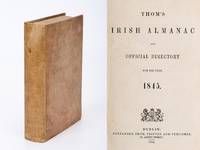
184529909AB1845. First Edition. Dublin Alexander Thoma 1845. Octavo 13 cm x 18.5 cm. VIII 906 pages. Original Hardcover Publisher's blindstamped cloth with gilt lettering and ornament to spine. Very good and firm condition with some minor signs of wear only. This is one of the most important and rarest sources for Statistics in Ireland in 1845 and one year prior of The Great Famine Gorta Mór / Irish Potato Famine. Thorough Statistics in Thom's Almanac for the Famine-years 1844 and 1845 in this Volume show for example: Page 180: "The Poor Law Act came into operation in 1839 but none of the Workhouses were opened for the reception of paupers till 1840 in which year 4 were opened in 1841 34 were opened in 1842 54 and in 1843 14 and in 1844 7; remaining to be opened prior to 1845: 17." Folding Tables show "Name Situation Extent Number of Electoral Divisionsand of Guardians in every Union in Ireland; also the Number for whom House Accommodation has been provided the Data of opening of every Workhouse with the number in each on 1st of January 1844 the average Number relieved daily etc. etc." Statistics show List of Articles Imported and Exported Net Produce of Molasses Hemp Rice as well as Exports of Corn Grain Lard Horses etc. The Statistics are detailed and thorough and list results from Skibbereen to Belfast. The Almanac also lists in detail for example: Tables for finding the rising and setting of Sun and Moon / Lighthouses on the Coast of Ireland / Fairs now held in Ireland / Stamp Duties / Corn Duties / Table of Irish and British Money / Bill Card for 1845 / Courts of Law / Governors of Colonies / Scotland Officers of Crown and State / Peerage / Peerage of Ireland with alphabetical Index / Knights of St.Patrick and Officers / Baronets of Ireland / Knights Bachelors in Ireland / Ancient Irish Titles retained by desendents / Foreign Titles borne by residents in Ireland / Knights of British & Foreign Orders in Ireland / Statistics of Ireland: Railways / Poor Law Statistics / Populations of Towns Skibbereen in West Cork showing for example: 4715 / Dunmanway: 3086 / etc. etc. hardcover
20098'"Standard" Office Wigan May 27th. 1862.'. For the background to this letter see William Otto Henderson 'The Lancashire Cotton Famine 1861-65' 1934 and Angela V. John 'By the Sweat of their Brow' 2013. Between 14 April and 16 October 1862 Whittaker published a dozen letters on the 'Lancashire Distress' in the London Times under the pseudonym of 'A Lancashire Lad'. Edwin Waugh in his 'Home Life of the Lancashire Factory Folk During the Cotton Famine' 1867 describes Whittaker as 'one of the first writers whose appeals through the press drew serious attention to the great distress in Lancashire during the Cotton Famine. There is no doubt that his letters in The Times and to the Lord Mayor of London led to the Mansion House Fund. In The Times of April 14 1862 appeared the first of a series of letters pleading the cause of the distressed operatives.' The letter is 2pp. 12mo. Bifolium on grey paper. In fair condition aged and worn. Whittaker begins by apologising to Langley for sending only part of the note intended for him but as Langley has 'gathered the sense of what the whole note contained' he will not trouble him 'with the same thing again'. Regarding his seventh 'Lancashire Lad' letter he writes: 'In today's Times I try to correct the statement made by the chairman of your Board of Guardians last week. It is a great pity that he should have made that statement especially as about the very time that he was making it I was consulting with others as to the 400£ distributed to Preston and other towns. He ought to have seen that it is injurious to make any statement which may lead to cavilling and the more so in a case like this where the thousands of out-of-work-operatives are becoming more and more dependent upon what is being contributed for their relief. He concludes by suggesting that 'all ought to combine in helping and that each ought to be specially careful not to say or do anything which might lead to lessening the help afforded to our poor'. Whittaker's later activities are clouded in obscurity. In 1869 the 'Bookseller' reported that 'Mr. John Whittaker whose letters in " The Times" under the signature of " A Lancashire Lad" led to the formation of the Mansion-House Relief Fund has we are informed left the staff of The Daily Telegraph upon which paper he has been engaged during the last few years and joined that of The Echo the new half-penny daily paper.' '"Standard" Office | Wigan | May 27th. 1862.' unknown
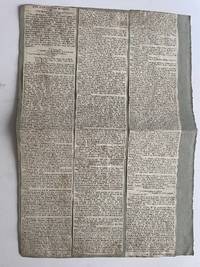
25921852; place not stated. The piece relates to 'the death by starvation of Commander A. Gardiner and the whole of the party sent out by the Patagonian Missionary Society in September 1850 to Picton Island the southern extremity of America'. '3 columns each 13½ inches by 2¾ attached to a piece of grey paper and a fourth column 3¾ inches by 2¾ attached to another piece. Discoloured and with minor spotting but in good condition overall. The article consists exclusively of transcriptions of two letters from Captain W. H. Morshead H.M.S. Dido at sea 22 January and 21 February 1852 and of a covering letter from Rear-Admiral Fairfax Moresby H.M.S. Portland at Valparaiso 21 February 1852. See Image. Note:"The Patagonian Mission founded in 1844 by Captain Allen Gardiner was the precursor to the South American Missionary Society SAMS an Anglican mission focused on bringing Christianity to the peoples of Patagonia. Although Gardiner and his companions tragically died of starvation and scurvy in 1851 during a disastrous expedition to Tierra del Fuego their sacrifice inspired the organization. The mission continued eventually expanding its scope renaming itself SAMS in 1864 to reflect its broadened work across the continent." AI Overview [1852]; place not stated. unknown
1990402398-UD22Washington : United States Government Printing Office 1990. Softcover. Good. Paperbackmost text in Ukrainian reprints from the collection of the Univerrsity of Michigan Library 8vo. Washington : United States Government Printing Office paperback
19901-1125225793University of Michigan Library 1990. Paperback. New. 604 pages. Ukrainian language. 9.00x6.00x1.51 inches. University of Michigan Library paperback
19901-1125225807University of Michigan Library 1990. Paperback. New. 604 pages. Ukrainian language. 9.00x1.51x6.00 inches. University of Michigan Library paperback
19901-1125225785University of Michigan Library 1990. Paperback. New. later printing edition. 588 pages. 9.00x6.00x1.47 inches. University of Michigan Library paperback
1125225793.Gpaperback. Good. Access codes and supplements are not guaranteed with used items. May be an ex-library book. paperback
19502090502113706464Not Available 1950. Soft Cover. Fine. The book is in fine condition. Not Available paperback
19392090502113708885Not Available 1939. Soft Cover. Fine. The book is in fine condition. Not Available paperback
20034701Aichi 1885 Odagiri. Grey stitched wrs. embossed covers very good bit of corner & spine wear contents clean 27 4 double folded leaves entirely woodblock printed on hand- made paper bit of old minor worming 35 color page plates. Essentially a very nice copy of a rare book. This very fasc- inating work shows the peasants suffering from the famine at its height. Illustrations show: a Samurai preparing to eat but with knowledge of peasant suffering hesitates. droves of peasants sit quietly before their feudal lord awaiting a turn to receive a bowl of food -most are clothed in Wara or rice-stalk mats for protection against the elements showing the very low level of their poverty & suffering. Others show the suffering of the common people starvation death moth- ers with dried out & withered breasts dogs and birds feed- ing on the dead cannibalism and villagers begging at the rice storehouses. With an important list of edible plants their name mushrooms & poisonous plants noted to stave off starvation. Nicely drawn by Kimura Kinshu/Kaneaki. Scans can be sent by e-mail. unknown
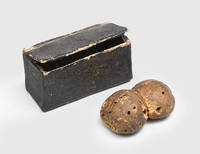
1817127400Germany: 1817. A relic from the Year Without a Summer This small "Hungersemmel" produced in German-speaking countries during the famine of 1816-17 illustrates the severity of the food shortage. It was kept as a memento of the hardship as the accompanying note explains: "This 2-penny bun is from the expensive time of the year 1817 stored here as a memorial on the 12th of July. Paid by Carl Weißenbach" our translation. The price of such famine buns remained unchanged throughout the period but their size decreased as the stock of flour dwindled. Bakers supplemented their scarce flour with inedible material such as sawdust straw and tree bark and added whiteners such as alum chalk gypsum and burnt bones Angerer p. 165. They were often passed through families to remember the dead although some public institutions such as churches and town halls also displayed them. The famine resulted in the first wave of German emigration in the 19th century with many fleeing to Poland Russia and the United States. "Hunger pastries" are scarce survivals. The Museum der Brotkultur in Ulm holds five similar examples. Four more are traced in the Historical Museum in Regensburg and two in the Gerätemuseum in Ahorn near Coburg Angerer p. 162. The note in German reads: "Diese 2-Pfennigsemmel ist von der theuren Zeit des Jahres 1817. Als Andenken hierin aufbewahrt am 12. July. Von Carl Weißenbach bezahlt". Dried bun 60 x 40 x 25 mm accompanied by a folded manuscript note in German. Housed in a contemporary black card box. Bun darkened and with some expected damage including insect; manuscript note browned finger-stained and with a 20 mm tear; box worn. In good condition. Birgit Angerer Gutes Wetter - Schlechtes Wetter 2013; Dorothee Bayer O gib mir Brot: Die Hungerjahre 1816 und 1817 in Württemberg und Baden 1966. unknown
15472From Nice France. On letterhead of the Diocese of Ohio. 25 January 1889. 1p. 12mo. In fair condition on aged and creased paper. Reads: 'Dear Sir and His Honor the Lord Mayor of London. Your appeal has this hour met my eye. Be so good as to add the enclosed $100 to your collection for "the China Famine Relief Fund." Messrs. Brown Shipley & Co are in the habit of cashing my check on Bank of New York; it it is desired.' With oval stamp of the City bankers Brown Shipley & Co. and initaled note of the converted sum '£20 7s 3d'. From Nice, France. (On letterhead of the Diocese of Ohio.) 25 January 1889. unknown
1330675460.Gpaperback. Good. Access codes and supplements are not guaranteed with used items. May be an ex-library book. paperback
0260665983.Gpaperback. Good. Access codes and supplements are not guaranteed with used items. May be an ex-library book. paperback
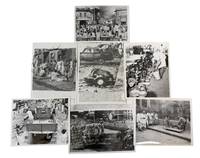
1943234951943. Indian famine crisis press archive depicting hunger relief work and public unrest from Bengal famine conditions through later food riots in independent India. The Bengal Famine of 1943 killed an estimated three million people and food scarcity remained politically volatile in India for decades afterward. Street demonstrations over grain rationing and hunger drew police deployments in multiple cities turning food access into a public order crisis as well as a humanitarian emergency.<br /> <br /> Photo archive of 7 silver gelatin press photographs mostly measuring 8" x 10" India 1943-1964. Crowds gather outside food distribution points children sit with metal bowls during feeding mounted police face demonstrators and uniformed officers move through dense street scenes. Press captions identify Calcutta famine conditions food rioters dispersed by police in Kerala fighting and fire in Lucknow and relief activity for famine victims. Typed captions identify "food rioters" being dispersed outside the Travancore state government house in Trivandrum Kerala where police and mounted officers filled the street after looting over food. Another caption describes Lucknow fighting in which "rioters set fire to about a six-block square" with crowds massed near burning buildings and shopfront signs. Calcutta scenes show famine victims clustered around relief vessels and feeding bowls with one caption stating that people had been "reduced to skin and bone" after food shortages. A street-side feeding scene shows children and adults crouched in rows with metal dishes receiving food from a man holding a large bucket.Verso stamps include Acme Newspictures NEA reference markings New York Bureau labels editor crop marks typed captions and publication dates.<br /> <br /> The group connects famine mortality postwar scarcity and street protest in India across a period when food distribution became a central test of colonial and postcolonial government authority. Press handling wear caption remnants crop marks corner creasing and scattered surface marks; overall in very good condition. A strong press group linking famine relief imagery with the public unrest that followed hunger into India's mid-century political life. unknown
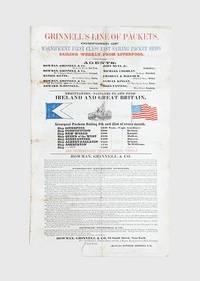
1850183852New York: Bowman Grinnell & Co. c.1850s. Fleeing to a new life in America An advertising poster assuring American patrons that Bowman Grinnell & Co. could be trusted to relocate their relatives from Ireland in comfort. The advertisement lists the addresses of the company's agents the names of their ships and the procedures for emigrating from Ireland. Throughout the Great Famine of 1845 to 1852 many companies took advantage of emigrants' desperation to force them to travel in overcrowded and understocked vessels and coffin ships or to scam them out of their money. As printed on this item "Bowman Grinnell & Co. have seen and witnessed with feelings of regret for a long time that something was necessary for the protection of the Irish people in the United States sending their remittances to their friends in Ireland. from the numberless disappointments they have lately met with and in many instances the heartless frauds that have been practiced on them by parties professing to bring them out on ships over which they had no control or with which they had no connexion". Bowman Grinnell & Co. was formed in the 1850s by William Bowman and Robert Minturn Grinnell of the Grinnell Minturn & Co. shipping line owners of the famous Flying Cloud clipper ship. It claims that their ships listed with their captains' names were fast well-ventilated and comfortably furnished that their drafts could be cashed anywhere in Ireland and that baggage would be transported for free. Single sheet 444 x 265 mm printed in red black and blue on one side only vignettes. Ink number on verso 19th-century pencil inscription on lower right corner. Sometime folded loss on lower left corner barely affecting printed area light toning and soiling especially on verso: a very good copy of an ephemeral item. unknown
1330831888.Gpaperback. Good. Access codes and supplements are not guaranteed with used items. May be an ex-library book. paperback
184897631848. Full Leather. Good binding. 5-1/4" x 3-3/8." 108 pp. Full brown leather over flexible boards. Vertical red rules for accounting printed on each page. 1-3/8" strip of leather neatly removed from the fore-edge of the front cover; occasional ink spotting and minor stains throughout; toned leaves with a few creases; faded pencil calculations to pastedowns. <br /> <br /> Interesting mid-19th century farm ledger apparently from eastern Scotland possibly Inverurie or Aberdeen recorded during the great famines in Ireland and the Scottish Highlands. The currency symbols at the top of the expense and income columns appear to be in pounds shilling and pence and various place and personal names which appear repeatedly in the text – i.e. Commercial Co. of Port Elfinston sic Aberdeen Wm. Duncan et al – lead to our deducing this locale. Although the ledger is anonymous the names of Robert Frasier Brach and James Dugard appear possibly as business clients as do the names of the recorder's many temporary workers. These workers usually hired around the planting and harvesting season are both male and female and include Mary Ellice Jas Marr George Dugard Wm. Duncan Alex Burr and many others. <br /> <br /> Extensively detailed and highly readable this ledger document the many expenses and income sources of a working farm showing precise amounts for equipment scythes and carts feature prominently horses bolls of meal barrels of lime whisky and various other sundries. The farm's produce relied heavily on grains especially corn and barley just as the Corn Laws were being heatedly debated in Parliament and its overall diversity demonstrates the crop diversity that allowed eastern Scotland and the Lowlands to evade the ravages of the potato blight; plots and crops for planting the "slack land" are also demarcated. Charts showing daily employee wages are also of special note. <br /> <br /> Overall a unique useful and well-maintained agricultural document concurrent with and standing in stark contrast to the devastation occurring in the western portion of the country and Ireland at that time. unknown
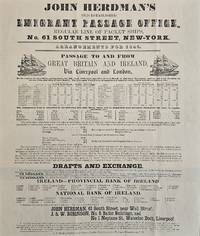
1845List2995New York City 1845. Two printed pages measuring 9 ¾ x 11 ½ inches one signed. Folded and slightly wrinkled near fine. A circular advertising passage between Great Britain and Ireland and numerous locations in the United States from Boston to New Orleans by a regular packet ship service managed by John Herdman and Company. The company also offered remittances whereby an individual in the US could send money to a friend or relative back across the Atlantic generally to pay for their passage to the States.<br /> <br /> The second sheet a signed letter offers a commission for finding customers: five percent of the passage fare and one percent of the remittance money. In 1845 the Great Famine in Ireland was just beginning and Ireland would lose a large proportion of its population not just to starvation but also to emigration. Earning commission on remittances could have been quite lucrative: the National Museum of Ireland estimates that the amount sent back to Ireland in remittances between 1845 and 1854—the height of the famine—reached $19 million. unknown