2 770 résultats
5761In folio, relié d'ép. pl. peau, rel à 5 nerfs, deux pièces de titre, un filet d'encadrement sur les plats, fleuron central repoussé sur chaque plat, coiffes bonnes, mors solides. Ouvrage peu manié, bien conservé, intérieur trés frais. 32 pp ; Impression du dictionnaire sur 2 col. (1 à 1624) ; Notes de David Hoeschel : 2 col. : 1 à 104 ; Index Rerum... 23 pp ; 2 p
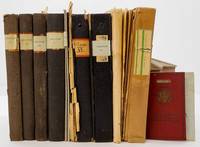
3080Together seven three-ring binder notebooks binders worn boards on vol. VI broken off -- retained by us as out of "respect du fonds" -- containing approximately 876 typescript and manuscript pages. TOGETHER WITH: 29 file folders of articles ideas proposals and miscellaneous publishing materials consisting of approximate 300 typescript and manuscript pages housed in a new Hollinger box. TOGETHER WITH: two of Lasker's passports 1921 and 1926 and a large b/w studio portrait photograph undated. An important discovery. This is the private largely unpublished literary archive of the noted social reformer Bruno Lasker 1880-1965 containing well over a thousand pages of typed and hand-written manuscripts. These writings date from 1923 until the year of his death in 1965. Lasker's social work is well known and concerned racial prejudice and justice trafficking and human rights immigration and immigrants' rights poverty in America and economic inequality. The present literary archive is hitherto UNKNOWN; without it a full and balanced assessment of Bruno Lasker's life and work cannot be undertaken. <br/><br/>That the materials herein are mostly unpublished is attested by Lasker's own statement in the first of seven folio notebook diaries named "Reflections." In addition to the "Reflections" the archive also contains working typescripts of 29 essays speeches and proposals including 19 writings which were evidently destined for a collection to be entitled "Rational Sympathy" that never appeared. It is instructive to present the transcription of Lasker's handwritten "To My Executors" in its entirety which appears in the seventh and final volume of his "Reflections" diaries:<br/><br/>"This is the seventh volume of what might be called a diary though entries never were made with the frequency suggested by that term. It consists of original reflections observations and discussions suggested either by experiences by reading or by verbal colloquies. Only a minute portion of this material therefore has ever entered into literary use i.e. publication and the bulk of it constitutes a continuous though not intentional progression of my major concerns sentiments and ideas over a large part of my life. Or rather it constitutes a collection which represents my un-professional pre-occupations sic. Those connected with my work are more likely to be embodied in memoranda articles prefaces book reviews reports and lectures. These are for the most part either on record as printed documents or in the parallel series of binders much larger in number which has now reached vol. XXX which I call my workbooks and which properly form an appendix to my recorded autobiography made for the Oral History Project at Columbia University and will be deposited with it in the archives of the Butler Library of that institution. NOTE: the 30 volumes were indeed deposited at Columbia University -- Bruno Laster Papers 1923-1951.<br/><br/>"The present collection or diary therefore is unpublished literary raw material and on my decease may either be handed to some interested person to be mined for items worth preserving perhaps even for the production -- such as I contemplate myself if I should find myself with enough time energy and self-confidence for such a task -- of an unpretentious volume or two of short essays or may also be appended to my MSS autobiography at Columbia University. Seattle May 8 1957. signed Bruno Lasker."<br/><br/>Lasker "Reflections" diaries were written for an audience of just one person: himself. It is clear that again and again Lasker turned to the writings herein for inspiration as is attested by other materials in the present archive SEE FINDING AID. As a social commentator Laske was erudite and penetrating. He observes and elaborates on an unusually broad array of topics SEE FINDING AID and have found ourselves continuously impressed by his intelligence imagination introspection and his command of the English language. The personal nature of the diaries is attested by just one poignant passage in Vol. I namely the entry dated July 26 1925 which in its entirety consists of 18 paragraphs:<br/><br/>"Yet but two weeks ago everything seemed so plain; I had the sensation of knowing that all was right that I was encircled by an all-loving power that there was in the world an all-seeing eye comprehending everything comprehending everything there is from the beginning to the end of time that nothing was impossible and therefore nothing pre-determined. I must have known or at least I must have been overpowered by consciousness that the being of this overarching trinity of power was knowable even though I could only see a glimpse of it afar. And that consciousness did not come to me in a state of dreaming but in one of those rare states of unusual clarity when the mind leaps unimpeded over chasms of difficulty. For days after I walked as one who had seen as one who thought he saw -- and then gradually the light grew dimmer and I saw no more. <br/><br/>"Yet even in this returning blindness I do not feel as one utterly lost neither worried nor sorrowful; for what I have glimpsed once I know I shall glimpse again and from that lighted cave I shall proceed to other caves as yet unexplored."<br/><br/>A sample passage from the same volume of "Reflections" on a very different topic: <br/><br/>"These suburban and small-town Negroes are magnificent. They dress well without garishness; their children are clean and well behaved; they are courteous without being abject -- above all they are available for any odd job that needs doing whether it be an extra hand in the kitchen on Jane's wedding day the cleaning of a gutter the hauling of a load of gravel or voting hansome sic Herman into office as overseer of the poor. The question is how long will they remain contented with the modest roles we have assigned to them How long will it be until their bank savings will make them independent of contractors and tradesmen who overcharge them of housewives who too openly and sneeringly despise them of landlords and industrialists who exploit them<br/><br/>"Another question is how long will it be until the white Americans with their insane pride in an imaginary Nordic descent will realize that the annual addition to the population they have denied to east and south European peoples or part of it is being made by a race which they deem even lower in the scale of human values" <br/><br/>FINDING AID:<br/><br/>Reflections Vol. 1: January 24 1924 to September 8 1925. Ca. 120 pp. numbered 1-112 with "Rough Index" manuscript; topics include -- but certainly are not limited to -- telepathy surplus wealth the social worker's dilemma assimilation and language the Americanization of the Iroquois Goethe's botanical writings popular fiction "My Reputation for Wit" habits and survival poverty prejudice measure of civilization "If This Be Treason" suggestions for authors world friendship beauty and illusion sex interest American manners wage-slaves substitution for war mechanics and divinity whimsical news seeing cities international credit sanctity of the home childhood reminiscences "Natural Science" Bible reading Bragdon's "Four Dimensional Distances" suffering for an ideal man-made trouble tradition the failure of Christianity the deteriorating environment and climate change Europe's race overpopulation the character of race the Christian church idealists' fractured man "Go and Sin No More" beauty of landscape workers' participation baby language erotic theology self-government for India "Das Heilige" liberation of youth a suction theory of population suburban and small-town negroes white Americans and much more. <br/><br/>Reflections Vol. 2: September 9 1925 to July 12 1926. Ca. 92 pp. numbered 113-205 with "Rough Index" manuscript; topics include -- but are certainly not limited to -- jaywalking "Nibelungenlied" social observations patrician cultures contract and conduct moral unrest in modern life "Religious" architecture the Golden Rule Holy Communion Christian dynamic intuition and experience internationalism America's mental age the 18th century stray thoughts stray observations friendliness and mechanism teaching internationalism social workers and the churches dishonesty Tompkins Square dramatic value of absence stature and experience claims of the church reading habits sex relations cultural heritages the Cleveland Madonna Christianity life and breath philanthropists the absurdity of female models as ideals of beauty and much more. <br/><br/>Reflections Vol. 3: August 10 1926 to March 23 1928. Ca. 130 pp. numbered 206-334 with "Rough Index" typed; topics include -- but are certainly not limited to -- theory of chance pluralism and free will fantastic eugenics comparison with Rome laws of life neighborhood as sociological museum an outline for a comedy bias of "scientists" Dewey on animal experimentation unreality of Jewish ideals Freud: Beyond the Pleasure Principle Freud's scientific courage Mozart and Jazz stray thoughts sacrifice of racial and cultural heritage necessary real sex problems of today that of normal folk El Greco and Van Dyck Fiction: a bridge between folkways and new understanding Broadway: a vain search for life Bach and the inferiority complex the future of music the absurdity of War Departments of Government the neighborhood playhouse public celebrations and rites modern music diet and internationalism sport and commercialism acting and the Kinema sic the "Modernistic" home kinetic aims in painting fear of religion art criticism in America conflict of creative and possessive impulses popular reactions to cleverness in the arts and much more. <br/><br/>Reflections Vol. 4: April 28 1928 to January 30 1934 and June 25 1934. Ca. 138 pp. numbered 335-473 with "Contents" in manuscript / partially typed; topics include -- but are certainly not limited to -- immortality A.E. Housman socialism in a new world free will the new industrial revolution and land values progress and vandalism choral music "Can We Change Human Nature" ethics and aesthetics continuous social registration cultural conservation ribaldry Ruth St. Denis: Symbol of Vandalism dynamic architecture dream cities enlarged horizons and morality superstition satire the "Medea of Euripides reflections at fifty hypocritical liberals science and consciousness "Rome is Burning" notes for a play "Ancient Sound" notes for a play common sense may be nonsense why radicals have long hair "Are Canaries Cheerful" ventriloquists in the pulpit life without sentiment social work as a profession gardens "C'est l'heure" aerial surveys a dream "Most people would rather have footmarks around their grave than flowers" museum policy new problems of wealth social theory and social practice our concern with techniques the Last Judgment severity of colonial powers a Christmas card blessings of poverty sic notes for sociological studies extremists fashions and new wealth from a future textbook of literature "What We Confront in American Life" notes for a speech two news films the greatest luxury Germany: a nation in flight the sense of guilt the immoral science what is "social" reform social re-education obeying traffic signals party principles the need for laughter and much more.<br/><br/>Reflections Vol. 5 according to the "Advertisement" laid into Reflections Vol. 1 was "unfortunately mutilated apparently to provide the main substance for one or more projected volumes of essays": April 18 1936 to July 19 1936. Ca. 14.5 pp. numbered 96-111 with typed "Contents." NB: Lasker writes: "Pages 1 - 96 consisting of observations and reflections in Eastern Asia in 1935-1936 mainly China Japan Java but also including Malaya Indochina Philippines and sea voyages have been incorporated with the documentary material appended to the typewritten record of the tape-recorded autobiography made by the Oral History Project Columbia University and to be deposited in the archives of the Butler Library of that University 1957. No literary use has been made of that material; but since it is largely reportorial and perhaps rather unique because of its informal character and aesthetic as well as sociological appreciation of things seen it seemed more appropriate for preservation in that connection than for the possible implementation of future reflective lectures or articles. ~ BL." Lasker also writes: "The diary pages following p. 111 are temporarily mislaid" as of January 1957 these are not known to have survived. Topics include American symphonic music in our time Common sense and universally valid knowledge Patriotism The intimacy of Oriental art symmetry in art the precariousness of the present peace expensive vulgarity dogmatism in "factual knowledge" and literacy and propaganda.<br/><br/>Reflections Vol. 6: January 31 1937 to October 31 1952 sic. Ca. 187 pp. numbered 1-187 with "Contents" in manuscript / partially typed; topics include -- but are certainly not limited to -- socialism and aristo-democracy authoritarian education age composition of the Supreme Court feminine beauty boys' clubs as citadels of capitalism institutional philanthropy and the relief of suffering on breaking a cut-glass dish understanding the self-sufficient cultures of Germany and Japan on getting wet with two raincoats selection as a creative process in art visual unreality in America eggs in modern literature notes for an article our lessening dependence on land surface "God knows" the cross on Mt. Davidson industrial unionism reflections in a library "The limited edition is a parasite that flourishes where literature is in decay" landscape with a figure desire for survival Bruckner's Fourth Symphony antisemitism and the Jewish future invention and war sexual promiscuity translation from Victor Hugo reducing college admission failures of American social science training reflections on Easter marriage for life impressionism and peace America's 20th-century Chinoiserie Bibles are dangerous Catholic priesthood a subway ride and the shadow of the third World War "Who are the Slum Dwellers of Today" experimental art free enterprise love of children walnuts and class government the poison of advertising fear of books satiety epic follies "The Fur Coat" outline for a short story loud song loud color the blight of old age the Russian communist a young priest Descartes' idea of God loneliness in a crowd freedom of women "Career" an outmoded concept prohibition of firearms thrift early morning things rarely seen an old man's joys efficiency expert revolutionary fanaticism death in a hospital "private room" American humor and much more. <br/><br/>Reflections Vol. 7: January 3 1953 to June 25 1965. Ca. 195 pp. numbered in 1-31 32-195 with typed "Contents" and instructions "To My Executors" in MS see transcription; topics include -- but are certainly not limited to -- Stalin's divinity and my own theories of probability Nicolai Hartmann's ontology of a stratified universe the vanity of "saints" Tristan and Iseult and the temper of medieval life childhood memories and religious conversion Milton's "Paradise Lost" the measurement of happiness crime and business classical perfection childish innocence and imagination in literature a squashed mosquito Boethius and prophecy the moral dilemma of our time: support for the stand of J. Robert Oppenheimer an old man's dreams: their moral significance love and morality the future of socialism national defense Salvator sic Dali's "Crucifixion" looking at life through the sun-glasses of prejudice the dream of human flight uniformed women youthful marriages the right to live cultural decay loneliness fatalism "Pictures that have influenced my life" Ruskin the American standard of living teaching science widowhood and its terror Trotsky's diary the burden of memories social change without revolution: the American home our decaying speech habits a reasonable view of death friendship and spiritual growth "Come Nearer Death" and much more. <br/><br/>ADDITIONAL TYPESCRIPTS / MANUSCRIPTS: 29 file folders preserved in a Hollinger box together with Bruno Lasker's 1921 U.S. passport featuring a signed photograph Lasker as a 41 year-old man; his 1926 U.S. passport; and a large undated b/w photograph of Lasker as an elderly man.<br/><br/>"Notes for Articles and Unfinished Articles":<br/><br/>1. Pragmatism and Prophesy 1927 see also Rational Sympathy IX<br/>2. By a Javanese Roadside<br/>3. Goethe: the Poet as Botanist<br/>4. Social Work and Social Forecast 1929 for a speech at Smith College <br/>5. The Marriage of Heaven and Hell notes for a one-act play<br/>6. Village of a Thousand Mandarins Pearl River Delta 1941<br/>7. Why Porcelain is Called China 1928<br/>8. The Youth Movement of Germany 1921 and 1924 for Survey Graphic journal<br/>9. Some Observations on Harlem 1924 for Survey Graphic journal<br/>10. A Philosopher on the Fifth Avenue<br/>11. The Good Life: prospectus and proposal for an ethics magazine social ethics social education 1929-1931<br/>12. Conflict of Values<br/><br/>"Notes on Diary and Other Material for Possible Book Use": <br/><br/>13. "Go and Sin No More": Pages from a Sociologist's Diary -- plans for publication of materials from "Reflections" vols. 1-6 SEE BELOW<br/>14. Misc. Publications Files: Upcoming Projects and "Manuscripts in Hand"<br/>15. Fugues: Studies in Life's Counterpoint 90 pp. for the Survey journal<br/><br/>"Rational Sympathy and Other Essays" Manuscript / Unfinished Book 1952<br/><br/>16. Man's Changing Universe<br/>17. The Combat of Superstition<br/>18. Fear of Religion<br/>19. This Talk about Spiritual Dynamic<br/>20. Individual and Society / Self-Indulgence and Discipline<br/>21. Thoughts on Immortality I<br/>22. Thoughts on Immortality II<br/>23. Pragmatism and Prophecy<br/>24. On the Sharing of Food<br/>25. The Philanthropist<br/>26. Humility: True and False<br/>27. Fidelity and Honor<br/>28. Published articles 1927-1946<br/>29. An Old Man Speaks. <br/><br/>Lasker defines and refines the fascinating history and sweeping contents of the "Reflections" series for some future reader on a typed "Advertisement" sheet laid into Vol. 1. It bears repeating in full: <br/><br/>"This series of seven manuscript volumes - the fifth unfortunately mutilated apparently to provide the main substance for one or more projected volumes of essays "The Good Life" "Science and Religion" etc. - started as a journal or diary. But in the course of time the entries became fewer and longer; and it seems to me that the new title " Reflections" with which I am now relabelling these binders is more appropriate. <br/><br/>"This series was preceded by other - handwritten - diaries one or two may inadvertently be preserved together with a thin paper cahier of carbon-copied early letters home from London in my green sailor's chest. These early diary entries are in part excessively sentimental and betray a highly emotional attitude toward my experiences and observations in my early twenties. And even up into the thirties for I distinctly remember a piece written on the birth of my daughter which I later have read with astonishment. <br/><br/>"Although it began as a diary and continued as a more or less conscious endeavor to preserve some of my passing thoughts for potential further literary uses this series in the main has been in my mind a substitute for lacking opportunities to express myself in writing on matters of intensive though passing and unprofessional interest. I wrote each piece - usually late at night or in hours of uninterrupted leisure at home - as a sort of editorial addressed to just one reader my future self. The occasions which stimulated such writing ranged from personal experiences to things seen and heard but more and more came to be dominated by my reading in many fields. Many of them carry on a sort of dialogue with some author or other not always in stark disagreement with his views but more often in admiration for him but somehow feeling urged to stress some aspect of the matter which to me he seemed to have neglected or perhaps misinterpreted. In this way I have managed through the years to retain my status in my own eyes at any rate as a writer and social student fully conscious though I have been at all times of my lack of skill and literary grace. <br/><br/>"This attitude on my part more fully revealed itself to me when I tried on various occasions spread over many decades to collect some of these minor essays for publication as contributions to some particular field of interest such as the change in moral standards the survival of a truly religious faith when all superstitions have been thrown out of one's conscious awareness of the personal relation to the cosmic forces and so forth. The task it always appeared was beyond my capacity - not because of insuperable technical difaculties but simply because these spontaneous and previously uncorrected entries were too clumsy too half-cocked and sometimes too dull and verbose to lend themselves to rewarding further manipulations - and to publication in any form. In part too intimate and in part roaming over too vast a region of concerns in which I needs must remain an errant amateur traveller these pages essentially remained either intellectual exercises of insufficient substance to be of interest to anyone but their perpetrator or else too way moody to represent even the writer's own thinking about the subject at issue under conditions other than those which had stimulated the initial effort at self-expression. <br/><br/>"That the entries gradually peter out is not so much a result of lacking enterprise or mental energy as of the fact that in recent years I have used another outlet for many of my cogitations and reflections: the notes appended to my collection of abstracts on Prophetics - a theme so large as to invite comments on my part on the widest range of topics. -- July 1 1962 Bruno Lasker."<br/><br/>The present archive contains Lasker's own design for a possible publication of selections from the "Reflections" SEE FINDING AID Hollinger box folder 13. The title of the proposed work is "Go and Sin No More: Pages from a Sociologist's Diary" alternate title: "Looking at Life: Chosen Leaves from the Diary of a Sociologist to 1950." A truncated version of Lasker's outline follows:<br/><br/>Introduction<br/>I. Faith and Knowledge / On Human Worth<br/>II. Rational Sympathy / Family<br/>III. Conflict of Values<br/>IV. Contact and Conduct<br/>V. Moral Attitudes / Crime<br/>VI. Morals and Taste / Parables<br/>VII. Citizenship<br/>VIII. Social Reform.<br/><br/>COLUMBIA UNIVERSITY BRUNO LASKER PAPERS: These were donated by Lasker himself in 1965 includes "further material on Mr. Lasker's history of his life career namely material covering the period 1957-1965 and material for his Study of Prophetics. The latter group -- the result of several decades of accumulation -- deals with conditions psychological and physical methods history and case studies of prediction. It comprises some 5000 pages in 33 binders of abstracts and comments; an index of abstracts by names topics and sub-topics; notes for a substantial bibliography; printed and manuscript materials; and the typed draft of an unpublished book 'Dates of Destiny'" SOURCE: Columbia University Columns XV:1 1965 pp. 40-41. <br/><br/>PARTIAL BIBLIOGRAPHY MONOGRAPHS: <br/><br/>Bruno Lasker Race Attitudes in Young Children 1929 one of the first to challenge notions of innocence race and "color-blindness" in young children <br/>-----. Human Bondage in Southeast Asia 1950 a classic study of the evolution of dependency in the history of human -----. Changing standards of living in South China as affected by overseas migration 1935<br/>-----. Japan in jeopardy 1937<br/>-----. Living on a moderate income; the incomes and expenditures of street-car men's and clerks' families in the San Francisco bay region 1937<br/>-----. Populations adrift 1941<br/>-----. Problems of the Pacific 1931<br/>-----. Propaganda from China and Japan: A case study in propaganda analysis 1938<br/>-----. Standards and planes of living in the Far East; a guide to discussions of postwar changes and prospects 1953<br/>-----. Books of Southeast Asia: a select bibliography 1956<br/>-----. Asia on the Move 1945<br/>-----. Peoples of South-East Asia 1944<br/>-----. Filipino Immigration to Continental United States and to Hawaii 1931<br/>-----. Jewish Experiences in America 1930<br/>-----. With B.S. Rowntree. Unemployment in York UK: a social study 1911.<br/><br/>PROVENANCE: Estate of Russell Johanson Ravenna Rare Books Seattle. unknown books
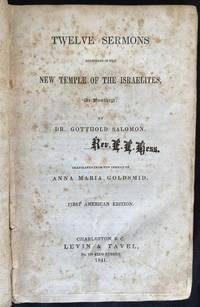
184141441Charleston S. C. : Levin & Tavel 1841. 1st American Edition Original Publisher's Cloth Small 8vo 2 236 pages followed by several unnumbered pages of publisher's advertisements. Singerman 0761 Rosenbach 483. <br> <br> Jacob Rader Marcus the dean of historians of American Jewish history suggests in his work UNITED STATES JEWRY 1776-1985 Detroit 1989 that "The motive that prompted Nathaniel Levin and a Charleston associate to reprint an English translation of the sermons of Gotthold Salomon was apologetic.The book was Twelve Sermons Delivered in the New Temple of the Israelites at Hamburgh. The Hamburg temple in Germany was a liberal Jewish synagog one of the first in Europe. <br> An English translation had been made of the sermons at London in 1839 by Anna Maria Goldsmid the daughter of Sir Isaac Lyon Goldsmid the Anglo-Jewish emancipator and religious liberal. The American reprint appeared two years later. <br> Both editions were intended not only to edify Jews but also to interest and attract non-Jews. It was Levin's hope that these sermons would remove unjust prejudices against the Jew and would present 'the lofty character of the Israelite in its true colors.' A book of this sort would help the Jews put their best foot forward." <br> Interestingly this 1st American edition of Twelve Sermons contains a new preface extolling the religious liberty of America and highlighting the refuge it afforded to the Jews. The new preface is merely signed "L" certainly referring authorship by Isaac Leeser and further supported by the fact that volume is preceded by two pages of advertisements for works by Leeser even though his works had no connection to the Charleston Publisher of this work.<br> That Leeser who would become American Orthodoxy's greatest warrior against the Reform would offer a preface to and advertise his works in a collection of sermons from the breakaway Liberal Hamburg Temple in Germany suggests that he did not yet see the coming threat from the Reform movement. <br> At the time of printing in Charleston Gustavus Poznanski 5 years into his term as rabbi and still somewhat traditional was just starting to make what felt like radical reforms as he "excised the Resurrection of the Dead and abolished the Second day of festivals five years before the same was done at the Breslau conference." <br> <br> America's first Reform import from Germany and it's first synagogue established as Reformed Har Sinai Congregation in Baltimore was still a year away from birth. Indeed the official term "Reform" did even come into use to describe Liberal Judaism except as a general adjective until 1845 even in Germany. <br> Leeser's involvement in this publication merits further study as it is not mentioned in the bibliographies nor in Sussman's comprehensive "Isaac Leeser and the Making of American Judaism." <br> Indeed in the 1840s at the time of this printing "there was a major split in Congregation Beth Elohim which many historians of American Jewish history see as the beginning of the American Reform movement. The conflict began after the introduction of an organ into the synagogue when it was rebuilt following a fire in 1840. <br> The series of conflicts between Reform and Traditionalist elements in Beth Elohim resulted in a complicated dispute between the President who favored Reform and the Board of Trustees which was controlled by the Traditionalists. The President refused to call the Board of Trustees to meet as was required by the synagogue's constitution because he knew they would admit new traditionalist members and obtain control of the congregation. The Board ignored him and met on their own a move which the Reformers challenged in court. The resulting case State v. Ancker has become known as an early example of U. S. Courts refusing to intervene in complex religious questions" Wikipedia. <br> <br> Salomon 1784-1862 was the preacher of the new Reform Hamburg Temple. His "sermons modeled like those of other preachers on Protestant examples were praised by his contemporaries notably H. Heine." Goldsmid 1805-1889 a daughter of Sir Isaac Lyon Goldsmid was a London author poetess translator educator and communal worker JE. Includes bibliographical references. <br> SUBJECTS: Jewish sermons. OCLC: 5001081. OCLC lists 11 copies worldwide. Ownership stamp of "Rev. E.L. Hess" on title page signiture of "S. Uhlfelder" on blank endpaper. Lacks backstrip wear and foxing occational period notes binding starting to loosen but Good Condition in acid-free book box. A scarce and important publication associated with the early beginnings of the Reform movement in Charleston and with Leeser's first years of scholarly output. B KH-9-29-BDZ-elx. Charleston, S. C. : Levin & Tavel unknown
In-8°, 59pp, (1cb), prima edizione. Legatura in marocchino rosso alle armi di don Felipe Ramirez Nuñez de Guzmán Duca di Medina sui piatti in oro, entro cornice in oro. Titolo in oro al dorso (PRO. PONT; VAR.), nervature, tagli in oro. L’opera del teologo bresciano Lodovico Oriano è una risposta alle questioni e dubbi sollevati da Martin Lutero sulla liceità della potestà del romano pontefice, sul libero arbitrio, sulla giustificazione per fede e opere, cioè sui cardini su cui poggiava l’intero impianto teologico della Chiesa cattolica. Rilegato con Discussio decreti magni Concilii Lateranensis, et quarundam rationum annexarum, de potestate ecclesiæ in temporalibus; & incommoda diuersæ sententiæ, authore Guilhelmo Singletono, 135pp, stemma dei Gesuiti sul frontespizio, fregi, iniziali e finalino xilografici. L’opera di Leonardo Lessio (alias William Singleton) è stata spesso oggetto di contestazione per apparire come non ortodossa alla lezione biblica. In-8°, 59pp, (1cb), first edition. Binding in red morocco, gilt coat of arms of Don Felipe Ramirez Nuñez de Guzmán Duke of Medina on plates, within a gilt frame. Gilt title on spine (PRO. PONT; VAR.), bands, gilt edges. The work of the Brescian theologian Lodovico Oriano is a response to the questions and doubts raised by Martin Luther on the legitimacy of the power of the Roman pontiff, on free will, on justification by faith and works, that is the cornerstones on which was placed the entire theological structure of Catholic church. Bound with Discussio decreti magni Concilii Lateranensis, et quarundam rationum annexarum, de potestate ecclesiæ in temporalibus; & incommoda diuersæ sententiæ, authore Guilhelmo Singletono, 135pp, Jesuit coat of arms on the title page, wood engraved friezes, initials and tail. The work of Leonardo Lessio (alias William Singleton) has often been the subject of dispute for appearing as unorthodox to the biblical lesson.
In-4°, 48cc, frontespizio in cornice figurata, gotico corsivo, illustrazioni xilografiche, capilettera, legatura in piena pergamena, buone condizioni. Prima edizione. Si tratta del diffuso Catalogus scritto dal Domenicano Bernardo di Lussemburgo come continuazione di quello di Nicola Eymerich, e che tratta delle più diffuse eresie del tempo, includendo ovviamente quella luterana. In-4 °, 48cc, frontispiece in ornated frame, gothic text, woodcut illustrations, inital letters, full vellum binding, good condition. First edition. This is the widespread Catalogus written by the Dominican Bernard of Luxembourg as a continuation of that of Nicola Eymerich, and which deals with the most common heresies of the time, obviously including the Lutheran one.
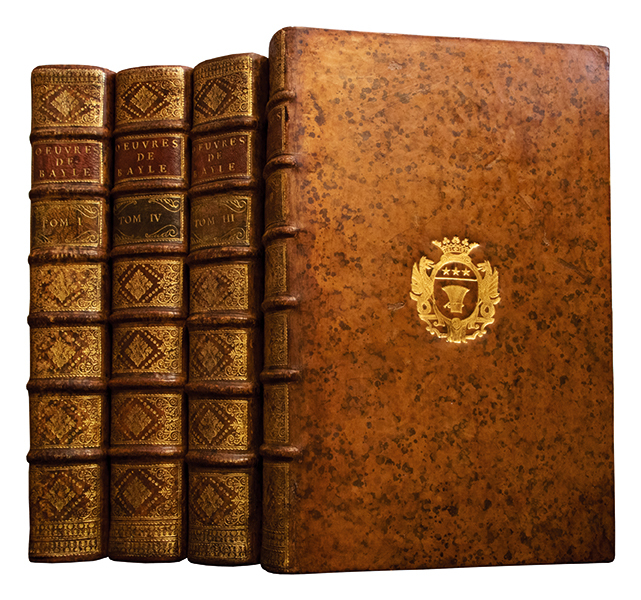
5 tomes en 4 volumes in-folio (391 x 250 mm), plein veau blond marbré de l’époque, dos à 6 nerfs guillochés or, ornés de caissons richement fleuronnés et cloisonnés, armes dorées au centre des plats, pièces de titre et de tomaison de veau havane et blond, coiffes et coupes filetées or, tranches rouges. Edition la plus complète des oeuvres collectives de Pierre Bayle, donnée par Pierre Desmaizeaux, proche protégé de l'auteur. "Edition qui doit être préférée à celle de 1727-31, parce qu'elle contient, de plus que la première, cent cinquante lettres à sa famille, formant un cahier de 211 pages qui est placé à la fin du premier volume" (Brunet). "Ce recueil contient tous les ouvrages publiés de Bayle, hors le dictionnaire. Il comprend aussi tout ce qui avait été imprimé de la correspondance" (Delvolve, 'Pierre Bayle…', Bibliographie, p. 436). Selon le catalogue de la BnF, qui se fonde sur le matériel typographique, cette édition aurait été imprimée en France, probablement à Trévoux. Vignette de titre allégorique gravée par Frederik Ottens, d'après Bernard Picard. Table des matières en tête de chaque volume et table des matières de l'ensemble en fin du volume IV. Le premier volume renferme plusieurs gravures sur bois dans le texte et 3 planches hors texte sur cuivre (pages 518, 578 [placé face 584] et 600). Le volume III est divisé en deux parties sous page de faux-titre, titre particulier et pagination continue. Le volume IV renferme plusieurs illustrations sur bois dans le texte dont trois grandes représentations des systèmes planétaires de Ptolémée (p. 394), de Ticho-Brahé (p. 398) et Copernic (p. 401). Quelques rousseurs et petites auréoles éparses. Quelques traces de restauration à la reliure. Très bel exemplaire en veau blond de l'époque aux armes de Jean-Claude Fauconnet de Vildé (1694–1765) dorées sur les plats (aux volumes II, II et IV). Ecuyer, conseiller du roi et de la Ville de Paris, il devint avocat à la cour et au Parlement (Catalogue des livres de feu M. Fauconnet de Vilde, Paris, de Bure le jeune, 1765, p. 24). (Guigard, II, 210. OHR, pl. 1654).
1737380701737 5 tomes en 4 volumes in-folio (391 x 250 mm), plein veau blond marbré de lépoque, dos à 6 nerfs guillochés or, ornés de caissons richement fleuronnés et cloisonnés, armes dorées au centre des plats, pièces de titre et de tomaison de veau havane et blond, coiffes et coupes filetées or, tranches rouges. A La Haye, par la Compagnie des Libraires [i.e. en France], 1737.
17600041101760 Sans lieu d'édition [Paris], ni nom d'éditeur [Chaubert et Hérissant], 1760. In-quarto (206 X 265 mm) demi-basane fauve à coins, dos cinq nerfs, pièce de titre chagrin grenat, tranches rouges (reliure de l'époque) ; (1) f. blanc, VIII (dont titre)-336 pages, (1) f. blanc. Pièce de titre renouvelée. Ex-libris ancien collé sur le premier contreplat.
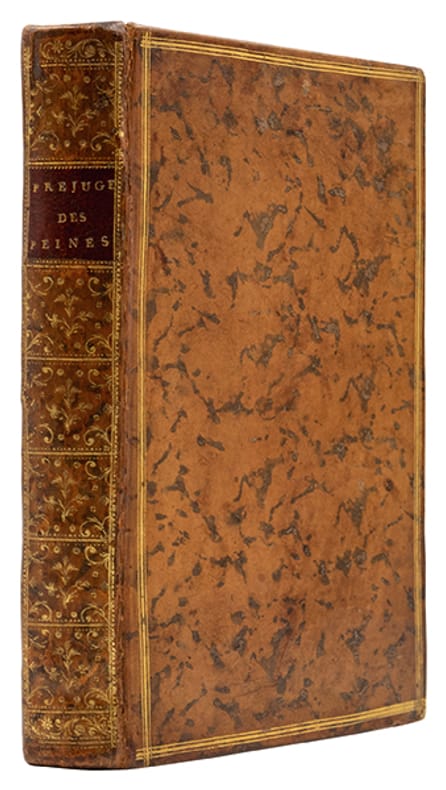
2 ouvrages reliés en un volume in-8 (195 x 124 mm), plein veau marbré de l'époque, dos lisse orné de compartiments fleuronnés et cloisonnés, pièces de titre de maroquin bordeaux, triples filets d'encadrement sur les plats, roulette sur les coupes, tranches jaspées. 1- Édition originale, rare. Le premier essai politique de Robespierre, alors jeune avocat âgé de 26 ans, qu’il composa en réponse à un concours ouvert par la Société royale littéraire de Metz en 1784, et pour lequel il obtint une médaille d’or ainsi qu’un prix de 400 livres. En homme des Lumières disciple de Montesquieu et de Beccaria, sur un mode modéré mais en un style lyrique et enflammé qui sera sa marque, Robespierre critique l’arbitraire de la justice de son temps et soumet un plan de réforme de la justice pénale. Il propose de bannir le déshonneur imposé aux familles des condamnés, plaide pour la suppression de la confiscation de leurs biens, pour l’égalité devant le châtiment et pour que les bâtards puissent accéder à la condition de citoyen à part entière. (Martin & Walter, 29526/1). 2- Edition originale. L'essai, en tête du volume, composé par le juriste et académicien Pierre-Louis Lacretelle (1751-1824) fut couronné en même temps que celui de Robespierre. Devançant celui-ci, Lacretelle obtint le premier prix, Robespierre le second, mais on décida que la récompense serait la même. Si les deux mémoires comportaient "nombre d'idées semblables", de celui de Lacretelle, on vanta "la hauteur de ses considérations philosophiques et morales, la sagacité de son esprit, la justesse de ses idées et l’humanité de ses sentiments". En 1823, en publiant ses Œuvres complètes, Lacretelle revint sur cette rencontre avec Robespierre : "Rien, dans ce début, ne promettait le personnage qu’on a vu sept ans après. On pourrait croire qu’il s’ignorait encore lui-même. Il faut avoir vu toute une révolution pour savoir à quel point elle peut transformer un homme, ou plutôt développer en lui des poisons cachés et encore sans fermentation". Infimes accrocs à un mors. Très bel exemplaire, très frais, grand de marges, très bien relié à l'époque.
1785384201785 2 ouvrages reliés en un volume in-8 (195 x 124 mm), plein veau marbré de l'époque, dos lisse orné de compartiments fleuronnés et cloisonnés, pièces de titre de maroquin bordeaux, triples filets d'encadrement sur les plats, roulette sur les coupes, tranches jaspées.
Very Good Turkish, Ottoman (1500-1928) Handsome fine contemporary brown half-leather bindings. Six raised bands to spine, title, and issue numbers gilt lettered, floral decorations in compartments. 4to. (30 x 24 cm). In Ottoman script (Old Turkish with Arabic letters) and French. All pages with illustrations in text or full-page illustrations, all numbers with an Islamic numbering system, reversed collation, with two title pages: Ottoman recto and in French verso, numbers 35, 41, 44, 45 with title pages in color. Rare poster is coming with the set inside the volumes as a supplement to the magazine. Extremely rare togetherness of the complete set of 130 issues of the Ottoman Turkish-French satirical magazine "Kalem", richly illustrated with thousands of attractive illustrations and cartoons, started its publication life with the end of Sultan Abdulhamid II's repression regime in 1908. The collection provides an invaluable resource, reflecting the changes in society after the Second Constitutional Revolution in New Ottoman State. The magazine was published weekly in 130 numbers between 21 August 1324 (3 September 1908) and 16 June 1327 (29 June 1911), starting immediately after the Second Ottoman Constitutional Revolution. The magazine was a mixture of satire and a saloon magazine, focusing on politics, social life, and revolution. The only continuously running part of the magazine was Haftalik Dedikodu (Weekly Gossip). The founders of the magazine were Salah (Selah) Cimcoz (1875-1947), a Turkish politician, lawyer, and owner of Kalem Newspaper, and Celal Esat Arseven (1876-1971) a Turkish painter, writer, and parliamentarian. He was the first to introduce the history of art and urbanistic architecture to Turkey. Duman 1080.; Only one complete copy survive in institutions worldwide in OCLC 472569754 (Bibliothèque nationale de France, BnF). (Source: References: Tobias Heinzelmann, Die Balkankrise in der osmanischen Karikatur).
In-8 (188 x 118 mm), pleine peau de truie estampée sur ais de bois, dos gothique à 5 nerfs ornés d'un décor de rinceaux, grandes armes d'Auguste Ier de Saxe (August von Sachsen) dans un large cartouche au centre des plats légendées "Von Gottes gnaden Augustus Herzog zu Sachsen des heiligen Römischen Reichs", encadré d'une roulette comportant également ses armories, des portraits en médaillon dans un décor de rinceaux, initiales "A W E / G G O V" en tête et date de "1574" en pied estampés au noir, quatre fermoirs en laiton ciselé conservés, coupes biseautées, tranches rouges (reliure allemande de l'époque), (22), 888 p., (1) f. bl., portrait de l'auteur gravé sur bois au titre. Édition imprimée à Leipzig par Hans Rambau, du compendium de ses oeuvres donné par Philip Melanchthon lui-même l'année de sa mort, afin de fournir la première dogmatique protestante. Conçu dans un but pédagogique, il était destiné à diffuser les principes de la Réforme en matière de dogme et de liturgie. Contient: "La Confession de foi luthérienne": la confession d'Augsbourg ("Confessio Augustana") et son "Apologia confessionis"; Les "Lieux communs théologiques" ("Loci communes"); "Examen eorum, qui audiuntur ante ritum publicæ ordinationis" sur l'ordination sacerdotale; la réfutation des doctrines de Michel Servet et des anabaptistes ("Responsiones erroris Serveti et Anabaptistarum") ainsi que la réponse à Francesco Stancaro ("Responsio de Controuersijs Stancari"). Portrait de Melanchthon gravé sur bois au titre. Le nom de l'éditeur est donné au colophon. L'ouvrage est dédicacé à l'empereur Charles V. (Bindseil, 'Bibliotheca Melanchoniana', n°63. VD16 M 2890). Exemplaire aux grandes armes d'Auguste Ier de Saxe (August von Sachsen) estampées à froid sur les deux plats, légendées "Von Gottes gnaden Augustus Herzog zu Sachsen des heiligen Römischen Reichs" ("Par la grâce de Dieu, Auguste, duc de Saxe du Saint Empire romain germanique"). On trouve également ses armories incorporées à la roulette d'encadrement des plats au sein d'un décor de portraits en médaillon et de rinceaux. Electeur de Saxe de 1553 à sa mort, Auguste Ier (Freiberg, 1526 – Dresde, 1586), comte palatin de Saxe et margrave de Misnie de 1556 à sa mort, a été l'un des principaux protecteurs du parti luthérien dans le Saint Empire entre 1570 et 1586. Il est le responsable du privilège accordé à l'éditeur de ce volume ("Cum priuilegio Pr. Aug. Elect. D. Sax."). Ex-libris autographe du théologien Johannes Georgius Gottsmann de Hartroda en Thuringe sur le premier contre-plat à la date du 23 juillet 1674. Ainsi qu'un ex-dono autographe de Heinr[ich] Andr[ea] Friederici, à la date de 1719. Papier légèrement bruni. Petits accrocs de papier sans gravité ni perte à la marge extérieure du titre. Le décor du plat supérieur et du dos est estompé. Très bon exemplaire, bien conservé, dans sa première reliure allemande de truie estampée.
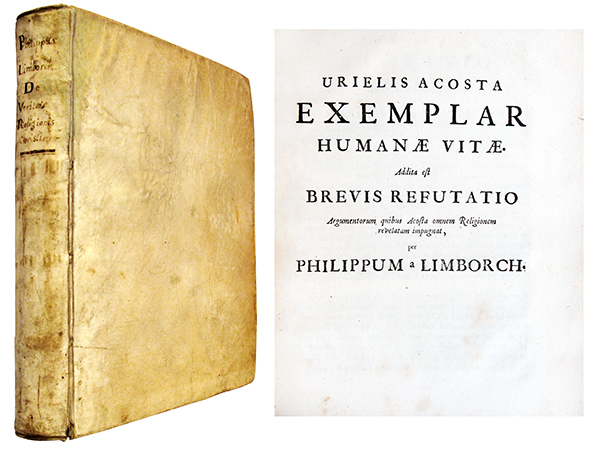
In-4, plein vélin rigide de l'époque, dos titré à la plume, (16), 364, (14) p. Edition princeps de la célèbre autobiographie testamentaire d'Uriel da Costa ('Exemplar humanae vitae'), composée à la veille de son suicide en 1640 et publiée "presque par hasard" (Daniel Lacerda) quarante-sept années après sa mort. Elle est insérée entre les pages 341 et 354 d'un recueil qu'un ministre calviniste arminien, Philip Van Limborch professeur à Amsterdam (1633-1712), consacre à la défense de la "vérité de la religion chrétienne", en discussion avec un Juif érudit, Isaac Orobio de Castro (c.1617-1687), lui-même réfugié du Portugal à Amsterdam. Éditée d'après un manuscrit et peut-être révisée, "Une vie humaine" est suivie de sa réfutation par Limborch. Né au sein d'une famille portugaise marrane, Uriel Da Costa (1585-1640) s'installa à Amsterdam en 1617 et revint au judaïsme, mais il entra bientôt en conflit avec la synagogue. Soumis à une humiliante pénitence publique, il se suicida. Ce document demeurait l'unique seule source d'informations sur Uriel da Costa jusqu'à la découverture récente (1990), à la bibliothèque d'Amsterdam, d'un exemplaire unique d'un autre de ses textes que l'on croyait perdu ("Exame das tradições fariseas") et qui le place aux côtés de Spinoza, dix années avant la condamnation de celui-ci, parmi les victimes du durcissement doctrinaire des autorités juives d'Amsterdam. "Cette autobiographie écrite par Uriel da Costa en 1640 avant de se suicider, reflète toute la culture et toutes les interrogations religieuses de cet esprit qui passa du christianisme-marranisme au judaïsme puis au sadducéisme, enfin au déisme vénérant la Nature. Juif portugais d'Amsterdam, Gabriel, devenu Uriel da Costa, reflète - lui et toute sa famille, affiliée à celle de Spinoza - les recherches de cette société des nouveaux convertis du Portugal et des pays occidentaux au XVII° siècle" (Béatrice Leroy). Cf. I.S. Revah, H. Méchoulan et coll., 'Des Marranes à Spinoza', Vrin, 1995, passim. (Bamberger, 'The printed literature of Spinozism', n° 67. Fürst, 'Bibliotheca judaica', I, p. 17). Quelques rousseurs éparses. Petite trace de restauration de vélin au dos. Très bon exemplaire, très bien conservé dans sa première reliure hollandaise de vélin rigide.
1st edition. Original printed paper wrappers bound into period outer wrappers. 12mo, 56 pages, 1 leaf ; 18 cm. Title page and all song lyrics are bilingual, German-English; Preface by Lob is in German. This is only the second Jewish hymnal published in Chicago (the first is 1861) . The Jewish Virtual Library cites this work, and includes an image, in its article on Judaic Treasures: From Haven to Home, Sacred Music: Otto Lob's German-English hymnal published in Chicago, which included simple, natural, and light rearrangements of traditional melodies, was also part of the effort to revitalize liturgical music. They include an image of the title page as well. (Jewishvirtuallibrary. Or) in Musik gesetzt von Otto Lob ; mit deutschem und englischem Text. Singerman 2570, listing 3 copies. SUBJECT(S) : Synagogue music. Hymns, OCLC: 77655959. OCLC lists 4 copies worldwide (JTS, HUC, Carnegie Libr, LBI) , none west or south of Cincinnati. Jewish institutional stamp on title page, previous owners name/adderss on inside later rear cover, corners a bit rounded, otherwise Very Good Condition. Scarce. (KH-8-64)
Very Good Turkish, Ottoman (1500-1928) Original color manuscript calendar prepared on a fine special paper with 'ahar'. 36x22,5 cm. In Ottoman script (Turkish with Arabic letters). 2 p. Several ink stains on paper, chipped on extremities. A very good manuscript. It shows astronomic situations, locations of planets and stars, and climates in 1324 [AD 1908]. It starts with high praise to Sultan Abdülhamid II with an old style of color moon & crescent icon. Sealed by Mehmed Pasazâde A. Ihsan. On the verso of paper, can be seen detailed calendar and details of 'ruzname'. Written on 'printed' down of the paper, probably it's prepared for the printing, therefore it's understood that Ihsan and Refet were thinking to print this 'taqwim'. Prepared in the year of the Second Constitutional Regime (II. Mesrutiyet) which was Abdul Hamid II's fall came as a result of the 1908 Young Turk Revolution, and the Young Turks put the 1876 Constitution back into effect. It seems, it's prepared before fall of the Sultan, and for the present to the Sultan. The Second Constitutional Period spanned from 1908 until after World War I when the Ottoman Empire was dissolved. "The starting year of the Hijrî calendar (al-taqwim al-hijri), the fundamental Islamic lunar calendar still in use among Muslims until today, is 622 CE. Its beginning corresponds to the Hijra or emigration of Prophet Muhammed and his followers from Mecca to Medina. It is based on the revolution of the moon around the Earth and consists of twelve months of 29 or 30 days: Muharram (30), Safar (29), Rabî' al-awwal (30), Rabi' al-thani (29), Jumâda al-awwal (30), Jumâda al-thani (29), Rajab (30), Sha'ban (29), Ramadhan (30), Shawwal (29), Dhul-'l-qi'da (30) and Dhul-hijja (29 or 30). The lunar year consists of 354 days, which is 11 days less than the solar year, and every 33 years it falls one year behind the Gregorian calendar. The discrepancy with the solar year, which follows the seasons, meant that Muslim countries also used the solar calendar, and some calendars drawn up by astronomers include the dates according to the European Gregorian calendar named after Pope Gregory XIII in 1582. Ottoman Turkey used both the Islamic lunar calendar and a solar calendar known as the Rumî or Roman calendar, which was based on the Julian calendar introduced since the times of Julius Caesar in 46 BC. The Roman calendar was inherited from the Byzantines and was used by the Ottomans for the taxation of agricultural revenues. The year according to the Rumî or Julian calendar began on 1 March, and the Ottomans took the starting year to be that of the Hijra. To make up for the gain of 11 days made by the solar Rumî calendar over the Islamic calendar, a leap year was deducted from the Rumî calendar every 33 years. A rûzname is a set of tables giving the first days of the months in both the Islamic and Rumî calendars, the date on which the sun enters each sign of the zodiac, and eclipses of the sun and moon. Also known as takvîm-i dâimî (perpetual calendar) or takvîm-i devr-i dâim (calendar of perpetual motion), the ruzname were permanently valid whatever the year. There is no evidence that such calendars were produced in pre-Ottoman times, and they may, therefore, be regarded as a type unique to Ottoman Turkey.". (Source: Glances on Calendars and Almanacs in the Islamic Civilisation by Salim Ayduz).
19886Cologne, Pierre de la Vallée, [Amsterdam, Louis et Daniel Elzévier] 1657. In-12, [24]-398-111 pp., maroquin brou de noix de David, triple filet doré en encadrement sur les plats, dos à nerfs orné de caissons dorés, bordure intérieure ornée d'une dentelle dorée, tranches dorées sur marbrure (rares taches et rousseurs).
In-8 (168 x 110 mm), plein vélin souple de l'époque à rabats, (1) f. de titre, (46), 286 p., (1) f. bl. Rarissime première édition française, dans la traduction de François de Belleforest, "plus rare et plus recherchée que l'édition latine originale publiée à Bâle la même année" (Blackmer). Cet ouvrage demeure l’une des sources contemporaines fondamentales sur le conflit qui opposa, de 1570 à 1573, l'Empire ottoman à la République de Venise appuyée par la Sainte-Ligue, sur l’histoire de la conquête Chypre (1570-1571) par les Turcs et sur les relations entre l’Empire ottoman et Venise, l’auteur ayant été un protagoniste direct des événements et ayant eu accès à des documents inédits et de première main. Important représentant de l’historiographie humaniste, Pietro Bizzari (1530-1584) se convertit très tôt au protestantisme et quitta Venise. Entré en relation avec les principales personnalités de l’Europe des humanistes, il exerça d’importantes responsabilités universitaires, éditoriales, politiques et diplomatiques, à Wittenberg, en Angleterre sur la recommandation de Philipp Melanchthon, auprès d’Edouard VI, de James Stuart et de la reine Elizabeth Ier, puis à Bâle, à Anvers au sein du cercle de Plantin et auprès de l’électeur Auguste de Saxe au service duquel il entra. Cf. M. Firpo, 'Pietro Bizzarri esule italiano del cinquecento', Torino, Giappichelli, 1971. (Atabey, 110-111. Blackmer, 147. Brunet, II, col. 1956 qui signale que cette édition est "rare". Cobham-Jeffery, p.5. Göllner, I, 1612. M. Simonin, 'François de Belleforest', n°117). Sans la carte annoncée à verso du titre, qui ne se rencontre que dans un très petit nombre d’exemplaires. Titre renforcé dans la marge intérieure. Quelques petites auréoles et infimes défauts de papier. De la bibliothèque de Victor Duchâteau (1823-1905), avocat et bibliophile rémois avec ex-libris. Trois petites signatures ex-libris anciennes sur le titre dont une légèrement grattée. Très bon exemplaire, grand de marges, dans sa première reliure de vélin souple.
1687370031687 In-4 (232 x 185 mm), plein vélin ivoire rigide de l'époque, dos titré à la plume, (16), 364, (14) p. Goudae, Justum ab Hoeve [Gouda, Justus van der Hoeve], 1687.
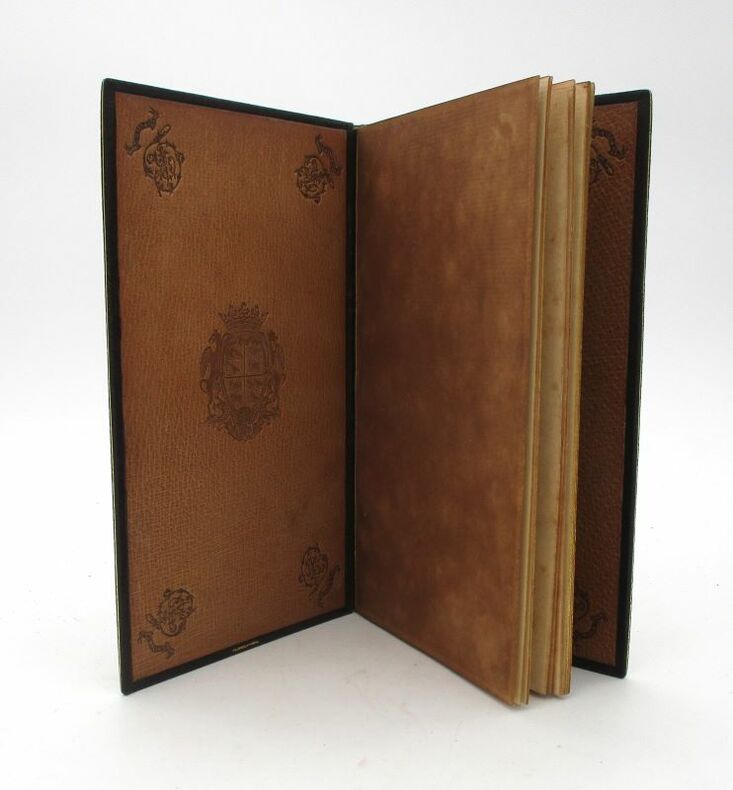
16744Paris, Jean Dallier et Jean Bonfons, 1562. In-12, [4] ff. dont titre, maroquin ébène de Chambolle-Duru, dos lisse, pièce de titre en long rouge, encadrement intérieur de même maroquin, doublure de peau de truie fauve ornée d'un blason héraldique estampé au centre et cantonné du chiffre R.B. et de la devise In via nulla invia, tranches dorées (très légers frottements).
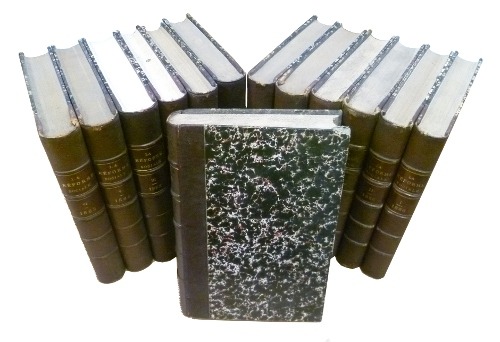
qv865Bureaux de la Réforme sociale La Réforme sociale Relié Treize volumes in-8 (15.5x24 cm), reliés demi-chagrin, titre et tomaison dorés au dos à cinq nerfs, , tomes I (1881) à X (1885) (sauf le IV (2e semestre 1882)), plus tomes I (1886) à IV (1887) ; revue publiée dans la droite ligne de la pensée de Le Play (Pierre Guillaume Frédéric, 1806-1882). Le Play est considéré comme le père de la sociologie. Polytechnicien, ingénieur des mines, il possède une vue positiviste, mais avec une approche plus interventionniste. Penseur conservateur et paternaliste (à la Joseph de Maistre dont il est proche philosophiquement), il défend les valeurs de la famille, de l'ordre social... ce qui fera de lui une influence importante d'auteurs comme Charles Maurras. Coiffes frottés, certains dos légèrement insolés, rousseurs aux tranches, bon état pour ce ensemble. Livraison a domicile (La Poste) ou en Mondial Relay sur simple demande.
First edition. Original Gilt leather binding, 12mo, 263 pages. All edges glit. Published by Wise as third and last volume of his grand project for American-Jewish liturgy titled "Minhag America", this final volume is a collection of liturgical hymns, psalms and prayers in English and German. Singerman 2109.The original two volumes of the Minhag America prayer book had both been published in 1857, one with Hebrew-English text (Prayer Book for Public and Private Worship) and the other with Hebrew-German text (Gebet-Buch fur den offentlichen Gottesdienst und die Privat-Andacht). Wise here indicates that with this third volume includes additional new writings by Wise and others. Text in English and German on facing pages. Also includes detailed service instructions, religious notes, a table of torah readings and a table of contents. Wises Minhag America would become the standard liturgy of American Refom congragations from its original publication until the introduction of the Union Prayer Book in the 1890s. Of the three volumes issued in the 1860s, this Hymnal-Psalter remains the scarcest, far, far less common than the volumes for Rosh HaShanah and Yom Kipur, reflecting the centrality in American Reform Judaism of the High Holidays above other forms of daily liturgy. OCLC 39805734. Lacks about half of backstrip (spine covering), but paper remain bright and clean, and the lovely original canary yellow endpapers show only a few marks and rubbing marks. Previous owners name stamp on front white end paper. About Very Good Condition with worn spine. A colleague offers a copy for $7500.00. Important work, a nice copy. (KH-5-48C)
Very Good English In contemporary hardcover. In Ottoman script and French ( are completely first series and first 33 issues of second series). Last 3 issues are in Modern Turkish. First series: Issue: 1 - 43. (28 November 1910 - 19 October 1912) / Second series: Issue: 1 - 36. (15 December 1927 ¿ 1928). 1st series set, 2nd series first 36 issues. (All published: 1 - 43 / 1 - 49). 4to. (27 x 20 cm). 2 volumes. Turkish political satiric humor periodical which has infuriated The Union and Progress party. Duman: 0286.
38648Petit in-8 (158 x 96 mm), maroquin rouge de l'époque, dos à 5 faux-nerfs guillochés or, richement orné "à la grotesque", triple filet d'encadrement sur les plats, roulette sur les coupes, dentelle intérieure, titre doré, tranches dorées sur marbrures (reliure de Padeloup), (16), 384 p., vignette de titre, bandeaux et culs-de-lampe gravés sur bois. Utrecht, Guillaume vande Water, 1692.
Ensemble de 62 pièces reliées en 4 volumes in-8°, 3 de demi-chagrin vert, dos à nerfs et un de demi-maroquin vert, dos lisse orné d'un décor romantique doré (reliures de l’époque). Précieux recueil de 62 pièces (dont 15 en double), composé en partie de ses propres œuvres, constitué par Charles Lucas pour sa bibliothèque personnelle. Chaque volume est précédé d'un index de sa main. Charles Lucas (1803-1899) est l'homme "qui, sans conteste, pendant le XIXe siècle, a le mieux incarné les ambitions et les ambiguïtés de la réforme pénitentiaire (...) et a fondé la Science des prisons" (J.G. Petit). Il personnifia le libéralisme pénal de la Restauration, jetant les bases d'un système pénitentiaire qui récusait l'emprisonnement perpétuel. Guizot le nomma inspecteur des prisons dès le changement de régime, en 1830. Il demeura trente-cinq ans à ce poste. À partir de 1830, l'engouement pour l'amélioration du système pénitentiaire suscita des centaines d'ouvrages. Charles Lucas se constitua une très riche bibliothèque spécialisée, augmentée des nombreuses brochures que l'inspecteur général des prisons recevait. On trouve ici une importante réunion de 21 plaquettes traitant de la colonie agricole du Val d'Yèvre qu'il avait fondée, en 1841, pour recevoir des jeunes délinquants. Après avoir acheté 140 ha de marais au Val d’Yèvre près de Bourges, Charles Lucas soumit son projet au ministère de l’Intérieur qui ne le retint pas. En 1846, il décida de se lancer personnellement dans "l’aventure". La construction coûta 450.000 francs et l’Etat alloua 80 centimes par jour et par colon qui furent transférés de la prison de Fontevraud dès 1847 : 100 en 1850 puis 400 en 1860. En 1865, Charles Lucas devenu aveugle fut remplacé par son fils docteur en droit. En 1872, la colonie fut louée, puis acquise par l’Etat et "nationalisée". La loi de 1912 sur les tribunaux pour enfants entraîna une réduction progressive des effectifs jusqu’en 1924 pour le Val d’Yèvre ferma définitivement.