TISSIER (Jean).Livre Rare Book

198 résultats
19000006811900 Narbonne, Imprimerie Caillard, 1900. Grand in-8 (170 X 250) relié demi-chagrin havane, dos cinq nerfs surlignés de pointillés dorés, fleurons dorés dans les compartiments, titre doré (reliure de l'époque) ; 576 pages + 1 feuillet d'errata.
1887BD3-1207Wien, Manz Verlag, 1887. gep?gter und vergoldeter Leinenband der Zeit , 8?, VI, 184 Seiten; Zustand: sehr gut
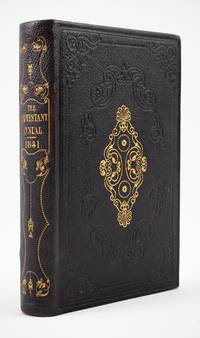
1840ST20302-02London: Francis Baisler 1840. FIRST EDITION. 195 x 130 mm. 7 3/4 x 5". xi 1 307 1 4 pp. <br/> Publisher's black pebbled morocco covers elaborately decorated in blind with gilt centerpieces smooth spine decorated in gilt all edges gilt gutter between the end of the text and the ads at the back expertly reinforced. With 10 engraved plates including the frontispiece and engraved title. Dedication page with contemporary ink ownership inscription of Wm. C. Drysdale. Noticeable discoloration to pastedowns and flyleaves from binding adhesive plates negligibly foxed otherwise especially clean and fresh internally with only the most trivial of imperfections; the exceptionally clean binding showing virtually no signs of use.<br/> <br/> This collection of essays and verse promoting Protestant thought and values comes in a beautifully preserved Victorian publisher's binding. The editor of this work Charlotte Elizabeth Tonna 1790-1846 was an evangelical Protestant social reformer particularly devoted to exposing poor factory conditions and improving the welfare of women and the poor. Writing under the name Charlotte Elizabeth she made "contributions to social reform literature and her use of the 'Christian Lady's Magazine' as a forum to influence politics through her female readers mark her as a significant nineteenth-century figure especially for other women social reform writers such as Harriet Beecher Stowe . . . and Elizabeth Gaskell." DNB Of particular note in our volume is an essay by Charlotte Elizabeth discussing the figure of Katherine Parr sixth wife of Henry VIII as a model of Protestantism and womanhood. Francis Baisler unknown
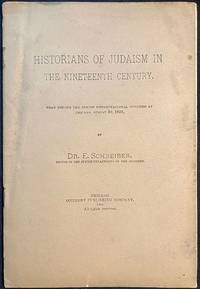
189442366Chicago: Occident Pub. Co 1894. 1st edition. Original Printed Wrappers. 8vo. 28 pages. 23 cm. Singerman 4766. <br> <br> “We have no work like it in the English language. It is a valuable contribution to the literature of the Reform Movement. Dr. Schreiber has acquitted himself remarkably well in performing the difficult task of portraying in biographies the origin and growth of reform in Judaism. The book should be read by every Israelite be he conservative or radical. – Jewish Spectator Memphis†Back cover. <br> <br> The Author Rabbi Emanuel Schreiber was head of the Religious Department at the Occident Publishing Company which published this work and also produced the “Occident Newspaper†no apparent connection to Leeser’s Occident published in Chicago 1873-1896. It was a “weekly radical reform Jewish journal. It was devoted to general news politics literature science art and the interest of the Hebrews of the Northwest….this paper was printed in both English and German†Scott “Newspapers And Periodicals of Illinois 1814-1879.†Urbana 1911. The paper described itself as "The foremost radical reform Jewish newspaper in the world. It is edited by the most eminent writers of today" from the rear cover of this work. <br> <br> Subjects: Jews -- Historiography. Jewish historians. OCLC: 7426681. <br> <br> Some staining to wrappers and occasional text pages paper bright and binding very good very well preserved Very Good Condition Overall. B AMR-43-30-XX-LDBLVRF-'ex. Chicago: Occident Pub. Co unknown
187230317Philadelphia: Published for the Industrial League by Henry Carey Baird 1872. First Edition. Octavo 23.5cm.; disbound from larger volume with remnants of cloth spine still present; 96pp.; frontispiece full-page illus. throughout. Very faint previous vertical fold else Very Good and fresh. The title story is a satirical utopia intended to discredit supporters of laissez-faire economics and the Free-Trade League in particular. LEWIS p. 57; SARGENT p. 29; not in NEGLEY. Published for the Industrial League by Henry Carey Baird unknown
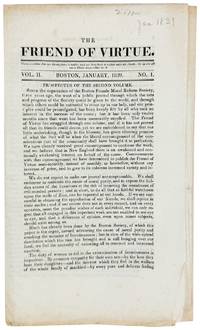
183933043Boston: New England Female Moral Reform Society 1839. Very Good. Boston: New England Female Moral Reform Society 1839. First Edition. Octavo; self-wrappers unopened. 16pp. Toning and creasing to edges with a few minor nicks; about Very Good. <br /> <br /> The New England Female Moral Reform Society's stated goal was the "prevention of licentiousness" prostitution the moral double standard regarding both and protecting young women from the "unprincipled destroyer who seduce and ruin the unsuspecting." Indeed this issue devotes a section to "Street Beggars" who are imposters attempting to lead astray the young and unsuspecting. The paper continues in telling the story of two young women who were led to "a house of ill fame" by one such imposter and were saved from a member of the society and thus saved "from this sink of iniquity. from her 'whose house is the way to hell going down to the chambers of death.'"<br /> <br /> Also of note here is the ongoing "Letters to Sarah E. Grimke" portion of this publication which runs several pages in this issue gently arguing several points regarding the role of women in society. The letter concludes with a post script that the author has just received Grimke's pamphlet "Equality of the Sexes" acknowledges her sincere obligations and urges everyone who reads this publication to also read Grimke's. Scarce in retail. New England Female Moral Reform Society unknown
187230317Philadelphia: Published for the Industrial League by Henry Carey Baird 1872. First Edition. Octavo 23.5cm.; disbound from larger volume with remnants of cloth spine still present; 96pp.; frontispiece full-page illus. throughout. Very faint previous vertical fold else Very Good and fresh. The title story is a satirical utopia intended to discredit supporters of laissez-faire economics and the Free-Trade League in particular. LEWIS p. 57; SARGENT p. 29; not in NEGLEY. Published for the Industrial League by Henry Carey Baird unknown books
187410163CBStrassburg / London, Trübner, 1874. gr.8°, XV, 216 S. auf recht dickem Papier, Text: Englisch, Halbleinen-Einband des mittleren 20. Jahrhunderts mit goldener Rückenbeschriftung (nur: Valdes) sowie dezenter goldener Rückenverzierung Erstausgabe Einband minimal berieben, Buchrücken unten ein wenig beschabt, Seitenränder leicht nachgedunkelt, obere Ecke von Seite 13/14 mit kleiner Fehlstelle, sonst schönes, sauberes Exemplar (vo2gla)
186276501Philadelphia: Philadelphia Society for Alleviating the Miseries of Public Prisons 1862-1871. First editions. Octavo. Various paginations but all complete. Publisher’s printed green wrappers two issues have had their wrappers reattached a few instances of erosion to spine but never affecting integrity. Overall in very good condition.There were two main series of this publication. The first series began in 1845 under the title Pennsylvania Journal of Prison Discipline and Philanthropy and in 1862 a second or “new†series was begun leaving off the Pennsylvania no doubt in hopes of national readership. It was a yearly publication. This two-series format continued until the journal ceased publication in 1920 after which it was succeeded by what is now known as The Prison Journal. The Pennsylvania Prison Society founded in Philadelphia in 1787 was the first private agency to concentrate specifically on correctional issues. The society's journal was one of the earliest periodicals devoted solely to studies of correction and crime. The articles run the gamut of subjects related to these fields from discussions of penal philosophy to inmate interviews and even down to the brass tacks of the costs involved in running a prison. . The journal not only provides information on prison conditions and the evolution of the American penal system particularly in Pennsylvania but also offers a detailed record of the penal reform movement in this country. They were remarkably foresighted. This can be seen in the following two quotes; "The readers of this Journal need not be told that we are not very sanguine in our expectations of the permanent reformation of the mass of convicts. There are doubtless instances enough of success in such efforts to warrant and encourage them and we are not to suppose that they are ever wholly useless. The true position for us to take is this. The earlier we address ourselves to the cultivation of right principles and habits in a human being the more hopeful is the prospect of success" and this little gem "May we not easily forget that between a score of men in our prison cells and twenty score of men that may be selected from society at large the only difference is that the former are detected rogues and the latter are perhaps greater rogues undetected" It was a bold movement away from prison as a punishing experience toward a kinder belief that prisoners must once again become useful members of society. Philadelphia Society for Alleviating the Miseries of Public Prisons unknown
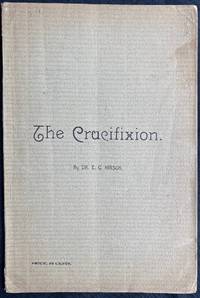
189243449Chicago: Bloch 1892. paperback. 1st edition original printed green paper wrappers 8vo. 49 pages. Singerman 4345. <br> <br> Rabbi Emil G. Hirsch 1851-1923 "who headed Chicago's Sinai Congregation for forty-two years and led Reform Judaism into the Progressive movement and down social justice pathways was born in Luxemburg.<br> One of several Jews involved in founding the NAACP Hirsch was married to the daughter of abolitionist rabbi David Einhorn and served in his father-in-law's former pulpit in Baltimore before moving to Louisville Kentucky and then Chicago. He was professor of rabbinical literature and philosophy at the University of Chicago in 1892 active in the Republican Party and editor of several influential Jewish publications" Lawrence Bush in Jewish Currents<br> "Hirsch and his congregants struggled to come to terms with the large number of Jewish immigrants who moved to Chicago after 1880 boosting the Jewish community from about 10000 in 1880 to over 300000 in 1920.For the established Jews represented by Sinai the Jewish 'Ghetto' - the immigrant neighborhood on the city's West Side - appeared to represent a world apart and a sharp contrast to Sinai's radical and inclusive reform agenda: a highly visible expression of Jewish ethnicity and traditional Judaism which Reform Jews associated with isolation discrimination and exclusion." <br> Nevertheless during the 1890s "Hirsch spoke up against the deplorable condition of Jews in the Russian Empire and reached out to West Side residents. His support for workers' rights also won him much support among Jewish immigrants who overwhelmingly belonged to the working class.<br> "Hirsch worked closely with Jane Addams and other members of the Hull House circle. In 1908 Hirsch and Addams were among the co-founders of the NAACP. Hirsch inspired several members of Sinai congregation: Sears and Roebuck president and philanthropist Julius Rosenwald was one of Hirsch's closest associates so was legal scholar Julian Mack who presided over a widely noted juvenile court in Chicago in the first decade of the 20th century. <br> Hannah Solomon was one of the founders of the organized Jewish women's movement in the United States. Joseph Schaffner and Harry Hart were the leading partner of the clothing manufacturer Hart Schaffner & Marx one of Chicago's largest employers. Influenced by Hirsch's social theology Schaffner and Hart settled with their workers during the 1910-1911 clothing strike recognizing their right to form a union" Tobias Brinkmann.<br> <br> SUBJECT S : Jesus Christ -- Jewish interpretation. Jewish Christ -- Crucifixion.OCLC: 13532781. Light wear excellent condition a beautiful copy Very Good Condition B AMR-2-2-XLF#. Chicago: Bloch unknown
1845547003New York: American Female Moral Reform Society 1845. Unbound. Very Good. Single leaf folded to make eight pages. One quarter of first page toned old folds very good or better. A cursory examination of the contents indicates that the American Female Moral Reform Society weren't very enthusiastic about prostitution. American Female Moral Reform Society unknown
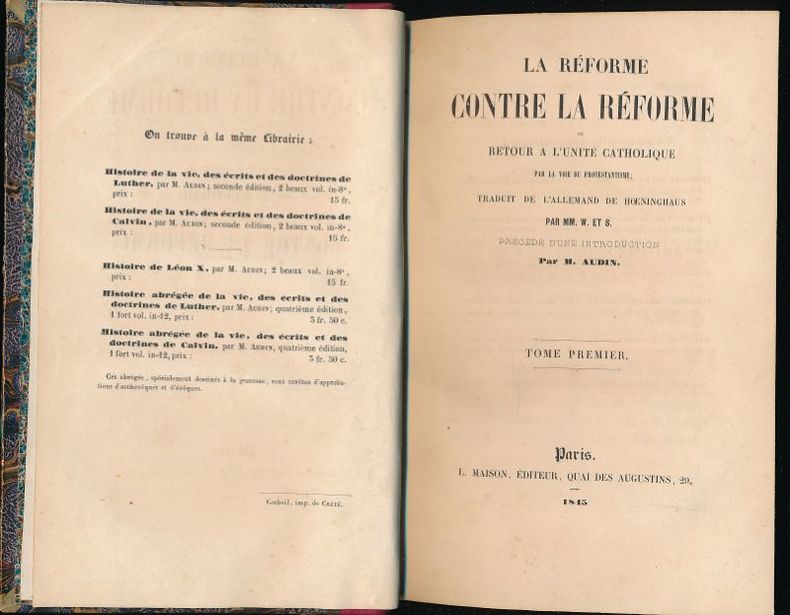
1845146999L Maison éditeur Paris, L Maison éditeur, 1845. 2 volumes in-8 relié demi-veau glacé cerise, dos à faux nerfs, titre et tomaison doré. 1 feuillet blanc, fx titre, titre, LXXXVI + 508 +556 pages. Précédé d'un introduction par Audin. Bel exemplaire
1822PHO-1985Halle-Magdebourg, Orphanotrophel, 1827, in-8, 140pp.-112pp., reliure demi-veau brun, dos lisse, tranches jaspées, frottements, coins usés, rousseurs.
186210882Genève, sans nom; Imprimerie centrale genevoise;, 1862-1886-. Petit in-folio de 135-141-[3]-70-[2] pages, demi-veau moucheté brun à coins, dos à nerfs richement orné de filets et fleurons dorés, pièces de titre rouge et brune. Reliure XXe. Ex-libris A. M. Perrin.
181898489Paris, Chez Janet et Cotelle, Libraires 1818 2 volumes. In-8 20,5 x 13 cm. Reliures de l’époque basane havane marbrée, dos lisses orné d’un grand fer, de roulettes et de filets dorés, pièces de titre et de tomaison maroquin grenat, LXIV-392-449 pp., table des matières. Exemplaires en bon état avec de faibles rousseurs.
1893124305P., E. Flammarion, s.d. (1893-1895), 8 vol. in-8°, reliures demi-maroquin acajou, dos à 5 nerfs filetés, titres, tomaisons et caissons fleuronnés dorés (rel. de l'époque), dos uniformément passés, bon état (Œuvres complètes de J. Michelet)
18810045781881 Paris, Lemerre, 1881. Deux tomes in-12 (102 X 163 mm) demi-maroquin havane, dos cinq nerfs filetés, caissons dorés ornés d'un quadrilobe de maroquin noir et fers dorés, auteur, titre et tomaison dorés, date en queue, étui (David). Tome I : (2) ff. de faux-titre et titre, III-342 pages, (1) f. d'achevé d'imprimer - Tome II : (2) ff. de faux-titre et titre, 231 pages, (2) ff.
183284913London: Effingham Wilson 1832. A New Edition Greatly Enlarged and Corrected. Octavo. 23cm. Bound in later rather institutional black buckram with paper title label. 16pp. ads to front matter; xxxii; 683pp. 1pp ads to rear. Minor wear and bumping to extremities with a little rippling of the cloth to the front board strong and tight; internally clean later endpapers ink ownerships to front flyleaf frontispiece portrait "Friends of Reform - Foes of Revolution" quite heavily spotted with some offsetting to the title page edges untrimmed some occasional light spotting within. A very good copy in a later binding of a rather unwieldy work.<br /> <br /> A later printing of Wade's incendiary 1820 catalog of abuses performed by the Church The King the Government and various business interests against the people security and progress of Great Britain. A continued bestseller demonstrating a fervent appetite on the part of the British public to read Wade's excoriating denunciation of the upper classes and their merely wealthy counterparts. On a number of fronts this public airing of secretly dirty laundry met with some political and social success and led to some very public gestures at reform. Effingham Wilson unknown
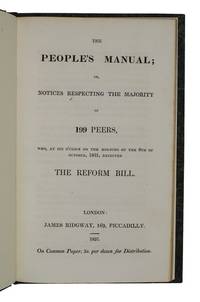
1831AQ30613London: James Ridgway 1831. 32pp. Modern marbled paper boards printed paper lettering-piece to spine. A trifle rubbed. Scattered spotting. The first edition of a register of the 199 members of the House of Lords that voted against the passing of the Reform Bill. A second edition appeared the same year. . First edition. 8vo. James Ridgway hardcover
188192771881 Auxerre Vosgien 1881 , complet en 2 volumes in8, reliés en demi toile, , pièces de titre cuir, couvertures conservées, 511 +337 pp
186746000Leipzig, S. Hirzel, 1866-1867. 8°. XII, 303 (1) S.; VIII, 262 S., 1 Bl., Lwd. d. Zt. m. goldgepr. Rückentitel.
186414111864 Imp. Boehm et Fils, Montpellier, 1864. In-8 demi-chagrin, dos orné. (vii), 845 pages. 5 planches gravées hors-texte
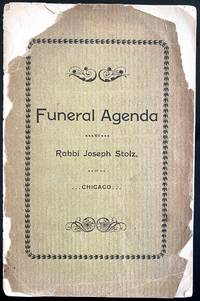
189743201Chicago 1897. 1st edition. Original Wrappers 12mo. 23 pages. Singerman 5280. <br> "Read before the Central Conference of American Rabbis at Montreal Canada July 9 1897." <br> <br> Rabbi Joseph Stolz 1861–1941 was a pioneering Reform rabbi and communal leader primarily in Chicago. He was ordained at Hebrew Union College in 1884 and began his rabbinic career began in Little Rock AR before moving to Chicago in 1887 as assistant to Dr. Bernard Felsenthal at Zion Congregation. In response to demographic shifts Stolz founded Isaiah Congregation one of Chicago’s most prominent Reform synagogues which under his leadership built a major temple at 45th and Vincennes Ave. in 1896.<br> Stolz emphasized traditional observance within Reform delivering biblically rooted ethically driven sermons. His contribution to the 1896 Sermons by American Rabbis reflects his emphasis on “deed over creed.â€<br> He was awarded a Doctor of Divinity by HUC in 1890 and a Doctor of Hebrew Law honoris causa in 1931. He held key roles in the Central Conference of American Rabbis President 1905–07 Chicago Rabbinical Association American Jewish Committee JPS and UAHC and was appointed to the Chicago Board of Education 1899–1905 by Mayor Carter Harrison.<br> Stolz’s legacy remains central to the development of Reform Judaism in Chicago Tobias Schanfarber in AJYB 1942. OCLC: 37779652. <br> Covers detached and edgeworn internal text and paper bright and strong Good Condition thus B kh-2-7-BFCL-CC. [Chicago] unknown
183156386London: Effingham Wilson 1831. Octavo 22.5cm. Later half brown calf purple cloth over boards and subsequently rebacked with brown calf reinforcements to corners top edge stained other edges sprinkled red; orange endpapers; xx576pp. Lacking frontispiece. Externally worn but skilfully repaired internally clean with occasional spots of foxing: Very Good. <br /> <br /> A key text of early nineteenth-century English parliamentary reformers: "a massive compendium of all the abuses electoral ecclesiastical legal" that they "sought to abolish. . . its emphasis on the need to have practical as well as equitable representation lies at the root of parliamentary democracy." The book "passed through edition after edition continually augmented with new arguments new reports of abuses and new statistics"; this 1831 edition "was the most influential coming as it did on the eve of the Reform Bill 1832" Printing and the Mind of Man p.180. PMM296. GOLDSMITHS 23071. KRESS C.638. Effingham Wilson unknown
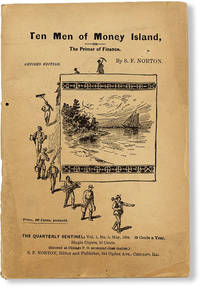
189448920Chicago: By the Author 1894. Revised Edition. 12mo 20cm; original pictorial wrappers stapled; 931pp; illus. Text is tanned and a bit brittle at the edges neat splits to front wrapper above and below the staples with several tiny tears and a few slivers missing from wrapper extremities particularly at preliminary and terminal leaves; Good complete copy. A tax reform utopia originally published serially in the Chicago Sentinel between 1879 and 1885. An author's note at base of title page states: ".it was then published in cheap pamphlet form - of which over a hundred thousand copies have since been sold. Its popularity as an educator seems to warrant the present better and more expensive edition." Issued as Vol. I no. 1 in Norton's Quarterly Sentinel apparently a successor to his weekly newspaper of the same name. No further numbers of the Quarterly appear to have been issued. <br /> <br /> Ten Men of Money Island was variously reprinted even as late as 1930 including editions by Wayland's Appeal to Reason the London utopian publisher Reeves and the Chicago publisher F.J. Schulte. SARGENT p.45 citing only the London ed. Not in Negley or Lewis and not found in Wright. By the Author unknown