1 707 résultats
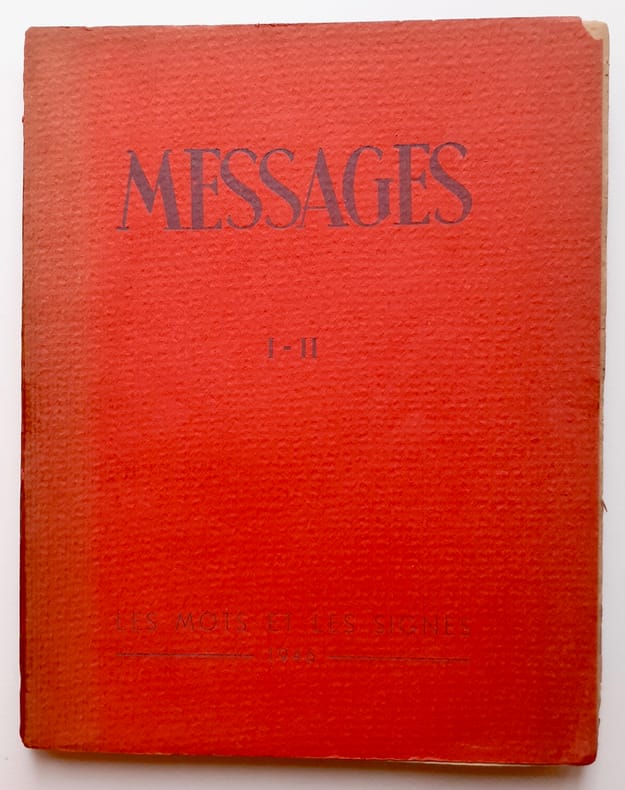
43704Paris : Editions de Minuit, octobre 1946. Un volume broché (18,7x24 cm), (160) pages. Au sommaire : André Frenaud : Les poèmes du petit vieux, Raymond Queneau : Pictogrammes, René Char : L'extravagant, Jean tardieu : Les travaux du professeur Freppel, Jean Lescure : La Marseillaise bretonne. Couverture passée sinon bon état.
46586Marseille, directeur : Yves Broussard. 1 volume 14,5x22cm, 258 pages. Bon état. Numéro consacré à Andrée Chedid.
42546174-nnew. unknown
42546174like new. unknown
A9780367777456Paperback / softback. New. paperback
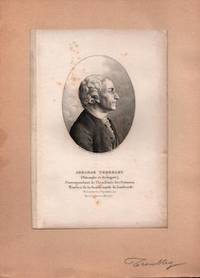
70-1268Paris : 19th Century European Publisher 1800s. Original B&W gravure. 8.25 x 5.5 inches. Good. Light foxing in upper half including some spots on image. Text in French.Abraham Trembley a Swiss naturalist was born Sep. 3 1710. In 1740 Trembley discovered a small freshwater organism which he called a polyp that he thought was new to science in fact Leeuwenhoek had discovered it nearly 40 years before. Experimenting with his tiny tentacled beastie which we now call a hydra Trembley cut the organism in half and discovered to his amazement that both halves could regenerate producing two fully functional hydra from the incomplete pieces. Most scientists who did not see this with their own eyes would not believe it. So Trembley did a very clever thing. He found ways to keep the delicate organisms alive during long carriage rides and he sent living specimens to the leading naturalists of Paris and London with instructions on how to conduct the experiments. Trembley’s experiments were re-performed before the French Academy of Sciences and the Royal Society of London and the hydra regenerated just as Trembley had promised. By thus using what one scholar has called this “strategy of generosity†Trembley converted what might have been fierce critics into supporters. By the time his book came out Mémoires pour servir ą l’histoire d’un genre de polypes d’eau douce Memoirs on the natural history of a kind of freshwater polyp 1744 he no longer had to battle skeptics and Trembley was proclaimed everywhere as a master investigator of nature. Paris : [19th Century European Publisher], [1800s?]. unknown
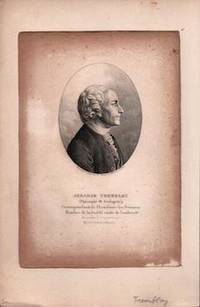
70-1269Paris : 19th Century European Publisher 1800s. Original B&W gravure. 8.5 x 5.75 inches. Good. Toning throughout particularly along edges. Text in French.Abraham Trembley a Swiss naturalist was born Sep. 3 1710. In 1740 Trembley discovered a small freshwater organism which he called a polyp that he thought was new to science in fact Leeuwenhoek had discovered it nearly 40 years before. Experimenting with his tiny tentacled beastie which we now call a hydra Trembley cut the organism in half and discovered to his amazement that both halves could regenerate producing two fully functional hydra from the incomplete pieces. Most scientists who did not see this with their own eyes would not believe it. So Trembley did a very clever thing. He found ways to keep the delicate organisms alive during long carriage rides and he sent living specimens to the leading naturalists of Paris and London with instructions on how to conduct the experiments. Trembley’s experiments were re-performed before the French Academy of Sciences and the Royal Society of London and the hydra regenerated just as Trembley had promised. By thus using what one scholar has called this “strategy of generosity†Trembley converted what might have been fierce critics into supporters. By the time his book came out Mémoires pour servir ą l’histoire d’un genre de polypes d’eau douce Memoirs on the natural history of a kind of freshwater polyp 1744 he no longer had to battle skeptics and Trembley was proclaimed everywhere as a master investigator of nature. Paris : [19th Century European Publisher], [1800s?]. unknown
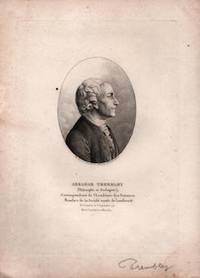
70-1288Paris : 19th Century European Publisher 1800s. Original B&W gravure. 7.75 x 10.75 inches. Very Good. Light surface wear. Small perforation on upper left side not affecting image. Text in French.Abraham Trembley a Swiss naturalist was born Sep. 3 1710. In 1740 Trembley discovered a small freshwater organism which he called a polyp that he thought was new to science in fact Leeuwenhoek had discovered it nearly 40 years before. Experimenting with his tiny tentacled beastie which we now call a hydra Trembley cut the organism in half and discovered to his amazement that both halves could regenerate producing two fully functional hydra from the incomplete pieces. Most scientists who did not see this with their own eyes would not believe it. So Trembley did a very clever thing. He found ways to keep the delicate organisms alive during long carriage rides and he sent living specimens to the leading naturalists of Paris and London with instructions on how to conduct the experiments. Trembley’s experiments were re-performed before the French Academy of Sciences and the Royal Society of London and the hydra regenerated just as Trembley had promised. By thus using what one scholar has called this “strategy of generosity†Trembley converted what might have been fierce critics into supporters. By the time his book came out Mémoires pour servir ą l’histoire d’un genre de polypes d’eau douce Memoirs on the natural history of a kind of freshwater polyp 1744 he no longer had to battle skeptics and Trembley was proclaimed everywhere as a master investigator of nature. Paris : [19th Century European Publisher], [1800s?]. unknown
1896558071 vol. grand in-8 reliure demi-basane blonde, dos à 2 nerfs, Librairie P. Juliot, Clermont-Ferrand, 1896, VIII-340 pp. et 12 planches hors texte
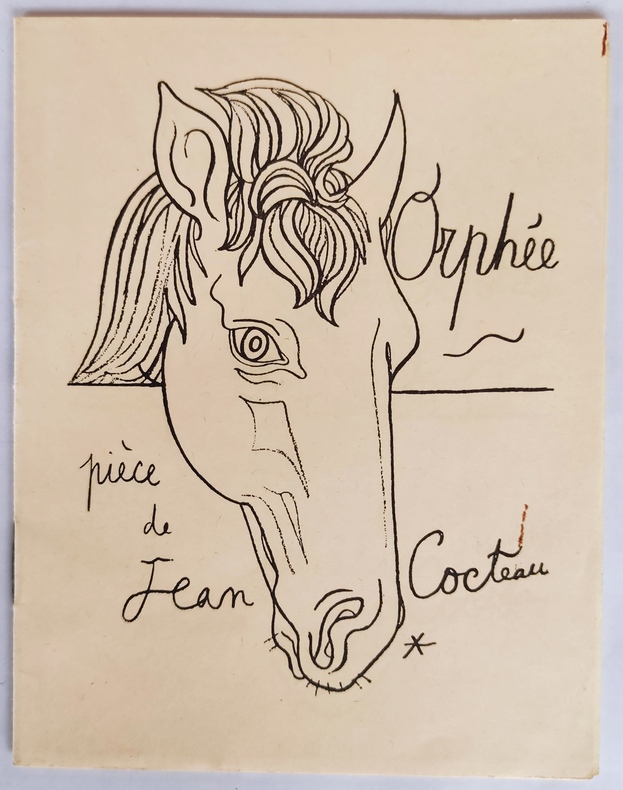
18947Reims, Imprimé Photec, In-12, agrafé, 12 pp., couverture de Cocteau.
72730Bruxelles et Paris, éd. de Minuit et La Renaissance du Libre, imprimerie Desoer, 1946, réimpression de l'édition originale de 1943 au éditions de Minuit, tirage uniquement pour la Belgique, expl. n° 584/2000, pt. in-12, cartonnage souple remplié éd., couv. texte en noir sur fond crème éd. titre et lettre "D" sur le dos, 92 - (4) pp., non coupé et non rogné, Réédition de la célèbre maison d'édition de Minuit pour la diffusion uniquement en Belgique et ce juste après l'Occupation allemande durant la Seconde Guerre mondiale. Cette édition "belge" est entièrement recomposée et ne comprend que les 20 premiers titres de cette collection ! RARE Très bon état
1911118012Félix Alcan, 1911, in-12, xviii-242 pp, 5 cartes hors texte (dont 3 dépliantes), reliure demi-basane mordorée, dos à 4 nerfs soulignés à froid, titres dorés, bon état
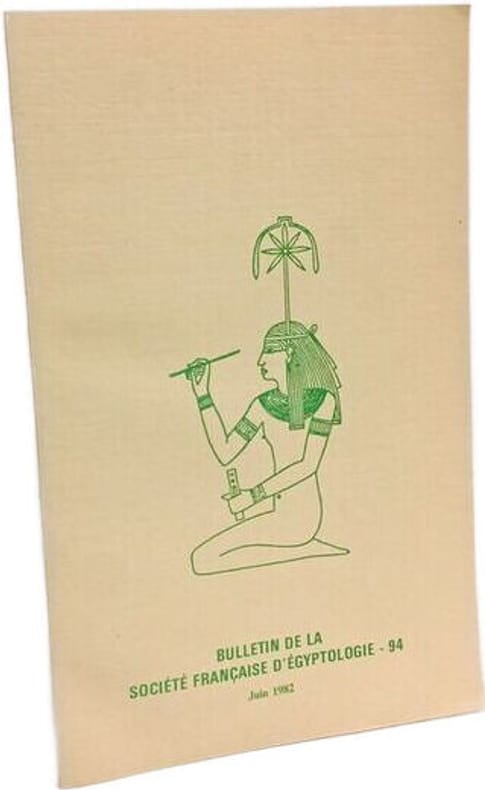
1982100143311Société française d'égyptologie 1982 19 pages in8. 1982. Agrafé. 19 pages.
13093Revue bimestrielle, éditée à Genève sous la direction de Pierrette Courthion. Au sommaire : Notes d'un homme étonné, par Jean Tardieu - L'homme de feu (Van Gogh), par Pierre Courthion - Quelques pensées, par Van Gogh - La migration, par Hölderlin - Prélude, par Anne Fernier - Poèmes inédits, par M. Desbordes-Valmore - Le "moi pur" selon Valéry ou le refus d'être quoi que ce soit, par Marcel Raymond - etc. In-8 broché de 96 pp., orné de 6 dessins hors texte de Fougeron. Couverture un peu usagée en bordure, intérieur en très bon état.
Mm 130x215 Europe: revue littéraire mensuelle, 64 année, n° 688-689, Aout-Septembre 1986. Brossura editoriale di 224 pagine. Copia molto buona. Testo in lingua francese - french text. SPEDIZIONE IN 24 ORE DALLA CONFERMA DELL'ORDINE.
202670878Sources de la poesie seghers 2026. in8. 2026. Broché. 88 pages. paperback. Bon Etat car jauni numerote 254 sur 1500 sur madagascar avec son bandeau. Sources de la poesie seghers paperback
190825822Paris aux Bureaux de la Sucrerie Indigène et Coloniale 1908 -in-8 demi-chagrin un volume, reliure demi-chagrin vert olive in-octavo (binding half shagreen duodecimo) (24 x 15,5 cm), dos long (spine without raised band), décoration "or" (gilt decoration), Titre et Date frappés "or" avec un double filet "or" de part et d'autre, double filet "or" en place des nerfs et en tête et en pied, papier granité imitation percale vert foncé aux plats, toutes tranches lisses, sans illustrations (no illustration) excepté quelques rares figures in-texte en noir, 748 pages, l'année complète 1908 Paris : aux Bureaux de la Sucrerie Indigène et Coloniale Editeur,
190825826Paris aux Bureaux de la Sucrerie Indigène et Coloniale 1908 -in-8 demi-chagrin un volume, reliure demi-chagrin vert olive in-octavo (binding half shagreen duodecimo) (24 x 15,5 cm), dos long (spine without raised band), décoration "or" (gilt decoration), Titre et Date frappés "or" avec un double filet "or" de part et d'autre, double filet "or" en place des nerfs et en tête et en pied, papier granité imitation percale vert foncé aux plats, toutes tranches lisses, orné de quelques figures in et hors-texte en noir, 628 pages, l'année complète 1912 Paris : aux Bureaux de la Sucrerie Indigène et Coloniale Editeur,
1869555921 carte dépliante lithographiée en couleurs entoilée format 89 x 67,8 cm, Chambéry, 1869, Carte du Département de la Savoie par M. Conte, Ingénieur en Chef des Ponts et Chaussées, Officier des Ordres de la Légion d'Honneur, des SS. Maurice et Lazare, etc. etc. avec le Concours de Mr. Tardieu, Agent-Voyer Chef, Par Jh. Perrin, Libraire Editeur et Lithographe
427101 vol in-8 - broché - N° 19 de avril-mai 1943 - 116 pages
1961R320036580CONSEIL MUNICIPAL DE PARIS. 1961. In-12. Broché. Etat d'usage, Couv. convenable, Dos satisfaisant, Intérieur frais. 33 pages agraffées et augmentées de nombreuses copies de reproductions en noir et blanc hors texte.. . . . Classification Dewey : 750-La peinture et les peintres
1819M8213Paris. c. 1819. Very Good. Notes: Rare first edition of this important map of Mexico and the South & Western US. This map is based on the works of Humboldt Pike and Lewis & Clark. <br><br> Size : 222x298 mm 8.75x11.75 Inches Coloring: Hand Colored in Outline Category: Maps Central America Mexico; unknown
0259438316.Gpaperback. Good. Access codes and supplements are not guaranteed with used items. May be an ex-library book. paperback
066687199X.Ghardcover. Good. Access codes and supplements are not guaranteed with used items. May be an ex-library book. hardcover
18233179PARIS. F. G. LEVRAULT, LIBRAIRE-EDITEUR. 1823. IN-8 (13 X 21,5 X 3 CENTIMETRES ENVIRON) DE 100 PORTRAITS SOUS SERPENTE LITHOGRAPHIES EN NOIR PAR AMBROISE TARDIEU, RELIURE D'EPOQUE 1/2 VEAU HAVANE, DOS LISSE ORNE DE FILETS DORES, TITRE DORE. PLANCHES RELIEES SEULES, SANS FEUILLET DE TITRE. PETITES TRACES DE FROTTEMENT SUR LE DOS, SINON BON EXEMPLAIRE.