Hyacinthe Yves Bougainville / Baron de Potentien / Edmond de la Touanne / Tardieu / de VaisseauBiblio.com

628 résultats
183760644<p>lithograph 3 maps on double-page sheet EXTREMELY RARE. Maps from "Atlas Journal de la Navigation Autour du Globe de la Frégate la Thétis et de la Corvette l'Esperance pendant les années 1824 1825 et 1826"; pl. 47; REFERENCE: Borba de Moraes I p. 115; Sabin 6874; cf. Ferguson 2236; Ferguson 1204; cf. Hill p. 31; Numa Broc Oceanie 89; cf. Nissen ZBI 483; Howgego B50. Condition: with heavy foxing in margins slight foxing on plate. Soft cover.</p> Arthus Bertrand, Paris.
59-3111Paris: Didot 1749. From Histoire des Voyages by Abbe Prevost. Vol. 5 no. 33. Image size is 14 x 20.2 cm 5-1/2 x 8 inches. Paris: Didot, 1749. unknown
183756149<p>lithograph map and 2 profiles on double-page sheet. EXTREMELY RARE map from "Atlas Journal de la Navigation Autour du Globe de la Frégate la Thétis et de la Corvette l'Esperance pendant les années 1824 1825 et 1826"; pl. 51; REFERENCE: Borba de Moraes I p. 115; Sabin 6874; cf. Ferguson 2236; Ferguson 1204; cf. Hill p. 31; Numa Broc Oceanie 89; cf. Nissen ZBI 483; Howgego B50.</p> Arthus Bertrand, Paris.
16192942Paris 1916-1917. Hardcover. Very Good . Each volume approx. 300 p. 5 x 7 1/4 in. Half morocco binding with marbled boards gilt lettering on spines 5 raised bands top edge of text block gilt colored end papers. Condition of each volume is VERY GOOD: very light wear to covers and spines marbled boards very lightly worn a few lightly worn corners and spine edges light discoloration to some leather surfaces. Spine faded edges of text block very lightly darkened small book plate of David B. Ogden on inside of front cover pages very clean bindings very tight. LF LC- light soiling to end papers. Gaspard- small old worm hole at edge of text block. La France.- light soiling to end papers front hinge starting to crack this text alone from 1910 all others are from 1916-1917. NOTE- 10 volumes all in French all war memoirs pertaining to WW I all bound uniformly color variations in leather marbled boards end papers by Brentano's NY stamped on endpaper. hardcover
16-3711France: late 19th Century. 8vo. 13 x 20 Qtr. roan and Original boards. 28 double page handcolored maps most with one wormhole in the margins and waterstain. 28 world and country maps; Also bound in are 19th Century maps of Napolionic battles.Atlas. Recueil composite :-- 4 planches doubles couleurs sphère armilllaire lune mappemonde etc.- 23 cartes fin XVIIIe s. rehaussées sur double page mappemonde Europe pays d'Europe Asie Afrique Egypte Amérique etc.- 1 carte d'Océanie sur double page par Avril 1841. 10 plans de A.M. PERROT gravés par Tardieu sur les batailles napoléoniennes.In-8 ½ basane verte ép. dos lisse. Coiffes et coins usés. Galeries de vers et mouillures claires. France: late 19th Century hardcover
2070377326.Gpocket_book. Good. Access codes and supplements are not guaranteed with used items. May be an ex-library book. unknown
134470994X.Ghardcover. Good. Access codes and supplements are not guaranteed with used items. May be an ex-library book. hardcover
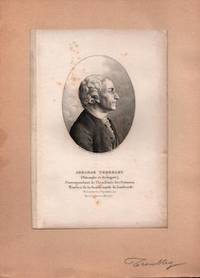
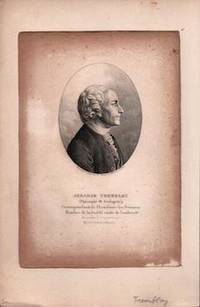
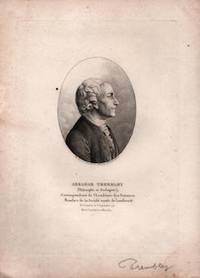
70-1268Paris : 19th Century European Publisher 1800s. Original B&W gravure. 8.25 x 5.5 inches. Good. Light foxing in upper half including some spots on image. Text in French.Abraham Trembley a Swiss naturalist was born Sep. 3 1710. In 1740 Trembley discovered a small freshwater organism which he called a polyp that he thought was new to science in fact Leeuwenhoek had discovered it nearly 40 years before. Experimenting with his tiny tentacled beastie which we now call a hydra Trembley cut the organism in half and discovered to his amazement that both halves could regenerate producing two fully functional hydra from the incomplete pieces. Most scientists who did not see this with their own eyes would not believe it. So Trembley did a very clever thing. He found ways to keep the delicate organisms alive during long carriage rides and he sent living specimens to the leading naturalists of Paris and London with instructions on how to conduct the experiments. Trembley’s experiments were re-performed before the French Academy of Sciences and the Royal Society of London and the hydra regenerated just as Trembley had promised. By thus using what one scholar has called this “strategy of generosity†Trembley converted what might have been fierce critics into supporters. By the time his book came out Mémoires pour servir ą l’histoire d’un genre de polypes d’eau douce Memoirs on the natural history of a kind of freshwater polyp 1744 he no longer had to battle skeptics and Trembley was proclaimed everywhere as a master investigator of nature. Paris : [19th Century European Publisher], [1800s?]. unknown
70-1269Paris : 19th Century European Publisher 1800s. Original B&W gravure. 8.5 x 5.75 inches. Good. Toning throughout particularly along edges. Text in French.Abraham Trembley a Swiss naturalist was born Sep. 3 1710. In 1740 Trembley discovered a small freshwater organism which he called a polyp that he thought was new to science in fact Leeuwenhoek had discovered it nearly 40 years before. Experimenting with his tiny tentacled beastie which we now call a hydra Trembley cut the organism in half and discovered to his amazement that both halves could regenerate producing two fully functional hydra from the incomplete pieces. Most scientists who did not see this with their own eyes would not believe it. So Trembley did a very clever thing. He found ways to keep the delicate organisms alive during long carriage rides and he sent living specimens to the leading naturalists of Paris and London with instructions on how to conduct the experiments. Trembley’s experiments were re-performed before the French Academy of Sciences and the Royal Society of London and the hydra regenerated just as Trembley had promised. By thus using what one scholar has called this “strategy of generosity†Trembley converted what might have been fierce critics into supporters. By the time his book came out Mémoires pour servir ą l’histoire d’un genre de polypes d’eau douce Memoirs on the natural history of a kind of freshwater polyp 1744 he no longer had to battle skeptics and Trembley was proclaimed everywhere as a master investigator of nature. Paris : [19th Century European Publisher], [1800s?]. unknown
70-1288Paris : 19th Century European Publisher 1800s. Original B&W gravure. 7.75 x 10.75 inches. Very Good. Light surface wear. Small perforation on upper left side not affecting image. Text in French.Abraham Trembley a Swiss naturalist was born Sep. 3 1710. In 1740 Trembley discovered a small freshwater organism which he called a polyp that he thought was new to science in fact Leeuwenhoek had discovered it nearly 40 years before. Experimenting with his tiny tentacled beastie which we now call a hydra Trembley cut the organism in half and discovered to his amazement that both halves could regenerate producing two fully functional hydra from the incomplete pieces. Most scientists who did not see this with their own eyes would not believe it. So Trembley did a very clever thing. He found ways to keep the delicate organisms alive during long carriage rides and he sent living specimens to the leading naturalists of Paris and London with instructions on how to conduct the experiments. Trembley’s experiments were re-performed before the French Academy of Sciences and the Royal Society of London and the hydra regenerated just as Trembley had promised. By thus using what one scholar has called this “strategy of generosity†Trembley converted what might have been fierce critics into supporters. By the time his book came out Mémoires pour servir ą l’histoire d’un genre de polypes d’eau douce Memoirs on the natural history of a kind of freshwater polyp 1744 he no longer had to battle skeptics and Trembley was proclaimed everywhere as a master investigator of nature. Paris : [19th Century European Publisher], [1800s?]. unknown
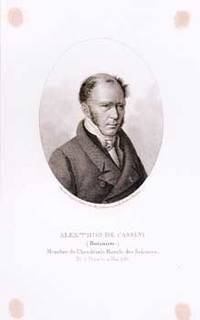
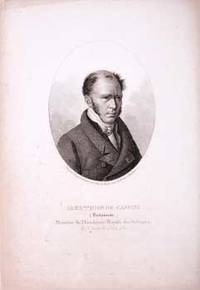
70-1160Paris : Ambroise Tardieu 1827. Original B&W gravure. 8 x 5 inches. Very Good. Lightly mounted on card with stains from adhesive on four corners else fine.Alexander Henri Gabriel de Cassini 1781-1832 the French botanist and naturalist who specialised in the sunflower family. He named many flowering plants and new genera in the sunflower family many of them from North America. Paris : [Ambroise Tardieu], [1827]. unknown
70-1159Paris : Ambroise Tardieu 1827. Original B&W gravure. 8.5 x 5.75 inches. Very Good. Significant toning and light spots of foxing not affecting image. Alexander Henri Gabriel de Cassini 1781-1832 the French botanist and naturalist who specialised in the sunflower family. He named many flowering plants and new genera in the sunflower family many of them from North America. Paris : [Ambroise Tardieu], [1827]. unknown
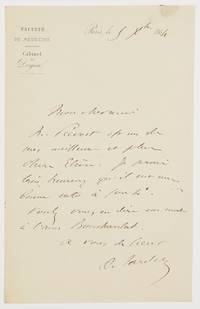
1864603961864. Paris 5.XII.1864. 1 Seite gr.-8°. Mit Siegelspur und Adresse. Gestochener Briefkopf "Faculté de Médecine / Cabinet du Doyen". Ambroise Auguste Tardieu 1818-1879 französischer Rechtsmediziner; das Battered-Child-Syndrome ist auch als Tardieu-Syndrom bekannt. - An Professor Regnauld mit der Bitte um Empfehlung eines Schülers. ". Mr. Prévost est un de mes meilleurs et plus chers elèves. Je serais très heureux qu'il eut une bonne note à sortie. Voulez-vous en dire un mot à l'ami Boucharelat ." unknown
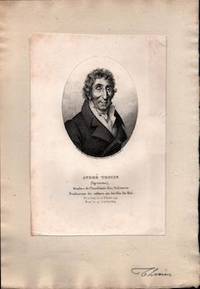
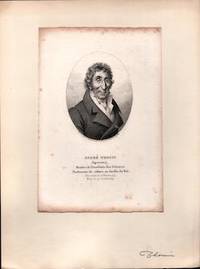
70-1311Paris : 19th Century European Publisher 1800s. Original B&W gravure. 8 x 5.5 inches. Very Good. Very minor signs of foxing beginning to start. Paris : [19th Century European Publisher], [1800s?]. unknown
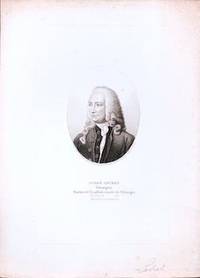
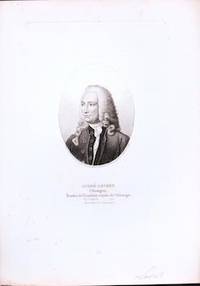
70-1312Paris : 19th Century European Publisher 1800s. Original B&W gravure. 8.5 x 5.5 inches. Very Good. Minor signs of foxing not affecting image. Toning on top and bottom edges. Paris : [19th Century European Publisher], [1800s?]. unknown
70-1193Paris: 18th Century European Publisher 1700s. Original B&W gravure. 11.75 x 8.5 inches. Very Good. Some foxing around sides and margins image mostly fine. Penciled notation in bottom margin. Paris: [18th Century European Publisher], [1700s?]. unknown
70-1192Paris: 18th Century European Publisher 1700s. Original B&W gravure. 11.25 x 8 inches. Very Good. Light spots of foxing throughout. Penciled notation in bottom margin. Paris: [18th Century European Publisher], [1700s?]. unknown
65-0867Paris de l'Imprimerie Royal Cabinet du Crozat 1729. Engraving by Nicolas Tardieu after the painting by Carte Maratte.Image size: 425 x 295 mmSheet size: 540 x 370 mm From "Recueil d'Estampes d'après les plus beaux Tableaux et d'après les plus beaux Desseins qui sont en France dans le Cabinet du Roy dans celuy de Monseigneur le Duc d'Orleans & dans d'autres Cabinets".Water damage and tears along left edge of paper and along left side of image as shown. Plate 124.Cabinet du Crozat. Paris, de l'Imprimerie Royal [Cabinet du Crozat], 1729. unknown
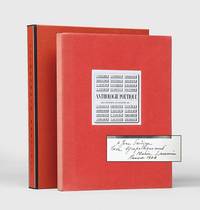
1943152544Paris: Éditions Pierre Trémois 1943. Inscribed by Marie Laurencin First and limited edition number 515 of 999 copies; this copy inscribed by Marie Laurencin to the poet and dramatist Jean Tardieu at the foot of her illustration on p. 38: "A Jean Tardieu bien sympathiquement Marie Laurencin Janvier 1944". A beautifully produced book particularly so considering wartime conditions. Painter printmaker and stage designer Marie Laurencin 1883-1956 is "known for her delicate portraits of elegant vaguely melancholic women" Britannica. She studied at the Humbert Academy in Paris and after an introduction to Picasso became involved with the avant-garde. Getrude Stein was one of her earliest supporters. She was romantically involved with Apollinaire whose work she here illustrates: a group of poems including "Marie" and "Crépuscule" which is dedicated to her. The recipient Jean Tardieu 1903-1995 published several poetry collections in the 1930s and after the war became a moving force in French radio. A number of his plays were staged and he was linked with the work of the Theatre of the Absurd. "Alone among the playwrights of the avant-garde Tardieu can claim that his work spans the entire gamut of exploration" Esslin p. 227. The publishing house of Pierre Trémois founded in 1922 specialized in illustrated books. The poems for this publication were gathered by Renée Garcia who later co-founded the literary quarterly Cerf-Volant and comprise contributions by among others Mallarmé Jules Laforgue Apollinaire Paul Claudel Jean Cocteau Léon-Paul Fargue Rilke and Paul Valéry. Each poem has an accompanying pochoir frontispiece the illustrators including André Derain Jean Cocteau André Lhote and Hermine David. An online institutional search locates 12 copies worldwide: eight in the US; three in France BnF Bibliothèque Sainte-Genevieve and Bibliothèque Jacques Doucet; Leiden in the Netherlands. Quarto. With 12 pochoir plates. Original red wrappers paper label to front cover. Handsome bespoke solander box by Julie Nadot. Spine of volume sunned light peripheral creasing to wrappers. An excellent largely unopened copy. Martin Esslin The Theatre of the Absurd 2013. unknown
2009SKU-1233AB02110152Quintessence Publishing Co 2009. 1. Hardcover. Good. Good; Hardcover; Covers are moderately shelfworn with edge-protectors applied to the corners; Unblemished textblock edges; The endpapers and all text pages are clean and unmarked; Good binding; This book will be shipped in a sturdy cardboard box with foam padding; Large Format Quatro 10.75" - 11.75" tall; Black covers with title in green and blue lettering; 2009 Quintessence Publishing Co; 240 pages; "Art of Computer-Guided Implantology" by Philippe Tardieu & Alan Rosenfeld. Quintessence Publishing Co hardcover
2009SONG0867154772Brand: Quintessence Pub Co 2009-03-31. 1. hardcover. Used: Good. 8.75x0.75x11.00. Buy with confidence. Excellent Customer Service & Return policy. Brand: Quintessence Pub Co hardcover
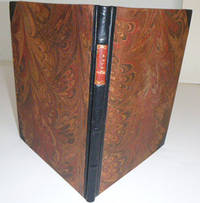
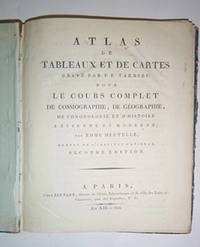
51-4449Paris: Chez Bernard 1804. 4to . 23 x 25 cm . Modern half Sakora goat and marbled boards by the artisan binder Sasha Mosalov. Without the title page. 15 handcolored double page maps each 25 x 41cm. . Includes a world map and maps of North and south America. .OCLC Number: 879716030; 45848528. Paris: Chez Bernard, 1804. hardcover
16-4498Paris Bernard 1804. 4to. 21 x 25.5 cm. With 19 of handcloored double-page maps Lacks the 20th of France but the 2 of America are present.Contemporary qtr. roan somewhat worn.in-4 relié demi-basane frottée. Illustrées de 6 tableaux dépliants montés sur onglet et de 19 cartes ou plans sur 20 manque la dernière. Quelques restaurations dans les marges blanches de quelques cartes Paris, Bernard, 1804, unknown
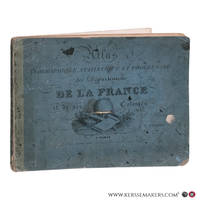
183578717Paris: Chez de Pelafol libraire c 1835. Oblong folio 26x34 cm. Original printed publishers wrappers with vignette soiled some small stains and a few loss of paper. - Missing: endpapers title the 2 large flding maps and 1 folding map "Ile de Bourbon". But still a nice collection of all the 86 engraved departemental maps & "Paris" & "Environs de Paris" coloured by hand in vivid colors and the folding maps: "Alger" and 5 of 6 of the colonial maps "Guyane" "Sénéal" "Martinique etc" Guadaloupe" and "Les Possessions Françaises Orientales" also coloured by hand. - Together 94 maps. Chez de Pelafol, libraire unknown