118 résultats
200018647Boston: Little Brown 2000. 1st edition. Purple cloth spine with green paper-wrapped boards. Dust jacket. NF remainer mark on bottom edge/F. 205 pp. 8vo. <br/><br/> Little Brown hardcover books
1948UGIBRED00MELSaturn Press 1948. Very Good. Gibbon Mark. The Red Shoes Ballet: A Critical Study. London: Saturn Press 1948. Second edition. 95pp. Illustrated. 4to. Hardcover. Book condition: Very good with remains of an old sticker on front free endsheet. Saturn Press hardcover books
1994Embry 138722Indiana U. Press 1994. First edition first printing. Fine in fine dust jacket in mylar cover. Indiana U. Press, 1994. First edition, first printing. unknown books
1932124744London: Jarrolds Publishers 1932-1934. First editions of each volume of Gibbon's classic trilogy describing the life of Chris Guthrie a woman from the north-east of Scotland during the early 20th century each volume inscribed by him to George Malcolm Thomson. Octavo original cloth 3 volumes. Sunset Song is inscribed on the title page "For G. Malcolm Thomson L. Grassic Gibbon." Cloud Howe is the dedication copy inscribed on the title page "For the 'dedicatee' with kind regards. L. Grassic Gibbon." Grey Granite is inscribed on the title page "For George Malcolm Thomson with good wishes L. Grassic Gibbon." Each are in very good condition. Rare and desirable signed and inscribed. A Scots Quair is revolutionary - innovative in its form deft and humorous in its use of language courageous in its characterization and politics. Central to the trilogy is Chris Guthrie one of the most remarkable female characters in modern literature. In Sunset Song Gibbon's finest achievement the reader follows Chris through her girlhood in a tight-knit Scottish farming community: the seasons the weddings the funerals the grind of work the gossip. As the Great War takes its toll machines replace the old way of life. Cloud Howe and Grey Granite take Chris from her rural homeland to life in an industrial Scotland and the desperate years of the Depression. Gibbon attracted attention from his earliest attempts at fiction notably from H. G. Wells but it was his trilogy entitled A Scots Quair and in particular its first book Sunset Song with which he made his mark. A Scots Quair with its combination of stream-of-consciousness lyrical use of dialect and social realism is considered to be among the defining works of the 20th century Scottish Renaissance. All three parts of the trilogy have been turned into serials by BBC Scotland written by Bill Craig with Vivien Heilbron as Chris. Additionally Sunset Song has been adapted into a film released in 2015. Jarrolds Publishers hardcover books
1854207072U.S. Government 1854. hardcover. very good. Case Map. Color lithograph in original brown buckram case. Image measures 9.25" x 5.75".<br/><br/> Case map of two maps pertaining to the Amazon River and it's surrounding area with notes on gold and copper mining. Embossed cloth cover with gilt title. Some wear to spine but both maps are attached. First map is "Map of the Andes" a minimalist chart of altitudes measured by varying boiling points. Measures 17" x 19.75". Second map is "Map Drawn by Lieut. Lardner Gibbon to Accompany His Report" a beautiful map of South America including Bolivia parts of Brazil Argentina and Peru. Includes a side inset of the Rio Mamore in Northern Bolivia to Rio Madeira to Rio Amazon. Measures 18.5" x 28".<br/><br/> U.S. Government unknown books
18534192baWashington D.C: A. Hoen 1853. Book. Good condition. Hardcover. First Edition. Octavo 8vo. 23.3cm blind stamped brown cloth folder spine is tape repaired; no text; First map measures 16 3/4" x 20" topographical map of Andes 7 1/2" tear at fold small tear at other fold; Second map measures 18 1/2" x 28 1/2" folded map including south Peru Bolivia part of Argentina roughly folded 2 small tears at folds; also printed beside larger map 18 1/2" x 4 1/2" Brazil map showing rivers Madeira Mamone 4 1/2" tear at fold; ex libris. Exploration South America Cartography Maps. A. Hoen Hardcover books
36876London: Laurence King Publishing 1997. Hardcover. 15.25" x 12.5". 368pp. Profusely illustrated in color and B&W. Black cloth boards in illustrated DJ in navy and illustrated two part slipcase. Still in publisher's shrinkwrap. As New. ISBN 9781856691017 . LikeNew. Hardcover . Laurence King Publishing 1997 hardcover books
199745442London: Laurence King Publishing in association with Alan Marcuson 1997. First edition large 4to pp. 368; numerous color illustrations throughout many full-page; fine copy in the dust jacket and publisher's slipcase. <br/><br/> Laurence King Publishing in association with Alan Marcuson unknown books
193342239NY: Frederick A. Stokes 1933. First Edition. Greenwood C. R. 8vo pp. xv 128. Discography index. Illustrations by C. R. Greenwood. Spine and corners little scuffed o/w a VG tight copy. About setting words to classical melodies. Musical examples given. Frederick A. Stokes unknown books
29948Other: Other. Very Good. Hardcover. NY Stokes 1933 . 128 pages. Fine copy in dust jacket. . Other hardcover books
193956508Toronto: The Ryerson Press. Very Good. 1939. Hardcover. Inscribed by the Author; red cloth boards with gilt stamping are toned spine is sunned otherwise contents are clean and very good with illustrations. . The Ryerson Press hardcover books
30026Other: Other. Very Good. Hardcover. The Romantic History of the Canadian Pacific the Northwest Passage of Today. 1st ed Indianapolis 1935 . 423 pages good condition in worn dust jacket. Inscribed. . Other hardcover books
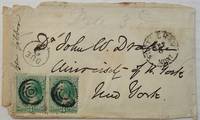
1876253726Fort Ellis Montana 1876. unbound. 3.25 x 5.25 inches September 6 no year but almost certainly sent at the height of the Indian Wars circa 1876 postmarked in Fort Ellis Montana and affixed with two Scott # 136 3c Washington stamps. Addressed in Gibbon's hand to "Dr. John W. Draper University of New York New York." Draper 1811 - 1882 was an American scientist chemist historian and pioneer photographer who is credited with taking the first image of a female's face in 1839. He is also the founder of NYU Medical School. Draper has docketed the envelope "Genl. Gibbon" -- a wonderful association piece considering the fact that Draper is rare in any form. Chipping along the borders; very good- condition.<br/><br/> Union General and Indian fighter who was in Montana Fort Ellis during General Custer's expedition against the Sioux Indians in 1876.<br/><br/> unknown books
19949022167Bloomington: Indiana University Press 1994. 1st . Hardcover. fine/fine. Edited by Alan and Maureen Gaff. <br/><br/> Indiana University Press hardcover books
1890WRCAM56663N.p. 1890. 19pp. plus an additional nine lines of manuscript note on two other slips of paper. Main text written on 9 3/4 x 7 1/2-inch sheets. Approximately 2500 total words. Several sheets with penciled cross-outs but very easily readable overall. Minor edge wear. Near fine. In a half green morocco and white cloth folding case spine gilt leather labels. An exceedingly interesting and important firsthand account of the planning leading up to the massacre at the Little Big Horn in June 1876 written by Gen. John Gibbon who was involved in the planning and operations and was one of Custer's superior officers. Gibbon and his troops were among the first to arrive at the scene of the battle and helped to bury Custer's dead and evacuate the survivors. <br> <br> A major question surrounding the Custer tragedy was whether or not Custer exceeded or ignored his orders in attacking the Sioux before the arrival of Gibbon and his reinforcements. This manuscript recounts the deliberations conducted by Gen. Alfred Terry and his officers including Custer and Gibbon and gives a great deal of information on the decision-making process the plans at which they arrived and the orders under which Custer was to operate. Gibbon wrote about his experiences in the Sioux Campaign in an 1877 article called "Last Summer's Expedition Against the Sioux and Its Great Catastrophe" which also appeared as a chapter in his posthumously published memoir ADVENTURES ON THE WESTERN FRONTIER. The information in the present manuscript is not included in either of those works however and to our knowledge the present manuscript is completely unpublished. <br> <br> Gibbon begins by explaining that on June 21 1876 he and his 7th Infantry troops were camped on the north bank of the Yellowstone River with Custer and his 7th Cavalry camped on the south bank. He relates that the two separate columns had already conferred three times and were about to meet for a fourth conference all under the supervision of commanding Gen. Alfred Terry. Gibbon writes that at the first conference with Terry he offered Terry the services of his trusted scout Mitch Bouyer who eventually died with Custer's men: "I little thought that I was sending poor faithful Mitch to his death." Gibbon also briefly discusses his second conference with Terry before describing a third conference which took place in Gibbon's tent. At that meeting Terry chastised Major Marcus Reno for "following the Indian trail up the Rosebud instead of at once returning & reporting what he had discovered; thus not only losing precious time but running the risk of being discovered by the Indians." <br> <br> Gibbon continues: <br> <br> "Shortly afterwards Custer's command made its appearance on the southern bank & I accompanied Genl. Terry on the ship Far West across the River & Custer found us on board.We sat down at a table & with a map before us discussed the situation. My Crow scouts had reported seeing smoke in the valley of the Little Big Horn and hence it was inferred there must be a camp of Indians somewhere along that stream. The question discussed was how to approach them & strike them to the best advantage.I think Genl. Terry had already made up his mind when the discussion took place to send Custer with a command to follow up the trail discovered by Reno.In the course of the discussion I proposed the question what would the Indians probably do when they were disturbed." <br> <br> Gibbon goes on to discuss the various questions that were posed and impressions that were given at the meeting. Among these was the presumption that the Sioux would attempt to "escape" rather than stand and fight. Gibbon notes that they were ignorant of the "desperate fight" that Crook had waged at the headwaters of the Rosebud just a few days earlier. <br> <br> Very importantly Gibbon writes: <br> <br> "I suggested it would be advisable for Custer to keep on up the Rosebud; instead of following the trail over into the Little Big Horn valley & after crossing over nearer to the mountains approach the supposed Indian camp from the south. This would not only interpose his force between the Indians & their refuge the Big Horn Mountains but would give my command the requisite time to get up as I had the longest distance to pass over. This was agreed to apparently on the part of all.Custer was directed to examine the head of that valley and endeavor to send a messenger down it to communicate to Genl. Terry news of his progress & any information of importance he may have gained. This was regarded as a matter of some considerable moment as it would bring us news of the other columns & might possibly cause a modification of our movement." <br> <br> Gibbon concludes by discussing Custer's failure to follow his orders and why he may have done so: <br> <br> "It is now a matter of history that Genl. Terry received no message from Custer.nor received any message from him of any kind nor ever saw him again. It is also well known that Custer did not follow the line of march marked out for him at the conference. It is difficult to account for Custer's failure to endeavor to communicate with Genl. Terry as desired.except upon the supposition that when in the vicinity of the head of that valley on the day he struck the Indians camp his mind may have been so engrossed by his preparations for the conflict before him as to cause him to overlook it for the time.His reasons for not conforming to the 'desires' of his Dept. Comdr. as expressed in the letter of instructions can never now be known.This is a case which forms no exception to the general rule which prevails in all well disciplined military bodies that the wishes of the commander are always when possible to be construed as orders." <br> <br> John Gibbon 1827-96 was born in the Holmesburg neighborhood of Philadelphia and attended West Point graduating in 1847. During the Mexican-American War he was stationed in Florida helping to keep the peace between American settlers and Seminole Indians and assisting the evacuation of Seminoles to Oklahoma Territory. This experience kindled in him a sympathy for American Indians that would last the rest of his life. Gibbon taught artillery at West Point and produced an influential treatise on the subject. Despite family ties to the Confederacy he fought for the Union during the Civil War and was involved in many important battles including Antietam. At Gettysburg he led forces against Pickett's Charge and was wounded on Cemetery Hill. Later Gibbon helped block the Confederate escape route at the Battle of Appomattox Courthouse and he was one of the three commissioners who received the Confederate surrender at Appomattox. After the Civil War he commanded an infantry unit in Montana Territory and took part in the 1876 campaign against the Sioux. Gibbon's men were among the first to arrive at the scene of the battle of the Little Big Horn and helped to bury Custer's dead and evacuate the survivors. The following year he led a bloody attack on the Nez Perce led by Chief Joseph at the Battle of the Big Hole. Afterward Gibbon and Chief Joseph would become friends. In 1885 Gibbon now a brigadier general took command of the Department of Columbia and placed Seattle under martial law during the anti-Chinese riots of 1886. Aside from his ARTILLERISTS MANUAL of 1859 Gibbon wrote two other books PERSONAL RECOLLECTIONS OF THE CIVIL WAR and ADVENTURES ON THE WESTERN FRONTIER both published posthumously. <br> <br> An exciting informative and unpublished firsthand account of the planning that preceded the massacre of Custer and his men at the Little Big Horn by one who was intimately involved in the process. hardcover books
1929030442London and Toronto: J. M. Dent & Sons 1929. Harmonizations by Geoffrey O'Hara and Oscar O'Brien. xxii 105p. music original cloth. Reprint of the 1927 first edition. J. M. Dent & Sons unknown books
1913M9012New York:: E. P. Dutton 1913. 1913. 8vo. xv 296 pp. Tables index. Full gilt stamped red cloth; minor shelf-wear front inner hinge starting. Early ownership signature of Charles Russell Bardeen. Very good. First edition. Bardeen was the first Dean of the Wisconsin Medical School. E. P. Dutton, 1913. hardcover books
1963UGIBDEC01AGGWashington Square Press 1963. Very Good. Gibbon Edward. The Decline and Fall of the Roman Empire and Other Selections from the Writings of Edward Gibbon. Trevor-Roper editor and abridgment Hugh R. NY: Washington Square Press 1963. 456pp. Indexed. Mass Market. Book condition: Very good with lightly rubbed and bumped edges and previous owner's name on first page. Washington Square Press paperback books
1963UGIBDEC00AGGWashington Square Press 1963. Very Good. Gibbon Edward. The Decline and Fall of the Roman Empire and Other Selections from the Writings of Edward Gibbon. Trevor-Roper editor Hugh R. NY: Washington Square Press 1963. 456pp. Indexed. Mass Market. Book condition: Very good with lightly bumped and rubbed edges and previous owner's name on first page. Washington Square Press paperback books
20001212153London: Folio Society 2000. Special Folio Society Edition Eleventh Printing. Octavo; VG/VG Slipcase No Jackets; White red and blue spines with gilt lettering; 8 Volumes housed in 2 red slipcases; Boards and covers are straight and with light rubbing to some covers and spines; Bindings are strong; Text blocks are pristine; 8 Volumes. Shelved in Folio Society. 1212153. Shelved Dupont Bookstore. Folio Society unknown books
19602311036New York: Harcourt Brace and Company 1960. Book Club BCE/BOMC. Hard Cover. Good/Fair. Book club edition. Very good hardcover in fair jacket. Jacket rubbed and creased with some tears and loss from corners. 1960 Hard Cover. 924 pp. Map illustrated endpapers. The classic abridgment by D.M. Low. "The History of the Decline and Fall of the Roman Empire was written by English historian Edward Gibbon and published in six volumes. Volume I was published in 1776 and went through six printings. Volumes II and III were published in 1781; volumes IV V VI in 1788 Harcourt, Brace and Company hardcover books
1940WRCLIT79066London: Jonathan Cape 1940. 288pp. Large octavo. Gilt polished black buckram untrimmed. Portrait. Plates. Slight tanning to edges and endsheets but a near fine copy in good somewhat darkened and soiled dust jacket. First edition the uncommon first issue. Keynes notes in his autobiography that the first printing sold poorly due to the war and a significant portion of the edition was destroyed in the blitz. Rupert Hard-Davis wrote in THE BOOK COLLECTOR that "Gibbon's Library was duly brought out in one of the worst months in publishing history - April 1940. It achieved the splendid record of selling fewer copies than any other book ever published by Cape - under a hundred I remember - and since most of the unsold stock was soon destroyed by enemy action the book must be the rarest in all Geoffrey's extensive oeuvre." In 1950 the Bibliographical Society bound up some sets of rescued sheets with a missing signature reprinted constituting the second issue. Jonathan Cape hardcover books
1946012282NY: Limited Editions Club 1946. 1s US Edition Thus. Hardcover. Good. 7 volumes complete simply yet elegantly bound in half black leather over black cloth gilt ruled spines. 1500 copies this #847. Limited Editions Club hardcover books
1844011998NY: Harper and Brothers 1844. 1s US Edition Thus. Hardcover. Good. First or early US edition with notes by English historian and ecclesiastic Rev Henry Hart Milman 1791 - 1868 4 volume set complete maps as called for in vols 1 2 and 3 all in original folds. Bound in original or old full calf crusty and flaking front covers loosened but holding in vols 3 and 4. Sporadic foxing throughout all volumes. A good reference set. Harper and Brothers hardcover books
197723063NY:: Modern Library. Near Fine in Near Fine dust jacket. 1977. Hardcover. B000KU3KOS . Complete in three volumes. No indication of printing. Each volume is near fine in a near fine dust jacket. Dust jacket design by R. D. Scudellari. . Modern Library, hardcover books