Eisenhower, Dwight DBiblio.com
708 résultats
1258411571.Gpaperback. Good. Access codes and supplements are not guaranteed with used items. May be an ex-library book. paperback
P12OS-00063National Archives of the U.S. Used - Very Good. Very Good condition. united states politics and government sources A copy that may have a few cosmetic defects. May also contain light spine creasing or a few markings such as an owner’s name short gifter’s inscription or light stamp. NOT AVAILABLE FOR SHIPMENT OUTSIDE OF THE UNITED STATES. National Archives of the U.S unknown
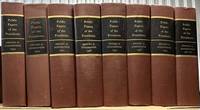
00598720United States Government Printing Office. Hardcover. Very Good. A nice set of the First Printings . Complete set eight volumes 1953 - 1961 . The hinges are tight on all of the large books . The graphics on the spines are bright . All of the books are clean no marks of any kind except for a large bookplate on the front pastedown of volume eight . Volumes one and two show faded spots to the cloth on the back boards . Otherwise the cloth on all of the books is fresh . The books are protected with mylar covers . Overall a solid nice set . United States Government Printing Office hardcover
BOOKS330188United States Government Printing Office. Used-Very Good/NO DUSTJACKET. Hardcover. Sm 4to. . United States Government Printing Office hardcover
195869212Washington DC: U. S. Government Printing Office 1958. Presumed first edition/first printing. Second volume in series. Hardcover. Good. No dust jacket. Cover has some wear and soiling. Corners bumped. xxxiv 1220 pages. Includes index. Frontis. List of items The was published by the Federal Register Division National Archives and Records Service General Services Administration. From Wikipedia: "The Public Papers of the Presidents contain the papers and speeches of the Presidents of the United States that were issued by the Office of the Press Secretary. The series constitutes a special edition of the Federal Register. The Public Papers of the Presidents series was begun in 1957 in response to a recommendation of the National Historical Publications Commission. An extensive compilation of messages and papers of the Presidents covering the period 1789 to 1897 was assembled by James D. Richardson and published under congressional authority between 1896 and 1899. Since then various private compilations have been issued but there was no uniform publication comparable to the Congressional Record or the United States Supreme Court Reports. Many Presidential papers could be found only in the form of mimeographed White House releases or as reported in the press. The Commission therefore recommended the establishment of an official series in which Presidential writings addresses and remarks of a public nature could be made available. The Commission s recommendation was incorporated in regulations of the Administrative Committee of the Federal Register issued under section 6 of the Federal Register Act 44 U.S.C. 1506 which may be found in title 1 part 10 of the Code of Federal Regulations." The Public Papers series is compiled and published by the Office of the Federal Register National Archives and Records Administration. Each volume generally covers a 6-month period of a given administration and presents content in chronological order with headings providing the dates of the documents or events. In instances when the release date differs from the date of the document itself the date of public release is shown in the textnote. Remarks are checked against an audio recording if available or read aloud against official transcripts if no audio source is available and issued documents are checked against the original with exacting attention paid to preserving the integrity of the signed document. Textnotes and cross references are provided by the editors for purposes of identification or clarity usually of notable people referred to by the President or others participating in an event. Speeches are assumed to have been delivered in Washington DC unless otherwise indicated in the item heading. The times noted are assumed to be local times. All materials printed in full text in the book are indexed in the subject and name indexes and listed in the document categories list. With few exceptions deceased people are not indexed by name. The notes are intended for the general reader and specific criteria govern decisions about inclusion in or exclusion from the note with an eye toward keeping references standardized succinct and useful. U. S. Government Printing Office hardcover
81273718Government Printing Office 1960. Library Binding. Very Good. Clean unmarked pages. Good binding and cover. Hardcover. GPO 1960 printing. Ships daily. Government Printing Office unknown
007868Government Printing Office. Hardcover. Very Good Plus. Eight Volumes complete set covering the two terms of his Presidency from 1953 through 1961. All volumes are First Printings. This is a very nice complete set of Eisenhower's presidential papers. The set is visually attractive with the gold gilt graphics very bright on the spine of each volume. The hinges on the large books are very tight. The interior of each volume is clean no marks of any kind. The cloth on each volume is fresh and shows very light rubbing All books are protected with mylar covers. Government Printing Office hardcover
19531704250042US Government Printing Office 1/1/1953. Hardcover. Good. 8 volume complete set. 26 cm. Hardcover. Good binding and cover. Some volumes Library of Congress stamps. v. 1 Jan. 20 to Dec. 31 1953.--v. 2 Jan. 1 to Dec. 31 1954.--v. 3 Jan. 1 to Dec 31 1955.--v. 4 Jan. 1 to Dec. 31 1956.--v. 5 Jan. 1 to Dec. 31 1957.--v. 6 Jan. 1 to Dec. 31 1958.--v. 7 Jan. 1 to Dec. 31 1959.--v. 8 Jan. 1 1960 to Jan. 20 1961. This is an oversized or heavy book that requires additional postage for international delivery outside the US. US Government Printing Office hardcover
42923first Viscount Waverley 1882-1958 Administrator and Statesman together with the printed sheet giving the "Arrangements for the Ceremony of the Presentation" and the handwritten place name on crested card the Guildhall 12th June Eisenhower received the Freedom of the City honour from several locations and this was the first. He was subsequently awarded the Freedom of the City by Belfast Edinburgh and the Burgh of Maybole. unknown
42924Ava née Bodley 1896-1974 wife first of Ralph Follet Wigram and secondly of Sir John Anderson Political and Society Hostess together with the printed sheet giving the "Arrangements for the Ceremony of the Presentation" and the handwritten place name on crested card the Guildhall 12th June Eisenhower received the Freedom of the City honour from several locations and this was the first. He was subsequently awarded the Freedom of the City by Belfast Edinburgh and the Burgh of Maybole. unknown
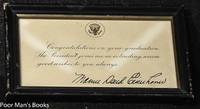
34242White House. Very Good with no dust jacket. Framed. 7 "x 4.375".; In somewhat worn black frame 7 "x 4.375". Printed note with her boldly written signature- presidential golden seal. Toned not examined out of frame. Not examined out of frame but it appears to be mounted over the original envelope it was mailed in. . White House unknown
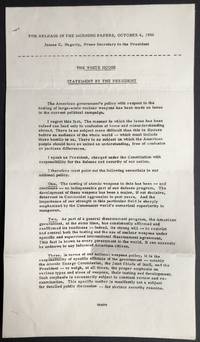
1956H35632Washington DC: The White House 1956. Very good. 14 x 8 inches 3 sheets stapled with Eisenhower's statement on the testing of nuclear arms with a committment to testing them stil further which had bipartisan support along with Eisenhower's reaffirmation that his committment is also to peace and de-escalation of Cold War tensions. We could not locate this on Worldcat. The White House unknown
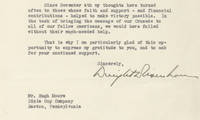
14013045914/01/1953. <blockquote><p>“Since November 4th my thoughts have turned often to those whose faith and support - and financial contributions - helped to make victory possible. In the task of bringing the message of our Crusade to all of our follow Americans we would have failed without their much-needed help.â€</p></blockquote><p>The 1952 United States presidential election was held on Tuesday November 4 1952. Republican Dwight D. Eisenhower won a landslide victory over Illinois Democratic Governor Adlai Stevenson becoming the first Republican president in 20 years. This was the first election since 1928 without an incumbent president on the ballot. Eisenhower was re-elected in 1956 in a rematch with Stevenson.</p><p>The 1952 presidential election campaign was conducted against the backdrop of a “red scare†in which many Americans feared that foreign communist agents were attempting to infiltrate the government. Two years earlier Sen. Joseph R. McCarthy who held that the Roosevelt and Truman administrations amounted to “20 years of treason†claimed that he had a list of State Department employees who were loyal only to the Soviet Union. Though McCarthy offered no evidence to support his charges and revealed only a single name he won a large personal following. The Red Scare the stalemated Korean War and a renewal of inflation handicapped Stevenson who fought a vigorous campaign.</p><p>Eisenhower campaigned tirelessly impressing millions with his warmth and sincerity. His wide friendly grin wartime heroics and middle-class pastimes—he was an avid golfer endeared him to the public and garnered him vast support. On the eve of the election there was a general opinion that the presidential race was close. The final tally however was anything but. Eisenhower won by more than six million votes capturing 39 states and 442 electoral votes to Stevenson’s 9 states and 89 electoral votes. The election was considered a great personal triumph for Eisenhower.</p><p>In the wake of the election Eisenhower thanked his major contributors for their financial support which had enabled him to bring his message to the American people.</p><p><strong>Typed letter signed</strong> on his letterhead New York January 14 1953 to Hugh Moore president of the Dixie Cup Company and a supporter of his. <em>“Dear Mr. Moore: To the thanks you have undoubtedly already received for your generous contribution during the campaign I wish to add my own.</em></p><p><em>“Since November 4th my thoughts have turned often to those whose faith and support - and financial contributions - helped to make victory possible. In the task of bringing the message of our Crusade to all of our fellow Americans we would have failed without their much-needed help. That is why I am particularly glad of this opportunity to express my gratitude to you and to ask for your continued support.â€</em></p><p>It is interesting that Eisenhower saw his election as a crusade and his views as carrying a message.</p><p><img class=""alignnone size-post-window wp-image-25018"" src=""https://cdn.raabcollection.com/wp-content/uploads/20231204144051/Folder-site-11-1600x1327.jpg"" alt="""" width=""1600"" height=""1327"" /></p> unknown
4391DWIGHT EISENHOWER 1890-1969. Eisenhower was the Thirty-Fourth President. TLS. 1pg. October 15 1960. The White House Washington. A typed letter signed “Dwight D Eisenhower†as President on “The White House†letterhead. Eisenhower thanks a White House staffer for sending a cake and card in honor of Eisenhower’s birthday: “Dear Charles: In view of all the activities at the White House the last week I am more than ever grateful for the cake and the card that you sent to me from yourself and the members of your staff. My gratitude goes to all of you for your dedicated service – and not at all incidentally for your thought of me on my anniversary. With warm regard Sincerely Dwight D Eisenhower P.S. The cake was delicious!†The letter has a large dark autograph and a central mailing fold that affects little; the condition is fine. unknown books
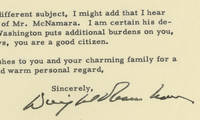
19602101927/12/1960. <p>“I doubt if you realize just how much you have helped me carry on the official work of government…â€</p><p>In the waning days of 1960 Eisenhower prepared to leave office and hand the presidency to John F. Kennedy. Henry Ford II was a close confidant of Eisenhower’s and during his presidency provided Ike with important assistance. So as he said farewell to the presidency Ike wanted to tender to Ford his heart-felt thank you.</p><p>On three occasions Ford lent one of his senior executives Leo Beebe to the U.S. government to supervise the resettlement of refugees and manage similar projects. Beebe became executive vice chairman of Eisenhower’s Committee for Hungarian Refugees in 1956 a need that resulted from the Hungarian Revolution and subsequent flight from the country of many refugees. In addition to his committee work during 1956-1957 while working out of Camp Kilmer in northern New Jersey Beebe oversaw the relocation and resettlement of 35000 Hungarian refugees in the United States eventually finding them permanent residences in this country. In 1959-1960 Beebe organized the U.S. Center for Cuban Refugees in Miami Florida to help with the mass influx of Cuban refugees that fled Castro’s Cuba in 1960 and beyond. Ford backed the refugee aid effort all the way and it was of incalculable importance.</p><p>In 1960 Robert McNamara was President of the Ford Motor Company. Kennedy the President-elect sought to name McNamara Secretary of Defense. Ford agreed to spare McNamara yet another example of his largess.</p><p>Ford Motor Co. required its top executives to use private aircraft for business and personal travel. We see in this letter that he also served Eisenhower by providing private jet transportation to and from meetings.</p><p><strong>Typed letter signed</strong> on White House letterhead Washington December 27 1960 to Henry Ford II. <em>“As the end of my Administration approaches I want once again to express to you and through you to your associates the appreciation I personally feel and which is shared by the members of the White House staff who normally travel with me of the many courtesies that have been extended to us not only during 1960 but through all the years here. I doubt if you realize just how much you have helped me carry on the official work of government by making transportation available to the key personnel who must be with me but are necessarily scattered during any one of the so-called ‘work-vacation’ trips I have taken. I assure you however that without your cooperation it would have been exceedingly difficult for me to carry out my responsibilities and still get some periods of relaxation. I shall be lastingly grateful to you and your officials in the various places we have visited with some regularity and at some length.</em></p><p><em>“On a totally different subject I might add that I hear good reports of Mr. McNamara. I am certain his departure for Washington puts additional burdens on you but as always you are a good citizen.</em></p><p><em>“With best wishes to you and your charming family for a fine 1961 and warm personal regard Sincerely Dwight D. Eisenhower.â€</em></p><p>This letter is the first valedictory of Eisenhower’s we can recall seeing and it remained in the Ford family until 2020. It has never before been offered for sale.</p><p><img class=""alignnone wp-image-25018 size-post-window"" src=""https://cdn.raabcollection.com/wp-content/uploads/20231204144051/Folder-site-11-1600x1327.jpg"" alt="""" width=""1600"" height=""1327"" /></p> unknown
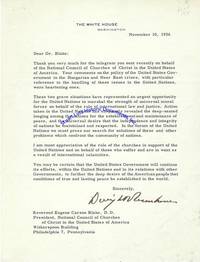
5932DWIGHT D. EISENHOWER 1890-1969. The Thirty-Fourth President Eisenhower was an Allied commander in World War II and ordered the Normandy invasion. He was elected President in 1952 for two terms.TLS. 1 pg. 8 x 10. November 30 1956. The White House Washington. A typed letter signed by Dwight D Eisenhower to Reverend Eugene Carson Blake D.D.: Thank you very much for the telegram you sent recently on behalf of the National Council of Churches of Christ in the United States of America. Your comments on the policy of the United States Government in the Hungarian and Near East crises with particular reference to the handling of these issues in the United Nations were heartening ones. These two grave situations have represented an urgent opportunity for the United Nations to marshal the strength of universal moral forces on behalf of the rule of international law and justice. Action taken in the United Nations has eloquently revealed the deep-seated longing among the nations for an establishment and maintenance of peace and the universal desire that the independence and integrity of nations be maintained and respected. In the forum of the United Nations we must press our search for solutions of these and other problems which confront the community of nations. I am most appreciative of the role of the churches in support of the United Nations and on behalf of those who suffer and are in want as a result of international calamities. You may be certain that the United States Government will continue its efforts within the United Nations and in its relations with other Governments to further the deep desire of the American people that conditions of true and lasting peace be established in the world. President Eisenhower sent this letter to Eugene Blake the leader of the National Council of Churches of Christ in the United States of America. Blake was a prominent Presbyterian leader who served as President from 1954-1957 and later was a participant in the March on Washington. The NCC is an interdenominational partnership of Christian faith groups in the United States that often spoke forcefully about promoting peace in U.S. foreign policy. The two crises that Eisenhower refers to both in 1956 were the Hungarian Revolution which saw the Soviet Union violently invade and suppress Hungarys new reformist government and the Suez Canal Crisis which saw Great Britain France and Israel launch a joint operation to retake the Suez Canal after Egypts Nasser nationalized it. The actions by Eisenhower and the United Nations in resolving both crises were supported by many like Blake but also criticized by many in the U.S. and around the world. This was especially true as Eisenhower and the United Nations sat back while the Soviet Union killed over 6000 Hungarian soldiers and civilians and displaced over 200000 which was seen as hypocritical given American action in Korea and Vietnam. Regardless this letter is an important reminder about the influence the NCC had as a Christian advocacy body and Eisenhowers role as the leader of the internationalist and institutionalist wing of the Republican Party in the decade after World War II. unknown
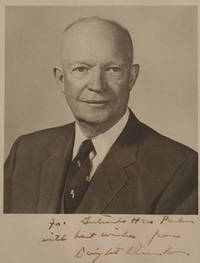
37379n.p. n.d. Image 10 x 8 Inches. 1 vols. Framed and glazed. Image 10 x 8 Inches. 1 vols. Inscribed Photograph of Eisenhower. Portrait is inscribed on photo's lower margin: "For Gertrude Hess Parker/with best wishes from/Dwight Eisenhower. unknown books
GF15526Planche en couleurs sur japon spécial (24,5 x 16 cm) extraite de Soldats et Généraux des Campagnes d'Europe Occidentale 1944 - 1945 - publié à Paris en 1946 chez Chavanne et Cie à Paris
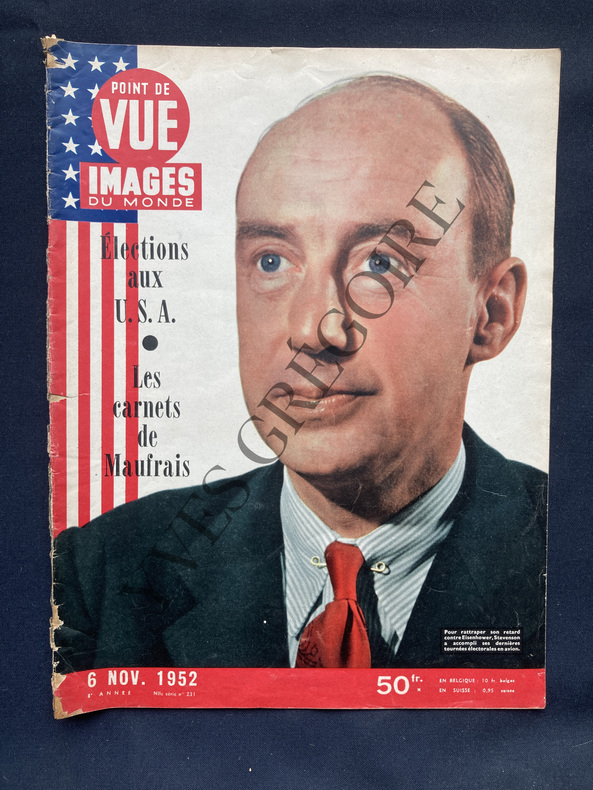
1952ABE-1549284937627EN COUVERTURE "POUR RATTRAPER SON RETARD CONTRE EISENHOWER, STEVENSON A ACCOMPLI SES DERNIERES TOURNEES ELECRORALES EN AVION", GROS PLAN COULEURS-ENTREE EN FONCTIONS: 20 JANVIER 1953, ELECTIONS PRESIDENTIELLES AMERICAINES, 9P, DESSIN DE SENNEP-LE DERNIER ALLIE DE LA MEDECINE: LE FROID, 3P, 4 PHOTOS-LES TRAVAILLEURS DE LA JOIE, REPORTAGE DE JOHN CRAVEN, FORAINS, 8 PAGES, 27 PHOTOS-CHARLOT EN AVION CHARLOT A PARIS POUR LA 4e FOIS, 2P, 12 PHOTOS, REPORTAGE BRODSKY-LA MODE LES JEUNES FILLES, 1P, 4 PHOTOS (BRIGITTE BARDOT, FRANCOISE ARNOUL)-EN 4 DE COUVERTURE "DES MILLIERS DE KILOMETRES, DES CENTAINES DE DISCOURS, BILAN DE LA LUTTE D'EISENHOWER CONTRE STEVENSON", GROS PLAN COULEURS
1959ABE-1739142324882TIRAGE ARGENTIQUE NOIR ET BLANC-20,5 CM X 15,5 CM-AU DOS: CACHET AGENCE ASSOCIATED PRESS-LEGENDE SUR PAPIER-(CP8)
264157No place nd. 1 vols. In 11 3/4" x 14 3/4" frame. Fine. Framed and glazed. 1 vols. In 11 3/4" x 14 3/4" frame. From the Estate of actor Robert Montgomery. unknown books
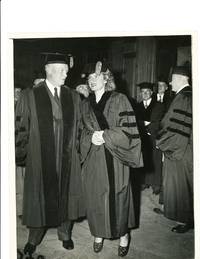
2551The black and white glossy photograph by "The News" captures Eisenhower in academic robes when he was President of Columbia University and Bourke-White also in academic robes on the day they each received honorary degrees from Rutgers: the future U. S. President for Doctor of Laws and renown World War II photographer for Doctor of Letters. The explanation of the photograph is docketed on verso. Trim lines visible with notations on verso. Condition: Bends at corner tips cracking at lower left corner and throughout visible under light. During the Second World War he served as Supreme Commander of the Allied Forces in Europe with responsibility for planning and supervising the successful invasion of France and Germany in 1944-45. After the war he served as President of Columbia University and in 1951 he became the first supreme commander of NATO. As a photographer for "Life Magazine" Margaret Bourke-White was the first female photographer to serve with the US armed forces covering World War II. She photographed Eisenhower for Life Magazine in 1942. unknown books
1950D7442probably late 1950s. Ephemera. Very Good. Black-and-white photograph silver gelatin print 8x10 inches with thin white border; capturing Eisenhower in a squinty laugh standing amongst 3 other men. It's inscribed on the back "To Mr. Sutnar with a reminder that if you need anything -- I know big people / Lauther Carrer." Two faint pencil marks in the top border; a little faint soiling on the back. <br/><br/> unknown
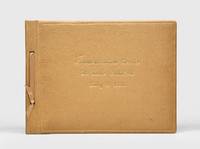
19511604641951. Commemorating the American fallen A compelling album apparently made by the family of a fallen serviceman and therefore unique commemorating Eisenhower's presentation of the Roll of Honor to St Paul's Cathedral. The roll lists the 28000 American soldiers stationed in Britain who gave their lives in the Second World War. The album includes large-format photographs of the military procession to the ceremony; attendees entering the cathedral including Churchill Mountbatten Attlee the Queen Mother and Princess Elizabeth Eisenhower and Curtis LeMay; photographs of the service including the congregation singing hymns and the sermon by the Archbishop of Canterbury; and Eisenhower leaving the Cathedral. The ceremony was held on Independence Day. Eisenhower delivered a message: "Each name inscribed in this book is a story of personal tragedy and a grieving family; a story repeated endlessly in white crosses girdling the globe. The Americans whose names here appear were part of the price that free men have been forced a second time to pay in this century to defend human liberty and rights". The album includes a copy of a page from the roll listing names from Hiltabidle to Hitchings - presumably the album was made by the family of someone listed there. We could trace no other similar album. In 1958 the American Memorial Chapel was completed in a part of the cathedral that a bomb had hit in 1940. The roll now resides there and a page is turned each day to show different names. Landscape quarto album 318 x 419 mm. Four letterpress leaves partly printed in gilt comprising title excerpt from the Archbishop of Canterbury's address Eisenhower's introduction to the Roll of Honour and copy of page from roll all with acetate covers. Tan leatherette front cover lettered in blind "Commemoration Service - St. Paul's Cathedral - July 4. 1951." cord-bound cord recently renewed 33 heavy card leaves with 28 mounted black and white silver gelatin press photographs 203 x 254 cm most captioned by hand. Binding neatly restored and consolidated the photographs in sharp unblemished condition slight discolouration around letterpress leaves. In very good condition. hardcover
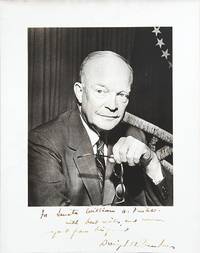
19531581571953. A notable portrait presented to a prominent early supporter Inscribed by the president "For Senator William A. Purtell with best wishes and warm regard from his friend Dwight D. Eisenhower"; an appealing image of a pensive Eisenhower by renowned Capitol Hill photographer George Tames taken in the White House as Eisenhower announced the truce ending the Korean War. Purtell 1897-1978 served as Republican Senator for Connecticut in 1952 and from 1953 to 1959. He was one of the earliest Connecticut Republicans to support Eisenhower's run for the presidency. In turn Purtell's success in the November 1952 Connecticut senatorial election rode on the back of the strong public support for Eisenhower in the simultaneous presidential election; Purtell allied himself closely to Eisenhower's campaign platform. "A strong supporter of President D. Eisenhower's policies Senator Purtell was also a staunch American who liked to say: 'we have the finest country the finest system of society and the finest government in the world'" New York Times obituary 1 June 1978. The photographer George Tames 1919-1994 worked for the New York Times on Capitol Hill and in Washington from 1945 to 1985 taking many shots which became iconic. He took the photograph after Eisenhower's joint radio and television address to the nation announcing the signing of the Korean Armistice 26 July 1953. Interestingly this image would have been familiar to millions of Americans through its use on the 6 cent stamp issued in 1970. Official photograph taken by George Tames 358 x 280 mm copyright notice to verso stating reproduction by the Signal Corps of the US Army. Dark oak frame with conservation acrylic glazing 427 x 351 mm. Slight cockling inscription a little faded but still clearly legible very good. unknown