David EisenhowerBiblio.com
708 résultats
1991Q-0517065010Random House Value Publishing 1991-08-07. Hardcover. New. In shrink wrap. Looks like an interesting title! Random House Value Publishing hardcover
1987Q-0394755332Vintage 1987-10-12. Paperback. New. New. In shrink wrap. Looks like an interesting title! Vintage paperback
1986Q-0394412370Random House 1986-08-12. Hardcover. New. New. In shrink wrap. Looks like an interesting title! Random House hardcover
1986DADAX0394412370Random House Books for Young Readers 1986-08-12. First Edition. hardcover. New. 0.00x0.00x0.00. Buy with confidence. Excellent Customer Service & Return policy. Random House Books for Young Readers hardcover
19863816<p>RANDOM HOUSE INC. 1986. hard cover with dj. very good with dj.</p> RANDOM HOUSE INC. hardcover
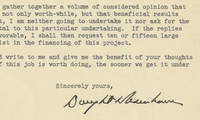
18122102918/12/1948. <blockquote><p>The Founding Letter of the Renowned Eisenhower Center for the Conservation of Human Resources</p></blockquote><p><strong>Yet during the war rejections and discharges of men for mental defects reached a total of more than two million.</strong></p><p><strong>This type of problem would affect industry as well and Ike sought to establish an entity to research causes and solutions</strong></p><p>In December 1948 Eisenhower was called to Washington where he met with Averill Harriman Omar Bradley and Harry Truman. The leadership of the military had not settled on a plan to counter the rising Soviet threat and wanted Ike's opinion on fighting force preparedness. He remained in Washington for these meetings in the first two weeks of December. The immediate threat was Russia and a possible attack. The long term threat was to create a more efficient military. He had been assured that such a job should it require long hours would be compatible with his new job at Columbia University and so he made that real.</p><p>Eisenhower gave thought and consideration on how to present the needs and issues and introduce the concept and program director. This letter/presentation is a product of that and in it Eisenhower also speculates on the role played by education and poverty and ponders whether “industry trade unions the school the church do to help reduce the volume of lossâ€. The recipient was Henry Ford II president of the Ford Motor Company who was one of America’s top industry leaders and well as a personal acquaintance who would become a friend.</p><p>The letter is at its essence how to learn from the failures of fighting force recruitment and support during World War II apply it to the next combat and see how far that lesson could be taken to workplace life and the reintegration.</p><p><strong>Typed letter signed</strong> on his Columbia University letterhead New York December 18 1948 to Ford. <em>“It seems to me that the time has come when the wastage of American resources must be combated along all fronts. There are numbers of organizations directing their efforts toward conservation of natural resources including the soil. Our future prosperity is going to depend directly upon the success of their achievements. There is another sector of the conservation problem however that deserves immediate attention and that so far has not been made the subject of widespread intelligent attack. It is the wastage of manpower through mental and emotional failures.</em></p><p><em>“My own attention was drawn forcibly to the matter during the war particularly in the late months of 1944 when the country found that its ability to supply replacements for the battleline was badly strained. Units had to fight under truly desperate handicaps by reason of lack of manpower. Yet during the war rejections and discharges of men for mental defects reached a total of more than two million. One of the numerous reasons that finally decided me to come to Columbia was the hope of assisting in finding some kind of an answer to this national problem. Obviously in the event of great emergency our manpower will be in limited supply but the basic problem is far broader in scope. Manpower losses of this kind imply tremendous costs and inefficiencies for our economy.</em></p><p><em>“This I believe is a particularly propitious time to begin a down-to-earth study of the matter. There exist today the rejection records of the two million men lost in World War II. Most of them are still alive and they provide therefore a great body of factual information for any group that can organize itself sufficiently well to dig out and correlate the facts. In addition there is available in business corporations an important body of personnel information bearing on civilian maladjustments which invites exploration and evaluation.</em></p><p><em>“It would seem particularly important to find out whether there are common causative factors responsible for these human failures. Numerous questions immediately suggest themselves. Among these are: 1. Are these men generally from the undereducated groups 2. Are they generally urban or rural in origin 3. How do these men spend their leisure time 4 Are they underfed or otherwise definitely underprivileged 5. Do they show a long history of emotional instability or do these defects come out only under fear or other stress 6. What has happened to them Are they now a charge upon society or are they leading useful lives </em><em>7. How accurate were our war-time yardsticks for measuring ""mental deficiency"" 8 What can industry trade unions the school the church do to help reduce the volume of loss Dozens of other questions suggest themselves but the foregoing will indicate some of the specific points I have in mind.</em></p><p><em>“Shortly after coming to Columbia University I detailed a very able young professor Eli Ginzberg to prepare a memorandum which would show the capacity and qualifications of this institution for undertaking a significant study in this area. His report is attached. Although the study of human resources is so important that it would warrant continuing support I have thought it best to propose a limit of five years on this investigation. My thought is that regardless of continuing scientific research into the various aspects of the question we need to develop at an early date helpful practical methods that will contribute much more than past procedures to the efficient utilization of human resources.</em></p><p><em>“The Columbia Deans commented on the enclosed proposal and they were unanimously of the belief that the investigation should be undertaken. Now I am particularly anxious to get the opinions of men who are experienced in business labor agriculture finance the church etc. and I should therefore like to have your reactions to the above suggestions which are amplified in the accompanying memorandum. </em><em>It might be that a large percentage of mentally ineffective manpower is inescapable and is a natural result of our particular civilization. This I do not believe and certainly I will not accept such a conclusion until we have done our best to prove or disprove the case</em></p><p><em>“However until I can gather together a volume of considered opinion that the proposed task is not only worth-while but that beneficial results should flow out of it I am neither going to undertake it nor ask for the financial support vital to this particular undertaking. If the replies are predominantly favorable I shall then request ten or fifteen large organizations to assist in the financing of this project. I wish that you would write to me and give me the benefit of your thoughts on this proposal. If this job is worth doing the sooner we get it under way the better.â€</em></p><p><strong>It comes with the retained response from Ford and the copy of the report sent by Eisenhower to Ford being Ford's copy.</strong></p><p>A few of these letters were sent out and the response was positive so these words heralded the establishment at Columbia of a project originally called The Conservation of Human Resources and later renamed The Eisenhower Center for the Conservation of Human Resources. Dr. Ginzberg ran the project while Eisenhower invigorated it with energy and direction until he left Columbia to run for president. The work provided for a three-pronged approach: 1 a study of inadequacy and maladjustment in civilian and military life 2 a study of the factors contributing to the development of talent and superior performance and 3 changing patterns of work in a dynamic economy. Over the years it has published numerous works a few of which are “The Ineffective Soldier: Lessons for Management and the Nation†“The Changing U.S. Labor Market†“The New Suburbanization: Challenge To The Central City†and “The physician and the poorâ€. The Center remains active today.</p> unknown
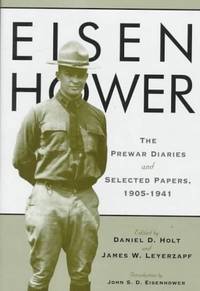
1998378789Baltimore: Johns Hopkins University Press 1998. 1st. Hardcover. Very Good/Very Good. Hardcover in a bright unclipped dust jacket 576 pages. Dwight D. Eisenhower's meteoric rise to prominence during World War II was not -- as popular myth would have us believe -- accidental but the logical outcome of years of preparation. Eisenhower had enormous talents opportunities to develop them and an attentive corps of senior officers who watched and encouraged his ascent to high command. The diaries letters and documents assembled in this volume for the first time present a fresh detailed examination of Dwight D. Eisenhower's formative years and the evolution of his genius for organization logistics and strategy. Record # 378789 Johns Hopkins University Press hardcover
6834DWIGHT EISENHOWER 1890-1969. Dwight Eisenhower was the Thirty-Fourth President.PS. 15 x 18. N.d. N.p. A colored photograph signed Dwight Eisenhower in white ink along his right shoulder. The photo is a bust portrait of Eisenhower. The photograph is in mint condition and is professionally framed. unknown
1998126998Johns Hopkins University Press 1998. Book. Near Fine. Hardcover. Near fine book and jacket. . Johns Hopkins University Press Hardcover
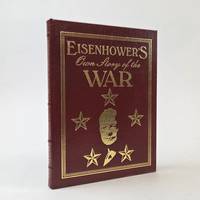
20141405515Norwalk: Easton Press 2014. Collector's Edition. Hardcover. Quarto 122 pages. In Very Good condition. Bound in publisher's full red leather with gilt ornamentation. Paneled spine with gilt titling. Boards have light shelf wear. Textblock has silk moiré end pages silk page ribbon and gilt edges. Shelved in Room A. 1405515. Special Collections. Easton Press hardcover
W3-3AOJ-0B4MPaperback. Good. Paperback. Average external wear pages yellowed with occasional minor blemishes binding intact owner stamp inside front cover. paperback
13132World War II Hero and 34th U.S. President. There is a tradition that the President "give" gifts at his Birthday Party. Very scarce Eisenhower PRESIDENTIAL BIRTHDAY GIFT. This gift is a Presidential Commemorative Plate Dated October 1953 About 10 1/2" diameter an attractive and high quality china plate with gold rim. Front of plate has symbol of intertwined dove with "The President's First Birthday in the White House" and Eisenhower's printed signature. On the back of the plate: "This plate commemorates President Eisenhower's first birthday in the White House. The Pennsylvania Dutch symbol of the intertwined dove signifies love and peace for which our President firmly stands." A great piece of Presidential Memorabilia. In excellent condition. You had to be invited by Eisenhower in 53 to get this gift otherwise here is your chance. unknown
0801856744.Ghardcover. Good. Access codes and supplements are not guaranteed with used items. May be an ex-library book. hardcover
1986Q-0002177692HarperCollins Publishers 1986-12-01. Hardcover. New. In shrink wrap. Looks like an interesting title! HarperCollins Publishers hardcover
1998Q-0801856744Johns Hopkins University Press 1998-03-18. Hardcover. New. New. In shrink wrap. Looks like an interesting title! Johns Hopkins University Press hardcover
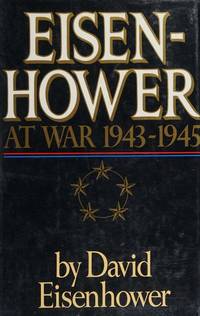
198685974New York: Random House 1986. First Edition stated presumed first printing. Hardcover. Good/Good. Anita Karl and Jim Kemp Maps. xxvii 1 977 3 pages. Principal Figures. Glossary. Bibliography. Notes. Index. DJ is in a plastic sleeve and has some wear tears and soiling. Some edge soiling. Some endpaper soiling. Inscribed by the author on the fep. Inscription reads To Doug Romagnoli With best wishes for a full life. David Eisenhower October 11 1986. This book focuses on Eisenhower's conduct of the war and provides an extensively documented analysis of the political ramifications of the course of the war and Eisenhower's decisions. Dwight David Eisenhower II born March 31 1948 is an American author public policy fellow professor at the University of Pennsylvania and eponym of the U.S. presidential retreat Camp David. He is the grandson of President Dwight D. Eisenhower and First Lady Mamie Eisenhower and a son-in-law of President Richard Nixon and First Lady Pat Nixon. He was a teaching adjunct and public policy fellow at the Annenberg School for Communication at the University of Pennsylvania author and co-chair of the Foreign Policy Research Institute's History Institute for Teachers. From 2001 to 2003 he was editor of Orbis a quarterly published by the institute. Eisenhower was a finalist for the Pulitzer Prize in history in 1987 for his work Eisenhower At War 1943-1945 about the Allied leadership during World War II. He was the host of a public television series called The Whole Truth with David Eisenhower distributed by American Public Television. Derived from a Kirkus review: The younger Eisenhower has spent some six years on this project covering only a three-year period in Ike's career. Eisenhower: At War is a work of dignified completely researched history. Three decades after Eisenhower's presidency a spate of books is being published on issues of his era or about the man. David's view is that Eisenhower's experiences in WW II were the clay he molded into his overall world view which is ultimately crucial to the understanding of his presidency. Eisenhower saw Russia's isolation as a danger to the postwar world and spent the next 15 years of his public life attempting to defuse the Cold War. When his attempts failed he warned his citizens of the consequences especially as they related to the "military-industrial complex." David Eisenhower's special status in being able to call upon his own father for firsthand information and on his father-in-law Richard Nixon's expertise in foreign matters has helped him to produce a very solid work. It is a secondary source but his interpretations are full of acumen and he doesn't shrink from uncomfortable topics such as Eisenhower's decision to allow Montgomery to go ahead with his Market Garden attack even when Ike knew that it was doomed in order to finally dispose of Monty's challenges to his authority. Nepotism in the pursuit of biography is no vice. Random House hardcover
1258005514.Ghardcover. Good. Access codes and supplements are not guaranteed with used items. May be an ex-library book. hardcover
1258492202.Ghardcover. Good. Access codes and supplements are not guaranteed with used items. May be an ex-library book. hardcover
95836Photograph of the Eisenhower family signed by Dwight D. and Mamie Eisenhower their son and daughter-in-law and only grandchild. Inscribed by Dwight D. Eisenhower "For Ken & Joyce Browne with best wishes Dwight D. Eisenhower" and signed "Mamie Doud Eisenhower." Additionally inscribed by the Eisenhowers' eldest son John and his wife Barbara "To the Brownes from Barbara and John Eisenhower" and signed by their son David Eisenhower. In fine condition. Double matted and framed. The entire piece measures 16 inches by 14.25 inches. Rare and desirable signed by members of three generations of the Eisenhower family. Dwight Eisenhower was an Army general who served as the 34th President of the United States from 1953 until 1961. He was a five-star general in the United States Army during World War II and served as Supreme Commander of the Allied Expeditionary Forces in Europe. He was responsible for planning and supervising the invasion of North Africa in Operation Torch in 1942–43 and the successful invasion of France and Germany in 1944–45 from the Western Front. In 1951 he became the first Supreme Commander of NATO. unknown
1986Sign0068New York: Random House 1986. 1st edition / 1st printing. As New. octavo. hardback with dust jacket xxvii 977pp. b/w plates appends. bibliog. index TO SEE MORE ITEMS FROM THE REX RILEY SIGNED BOOK COLLECTION PLEASE ENTER REX SIGNED INTO THE KEY WORDS FIELD Signed by David Eisenhower on ownerÕs Library Bookplate on the half-title. PHOTO available Random House hardcover
1986725NY: Random House. Very Good in Very Good dust jacket. 1986. Stated First Edition. First Printing. Hard Cover. 0394412370 . Publisher's full black cloth gilt lettering on spine blind-stamped medallion on cover fore-edge deckle. Illustrated with 24 maps several double-page. Includes Index of Principal Figures; Glossary; Bibliography extensive Notes; and Index. . Brief gift inscription on ffep otherwise unmarked tight square and clean. The unclipped dust jacket is very mildly chipped with a very small closed tear at the head of the spine. VERY GOOD/VERY GOOD. . Maps. Thick 8vo 8" to 9" tall. xxvii 977 1 pp . Random House hardcover
199114820NY: Wings Books. Very Good in Very Good dust jacket. 1991. First Edition. 1. Hard Cover. Blue cloth cover gilt lettering on spine glossary notes and extensive index. . Inscription in ink to former owner of fep little wear to head and heel of spine small mark on corner at top of pages hinge starting. The unclipped dust jacket rubbed slight wear to head and heel of spine. VERY GOOD/VERY GOOD. . B&W photgraphs and maps. xxvii 977 pp . Wings Books hardcover
2014x-0739189298Lexington Books 2014. Hardcover. New. 169 pages. 9.50x6.25x1.00 inches. Lexington Books hardcover
2016x-1498505880Lexington Books 2016. Paperback. New. reprint edition. 204 pages. 9.00x6.00x0.75 inches. Lexington Books paperback
Paris, Hachette 1945. In-4 plein cartonnage éditeur illustré de 63 pages. Nombreuses photos. Bel exemplaire.