2 100 résultats
Very Good Turkish Paperback. Roy. 8vo. (24 x 16 cm). In Turkish. 56, 32, [2] p., 29, [iv] numerous b/w and color plates, 1 plan. XVI.-XVII. yüzyillarda Süleymaniye Camiî ve bagli yapilari.
New Turkish Paperback. Roy. 8vo. (24 x 17 cm). In Turkish with Ottoman documents. XVI-XVII. yüzyil Üsküdar ser'iyye sicilleri. Diplomatik bilimi bakimindan bir inceleme.
Very Good English Paperback. Pbo. Roy. 8vo. (24 x 17 cm). In Turkish. [vii], 208, [1] p. Wooden works in the Ottoman Empire in the 15th century. XV. yüzyil Osmanli agaç isçiligi.
New English Paperback. Pbo. Roy. 8vo. (24 x 16 cm). In Turkish. 191 p. Istanbul (Constantinople) at 19th century: Impressions of an English voyager. XIX. yüzyil Istanbulu. Bir Ingiliz seyyahin izlenimleri.
Very Good Turkish Original bdg. HC. No DJ. 4to. (29 x 23 cm). In Turkish. 476 p., color and b/w ills. XIX. yüzyil Beyoglusu. ISBN: 9789757630234.
New New Turkish Original bdg. Dust wrapper. In publisher's special box. 4to. (29 x 23 cm). In Turkish. 476 p., color and b/w ills. XIX. yüzyil Beyoglusu. ISBN: 9789757630234.
Fine English Original bdg. 4to. (34 x 25 cm). In English and Turkish. [432] p., color and b/w ills. Works of Turkish architecture.= Türk mimari eserleri.
New English Paperback. Large 8vo. (22 x 20 cm). In English, German, and Turkish. 339 p., color and b/w ills. Wooden Istanbul: Examples from housing architecture.= Istanbuls Holzhauser: Beispiele seiner historischen Wohnarchitektur.= Ahsap Istanbul: Konut mimarisinden örnekler. ''Istanbul's real interior view,'' writes Tanpinar in describing the wooden houses of Istanbul ''was created by a colorful civil architecture ornate with oriels, bow windows and projections, eaves and awnings, velvety soft lines and decorations.'' To his observations on the perished wooden seaside palaces of the Bosphorus he adds, ''Perhaps the history of the Bosphorus fascinates us more than others, for we no longer find in place what we are looking for. .What intrigues us, in fact is none other than the void these buildings leave behind.'' Today, although it is rarely encountered in the landscape of Istanbul, wooden housing architecture continues to preserve its place in the city's image as it is enshrined in collective memory. While many have us may not have spent a portion of our lives in such houses, the memories of family members and friends and the impressions from the literature of a recent past sustain our connection to these houses. Whether we are aware or not, this heritage enthralls us with the mystique of a lost world while offering certain clues on the creation of an inescapably reconstructed Istanbul identity, which is shaped not only through architecture but also an entire way of living.
New New English Original bdg. Dust wrapper. Color photos. In English and Turkish. 191 p. Wiew of Istanbul from minaret balcony.= Serefeden seyristanbul. [Album of photographs]. ISTANBUL Constantinople Photography Mosque Social life.
New English Paperback. Pbo. Demy 8vo. (21 x 14 cm). In English. 312 p. "It is little known that in the early twentieth century, Istanbul was internationally condemned as a center for prostitution and vilified for its role in the traffic in white women. Through an examination of Turkish and foreign newspapers, Turkish state documents, and the publications of domestic and international organizations, this study explores how the leaders of the newly founded Turkish Republic attempted to negotiate these critiques and how the Ottoman system of state regulated prostitution was transformed in the urban geographies of Istanbul in the 1920s and 1930s. Since studies of urban prostitution cross-cut a number of fields, this work will be a useful reference not only for scholars of Turkish history, but also for research on gender, sexuality, urban studies, and colonialism.".
New New English Original binding with original dust wrapper. Oblong large 8vo. (23 x 24 cm). [xiii], 522 p. "What's Behind A Name'' firstly, is the history of the Sephardi Jews in the Iberian Peninsula and following their expulsion, their history in the Ottoman Empire through to the Turkish Republic.
Fine English Paperback. Pbo. 4to. (29 x 24 cm). In English and Turkish. 177, [1] p., color ills. Exhibition catalog on history of insurance in the Ottoman Empire. What hurts the purse, hurts the soul. Insurance in the Ottoman Empire with documents from the Collection of David M. Kohen.= Mal canin yongasidir. David M. Kohen Koleksiyonundan belgelerle Osmanli Imparatorlugu'nda sigortacilik.
New English Paperback. 4to. (29 x 24 cm). In English and Turkish. 428, [3] p., color and b/w ills. Byzantium in Popular Culture navigates through the eclectic presence of Byzantium in popular culture. Curated by Emir Alisik, the exhibition explores multiple and conflicting meanings of Byzantinism, and questions popular culture?s interaction with the Byzantine legacy. It scrutinizes a selection of motifs found in visual arts, literature, metal music, comics and graphic novels, video games, movies, and fashion representing Byzantium in popular culture. Emir Alisik and Gulru Tanman co-authors the introductory chapter to the catalogue accompanying ?What Byzantinism Is This in Istanbul!?: Byzantium in Popular Culture. The volume brings together the articles of 10 researchers who examine and interpret Byzantinism?s representations in various fields of art. The articles by Roland Betancourt, Felice Lifshitz, Brigitte Pitarakis, Sinan Ekim, Yagmur Karakaya, Elif Demirtiken, Jeremy J. Swist, Marco Fasolio, Haris Theodorelis-Rigas, and Emir Alisik discuss how Byzantinisms appearing in various domains of popular culture relate to the Byzantine history depending on the context in which those artworks are produced.
New English Paperback. Pbo. 4to. (30 x 21 cm). In English and Turkish. 48 p. What are we doing now?= Bugün neler yapiyoruz. [Exhibition catalogue]. November 4 - December 27, 2015. Edited by Öykü Aras. TURKISH PAINTING Modern art Exhibition Installation Photography Painting.
New English Paperback. 4to. (29 x 23 cm). Edition in English. 144 p., b/w photos. We will live after Babylon. [Album of photographs]. [ENGLISH EDITION]. This book brings together the short stories Ara Güler penned during his early period, and his photographs. Güler is known internationally as a photographer and considered the most important representative of creative photography in Turkey, however, he is a relative unknown as a short story writer, and the various aspects of Güler the writer appear in breathtaking range in We Will Live After Babylon. This new edition of three simultaneously published volumes in Turkish, Armenian and English, brings together Güler's visual production with his texts, who appear to also take photographs through the medium of the short story, to form a "photograph-short story album". Güler thinks that his early period short stories have an important role in his ability to "capture meaningful moments and combine them in a narrative", and describes these 13 short stories as "a kind of photography". There is no doubt that Güler is a "man of the visual world" and We Will Live After Babylon is a solid proof of that.
New English Paperback. Roy. 8vo. (23 x 16,5 cm). In English and Turkish. 344 p., ills. Waterfront residences and mansions of Istanbul.= Istanbul'un yalilari ve köskleri. What makes Istanbul a favorite city is its magnificent waterfront residences along the Bosphorus and the sumptuous mansions spreaded into the different points of the city. The stories of these buildings that shine like jewels with their design, colors, outbuildings, gardens and peripheral arrangements have become legendary. "Waterfront Residences and Mansions of Istanbul" harks back to the past by conveying knowledge about these mysterious and enchanting structures.
Fine English Paperback. Pbo. In English and Turkish. Color and b/w ills., Ottoman documents. [2], 75, [4] p., color and b/w ills., 1 folding map, 2 plates. Water being source of life quoted from various documents.= Belgelerin kaynagindan, hayatin kaynagi su. Introduction: Yusuf Sarinay.
New English Paperback. Pbo. 4to. (28 x 24 cm). In English and Turkish. 172 p., color and b/w ills. Wall, arch, dome: Byzantine Istanbul in the eyes of Ottoman photographers.= Sur, kemer, kubbe: Osmanli fotografçilarinin gözüyle Bizans Istanbulu. [Exhibition catalogue]. Text: Samih Rifat. One of the most outstanding characteristics of Istanbul's Byzan-tine monuments, as captured by Ottoman photographers, is their role as priceless documents in the city's history. The period between the second half of the 19th century and the turn of the 20th century is marked by profound changes in Istanbul with respect to urban structure, historical texture and monuments. A careful eye readily notices the considerable transformations spread over a hundred, hundred and fifty years in Istanbul city walls, Galata Tower, Hagia Sophia and the Hippodrome area. These photographs are replete with valuable clues for today's researchers, restorers, architectures and urban planners. Nonetheless, there is something beyond the obvious in these images: Istanbul's remaining city walls, arches, and domes of a far away past continue to survive in another form of existence in these old photographs, which reflect an age closer to us in time, yet just as rapidly vanished. The discolored surfaces permeating an indescribable sense of the old add another layer, another epoch to the historical richness of the city. Comprised of a selection from the Suna and Inan Kiraç Foundation Old Istanbul Photographs Collection, Wall Arch Dome ventures us into a journey in the same milieu and in a different time dimension. Yet, on this occasion, we find ourselves in an Istanbul more ancient, more distant than the Republican or Ottoman days; it is a Byzantine Istanbul of monuments, ruins and almost imperceptible traces from thousands of years past.
36956Constantinople. J. Ludwigsohn, Sans date (vers 1920). In-12 oblong (17/25 cm) Broché. Couverture éditeur imprimée.
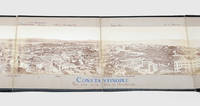
1875170484Constantinople c.1875. A superb photographic panorama A panoramic 360-degree view of the city. Towards the Golden Horn the Topkapi Palace and the city's great mosques can be seen including Hagia Sophia the Blue Mosque the Yeni Mosque and the Süleymaniye. Panoramas of this period usually favour the Galata Tower as a vantage point. The view is unsigned though likely from the studios of Pascal Sébah and Policarpe Joaillier or the Swede Guillaume Berggren. Both are renowned for their handsome panoramas of the city. In 1857 Sébah opened one of the first photographic studios in Constantinople. The business was taken over by his son Jean in 1883 who styled himself J. Pascal Sébah and went on to become a talented photographer in his own right. In 1888 he partnered with Policarpe Joaillier their firm becoming the official photographers of the Sultan. "From the 1870s Sébah and Joaillier were major suppliers of evocative imagery to the increasing number of people who undertook the Victorian Grand Tour" Hannavy p. 1261. Berggren moved to Constantinople in 1866 and opened his studio on Grand Rue de Pera in the early 1870s. His oeuvre included studio work a remarkable series of documentary portraits of working people and the eternalising of the construction of the Anatolian Railway. Oblong quarto concertina 290 x 255 mm. Comprising 8 mounted albumen prints each 165 x 248 mm together approximately 165 x 1984 mm mounts captioned in manuscript red and blue ink. Contemporary dark brown pebbled paper over bevelled boards later blue paper on verso of mounts. Minor loss to corners and edges of boards a few surface scratches; prints yellowed and faded in margins some a little creased at folds: a very good example. John Hannavy ed. Encyclopaedia of Nineteenth-Century Photography Vol. I 2005; Engin Özendes From Sebah & Joaillier to Foto Sabah: Orientalism in Photography 2004. hardcover
9808Paris, Chez Daumont, fin XVIIIéme. 33 x 48 cm (déchirure et petits manques dans les marges).
9807Paris, chez Mondhare, fin XVIIIéme. 31 x 45 cm contrecollé sur carton fort et entouré d'un filet doré.
New English Paperback. Pbo. 4to. (29 x 21 cm). In English and Turkish. 287, [1] p., color and b/w ills., 1 folding plate. Voyvoda Street from Ottoman times to today.= Bankalar Caddesi. Osmanli'dan günümüze Voyvoda Caddesi. "Following the last two exhibitions; A-135-Year Old Treasure and A History of Paper Money- Traces of History, our third exhibition "Voyvoda Street from Ottoman Times to Today was opened. One of the most important parts of the exhibition is its monograph having the same title. Although the book is based on a spatial and architectural setting, it tries also to reflect economic and social dimensions of the street, and, more, particularly of 33 buildings".
1766PHO-1265Paris, Robin, 1766. 3 volumes in-12, veau marbré, dos là nerfs orné (Reliure de l'époque) avec pièce de titre et tomaison , tranches rouges , ex-libris sur le contre-plat , défauts de reliure , coins et coiffes usés , début de fentes aux charnières , etc.